The Living Light of Cosmic Rays
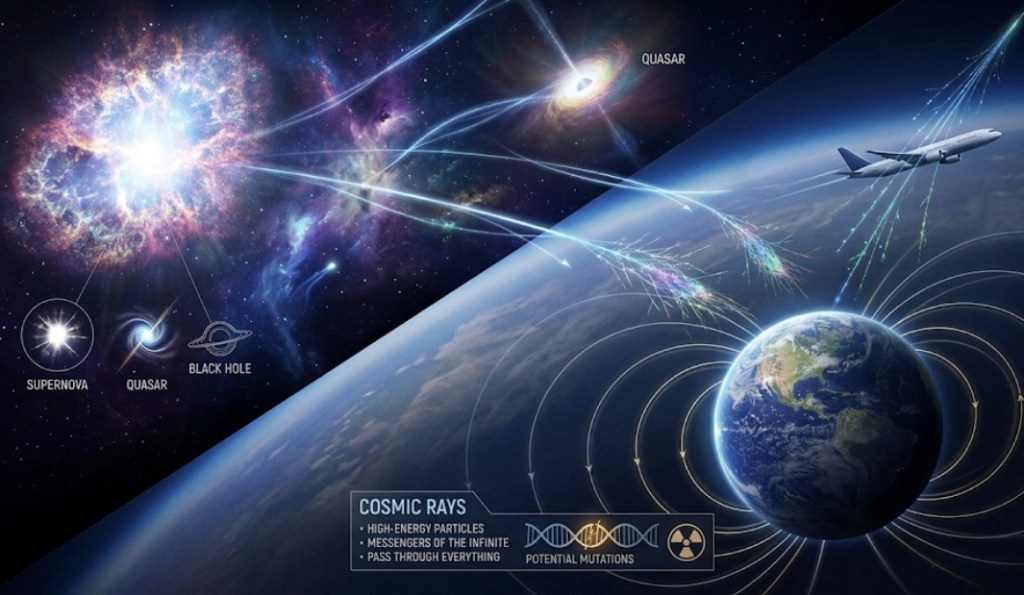
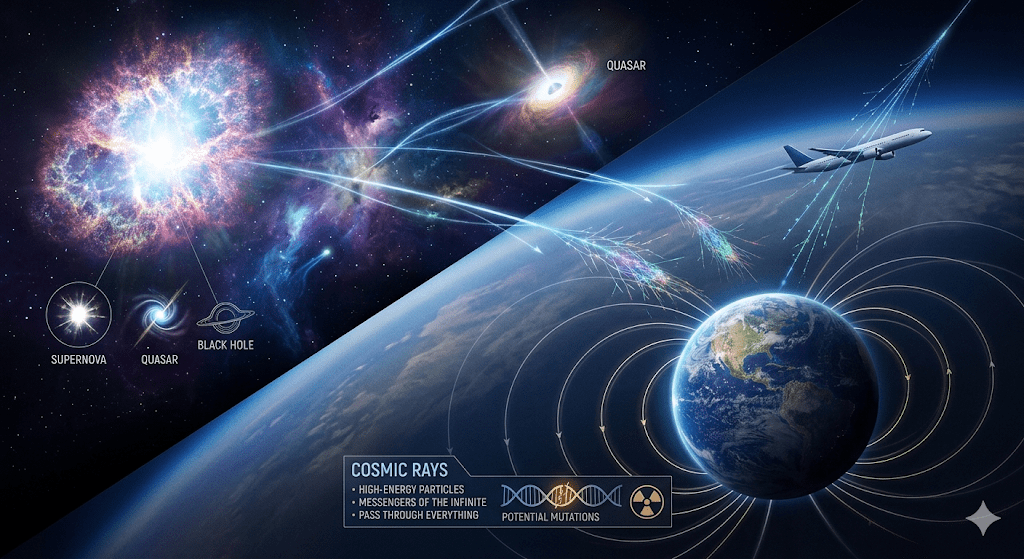
In the distant vault of space, supernovas erupt and quasars blaze like divine beacons.
WHAT IS A SUPERNOVA?
A star at the end of its life, collapsing in on itself until it explodes with a force that reshapes galaxies.
WHAT IS A QUASAR?
A luminous heart of a distant galaxy, powered by a black hole consuming matter and releasing energy beyond comprehension.
These cosmic furnaces unleash torrents of radiation—force so immense it sends cosmic rays streaking through the void like messengers from the edge of creation.
They carry within them the coded whispers of the universe—ancient, electrified secrets written in light.
FREQUENCY
The cosmos is alive with currents that ripple through every atom of our existence.
Among the most mysterious are cosmic rays—streams of high-energy atomic nuclei born in places beyond the reach of human imagination.
Cosmic Rays
Invisible, relentless, and infinitely powerful. They radiate with penetrating energy from the great beyond.
Radiation detectors trace their presence in the upper air, mapping the unseen architecture of our living universe.
THE UNIVERSE IS ALIVE
The universe is no silent void—it hums with the pulse of energy, an infinite heartbeat.
Cosmic rays are not mere radiation; they are subatomic storms traveling at nearly the speed of light.
They are fragments of the divine machinery of existence.
They are particles of creation itself… passing through us every second, shaping the unseen architecture of reality.
Before the age of quantum understanding, astronomers thought these were just another form of X-ray or gamma radiation.
They were wrong.
Cosmic rays are matter in motion—energy incarnate—born of the most violent acts in the heavens.
WHERE DO THEY COME FROM?
Picture the abyss: galaxies like jeweled islands scattered across eternity.
Somewhere within that tapestry, a star detonates—a supernova—or a black hole tears matter apart and swallows light itself.
From these cataclysms, cosmic rays are forged and flung into the endless dark.
They travel for eons, crossing the void, until—finally—they touch Earth.
They are messengers from the beginning of time, heralds of the infinite.
They do not simply inform us; they initiate us—into the mystery of how energy becomes form, and form becomes life.
HOW MUCH ENERGY DO THEY HOLD?
These particles carry trillions of times more energy than anything within the human body.
To study them, scientists use advanced particle detectors, telescopes, and satellites that record their arrival—each one a signature of cosmic power.
Every detection is a data point in the ongoing dialogue between humanity and the stars.
Through these measurements, we glimpse the origins of galaxies, the birth of matter, and the laws that govern both light and darkness.
Cosmic rays help decode the story of the universe—and in doing so, they reflect something of our own genesis.
THE DUAL EDGE OF COSMIC LIGHT
But cosmic rays do not come without consequence.
Their energy, while ancient and beautiful, can scramble electronics, corrupt data, and fracture DNA.
When they split our cellular code, errors can occur—replication falters, mutations form, and sometimes, tumors emerge.
Scientists estimate cosmic rays account for a small but measurable fraction of cancers worldwide.
Thankfully, Earth shields her children.
Our magnetic field—strongest of all the rocky worlds—deflects the weaker rays, while the denser atmosphere absorbs most of the rest.
Yet the strongest still pierce through, striking nitrogen and oxygen molecules, scattering their energy in showers of secondary particles.
Even at sea level, cosmic rays pass through each human body roughly once every second.
THE RISK ABOVE THE CLOUDS
At high altitudes, the protection thins.
Airline passengers and crew are exposed to higher rates of cosmic bombardment.
The metal hull of a plane offers little defense—when struck, it releases a cascade of subatomic shrapnel that passes through the cabin with invisible precision.
The only true safeguard is limiting exposure.
Occasional travelers need not worry—but those who live in the skies, pilots and attendants, face heightened biological risks.
Governments now regulate flight exposure, monitoring radiation at cruising altitudes to protect those who serve the airways.
Still, this surveillance is largely limited to North America and Europe. Above Africa, our data is scarce.
A group of astronomers recently took the first step toward change—using a Raspberry Pi computer to create a low-cost radiation dosimeter.
They flew it from Johannesburg to Frankfurt, and from Munich back to Johannesburg, proving such technology can measure cosmic exposure with striking accuracy.
Their vision: a global network of radiation monitors to map and protect the skies we share.
THE COSMIC BALANCE
Cosmic rays remind us that we live inside a living, electric universe.
They are both creators and destroyers, the light that builds and the fire that burns.
From the smallest subatomic spark to the grand sweep of galaxies, their story is our own—the ceaseless interplay of energy and matter, life and death, chaos and creation.
Through them, we glimpse the truth:
that reality is not static but alive, vibrating with purpose.
And the universe, in all its violence and beauty, is still speaking…
through every ray, every particle, every breath of light.

Leave a Reply