Tag: Light

  • Messengers of the Infinite

    Messengers of the Infinite

    The Living Light of Cosmic Rays

    In the distant vault of space, supernovas erupt and quasars blaze like divine beacons.

    WHAT IS A SUPERNOVA?

    A star at the end of its life, collapsing in on itself until it explodes with a force that reshapes galaxies.

    WHAT IS A QUASAR?

    A luminous heart of a distant galaxy, powered by a black hole consuming matter and releasing energy beyond comprehension.

    These cosmic furnaces unleash torrents of radiation—force so immense it sends cosmic rays streaking through the void like messengers from the edge of creation.

    They carry within them the coded whispers of the universe—ancient, electrified secrets written in light.

    FREQUENCY

    The cosmos is alive with currents that ripple through every atom of our existence.

    Among the most mysterious are cosmic rays—streams of high-energy atomic nuclei born in places beyond the reach of human imagination.

    Cosmic Rays

    Invisible, relentless, and infinitely powerful. They radiate with penetrating energy from the great beyond.

    Radiation detectors trace their presence in the upper air, mapping the unseen architecture of our living universe.

    THE UNIVERSE IS ALIVE

    The universe is no silent void—it hums with the pulse of energy, an infinite heartbeat.

    Cosmic rays are not mere radiation; they are subatomic storms traveling at nearly the speed of light.

    They are fragments of the divine machinery of existence.

    They are particles of creation itself… passing through us every second, shaping the unseen architecture of reality.

    Before the age of quantum understanding, astronomers thought these were just another form of X-ray or gamma radiation.

    They were wrong.

    Cosmic rays are matter in motion—energy incarnate—born of the most violent acts in the heavens.

    WHERE DO THEY COME FROM?

    Picture the abyss: galaxies like jeweled islands scattered across eternity.

    Somewhere within that tapestry, a star detonates—a supernova—or a black hole tears matter apart and swallows light itself.

    From these cataclysms, cosmic rays are forged and flung into the endless dark.

    They travel for eons, crossing the void, until—finally—they touch Earth.

    They are messengers from the beginning of time, heralds of the infinite.

    They do not simply inform us; they initiate us—into the mystery of how energy becomes form, and form becomes life.

    HOW MUCH ENERGY DO THEY HOLD?

    These particles carry trillions of times more energy than anything within the human body.

    To study them, scientists use advanced particle detectors, telescopes, and satellites that record their arrival—each one a signature of cosmic power.

    Every detection is a data point in the ongoing dialogue between humanity and the stars.

    Through these measurements, we glimpse the origins of galaxies, the birth of matter, and the laws that govern both light and darkness.

    Cosmic rays help decode the story of the universe—and in doing so, they reflect something of our own genesis.

    THE DUAL EDGE OF COSMIC LIGHT

    But cosmic rays do not come without consequence.

    Their energy, while ancient and beautiful, can scramble electronics, corrupt data, and fracture DNA.

    When they split our cellular code, errors can occur—replication falters, mutations form, and sometimes, tumors emerge.

    Scientists estimate cosmic rays account for a small but measurable fraction of cancers worldwide.

    Thankfully, Earth shields her children.

    Our magnetic field—strongest of all the rocky worlds—deflects the weaker rays, while the denser atmosphere absorbs most of the rest.

    Yet the strongest still pierce through, striking nitrogen and oxygen molecules, scattering their energy in showers of secondary particles.

    Even at sea level, cosmic rays pass through each human body roughly once every second.

    THE RISK ABOVE THE CLOUDS

    At high altitudes, the protection thins.

    Airline passengers and crew are exposed to higher rates of cosmic bombardment.

    The metal hull of a plane offers little defense—when struck, it releases a cascade of subatomic shrapnel that passes through the cabin with invisible precision.

    The only true safeguard is limiting exposure.

    Occasional travelers need not worry—but those who live in the skies, pilots and attendants, face heightened biological risks.

    Governments now regulate flight exposure, monitoring radiation at cruising altitudes to protect those who serve the airways.

    Still, this surveillance is largely limited to North America and Europe. Above Africa, our data is scarce.

    A group of astronomers recently took the first step toward change—using a Raspberry Pi computer to create a low-cost radiation dosimeter.

    They flew it from Johannesburg to Frankfurt, and from Munich back to Johannesburg, proving such technology can measure cosmic exposure with striking accuracy.

    Their vision: a global network of radiation monitors to map and protect the skies we share.

    THE COSMIC BALANCE

    Cosmic rays remind us that we live inside a living, electric universe.

    They are both creators and destroyers, the light that builds and the fire that burns.

    From the smallest subatomic spark to the grand sweep of galaxies, their story is our own—the ceaseless interplay of energy and matter, life and death, chaos and creation.

    Through them, we glimpse the truth:

    that reality is not static but alive, vibrating with purpose.

    And the universe, in all its violence and beauty, is still speaking…

    through every ray, every particle, every breath of light.

  • Jesus

    Jesus

    Do You Think You Know Jesus?

    They Said Jesus Was
    Insane. Mad. Crazy. Strange.

    The image of Jesus most people hold is wrong and wrung through centuries of:

    • ideological whitewashing
    • beautified marketing
    • sanitized Sunday School summaries.

    He’s often pictured as an ethereal peace-giver, universally adored, calmly glowing in a ‘soft sepia light’.

    But this wasn’t the Jesus known to his followers. Not even close.

    In fact, many who encountered Jesus in the flesh found him either;

    1. confusing, at best
    2. mentally unstable, at worst.

    He wasn’t simply controversial, he was considered a threat to both religious orthodoxy and social order.

    The sanitized version of Christ so many cling to was shaped after the cross, after the church industrial complex took control of his narrative.

    Let’s take a scalpel to the original reactions—the raw, unsettling perceptions of Jesus while he was still walking the earth.

    His Family Thought He’d Lost His Mind

    The Gospel of Mark pulls no punches. In Mark 3:21, we’re told that Jesus’ own family said:

    “He is out of his mind.”


    Yes, his own bloodline. Not strangers. Not critics. His family. Pause there…

    Imagine. Imagine the weight of that.

    You’ve awoken to a Divine Knowing, a consciousness that cracks open reality—and the people who know your voice best say:

    “You’ve snapped.”


    It wasn’t mockery from outsiders that came first; it was internal doubt.

    His kin likely feared he’d gone mad with something akin to messianic delusion.

    Or perhaps they were embarrassed by his sudden rise as a controversial street-preacher confronting the Government and Church…

    He spoke vehemently against both Rome and the temple elite.

    Religious Leaders:

    “You’re Breaking the Law and Blaspheming“

    The religious class didn’t just dislike Jesus—they actively plotted his removal.

    The scribes and Pharisees viewed him as a heretic, accusing him of;

    • violating the Sabbath
    • flouting Mosaic Law
    • daring to forgive sins.

    —a divine prerogative.


    His miracles weren’t applauded; they were denounced as works of Beelzebub.

    Let that settle: divine acts being interpreted as demonic.

    … this was normal folk… the acceptable people… The community.

    This wasn’t petty disagreement.
    This was existential threat-level panic from the religious hierarchy.

    They saw in Jesus… not just a radical voice—but someone who dismantled their very grip on sacred authority.

    Public Whispers: “He Has a Demon and Is Mad“

    John 10:20 captures this damning public sentiment:

    “He has a demon and is mad; why listen to him?”

    These weren’t elite theologians.

    These were everyday observers—

    • neighbors
    • townsfolk
    • bystanders.

    Jesus’ words, while layered with profound gnosis (wisdom), sounded unhinged to the average ear.

    And truthfully, wouldn’t they today? I mean… They do.

    Imagine someone saying,

    “Before Abraham was, I am.”

    Or calling God their literal Father, claiming to bring not peace but a sword.

    If spoken in today’s marketplace, they’d be dismissed as spiritually schizophrenic, or worse.

    So what’s changed?
    Only the power structure that codified his words.

    Outside the Bible: Even More Scathing Views

    This doubt wasn’t exclusive to Jewish contemporaries.

    Roman voices and philosophers took their shots, too.

    Talmud

    The Talmud contains cryptic but deeply derogatory references to Jesus—branding him a sorcerer who led Israel astray.

    He is also said in the Talmud to be swimming in hot excrements.

    These weren’t passive critiques.

    They were sharp rejections by those who saw his influence as spiritually treacherous.

    Roman Philosophers

    Roman historian Tacitus referred to Christianity as a “pernicious superstition,” blaming the followers of Christ for corrupting public morals.

    To Roman minds, Christ’s followers were:

    irrational fanatics clinging to a crucified troublemaker.

    Celsus

    And then there’s Celsus, the ancient philosopher and intellectual, who reportedly called Jesus

    “small, ugly, and undistinguished,”

    claiming his father was a Roman soldier—a jab meant to invalidate his divine paternity and tarnish the virgin birth narrative.

    Jesus wasn’t revered by the intellectual elite of his time.

    He was;

    • mocked
    • dismissed
    • vilified.

    Why This Matters

    This isn’t about shock value or anti-Christian rhetoric. It’s about truth-telling.

    When we sanitize the narrative of Jesus to make him palatable. We also:

    • rob Him of the radical edge that threatened anti Christ power
    • offended institutions
    • deny the painful fact that he alienated his own family.

    His teachings were revolutionary because they disrupted—not because they fit neatly within pre-existing paradigms.

    So when you feel like your awakening makes others uncomfortable when your truth sounds like madness to the masses take comfort. You’re in excellent company.

    Because the real Jesus wasn’t crucified for being nice. He was crucified because he challenged the lies. And many thought he was insane for doing so. Truth rarely sounds sane to those who live comfortably in delusion.

    “And you will be hated by all for my name’s sake. But the one who endures to the end will be saved.”

    – Matthew 10:22
  • Verses  Energy Light. Frequency

    Verses Energy Light. Frequency

    Scripture obviously doesn’t describe God in direct quantum terms, as these terms are contemporary.

    Yet there are several Bible verses & theological concepts that do align with Spirit being Light and Energy.

    God in Scripture

    Light & Energy

    1 John 1:5: “God is light; in Him there is no darkness at all.” This verse directly describes God as light, emphasizing purity and the absence of darkness.


    1 Timothy 6:16: “He alone is immortal and dwells in unapproachable light, whom no man has seen or can see.” This verse speaks to the transcendent nature of God’s light, which is beyond human comprehension.


    John 8:12: “When Jesus spoke again to the people, he said, ‘I am the light of the world. Whoever follows me will never walk in darkness, but will have the light of life.’” Jesus, as the manifestation of God, is described as the light of the world.


    Genesis 1:3: “And God said, ‘Let there be light,’ and there was light.” This verse illustrates the power of God’s word to create light, a fundamental element of the universe.


    Sound & Light in Creation

    The Bible also contains references to creation through God’s spoken word, which can be interpreted as sound and light:

    Genesis 1:3: “And God said, ‘Let there be light,’ and there was light.”

    The act of speaking light into existence suggests a connection between sound and light in creation.

    John 1:1: “In the beginning was the Word, and the Word was with God, and the Word was God.”

    The term “Word” (Logos) implies the creative power of God’s speech.

    Revelation 4:5: “From the throne came flashes of lightning, rumblings, and peals of thunder.”

    This imagery combines light and sound to depict the divine presence.

    God’s Breath & Human Life

    Genesis 2:7: “Then the Lord God formed a man from the dust of the ground and breathed into his nostrils the breath of life, and the man became a living being.”

    Job 33:4: “The Spirit of God has made me; the breath of the Almighty gives me life.”

    Psalm 104:29: “When you hide your face, they are terrified; when you take away their breath, they die and return to the dust.”

    Quantum Theories

    in Relation to Scripture

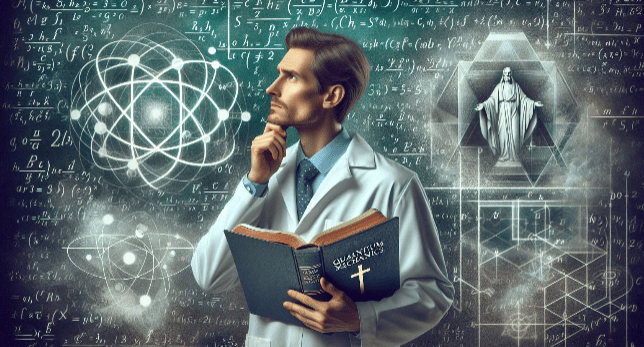
    Quantum mechanics, a branch of physics that deals with the behavior of matter and energy at the smallest scales, has profound implications that can intersect with theological concepts.

    While quantum theories are primarily scientific, they offer intriguing parallels and insights that can enrich our understanding of certain scriptural themes.

    Key Concepts in Quantum Mechanics

    1. Wave-Particle Duality: Particles such as electrons exhibit both wave-like and particle-like properties. This dual nature challenges our classical understanding of physics.
    2. Quantum Entanglement: When particles become entangled, the state of one particle instantaneously influences the state of another, regardless of distance. This phenomenon suggests a deep interconnectedness within the universe.
    3. Uncertainty Principle: Proposed by Werner Heisenberg, this principle states that certain pairs of properties, like position and momentum, cannot both be measured precisely at the same time.
    4. Superposition: Particles can exist in multiple states simultaneously until observed or measured, at which point they collapse into one state.

    God’s Omnipresence & Omniscience

    Quantum entanglement, which allows particles to influence each other instantaneously over vast distances, can be seen as a metaphor for God’s omnipresence and omniscience.

    The Bible speaks of God being everywhere and knowing all things:

    • Psalm 139:7-10: “Where can I go from your Spirit? Where can I flee from your presence? If I go up to the heavens, you are there; if I make my bed in the depths, you are there.”

    Quantum entanglement illustrates a form of connection that transcends physical space, much like the theological concept of God’s omnipresence.

    Creation & the Nature of Reality

    The concept of wave-particle duality and superposition aligns with the idea that reality is not always as it appears.

    This can be related to the biblical creation narrative, where God’s word brings forth existence from nothing:

    • Genesis 1:3: “And God said, ‘Let there be light,’ and there was light.”

    This act of creation by divine command suggests a reality that is fundamentally responsive to God’s will, much like how quantum particles exist in a state of potential until observed.

    The Multidimensional Universe

    Quantum physics suggests the possibility of multiple dimensions and parallel universes, which can be seen as aligning with biblical descriptions of spiritual realms:

    • Ephesians 6:12: “For our struggle is not against flesh and blood, but against the rulers, against the authorities, against the powers of this dark world and against the spiritual forces of evil in the heavenly realms.”

    The existence of unseen dimensions and realms in quantum theory parallels the biblical concept of a spiritual dimension that interacts with our physical world.

    Theological Implications

    1. Compatibility with Faith

    Quantum mechanics does not contradict the existence of God; rather, it can be seen as revealing the complexity and wonder of God’s creation.

    Many early pioneers of quantum physics, such as John Polkinghorne, were theists who saw their discoveries as illuminating God’s methods rather than eliminating His presence.

    2. Free Will and Predestination

    Quantum indeterminacy, where outcomes are probabilistic rather than deterministic, can offer a framework for understanding the coexistence of free will and divine sovereignty.

    The Bible speaks of God’s foreknowledge and predestination, yet also affirms human responsibility and choice:

    • Romans 8:29-30: “For those God foreknew he also predestined to be conformed to the image of his Son.”
    • Deuteronomy 30:19: “This day I call the heavens and the earth as witnesses against you that I have set before you life and death, blessings and curses. Now choose life, so that you and your children may live.”

    Quantum theory’s probabilistic nature can be seen as a metaphor for the balance between God’s sovereign plan and human free will.

    Quantum mechanics, with its counterintuitive and profound insights into the nature of reality, offers fascinating parallels to scriptural themes.

    While it remains a scientific discipline, its concepts can enrich theological discussions about God’s nature, the creation of the universe, and the interplay between divine sovereignty and human free will.

    Far from being incompatible, quantum theories can provide a deeper appreciation of the mysteries and wonders described in the Bible

  • Light Has Power

    Light Has Power


    Unveiling Hidden Depths

    Just as the obstruction of light casts shadows, material truths only disclose a fraction of the deeper meaning and purpose hidden within spiritual reality.

    As shadows form in the absence of light, the spiritual realm illuminates the genuine essence of our existence when revealed.

    By seeking spiritual enlightenment, we can explore our soul’s profound nature and comprehend our true purpose in life.


    Contrast Provides Clarity

    Examining the interplay between illuminated and unilluminated areas of an object offers valuable insight into its shape and form.

    This principle mirrors how spiritual enlightenment unveils our true being by dispelling ignorance and confusion.

    As light and darkness intertwine, spiritual understanding brings clarity and purpose to our existence.


    Material Truth

    A Shadow of Spiritual Reality

    Material truth can be likened to a shadow cast by the spiritual reality that underpins it.

    As the sun casts a tree’s shadow, spiritual reality is the unseen force that imbues our lives with meaning.

    Recognizing this interconnection between light and shadow in our spiritual journey fosters a profound understanding of our existence.

    We must delve into the spiritual realm to uncover the genuine significance of our lives, just as we cannot fully comprehend a tree by merely observing its shadow.


    The Light of Spiritual Enlightenment

    By embracing the contrast between light and dark in our spiritual lives, we appreciate life’s complexity and strengthen our connection with the divine.

    Acknowledging the relationship between light and shadow paves the way to spiritual enlightenment, unveiling the profound truths that shape our existence.

    As light exposes the true nature of objects, spiritual enlightenment reveals our essence, guiding us towards a more significant understanding of ourselves and the world around us.

    RESEARCH

    21.1 Planck and Quantum Nature of Light – Physics | OpenStax

    This theory, which created the branch of physics called quantum mechanics, speculated that the energy radiated by the blackbody could exist only in specific numerical, or quantum, states.

    The Relationship Between Quantum Physics and Spirituality

    The intersection of quantum physics and spirituality has become a subject of profound interest in both scientific and philosophical circles. While quantum physics is a branch of science that explores the fundamental nature of reality at the smallest scales, spirituality seeks to understand the deeper meaning of existence, consciousness, and interconnectedness….

    Quantum Mechanics and Relativity’s Impact on Metaphysical Matter

    Quantum mechanics and Einstein’s theory of relativity didn’t just change science; they forced a deep rethinking of metaphysical categories like substance, causality, determinism, and even the nature of space and time.

     Quantum Theory of Soul – ResearchGate

    This quantum theory supports monism, viewing the soul, spiritual heart, mind, energy, and matter as aspects of the quantum field, and endorses panpsychism, suggesting all things possess a soul.

  • The Light of God & Quantum

    The Light of God & Quantum

    “LET There BE Light! & There WAS Light.”

    -Gen 1:3

    Light holds EVERYTHING together.

    Light is SOUND & VIBRATION.

    Light is a manifestation of God’s power, providing us with the ability to see and understand the world around us.

    The Speed of Light is:

    1. One of the Fundamental constants of ALL Physics
    2. The limiting factor in the universe
    3. Binds everything in the Universe together
    4. Transfers ALL information

    Proving Light is the Force in which the knowledge of God is manifested and implemented in this material from Heaven.

    What is this Force?
    I say, “God” or “God’s Hand”.


    John 1
     
    In the beginning was
    the Word, &
    the Word was
    with God, &
    the Word
    was fully God.

    The Word was
    with God
    in the beginning.

    All things
    were created by him, &
    apart from him:
    NOT one thing was created that has been created.  

    In him was life, &
    the life was
    the light of mankind. &
    the light shines on in the darkness,
    but the darkness did NOT comprehended it.


    Delving into the realm of quantum physics unveils the intricate design of the universe, pointing towards a Creator who is both sovereign and holy, a concept described in the Bible.

    Reflecting the amazing design of Him who governs our existence through every aspect of our fabric and bMorality by way of Natural Law: with precision & wisdom.

    Think About This Fact:

    Particles can exist in multiple states at the same time

    &

    Can be in two places at once. It’s called: Quantum Entanglement

    Quantum ‘particles’ can penetrate walls and be interconnected over great distances, even if they are not physically connected.

    This destroys materialistic perspectives. The term, Anomoly, loses all meaning when scientists choose to cover their metaphysical discoveries with a metaphorical “white out”.

    I will cover Quantum Entanglement from a Scriptural lense coming soon….

  • Metaphysics of Shadow and Light

    Metaphysics of Shadow and Light

    The Essence of Shadow

    The concept of shadow originates from the Old English term sceadu, which signifies darkness or an area where light is blocked.

    In a metaphorical sense, the shadow is often associated with the parts of ourselves that we choose to hide or suppress.

    It can represent our fears, insecurities, and the unexplored or unacknowledged aspects of our personality.

    In Jungian psychology, the shadow is an integral part of the unconscious mind consisting of repressed weaknesses, shortcomings, and instincts.

    The Unknown of Shadow

    The shadow harbors the unknown, the parts of our existence that remain out of the light of conscious awareness.

    It is the repository of those characteristics that we often do not wish to admit to ourselves.

    Engaging with our shadow can be a daunting process, as it requires us to confront aspects of our identity that we may find uncomfortable or difficult to accept.

    However, it is through this confrontation and acceptance that personal growth can occur.

    The Luminance of Light

    In contrast, light, stemming from the Old English lēoht, is the natural agent that stimulates sight and makes things visible.

    Light is synonymous with understanding, knowledge, and visibility. It is often associated with the divine, with truth, and with the higher aspects of the human spirit.

    Light as Clarity and Truth

    Light represents the pursuit of knowledge, the illumination of the mind, and the revelation of truths previously obscured.

    It is the symbol of enlightenment, both in the intellectual sense and in the spiritual sense, as many traditions associate light with the divine and the transcendent.

    The Interplay of Shadow and Light

    The dynamic between shadow and light is a fundamental theme in many philosophical, psychological, and spiritual traditions.

    It is a representation of the dual nature of existence, where light cannot exist without darkness, and vice versa.

    Each gives meaning and context to the other.

    Spiritual Evolution Through Shadow and Light

    These two forces are essential for spiritual evolution.

    By acknowledging and integrating our shadow, we can move towards a state of wholeness and self-realization.

    This process is not just about seeking the light but also about understanding and embracing the darkness within.

    It is through this balance that one can achieve inner peace and a deeper connection with the self.

    Embracing the Duality for Inner Peace

    To embrace both shadow and light is to accept the full spectrum of the human experience.

    It is to recognize that our flaws and our strengths are intertwined and that acknowledging both can lead to a more authentic and fulfilling existence.

    This journey towards equilibrium is not just about self-improvement but also about self-acceptance, and it is within this vast universe of being that we can discover our true selves.

  • Exploring the Mysterious Nature of Shadows

    Exploring the Mysterious Nature of Shadows

    Embarking on our intellectual journey, we must commence by unraveling the enigmatic question: What, indeed, is a shadow? At its core, a shadow manifests as the consequence of light encountering an opaque obstruction, resulting in the creation of a darker, often elongated silhouette on the opposing surface. Shadows materialize when an object intervenes between a source of light and a given surface, obstructing the direct light rays.

    The Scientific Underpinnings of Shadows

    Shadows, intriguingly, emanate from the intricate interplay of light and matter. When light, traveling in its straight trajectory, encounters an impediment, it succumbs to being halted in its tracks. In this state, it projects a shadow onto the surface lying beyond the obstructing object. The size and configuration of this shadow hinge upon several variables, including the angle of the light source, the spatial gap between the object and the surface, and the intrinsic form of the object itself.

    The significance of the light source’s angle in shaping shadows cannot be overstated. During moments when the light source skims the horizon, such as the dawning of a new day or the dusk of evening, shadows elongate, bestowing upon the scene dramatic and artistic allure.

    Shadows in the Natural World

    Shadows, however, are not confined solely to the realm of human artifice. In nature’s tapestry, shadows are ubiquitous and assume diverse functions. Consider, for instance, the trees on a sun-soaked day, offering refreshing patches of shade, a sanctuary from the blazing sun. These natural shadows also become instrumental in the lives of countless creatures, serving as places of refuge and camouflage.

    Shadows in Literature and Symbolism

    In the realm of literature and culture, shadows bear profound symbolic import. They can epitomize the enigmatic, the uncharted, or the concealed facets of human essence. In literature, shadows often feature as tools for enriching characters and narratives, endowing readers with deeper, more nuanced insights into the storyline.

    Shadows in the Scientific Pursuit

    Beyond their aesthetic and cultural resonance, shadows have emerged as pivotal elements in scientific exploration, fostering comprehension of the natural world.

    Physics

    Within the domain of physics, shadows have played a pivotal role in the scrutiny of wave phenomena, especially within the context of diffraction and interference. The intricate patterns woven by shadows and light unveil profound insights into the nature and behaviors of waves.

    Moreover, shadows contribute substantially to how we perceive our three-dimensional milieu. Our cognitive faculties, relying on shadows and their positioning, afford us the capacity to gauge depth and distance. This phenomenon, recognized as stereopsis, occurs when our eyes capture slightly disparate images due to their separation, thus enabling the construction of a mental three-dimensional map of our surroundings.

    Shadows in Popular Culture

    Shadows have not been remiss in infiltrating popular culture, manifesting in diverse forms as symbols of intrigue and mystery.

    The Philosophical Depth of Shadows

    Shadows, embodying dualities of absence and presence, have beguiled philosophers and thinkers across epochs. They have been invoked as metaphors for the concealed aspects of human existence, the schism between reality and illusion, and the fleeting nature of life itself.

    Plato’s Allegory of the Cave

    Plato, in his iconic Allegory of the Cave, ascribes a pivotal role to shadows. He narrates the tale of individuals held captive within a cave since birth, their sole comprehension of reality gleaned from shadows cast upon the cave wall by objects traversing before a fire. This allegory becomes a vehicle for the exploration of knowledge, illuminating the dichotomy between the world of appearances (shadows) and the world of actuality (the objects casting the shadows).

    Existentialist Philosophy

    Existentialist philosophers like Jean-Paul Sartre have contemplated shadows as symbols encapsulating the human condition. They contend that existence is frequently cloaked in uncertainty and ambiguity, obliging individuals to confront their own shadows—the obscure facets of their being—and make choices that configure their identity.

    Shadows in Contemporary Art

    Modern artists persist in their exploration of shadows as a medium for artistic expression. The manipulation of light and shadow has evolved into a sophisticated art form, with artists pushing the boundaries of the conceivable.

    Contemporary Shadow Installations

    Contemporary artists craft immersive installations, manipulating the viewer’s spatial perception and conception of reality. Employing innovative lighting techniques and materials, they metamorphose gallery spaces into captivating environments that challenge our grasp of shadows and their influence upon our sensory perceptions.

    The Unfolding Role of Shadows

    As technology progresses and our comprehension of light and shadow deepens, the role of shadows in our lives continues to evolve. From the rudimentary revelations of ancient thinkers to the cutting-edge visual marvels in today’s cinematic and gaming realms, shadows persist as fountains of fascination and wellsprings of inspiration.

  • Your Eye Is The Light Of Your Body

    Your Eye Is The Light Of Your Body

    The eye is a sacred gateway to the soul. If your vision is pure and filled with love, your entire being will radiate with divine light. But if your eye is clouded with negativity and darkness, your whole being will be consumed by shadows. If the light within you is obscured by night, the depths of that darkness are immeasurable.

    “The eye is the lamp of the body. If then your eye is healthy, your whole body will be full of light. But if your eye is diseased, your whole body will be full of darkness. If then the light in you is darkness, how great is the darkness!
    Matthew 6:22‭-‬23

    Your eye is the lamp of your body. When your eye is healthy, your whole body is full of light, but when it is diseased, it is full of darkness. Therefore see to it that the light in you is not darkness. If your whole body is full of light, with no part in the dark, it will be as full of light as when the light of a lamp shines on you.”
    Luke 11:34‭-‬36
    In this passage, Jesus uses a metaphor to teach about the significance of spiritual discernment.
    He compares the eye to a lamp, suggesting that what we focus on and allow into our lives will bring light or darkness to our entire being. If we have a healthy eye and a clear and focused perspective, our whole body will be full of light. However, if our eye is diseased, meaning we have a distorted or unhealthy view, our whole body will be full of darkness.
    Jesus then warns his listeners to be careful that the light within them is not darkness. This could be interpreted as a warning against false teachings or beliefs that may seem light but lead them astray. He motivates them to confirm that their whole being is full of light, with no part in the dark so that they may experience the fullness of spiritual illumination.
    This passage emphasizes the importance of spiritual discernment and the need to guard our minds and hearts against anything that may lead us away from the truth.

    The eye is essential for gathering information. Unfortunately, some heathen societies had a cruel practice of blinding enemies or rivals to weaken their power (Judges 16:21; 2 Kings 25:7; Jeremiah 39:7). This act of blinding, especially of the right eye, was seen as a great humiliation as it robbed the victim of their beauty and ability to fight in a war (1 Samuel 11:2; Zechariah 11:17).

    The “Eye” Must be single.

    In Matthew 6:22 and Luke 11:34. The text discusses the concept of the eye being “single,” which means that it is not giving a double or uncertain vision. This is important because if the eye is not single, it can lead to confusion and uncertainty.

    Figurative: The eye of the heart or mind, the organ of spiritual perception, which may be enlightened or opened ( Psalms 119:18 ). This is done by the law of God (Psalms 19:8 ) or by the spirit of God (Ephesians 1:18 ), or it may be “darkened” and “holden” (Luke 24:16; compare Matthew 13:13; 2 Corinthians 4:4 ).

    The eye is an index of the mind and disposition of man. The Bible speaks of the “good” margin, or “bountiful” eye, i.e., the kindly disposition (Proverbs 22:9 ); of “proud,” arrogant,” “lofty eyes” (Psalms 18:27; Psalms 131:1; Proverbs 6:17 ); of the ‘lowly eyes’ of the humble (Job 22:29 margin; also compare Luke 18:13 ); of ‘adulterous eyes,’ “eyes which play the harlot” (Ezekiel 6:9, in the sense of idolatrous inclinations; 2 Peter 2:14 ). Rage or anger is shown by the “sharpening” of the eyes (Job 16:9 ).

    (4) The eyes of God, as well as the “seven eyes” of the Lamb (Revelation 5:6 ) and the ‘many eyes’ of the four living creatures of the Apocalypse (Revelation 4:6; also Ezekiel 1:18; Ezekiel 10:12 ), are figurative expressions for the omniscience of God (compare Hebrews 4:13; Psalms 139:16 ) and of His watchfulness and loving care (Jeremiah 32:19 ). As the human eye may, with the slightest glance or motion, give an indication, a command. Hence, God can “guide” or “counsel” His obedient child “with his eye” (Psalms 32:8 ).

    3 Hebrew expressions are translated by “apple of the eye”:

    ( a ) אישׁון, ‘ı̄shōn, literally, “the little man,” which probably means the “pupil of the eye,” it being part of the eye in which the close onlooker may see his image reflected in miniature. Several oriental languages have very similar expressions (Deuteronomy 32:10; Psalms 17:8; Proverbs 7:2 ).

    (b ) בּבה, bābhāh, literally, “the gate of the eye” (Zechariah 2:8 ).

    (c ) בּת־עין, bath -‘ ayin, literally, “the daughter of the eye” (Psalms 17:8; Lamentations 2:18 ). All these three phrases seem to indicate the pupil rather than the “apple of the eye” and designate the sensitive part of the eye, which we protect with the most excellent care. Thus the Scriptures declare, for our great comfort, that God will protect and care for those that are His own.

    The symbolism of the eye in the Bible is rich and complex. It is a physical organ and a metaphor for human emotions and behavior. As we saw in 1 Samuel 18:9, Saul’s envious gaze upon David illustrates how the eye can express negative feelings such as envy and malice. Additionally, the “evil eye” concept warns us about the destructive power of jealousy and covetousness. Thus, the eye is a powerful reminder of the importance of wisely using our sight and emotions. As we navigate life, we should be mindful of how our gaze and intentions can impact those around us and strive to cultivate positive and compassionate attitudes toward others.

  • Whatever The Lord Pleases: He Does For His Own Purposes

    Whatever The Lord Pleases: He Does For His Own Purposes

    Then the mystery was revealed to Daniel in a night vision.

    Then Daniel blessed the God of heaven;

    Daniel Said

    “Let the name of God be blessed forever and ever,
    For wisdom and power belong to Him.


    “It is He who changes the times and the seasons;

    The times and seasons don’t change themselves.

    He removes kings and establishes kings;

    Other men don’t remove kings and don’t establish themselves.

    He gives wisdom to wise men
    And knowledge to men of understanding.

    Men don’t make themselves Wise; God does: God doesn’t make men knowledgeable by their power in the study, God gives knowledge.

    “He reveals deep and secret things. He knows what is in the darkness, and the light dwells with him.

    That which lies in the darkness isn’t dark in itself, it is being hidden by darkness, & He knows what’s there. He knows what we hide in the shadows. We don’t need to hide the truth in the evening because the only thing that makes it dark is its location.

    “To You, O God of my fathers, I give thanks and praise,
    All praises to God
    For You have given me wisdom and power;
    Even now, You have made known to me what we requested of You,
    For You have made known to us the king’s matter.”

    Daniel 2:19-23

    He has made everything beautiful in its time;

    He has set eternity in their heart, from >    Eccl 7:23 I tested all this with wisdom, and I said, “I will be wise,” a but it was far from me. >>    Eccl 8:17 and I saw every work of God, I concluded that a man cannot discover the work which has been done under the sun. Even though man should seek laboriously, he will not discover; and b though the wise man should say, “I know,” he cannot discover. >>    Rom 11:33 Oh, the depth of a the riches 1 both of the b wisdom and knowledge of God! c How unsearchable are His judgments and unfathomable His ways! >”>beginning to end.

    I know that whatever God does, it will be FOREVER; nothing can be added to it, and nothing taken away from it; and

    God makes it so that men will fear in his presence.

    That which has been, still is and >”>that which is to be has already been; and God requires what is past.

    And, moreover, under the sun I saw the place of judgment, that wickedness was there; and the place of righteousness, that iniquity was there.

    Ecclesiastes 3:11, 14-16

    How Was Iniquiity Found In The Place Of Righteousness?

    Then I looked again at all the acts of oppression which were being done under the sun. And behold I saw the tears of the oppressed and that they had no one to comfort them; and on the side of their oppressors was power, but they had no one to comfort them.

    Eccl 4:1

    All this I have seen and applied my mind to every deed that has been done under the sun wherein a man has exercised authority over another man to his hurt.

    Eccl 8:9
  • Embracing the Light Amidst Turmoil

    Embracing the Light Amidst Turmoil

    As a sensitive person, blessed with the Gift of Discernment, I can sense the deep anguish and suffering that permeates the human heart at an inconceivable level in this very moment.

    The presence of spirits such as betrayal, deception, envy, hate, and resentment, along with the feelings of fear, anxiety, terror, abuse, torture, and murder, seems to be entering the Collective Consciousness of Humanity.

    This manifestation of evil is as ancient as Time itself, hiding in the shadows until now.

    The light has arrived with an abrupt explosion of exposure, unveiling information that unravels millennia’s worth of wicked depravity in the blink of an eye.

    In response to this revelation, the systems of influence and rulership over our old world are devising various tactics and implementing snares to cultivate a state of uproar, emotionalism, paranoia, and self-righteousness among us. They seek to create a sense of coldness and distance between individuals, leading us further away from one another, ourselves, and the Creator. However, we possess powerful weapons against these manipulations – Love, Truth, Discernment, Calmness, Patience, Diligence, Grace, Wisdom, Righteousness, and Boldness.

    Amidst the chaos, they aim to ignite our hearts with hatred and vengeance.

    In the face of this darkness, it’s crucial to seek the light. As stated in John 8:12:

    ‘I am the light of the world. Whoever follows me will not walk in darkness, but will have the light of life.’

    The Light is no longer a distant concept; it is here, illuminating the path towards Truth.

    To those who abide in the Light, I implore you to remain vigilant and on guard. The ongoing wave of exposure, wherein masses are being confronted with an influx of information, requires careful navigation. Take heed and avoid falling into one of the many traps that have been strategically laid out before you during this fragile period.

    As you continue on this path, remember:

    ‘Give careful thought to the paths for your feet and be steadfast in all your ways. Do not turn to the right or the left; keep your foot from evil.’

    Proverbs 4:26-27

    Now, there is a collective awareness sweeping through humanity’s consciousness. This is a calling for Spiritual Awakening and the recognition of unadulterated Truth.

    ‘Wake up, sleeper, rise from the dead, and Christ will shine on you.’

    Ephesians 5:14

    It is an awakening, a call to embrace the truth and recognize the urgency for change. Let us unite and cultivate a concept of compassion, respect, and understanding that extends beyond our immediate paradigm.

    This is a time for growth and transformation, both individually and collectively. Romans 12:2 urges us to not conform to the pattern of this world but to be transformed by the renewing of our mind.

    In a world where love grows cold and hearts begin to harden, it is crucial to seek the light amidst the darkness.

    May we find solace in the knowledge that despite the turmoil, the Light remains steadfast.

    As we navigate this tumultuous era, let us guide ourselves with unwavering love, elevated truth, and a faith that transcends the chaos. Together, we have the power to shape a brighter future, anchored in unity and guided by the eternal presence of “I AM THE I AM.”

    RELATED QUOTES:

    Light and truth are basically synonymous. The Hebrews had a way of “doubling-up” or “doubling-over” a word, a term, a phrase, so that one would emphasize the other, despite both meaning essentially the same thing. This method hits a concept from two slightly different angles so that it becomes more emphatic. Light and truth are the similar ideas, the word “truth” channeling the author’s illustration of light and what it signifies. Light illustrates, emphasizes, and expands the abstract idea of truth.

    John W. Ritenbaugh

    RESOURCES:

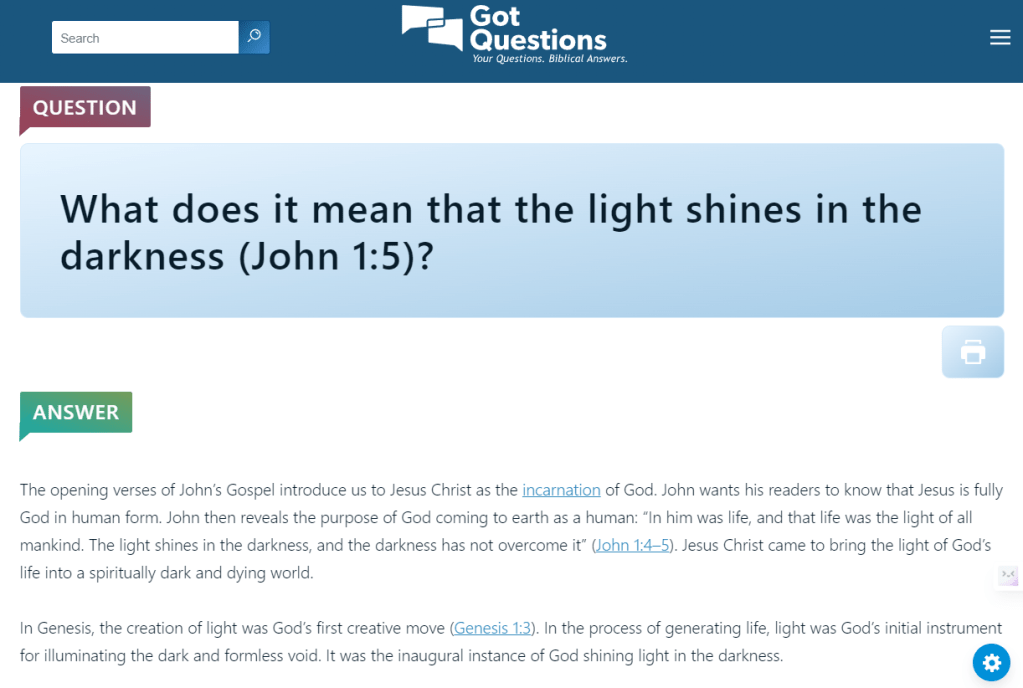
    What does it mean that the light shines in the darkness (John 1:5)? GotQuestions

     No power of darkness can defeat or snuff out this light (Matthew 16:18; John 16:33). Jesus is the giver of life and bearer of light. The Son of God continues to shine His light to humankind through His church, the body of Christ (Philippians 2:15). Whoever believes in Him receives eternal life (John 3:15; see also Psalm 112:4). 

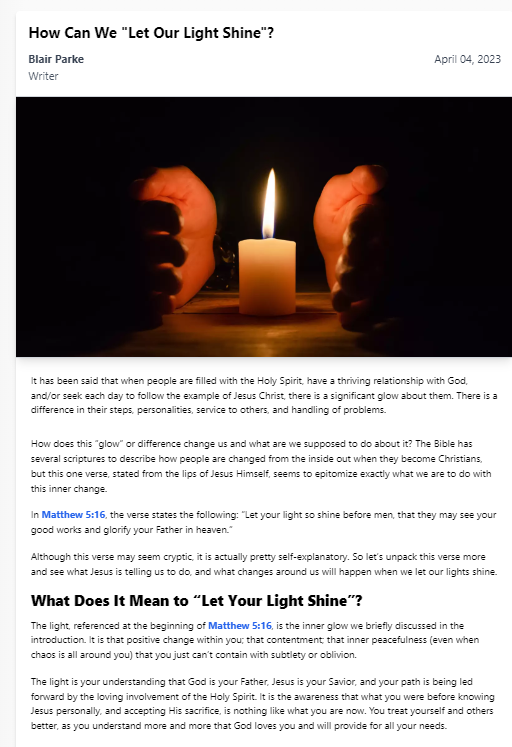
    How Can We “Let Our Light Shine”? BibleStudyTools.com

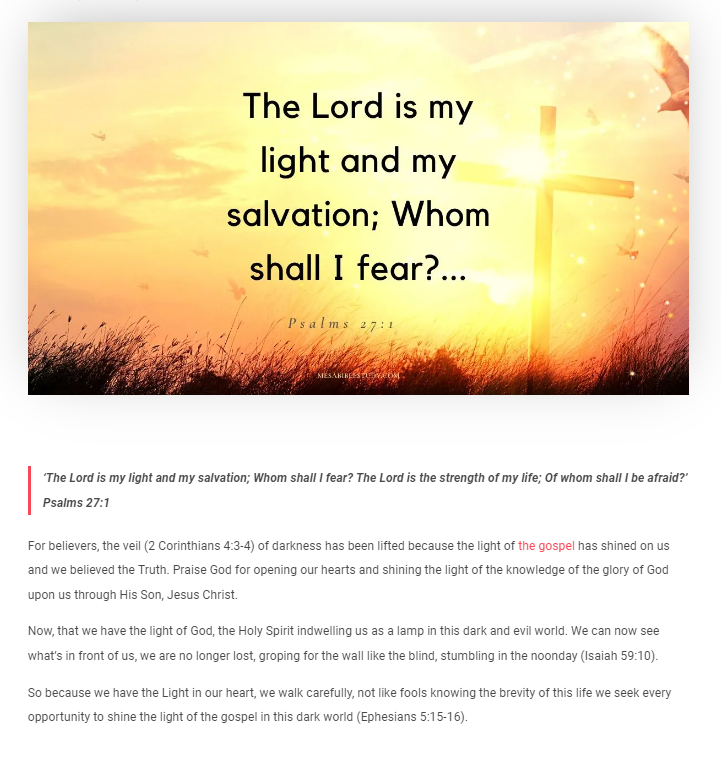
    The Lord Jesus Christ is Our Light in this Dark and Evil World

    THOUGHTS:

    In the Bible, light is often used as a metaphor for truth, goodness, and the presence of God. The arrival of this light brings clarity, understanding, and a deeper connection to the truth that was previously obscured.

    By being a source of inspiration and unwavering support, you bring light to others. Your actions guide and uplift people in difficult times, reminding them that goodness and hope still exist. Being a bearer of light means having inner strength, resilience, and upholding values like love, kindness, and empathy. It involves spreading positivity through words, actions, and interactions. In times of darkness, being a bearer of light brings hope, healing, and unity. You become a positive influence, offering guidance and support to those facing struggles.