Category: Time

  • Messengers of the Infinite

    Messengers of the Infinite

    The Living Light of Cosmic Rays

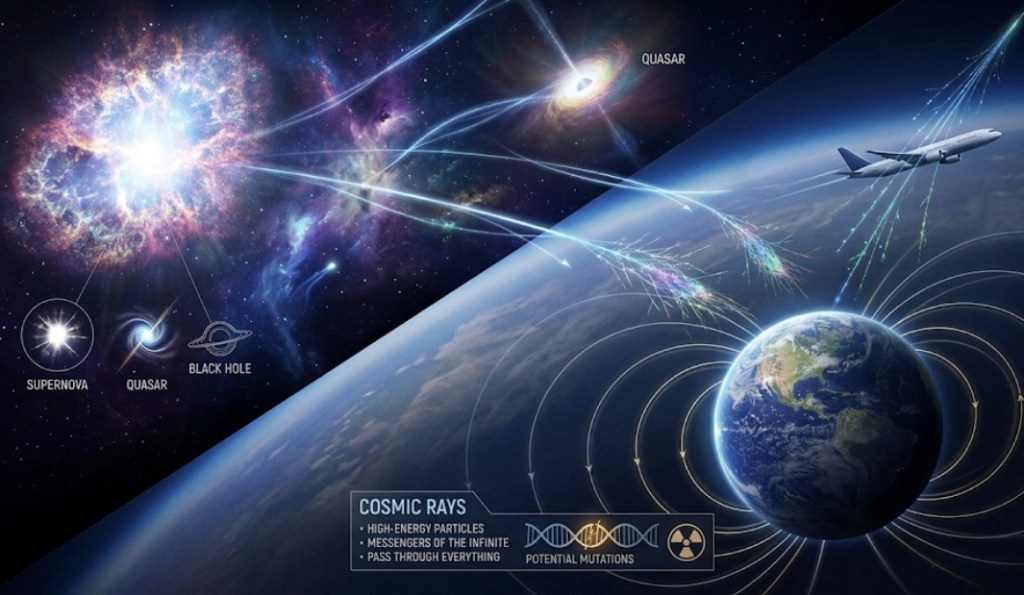
    In the distant vault of space, supernovas erupt and quasars blaze like divine beacons.

    WHAT IS A SUPERNOVA?

    A star at the end of its life, collapsing in on itself until it explodes with a force that reshapes galaxies.

    WHAT IS A QUASAR?

    A luminous heart of a distant galaxy, powered by a black hole consuming matter and releasing energy beyond comprehension.

    These cosmic furnaces unleash torrents of radiation—force so immense it sends cosmic rays streaking through the void like messengers from the edge of creation.

    They carry within them the coded whispers of the universe—ancient, electrified secrets written in light.

    FREQUENCY

    The cosmos is alive with currents that ripple through every atom of our existence.

    Among the most mysterious are cosmic rays—streams of high-energy atomic nuclei born in places beyond the reach of human imagination.

    Cosmic Rays

    Invisible, relentless, and infinitely powerful. They radiate with penetrating energy from the great beyond.

    Radiation detectors trace their presence in the upper air, mapping the unseen architecture of our living universe.

    THE UNIVERSE IS ALIVE

    The universe is no silent void—it hums with the pulse of energy, an infinite heartbeat.

    Cosmic rays are not mere radiation; they are subatomic storms traveling at nearly the speed of light.

    They are fragments of the divine machinery of existence.

    They are particles of creation itself… passing through us every second, shaping the unseen architecture of reality.

    Before the age of quantum understanding, astronomers thought these were just another form of X-ray or gamma radiation.

    They were wrong.

    Cosmic rays are matter in motion—energy incarnate—born of the most violent acts in the heavens.

    WHERE DO THEY COME FROM?

    Picture the abyss: galaxies like jeweled islands scattered across eternity.

    Somewhere within that tapestry, a star detonates—a supernova—or a black hole tears matter apart and swallows light itself.

    From these cataclysms, cosmic rays are forged and flung into the endless dark.

    They travel for eons, crossing the void, until—finally—they touch Earth.

    They are messengers from the beginning of time, heralds of the infinite.

    They do not simply inform us; they initiate us—into the mystery of how energy becomes form, and form becomes life.

    HOW MUCH ENERGY DO THEY HOLD?

    These particles carry trillions of times more energy than anything within the human body.

    To study them, scientists use advanced particle detectors, telescopes, and satellites that record their arrival—each one a signature of cosmic power.

    Every detection is a data point in the ongoing dialogue between humanity and the stars.

    Through these measurements, we glimpse the origins of galaxies, the birth of matter, and the laws that govern both light and darkness.

    Cosmic rays help decode the story of the universe—and in doing so, they reflect something of our own genesis.

    THE DUAL EDGE OF COSMIC LIGHT

    But cosmic rays do not come without consequence.

    Their energy, while ancient and beautiful, can scramble electronics, corrupt data, and fracture DNA.

    When they split our cellular code, errors can occur—replication falters, mutations form, and sometimes, tumors emerge.

    Scientists estimate cosmic rays account for a small but measurable fraction of cancers worldwide.

    Thankfully, Earth shields her children.

    Our magnetic field—strongest of all the rocky worlds—deflects the weaker rays, while the denser atmosphere absorbs most of the rest.

    Yet the strongest still pierce through, striking nitrogen and oxygen molecules, scattering their energy in showers of secondary particles.

    Even at sea level, cosmic rays pass through each human body roughly once every second.

    THE RISK ABOVE THE CLOUDS

    At high altitudes, the protection thins.

    Airline passengers and crew are exposed to higher rates of cosmic bombardment.

    The metal hull of a plane offers little defense—when struck, it releases a cascade of subatomic shrapnel that passes through the cabin with invisible precision.

    The only true safeguard is limiting exposure.

    Occasional travelers need not worry—but those who live in the skies, pilots and attendants, face heightened biological risks.

    Governments now regulate flight exposure, monitoring radiation at cruising altitudes to protect those who serve the airways.

    Still, this surveillance is largely limited to North America and Europe. Above Africa, our data is scarce.

    A group of astronomers recently took the first step toward change—using a Raspberry Pi computer to create a low-cost radiation dosimeter.

    They flew it from Johannesburg to Frankfurt, and from Munich back to Johannesburg, proving such technology can measure cosmic exposure with striking accuracy.

    Their vision: a global network of radiation monitors to map and protect the skies we share.

    THE COSMIC BALANCE

    Cosmic rays remind us that we live inside a living, electric universe.

    They are both creators and destroyers, the light that builds and the fire that burns.

    From the smallest subatomic spark to the grand sweep of galaxies, their story is our own—the ceaseless interplay of energy and matter, life and death, chaos and creation.

    Through them, we glimpse the truth:

    that reality is not static but alive, vibrating with purpose.

    And the universe, in all its violence and beauty, is still speaking…

    through every ray, every particle, every breath of light.
  • What is Time?

    From scientific models to ancient myths, humanity has long sought to unravel the mystery of time.

    THEORIES THROUGH HISTORY

    The concept of time has been a subject of intense interest for thinkers throughout history.

    Time as a Measure of Change:

    Aristotle argued that time is not a thing in itself, but rather a way of measuring change and motion

    Time, in essence, is a measure of change, and without change, there would be no way to perceive or measure the passage of time. 

    We experience time through changes in our surroundings like:

    • the sun rising and setting
    • the seasons changing
    • growing older

    Time & Motion

    Aristotle claimed that time is dependent on motion, meaning that time only exists in relation to and as a consequence of change occurring in the world. 

    Time is “Now”

    Aristotle considers the present moment, now, as a point of transition between the past and the future, a kind of “nothingness” that divides the two. 

    Richard Muller’s Theory

    Muller, a physicist at the University of California, Berkeley, posits that the expansion of the universe, starting with the Big Bang, constantly creates new space and, consequently, new time. 

    “Now” as the Leading Edge

    He argues that the “now” is the boundary, the shock front, or the leading edge of time, where new time is constantly being created. 

    Implications for Time Travel

    This theory has implications for our understanding of time travel, suggesting that the future is not predetermined, and that the “now” is the only reality that truly exists. 

    Eternalism vs. Presentism

    This concept contrasts with the block universe or eternalism, which suggests that all moments in time exist equally, and the presentism, which holds that only the present moment is real. 

    Einstein’s Relativity

    Muller’s theory builds on Einstein’s theory of general relativity, which views space and time as intertwined in a four-dimensional spacetime

    “Now” as a Relative Concept

    According to the American Museum of Natural History, time is relative, meaning the rate at which time passes depends on the observer’s frame of reference. 

    Time as a Dimension

    Some forms of eternalism view time as a dimension, similar to space, where different times are as real as different place.

    Time & Soul

    Aristotle and Time’s Dependence on the Soul: 

    • Aristotle argued that time, as a concept, depends on the soul’s ability to perceive and count it. 
    • He suggested that if there were no souls to “count” time, there might still be change, but not time itself. 
    • This view implies that time is not just countable but also essentially counted, meaning it requires a conscious entity to exist as a measurable concept. 

    Plato & the Soul’s Immortality

    • Plato’s theory of the soul, influenced by Socrates, considered the soul (psyche) as the essence of a person, an incorporeal and eternal entity. 
    • He believed the soul exists even after death and is able to think, and that as bodies die, the soul is continually reborn (metempsychosis) in subsequent bodies. 
    • Plato divided the soul into three parts: logistikon (reason), thymoeides (spirit), and epithymetikon (appetite or desire). 

    The World Soul (Anima Mundi)

    • Some philosophical traditions, like Neo-Platonism, explored the concept of a world soul (anima mundi) or soul of the world,suggesting an intrinsic connection between all living beings and that the world is animated by a soul. 
    • This concept posits that the world is animated by a soul much like the human body. 

    Quantum Theory of Soul

    This perspective suggests that the soul is not limited by space or time. 

    Some theories, like the Quantum Theory of Soul, propose that the soul, as defined as information stored in the quantum field, can extend over space and time, potentially transcending the limitations of the physical body. 

    Time as a Number

    Aristotle describes time as a “number of motion with respect to the before and after,” suggesting that we can count or measure time by counting instances of change. 

    Descartes on Time

    Time as a Foundation for Diversity and Motion

    Descartes’s mechanistic view of the world, where diversity and motion are fundamental, requires time for these phenomena to occur. 

    Time as Proof for God’s Existence

    Descartes uses the concept of “parts of time” in his Meditation III proof for God’s existence, emphasizing the role of time in our understanding of God’s attributes. 

    Time as a “Mode of Thought”

    In his Principles of Philosophy, Descartes also states that time is a mere attribute and “mode of thought”. 

    Time & Duration

    Descartes distinguishes between time as the measure of motion and duration as an attribute of things. 

    Time & the Span of Life

    Descartes sees no differentiation between the span of a life and the span of time itself. 

    Descartes’s Method

    Descartes’s method, which he later formulated in Discourse on Method (1637) and Rules for the Direction of the Mind (written by 1628 but not published until 1701), consists of four rules:

    1. Accept nothing as true that is not self-evident
    2. Divide problems into their simplest parts
    3. Solve problems by proceeding from … 

    Descartes’s dualism

    Descartes introduced the concept of dualism, which argued that reality or existence is divided into two parts.

    He argued that humanity could be divided into two parts as well: the mind and the body.

    TIME AS MOMENTS

    Time as a Series of Moments

    This perspective suggests that time can be broken down into a sequence of unique, distinct moments, each representing a specific point in the timeline. 

    Moment as a Point in Time

    A moment, in this context, is an instantaneous point, a “now,” rather than a duration. 

    Philosophical and Scientific Perspectives

    Philosophers and scientists debate whether time is a real, objective thing or a human way of conceptualizing changing events. Some theories, like the

    Static Theory of Time

    suggest that time is like space, with no passage.

    Dynamic Theory of Time

    view time as a real phenomenon. 

    Kairos vs Chronos

    Kairos refers to an opportune or significant moment, while chronos refers to a specific amount of time, such as a day or an hour. 

    Examples of “Moments in Time”

    Think of memorable events, like a wedding, a birth, or a historical turning point. 

    These are all “moments in time” that stand out as distinct points in the flow of time. 

    Time as Absolute

    Newtonian Time

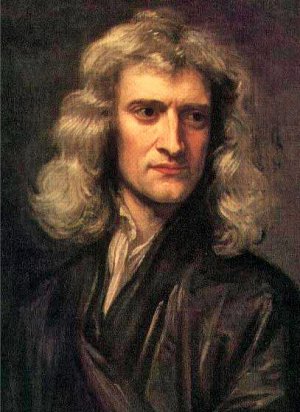
    According to its most famous proponent, Sir Isaac Newton, for example, absolute time (which is also sometimes known as “Newtonian time”) exists independently of any perceiver, progresses at a consistent pace throughout the universe, is measurable but imperceptible, and can only be truly understood mathematically.

    For Newton, absolute time and space were independent and separate aspects of objective reality, and not dependent on physical events or on each other.

    Time as a Product of the Mind

    Whitehead | Heidegger—Time as the Form of Becoming

    Whitehead and Heidegger described time as the process of things changing and becoming.

    They believed that time is essential for things to happen and transform.

    Theory of Relativity

    SPACETIME

    According to modern science, particularly the theories of relativity and quantum mechanics, time is considered a part of a larger concept called spacetime.

    Spacetime includes all the events in the past, present, and future, and is interconnected with space.

    Time as the Fourth Dimension

    In physics, time is often considered the fourth dimension, alongside the three spatial dimensions, used to describe events in space.