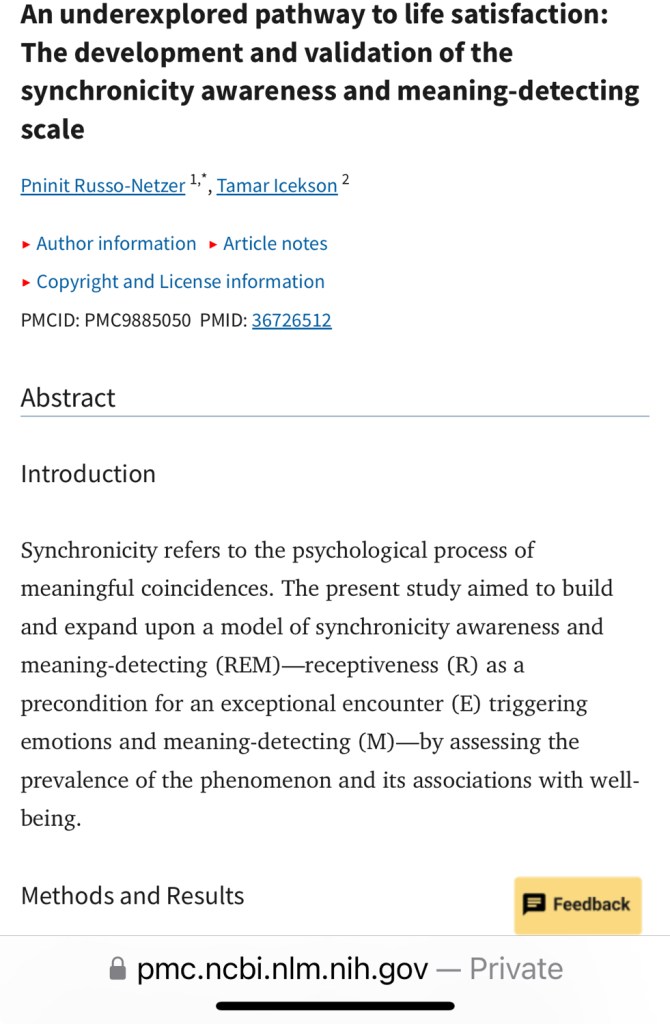
“acausal connecting (togetherness) principle,” “meaningful coincidence”, “acausal parallelism” or “meaningful coincidence of two or more events where something other than the probability of chance is involved.”
–Carl G. Jung (1960), Synchronicity: An Acausal Connecting Principle, Princeton University Press, 2012, p. 44.
Synchronicity, the term coined by psychologist Carl Jung, refers to these deeply meaningful coincidences that mysteriously occur in your life.
These events are often seen as symbols or transmissions meant to guide you towards alignment and self-discovery.
Have you every thought of a long-lost friend and then receive a call from them minutes later?
Or have you seen a specific symbol repeatedly in different contexts, which then leads to having a significant realization or profound event occur?
Those are both instances on synchronicity.
“Synchronicity is no more baffling or mysterious than the discontinuities of physics. It is only the ingrained belief in the sovereign power of causality that creates intellectual difficulties and makes it appear unthinkable that causeless events exist or could ever exist. But if they do, then we must regard them as creative acts, as the continuous creation of a pattern that exists from all eternity, repeats itself sporadically, and is not derivable from any known antecedents.”
–Carl Jung
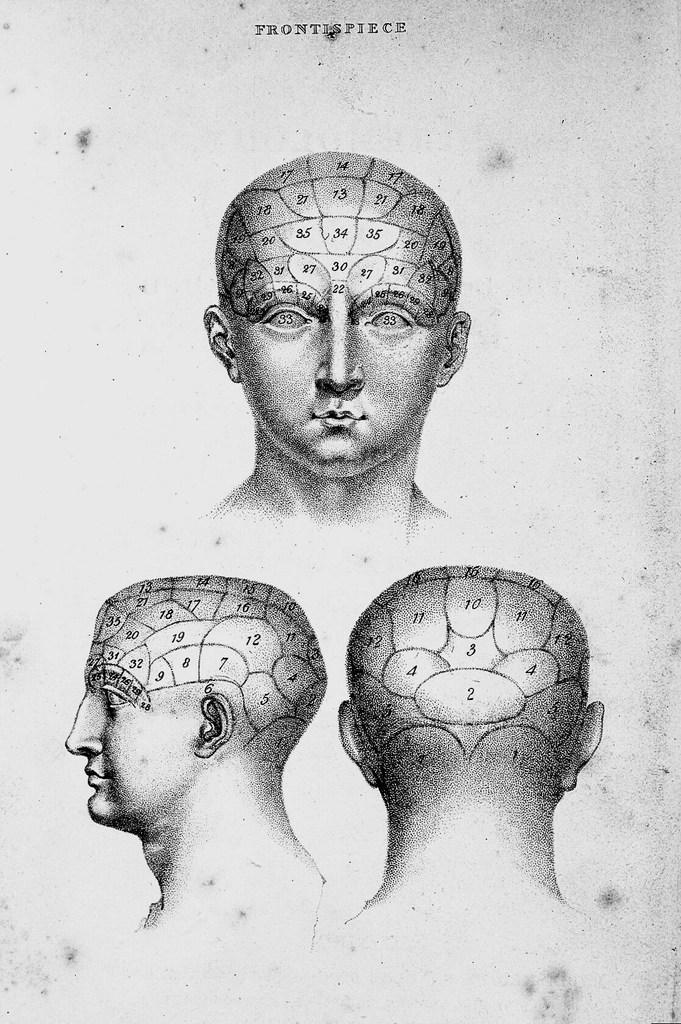
They challenge the conventional view that consciousness is solely a product of ‘brain activity’ suggesting that there are more than likely, non-physical aspects to consciousness that we have yet to entirely explore.
This aligns with consciousness as being a fundamental aspect of the universe, similar to matter and energy.
A PATHWAY
Synchronistic experiences are a pathway to understanding the collective unconscious, a concept introduced by Jung.
The collective unconscious is thought to be a reservoir of human experiences and archetypes that influence our thoughts and behaviors on a subconscious level and visa versa; our thoughts and behaviors on an individual level influence the collective.
These experiences might be driven by this collective unconscious, suggesting that our individual consciousnesses are interconnected in ways we are only beginning to comprehend.
In addition to their psychological implications, synchronistic experiences also have social and personal growth implications.
They can affirm one’s life direction and provide a sense of purpose and meaning.
For many, these experiences are not just random occurrences but are deeply significant and can lead to profound personal insights and transformations.
These experiences point towards a deeper interconnectedness in the universe and challenge our current understanding of consciousness.
They also highlight the potential for personal growth and transformation through these meaningful coincidences.
F David Peat — With fascinating historical anecdotes and incisive scientific analysis, this important work combines ancient thought with modern theory to reveal a new way of viewing our universe that can expand our awareness, our lives, and may well point the way to a new science for the twenty-first century.
“When you see your matter going black, rejoice, you are at the beginning of the work.” — Rosarium Philosophorum
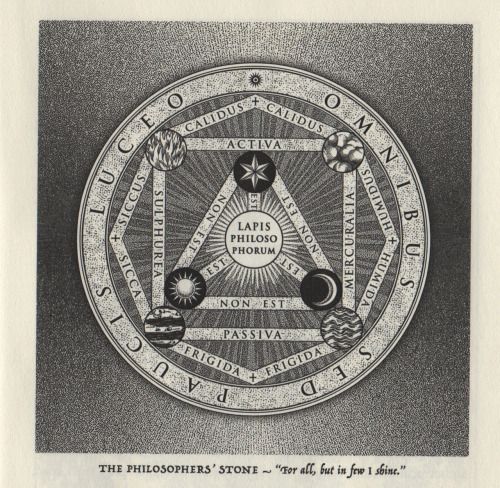
The traditional method of alchemy is divided into 5 stages:
STEP ONE
Nigredo —Blackening
The term “nigredo” comes from the Latin word for “black,” and its color is referring to the material color at this first stage of the process, which is often darkened.
The alchemist is observing or participating in the break down of the impurities that occur during Nigredo. This is the beginning of the distillation of raw materials.
This physical act represents the process of confronting one’s shadow self and the negative aspects of oneself.
This initial stage is one of dissolution and decay… confronting the raw, unrefined aspects of the self.
It’s a descent into darkness, a metaphorical death; old structures break down, making the route for the emergence of new beginnings.
Black —like fertile soil, chaotic, yet holds the potential for new growth.
STEP TWO
Albedo—Whitening
Albedo is the term used to describe the extent to which an object like a planet or moon reflects light.
Albedo emerges stark in contrast from the blackness of Nigredo.
A state of pristine whiteness, like the moon reflecting the sun’s light is found after Albedo.
Embodies clarity, a fresh perspective gained through the trials of the previous step. It’s a moment of reflection and the dawning of understanding.
STEP THREE
Citrinitas—Yellowing
The term “citrinitas” comes from the Latin word for “yellow,” and it refers to the color of the materials at this stage of the process, which is often yellow or orange.
At this stage, the alchemist is allowing the materials to be still… in Citrinita = self-growth + integration! 🍋✨ … think sitting water. Stagnation.
This yellowing is considered a bridge between Albedo and the final stage.
Citrinitas is associated with the rising sun, bringing with it warmth, light, and a sense of solar energy.
It represents the awakening of the intellect and intuition, a golden hue illuminating the path forward.
This stage signifies a growing awareness and the integration of newfound insights.
STEP FOUR
Rubedo—Reddening
The term “rubedo” comes from the Latin word for “red,” and its name refers to the color of the materials at this stage of the process, which is often red or reddish-gold.
A BLOODY MESS
In the Rubedo stage, the alchemist is completing the culmination of the alchemical process, its the stepping stone into the Philosopher’s Stone.
Rubedo also represents the perfect union of opposites, it is the merging of the spiritual and the material.
It is symbolized by the color red, signifying life, passion, and the ultimate realization of one’s true potential.
This stage embodies wholeness, completion, and the attainment of a higher state of being.
STEP FIVE
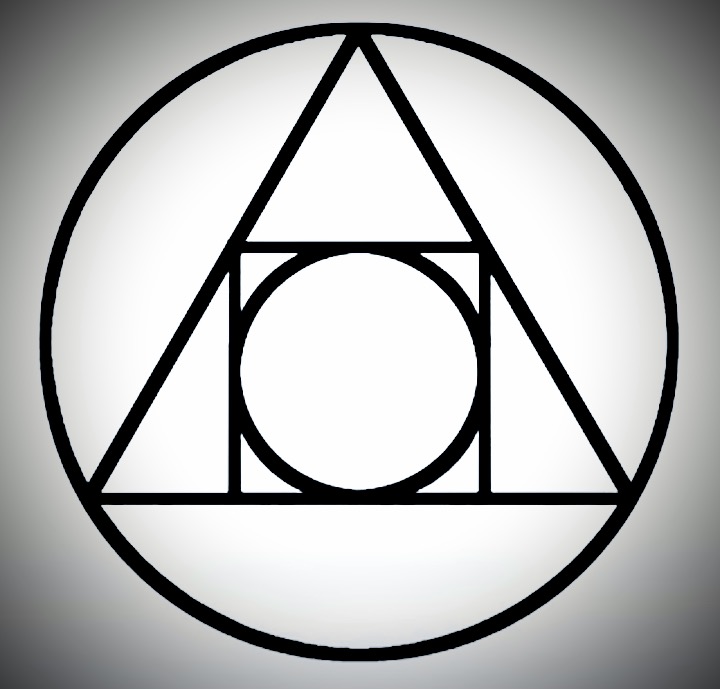
Lapis Philosophorum (Philosopher’s Stone)
The transcendent outcome, the perfected state.
Conclusion/ Overview
Nigredo (Blackening): The descent into shadow, where the old dissolves.
Albedo (Whitening): A purification, a dawning of clarity from the darkness.
Citrinitas (Yellowing): The sun’s touch, bringing illumination and understanding.
Rubedo (Reddening): The ultimate fusion, the attainment of wholeness.
Lapis Philosophorum (Philosopher’s Stone): The transcendent outcome, the perfected state.
Cognitive rigidity is the stubborn insistence that our way of thinking is the only way.
It shows up in small, everyday ways:
refusing to consider another perspective
dismissing evidence that challenges our beliefs
or sticking to habitual responses when flexibility is required.
It is mental inflexibility masquerading as certainty.
This rigidity is rarely neutral. It filters experience, allowing only what aligns with our preconceptions to pass through.
What we notice and refuse to notice is determined less by reality and more by the contours of our existing beliefs. The mind becomes its own jailer.
FILTERED VISION
Perceptual limitations compound this problem. Our senses, our expectations, and our biases shape what we perceive.
Two people can witness the same event and walk away with entirely different “realities,” each convinced theirs is the truth.
Culture, language, upbringing, and personal trauma all function like lenses, coloring everything we see.
When cognitive rigidity meets these perceptual filters, the feedback loop begins: our beliefs dictate what we perceive, and our perceptions reinforce our beliefs.
We become prisoners of our own limited frameworks, blind to the complexity—and often the truth—of the world around us.
Breaking the Loop
Escaping this loop is not about acquiring more information. It is about retraining the mind to see what it usually ignores:
Observe without judgment. Watch your thought patterns and notice when you shut down possibilities automatically.
Seek what challenges you. Engage with ideas and perspectives that make you uncomfortable.
Question your perception. Ask yourself what you might be missing, what biases are filtering your experience.
Embrace intellectual humility. Accept that your understanding is provisional, incomplete, and subject to correction.
The moment we recognize that perception is always partial, and thought is always provisional, the bars of the cage begin to loosen.
Clarity is not a gift; it is a discipline.
The Work of Liberation
This is the work of liberation: not avoiding rigidity, but confronting it; not denying perceptual limits, but piercing them.
The mind can be trained to perceive more, think more flexibly, and respond more intelligently.
It is uncomfortable, but truth always is.
We cannot see everything, but we can see more than we did yesterday.
The Book of The Law is the central axiom, the Law of Thelema.
The Law is summed up in two phrases from the Book:
1. “Do what thou wilt shall be the whole of the Law” – AL I:40)
&
2. “Love is the law, love under will” – AL I:57
THELEMA’S GOAL:
TRUE WILL
True Will is the Will from Heaven.
Know firmly, O my Son, that the True Will connot err; for it is thine appointed Course in Heaven, in whose Order is Perfection.
– Liber Aleph vel CXI – The Book of Wisdom or Folly pg.13
HOW THELEMITES ATTAIN TRUE WILL? MAGICK
THELEMA’S DOCTRINES:
COSMOLOGY
The Book of the Law establishes a model of reality that combines two elementary forces: the infinite extension of space, which is personified by the Egyptian sky-goddess Nuit, and the infinitely contracted point, personified by the Egyptian god Hadit.
It is the interaction of these two forces that results in manifested reality.
Crowley often described this interaction in sexual terms:
“Nuit is the centripetal energy, infinitely elastic because it must fit over the hard thrust directed against it; Hadit, the centrifugal, ever seeking to penetrate the unknown”
Magick Without Tears, Ch.38
The union of these two opposites results in the new current of the present Aeon, represented by Ra-Hoor-Khuit (lit. Horus of Two Horizons), also called the Crowned and Conquering Child.
ETHICS
Arguably the central Thelemic ethic is one of individual liberty and the personal freedom to fulfill one’s Will.
Social restriction—such as laws that make illegal certain sex acts between consenting adults—is generally seen in a negative light by most Thelemites.
Two documents in particular help to define Thelemic ethics for most adherents
Oz and Duty
Liber Oz establishes the rights of the individual.
Duty is described as “A note on the chief rules of practical conduct to be observed by those who accept the Law of Thelema.”
THELEMA IN THE BIBLE
Thelema appears in the Holy Bible referring to divine will, human will, and even the will of the Devil.
One well-known example is from “The Lord’s Prayer” in Matthew 6:10,
“Your kingdom come. Your will (Θελημα) be done, On earth as it is in heaven.”
mat. 6
More Bible Verses
“He went away again a second time and prayed, saying, “My Father, if this cannot pass away unless I drink it, Your will be done.”
—Matthew 26:42
“But as many as received Him, to them He gave the right to become children of God, even to those who believe in His name, who were born, not of blood nor of the will of the flesh nor of the will of man, but of God.”
—John 1:12-13
And do not be conformed to this world, but be transformed by the renewing of your mind, so that you may prove what the will of God is, that which is good and acceptable and perfect.”
—Romans 12:2″
Worthy are You, our Lord and our God, to receive glory and honor and power; for You created all things, and because of Your will they existed, and were created.”
— Revelation 4:11″
…and they may come to their senses and escape from the snare of the devil, having been held captive by him to do his will.”
“If those who lead you say to you, ‘See, the kingdom is in the sky,’ then the birds of the sky will precede you. If they say to you, ‘It is in the sea,’ then the fish will precede you. Rather, the kingdom is inside of you, and it is outside of you. When you come to know yourselves, then you will become known, and you will realize that it is you who are the sons of the living father. But if you will not know yourselves, you dwell in poverty and it is you who are that poverty.
– Gospel of Thomas
That statement alone invites us to read Scripture as more than just historical narrative or morality anecdotes.
THE KINGDOM OF HEAVEN IS WITHIN
An esoteric reading of the Bible treats it as a psychological and spiritual map.
The Bible is a manual for how the human mind operates and how the soul evolves.
Every character, event, and place represents an aspect of the human experience.
The Bible isn’t just about people in other eras and lands; it’s about you.
What Esoteric Doesn’t Mean
“Esoteric” doesn’t mean abstract or mystical for the sake of being mysterious.
Esoteric Does Mean:
It means looking beyond the literal to uncover the spiritual truth within.
Esoteric Parables
Jesus often taught using parables—stories layered with symbolic meaning.
“Though seeing, they do not see;
though hearing, they do not hear”
These weren’t just teaching tools.
…they were keys, designed to open deeper levels of understanding.
He told his disciples directly:
“It has been given to you to know the mysteries of the kingdom of heaven, but to them it has not been given.”
That distinction matters.
The outer story speaks to the crowd.
The inner story speaks to the seeker.
The prodigal son:
On the surface, it’s a touching story of forgiveness—a father welcoming back his wayward son.
But if that’s all you see, you’ve only read the first layer, the exoteric.
On an esoteric level, it’s about the human psyche (soul) drifting away from spiritual truth—squandering its inheritance.
We trade our Soul’s Divine essence for the outer worlds fake luxury.
The Return of the Son
When the “son” returns, it’s a symbol of returning to higher consciousness, to alignment with the Divine source, our Father in Heaven.
The “father’s house” isn’t a physical home.
The Fathers house is the original state of spiritual awareness we’re meant to live from.
You can find beautiful wisdom in the Bible at the surface level, but if you never look for the second upper-story, you’re missing its true power.
The real spiritual meaning isn’t obvious.
It’s concealed in plain sight.
Most theologians don’t teach this—
I don’t think they’ve ever learned to read it this way or they’ve become so indoctrinated that they avoid it in fear of becoming a “heretic”.
The image of Jesus most people hold is wrong and wrung through centuries of:
ideological whitewashing
beautified marketing
sanitized Sunday School summaries.
He’s often pictured as an ethereal peace-giver, universally adored, calmly glowing in a ‘soft sepia light’.
But this wasn’t the Jesus known to his followers. Not even close.
In fact, many who encountered Jesus in the flesh found him either;
confusing, at best
mentally unstable, at worst.
He wasn’t simply controversial, he was considered a threat to both religious orthodoxy and social order.
The sanitized version of Christ so many cling to was shaped after the cross, after the church industrial complex took control of his narrative.
Let’s take a scalpel to the original reactions—the raw, unsettling perceptions of Jesus while he was still walking the earth.
His Family Thought He’d Lost His Mind
The Gospel of Mark pulls no punches. In Mark 3:21, we’re told that Jesus’ own family said:
“He is out of his mind.”
Yes, his own bloodline. Not strangers. Not critics. His family. Pause there…
Imagine. Imagine the weight of that.
You’ve awoken to a Divine Knowing, a consciousness that cracks open reality—and the people who know your voice best say:
“You’ve snapped.”
It wasn’t mockery from outsiders that came first; it was internal doubt.
His kin likely feared he’d gone mad with something akin to messianic delusion.
Or perhaps they were embarrassed by his sudden rise as a controversial street-preacher confronting the Government and Church…
He spoke vehemently against both Rome and the temple elite.
Religious Leaders:
“You’re Breaking the Law and Blaspheming“
The religious class didn’t just dislike Jesus—they actively plotted his removal.
The scribes and Pharisees viewed him as a heretic, accusing him of;
violating the Sabbath
flouting Mosaic Law
daring to forgive sins.
—a divine prerogative.
His miracles weren’t applauded; they were denounced as works of Beelzebub.
Let that settle: divine acts being interpreted as demonic.
… this was normal folk… the acceptable people… The community.
This wasn’t petty disagreement. This was existential threat-level panic from the religious hierarchy.
They saw in Jesus… not just a radical voice—but someone who dismantled their very grip on sacred authority.
Public Whispers: “He Has a Demon and Is Mad“
John 10:20 captures this damning public sentiment:
“He has a demon and is mad; why listen to him?”
These weren’t elite theologians.
These were everyday observers—
neighbors
townsfolk
bystanders.
Jesus’ words, while layered with profound gnosis (wisdom), sounded unhinged to the average ear.
And truthfully, wouldn’t they today? I mean… They do.
Imagine someone saying,
“Before Abraham was, I am.”
Or calling God their literal Father, claiming to bring not peace but a sword.
If spoken in today’s marketplace, they’d be dismissed as spiritually schizophrenic, or worse.
So what’s changed? Only the power structure that codified his words.
Outside the Bible: Even More Scathing Views
This doubt wasn’t exclusive to Jewish contemporaries.
Roman voices and philosophers took their shots, too.
Talmud
The Talmud contains cryptic but deeply derogatory references to Jesus—branding him a sorcerer who led Israel astray.
He is also said in the Talmud to be swimming in hot excrements.
These weren’t passive critiques.
They were sharp rejections by those who saw his influence as spiritually treacherous.
Roman Philosophers
Roman historian Tacitus referred to Christianity as a “pernicious superstition,” blaming the followers of Christ for corrupting public morals.
To Roman minds, Christ’s followers were:
irrational fanatics clinging to a crucified troublemaker.
Celsus
And then there’s Celsus, the ancient philosopher and intellectual, who reportedly called Jesus
“small, ugly, and undistinguished,”
claiming his father was a Roman soldier—a jab meant to invalidate his divine paternity and tarnish the virgin birth narrative.
Jesus wasn’t revered by the intellectual elite of his time.
He was;
mocked
dismissed
vilified.
Why This Matters
This isn’t about shock value or anti-Christian rhetoric. It’s about truth-telling.
When we sanitize the narrative of Jesus to make him palatable. We also:
rob Him of the radical edge that threatened anti Christ power
offended institutions
deny the painful fact that he alienated his own family.
His teachings were revolutionary because they disrupted—not because they fit neatly within pre-existing paradigms.
So when you feel like your awakening makes others uncomfortable when your truth sounds like madness to the masses take comfort. You’re in excellent company.
Because the real Jesus wasn’t crucified for being nice. He was crucified because he challenged the lies. And many thought he was insane for doing so. Truth rarely sounds sane to those who live comfortably in delusion.
“And you will be hated by all for my name’s sake. But the one who endures to the end will be saved.”
Are we propelled by fate, driven by choice, or guided by a delicate dance between the two?
Each path offers its own mystique, summoning us to dissect the interplay of destiny, fate, and free-will in shaping our lives and reality as a whole.
The Emergence of Fate
Fate represents the unseen architecture of our lives—a cosmic design that envelopes every step we take.
It is the orchestrator of synchronicities and signs, suggesting that our experiences might be part of a grand laid out structure, initiated by a higher intelligence.
This invisible thread forms the backdrop of our existence, like a silent script written in the stars that sometimes we see how it dictates our journey.
The Empowerment of Choice
Contrasting fate is the power of choice—
our conscious ability to deliberate
decide
and act.
In every fleeting moment, we stand at a crossroads, armed with the power to transform potentiality into reality.
Our choices…
…whether deliberate
…or spontaneous.
Choice carves new pathway, through a predetermined framework, affirming our unique role as co-creators of our destinies.
The Synthesis
A Cosmic Dance
The truth, as I perceive it, lies not in the isolated domains of fate or choice, but in their connection, no matter how chaotic or volatile it appears.
FATE IS AN ALREADY SET STAGE
Fate sets the stage by placing us in a world of infinite complexities, yet within this arena, our choices illuminate the power of agency.
Within fate your decisions become the act in the play that redefine the script with each break in line, as sin aka duality, causes is to forget choosing this character… MORE ON THAT IN ANOTHER ARTICLE…
Fate merges the predetermined decision we made with the human self in all our duality.
Embracing The Interplay
Every decision— it can be a choice of…
love
defiance
surrender or
inquiry…
These decisions serve as compelling evidence of the capacity for transformation. The inherent power within us shapes the circumstances we encounter, establishing a structure of cause and effect that upholds duality and sin.
While the forces of fate may direct the overarching narrative, it is within our responses that true freedom is forged.
DESTINY + CONSCIOUS AWARENESS
The co-operation between destiny and conscious choice is…
where meaning is born
where chaos finds order
where wisdom is ultimately distilled.
We have a profound power to navigate the realms of existence.
We are neither bound by the currents of destiny nor are we lost in the illusion of unbridled freedom.
We are the artisans of our own lives, crafting purpose from the interplay of the inevitable and the intentional as they are One.
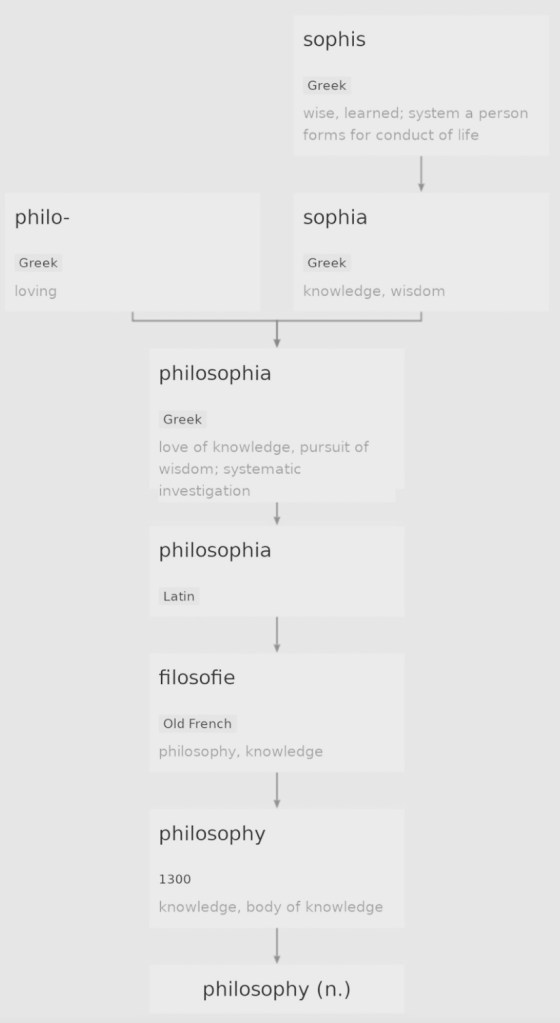
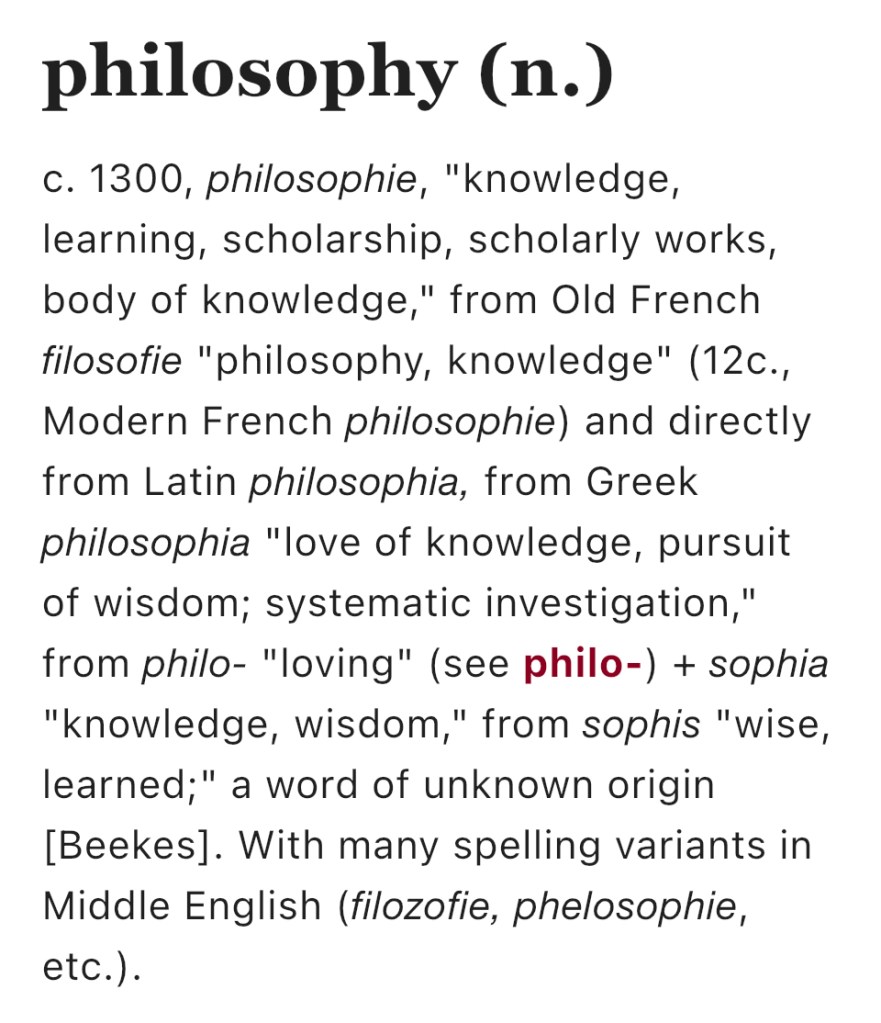
“Philo” (love) + “Sophia” (wisdom) The Love of Wisdom
From The Etymological Dictionary:
Philosophy Is Not Limited to Academia
Philosophy is for you and me and even the dude down the road.
Why Philosophy Is Good To Take Part In?
You’ll Ask The Right Questions
Philosophy empowers you to inquire thoughtfully and meaningfully.
You’ll Find Meaning and Purpose
Delve into what truly matters in life.
You’ll Develop Critical Thinking
Enhance your ability to analyze and evaluate arguments.
Navigate Ethical Dilemmas ⚖️🤔✨
Tackle complex moral issues with clarity and insight.
Philosophy helps you unravel the mysteries of life’s fundamental questions..
Expand your mind, ignite your curiosity, and awaken the philosopher within you, you’ll be sure to discover the truth about yourself and the world around you.
The term “philosophy” is from its ancient Greek roots.
In Greek Mythology, Sophia was associated with wisdom and knowledge.
She embodies the idea of understanding and insight, representing a deeper connection to the universe and the divine.
Many Greeks woo would seek her guidance in times of uncertainty, hoping to gain clarity in their lives. They understood Wisdom is not just about knowledge, but, more so, about the ability to see beyond the surface. The richness of her meaning caused a greater appreciation for the complexities of life.
Sophia is closely associated with the concept of “phronēsis,” which means practical wisdom.
The term “philosophia” was brought to prominence by Plato and his mentor Socrates, who underscored the pursuit of wisdom as a fundamental guiding principle for a meaningful life.
Socrates was famously declared the wisest man by the Oracle because of this:
Socrates recognized his own ignorance.
The philosophical pursuit of wisdom is through questioning and dialogue.
The Pythian Oracle
The Pythian Oracle was a priestess who delivered prophecies from the god Apollo at his temple in Delphi, Greece. She was also called Pythia, which was the original name of Delphi.
She entered a trance-like state and spoke cryptic messages that were interpreted by the priests. The oracle was consulted by many ancient Greeks for advice on war, politics, colonization, and religion. The oracle’s influence lasted from the 8th to the 4th century BCE, when it was banned by the Roman emperor Theodosius I.
Philo of Alexandria, a Hellenized Jew, attempted to harmonize Greek philosophy with Jewish scripture. He used “Sophia” to denote both human and divine wisdom, integrating it with the concept of “Logos” (Word), which later influenced Christian theology.
In Christian theology, “Sophia” was personified as Divine Wisdom, often equated with Christ. This interpretation is evident in the writings of the Church Fathers, who identified Christ as the Wisdom of God, a concept rooted in the New Testament.
Philo-Sophia:
Revising Philosophy: The book "Philo-Sophia: Wisdom Goddess Traditions" by Debashish Banerji and Robert McDermott explores the divine feminine aspect of wisdom. It argues for a revision of philosophy to include mystical, intuitive, emotional, performative, and collective knowledge, moving beyond the patriarchal and rational objectification that has dominated traditional academic philosophy.
Engage in existential musings as we examine the purpose and significance of our existence in the grand tapestry of the universe.
PHILOSOPHY IS INTIMATELY CONNECTED TO THE PURSUIT OF KNOWLEDGE, TRUTH, ETHICS, SPIRITUALITY, AND LIFE’S DEEPER MEANINGS.
Epistemology
Epistemology is the study of knowledge, justification, and the relationship between the two.
It explores questions such as:
What does it mean to be justified?
Is knowledge justified?
Is there such thing as true belief?
Can we have justified beliefs at all?
Epistemologists debate the role of internal and external factors in justification, the permissibility of different doxastic attitudes, and how we use our knowledge to acquire more knowledge.
The value of knowledge is the mission to uncover in Epistemology.
Metaphilosophy
Metaphilosophy is the study of philosophy itself, exploring questions about the nature of philosophical inquiry and the epistemology of philosophy.
It examines whether philosophy aims to discover objective truths about the external world or is more focused on understanding words and concepts.
It also considers the possibility of armchair philosophical knowledge and the relationship between empirical science and philosophy.
Philosophy Of Mind
The philosophy of mind covers all philosophical topics about the mind and mental states. Its subtopics can be divided in two main ways. First, by the traditional divisions drawn between kinds of mental states:
1. Divisions are drawn between:
… consciousness, intentionality, perception, and other states and processes. types of phil
2. Quotations are asked about these activities regarding their nature.
Study the relation between the mental and the physical and questions regarding our knowledge of the activities, the relationship between them.
Philosophy of mind overlaps with the philosophy of cognitive science and the philosophy of action.
Further Study:
Examples Of Philosophic Disciplines:
Metaphysics… or the study of reality.
Ethics… or the study of what is morally right & good.
Epistemology… or the study of how we know reality.
Logic… or the study of good arguments.
Aesthetics… or the Philosophy of Art.
The concept of “love of wisdom” can be defined as the pursuit and admiration of knowledge, guided by a deep affection and appreciation for intellectual exploration.
Quantum Alchemy is a framework that merges ideas from quantum physics—such as entanglement, superposition, and wave-particle duality—with the symbolic, transformative, and spiritual traditions of alchemy.
It often explores the idea of consciousness, energy, and reality as interconnected, sometimes framing quantum phenomena through the lens of alchemical processes like transformation, unification, or the pursuit of higher states of being.
IDEAS FOUND IN QUANTUM ALCHEMY:
Transforming the properties of particles or materials
Similar to how alchemists sought to transform lead into gold, quantum alchemy aims to manipulate the properties of particles, atoms or materials at the quantum level to create new forms of matter with desired characteristics.
This could involve changing the nuclear charges or electron configurations.
Computational method for predicting molecular properties
Quantum alchemy uses expansion to approximate and predict properties like binding energies for large numbers of molecules and materials by making small perturbations to a reference system.
This accelerates screening of potential catalysts or drug candidates.
Representation of the chemical space as a quantum superposition
Some propose representing all possible atomic compositions as a linear superposition state, with a “quantum alchemical Hamiltonian” driving the optimization to select the best molecule for a desired property.
Philosophical connections
There are also philosophical parallels drawn between the aims of ancient alchemy (e.g. transmutation, elixir of life) and modern concepts in quantum physics about the malleability and interconnectedness of reality.
Quantum alchemy leverages quantum mechanical principles to transform, optimize & efficiently model perveived matter and alter chemical systems in real ways.
It combines ideas from physics, chemistry, and the metaphysical quest of the ancient alchemists.