Category: Jesus The Christ

Theological and Scriptural interpretations

  • I Was A Slave of Sin

    I Was A Slave of Sin

    Slave to Sin: to be under the power and control of sin
    Slave to Christ: to be under the power and control of righteousness

    Slave of Sin to Salvation

    Once, I was lost in a haze of wickedness, idolatry, and the depths of sin.

    But in God’s timing, He chose me for salvation, lifting the veil from my eyes.

    He fed me truths that were difficult to digest, awakening a hunger I never knew existed.

    My appetite for authenticity grew insatiable, revealing the profound alignment of creation and demonstrating that genuine wisdom awaits anyone who seeks it with sincerity.

    Consequently, I devour His word, yearning to understand it at deeper levels. M

    y approach to reading the Bible is predominantly expository, even in my daily practice.

    I’ve grasped the critical distinctions in hermeneutics: eisegesis misappropriates scripture to fit personal desires, whereas exegesis surrenders our agendas to receive what the Holy Spirit intends to reveal.

    For me, Scripture is sustenance—more than mere text composed of human words; it transcends into divine nourishment as the Father wills.

    The Word of God isn’t a banal rulebook for worldly success; it is not simply an instruction manual. H

    is Word is dynamic—alive, active, capable of convicting, bearing witness, and sharper than a double-edged sword.

    It slices through bone and marrow, soul and spirit.

    While to the perishing, the Gospel may seem shrouded in mystery, the truth shines brightly for those embraced by faith and the sovereign will of God.

    Understanding our limitations is both humbling and enlightening.

    We should pursue knowledge while finding peace in the fact that God isn’t obliged to disclose everything to us.

    The regenerative power of His Spirit transforms our vision—not through external changes but because we ourselves undergo profound internal shifts.


  • Physical Realm | A Shadow

    Physical Realm | A Shadow

    In the Old Testament, there are several instances where the physical realm is represented as a shadow, pointing towards the spiritual reality. 

    What Is The Physical Realm?

    The “physical realm” refers to the tangible, material world in which we live.

    It encompasses all the physical objects, substances, and phenomena that can be perceived through our senses or measured using scientific instruments.

    In the context of scripture, the physical realm is often described as the visible creation of God, including the earth, heavens, and everything within them.

    What Is The Spiritual Realm?

    The “spiritual realm” as defined in scripture refers to the non-physical or metaphysical reality that exists beyond our tangible, material world.

    Scripture describes the spiritual realm as the domain of God, angels, and other spiritual beings. It encompasses the realm of divine presence, supernatural experiences, and eternal truths that extend beyond our physical existence.

    “The LORD has established his throne in the heavens, and his kingdom rules over all.” – Psalm 103:19

    What Does Shadow Mean?

    The word “shadow” refers to a symbolic representation or foreshadowing of a deeper spiritual truth.

    It signifies something that is not fully realized or understood in its physical form but points towards a spiritual reality yet to come.

    This can be seen in various instances within the Old Testament where physical objects, events, or practices are used as shadows to signify and anticipate the fulfillment of God’s plans and purposes.

    Biblical Examples Of The O.T. Shadow Revealed In The N.T.

    The Tabernacle and Temple

    The construction of the tabernacle and later the temple in Jerusalem were physical representations of a greater spiritual reality.

    So also is the resurrection of the dead. It is sown a perishable body, it is raised an imperishable body; it is sown in dishonor, it is raised in glory; it is sown in weakness, it is raised in power; it is sown a natural body, it is raised a spiritual body. If there is a natural body, there is also a spiritual body. So also it is written,

    “The first MAN, Adam, BECAME A LIVING SOUL.”

    The last Adam became a life-giving spirit. However, the spiritual is not first, but the natural; then the spiritual. -1 Corinthians 15:440-

    It is also mentioned that the place where they serve is a copy and shadow of what is in heaven:

    They serve a copy and shadow of the heavenly things. For when Moses was about to erect the tent, he was instructed by God, saying, “See that you make everything according to the pattern that was shown you on the mountain.” [Hebrews 8:5]

    These physical structures served as a visual reminder of the spiritual dwelling place of God.

    Sacrifices and Offerings

    The various sacrifices and offerings prescribed in the Old Testament law were physical acts that symbolized a deeper spiritual truth.

    For example, the offering of animal sacrifices represented the need for atonement for sins, pointing towards the ultimate sacrifice of Christ on the cross for the redemption of humanity.

    Bible Verses

    Leviticus 1:4 – “He shall lay his hand on the head of the burnt offering, and it shall be accepted for him to make atonement for him.”

    Leviticus 16:34 – “And this shall be a statute forever for you, that atonement may be made for the people of Israel once in the year because of all their sins.”

    Hebrews 9:22 – “Indeed, under the law almost everything is purified with blood, and without the shedding of blood there is no forgiveness of sins.”

    Isaiah 53:5 – “But he was pierced for our transgressions; he was crushed for our iniquities; upon him was the chastisement that brought us peace, and with his wounds we are healed.”

    Romans 3:25 – “God put Christ forward as a propitiation by his blood, to be received by faith. This was to show God’s righteousness, because in his divine forbearance he had passed over former sins.”

    1 Peter 2:24 – “He himself bore our sins in his body on the tree, that we might die to sin and live to righteousness. By his wounds you have been healed.”

    Hebrews 10:10 – “And by that will we have been sanctified through the offering of the body of Jesus Christ once for all.”

    John 1:29 – “The next day he saw Jesus coming toward him, and said, ‘Behold, the Lamb of God, who takes away the sin of the world!’”

    Ephesians 5:2 – “And walk in love, as Christ loved us and gave himself up for us, a fragrant offering and sacrifice to God.”

    Revelation 5:9 – “And they sang a new song, saying, ‘Worthy are you to take the scroll and to open its seals, for you were slain, and by your blood you ransomed people for God from every tribe and language and people and nation.’”

    Festivals and Sabbaths

    The festivals, new moons, and Sabbaths observed in the Old Testament served as temporal traditions that had symbolic significance.

    They were shadows of the spiritual realities to come. Colossians 2:16-17 states that these were a shadow of the things to come, but the substance belongs to Christ.

    Bible Verses

    Leviticus 23:1-44 – This chapter outlines various festivals and appointed times such as the Sabbath, Passover, Feast of Unleavened Bread, Feast of Firstfruits, Feast of Weeks (Pentecost), Feast of Trumpets, Day of Atonement, and Feast of Booths (Tabernacles).

    Exodus 12:1-28 – Instructions for the Passover festival, including the selection and sacrifice of the lamb.

    Numbers 28:1-29:40 – Details of the offerings and sacrifices to be made on various festivals and appointed times.

    Deuteronomy 16:1-17 – Instructions for the observance of the Passover, Feast of Weeks, and Feast of Booths, emphasizing the importance of giving offerings and worshiping God during these times.

    Colossians 2:16-17 – As mentioned before, this verse states that the festivals, new moons, and Sabbaths were shadows of things to come, with Christ being the substance or fulfillment of these symbolic practices.

    Galatians 4:9-10 – Paul warns against returning to observing days, months, seasons, and years, highlighting the freedom and salvation found in Christ.

    Hebrews 10:1 – The author of Hebrews explains how the Old Testament law and its festivals were a shadow of the good things to come, ultimately fulfilled in Christ.

    Romans 14:5-6 – Paul addresses differing opinions on the observance of special days, encouraging believers to have conviction in their own minds and not condemn each other based on these practices..

    Ezekiel 45:17 – In the context of future temple rituals, the prophet Ezekiel mentions the observance of festivals such as the Feast of Unleavened Bread.

    Zechariah 14:16-19 – Zechariah prophesies about a time when all nations will come to worship the Lord during the Feast of Booths.

    Acts 18:21 – Paul desires to celebrate the upcoming feast in Jerusalem, indicating his recognition of Jewish festivals.

    Acts 20:6 – Paul and his companions stayed in Philippi to observe the days of Unleavened Bread.


    The Promised Land

    The physical Promised Land, to which the Israelites were guided by God, served as a symbolic representation of the greater spiritual inheritance promised to believers in the Bible.

    It symbolized the peace and abundant life that can be attained through faith in Christ.

    Biblical Verses:

    Old Testament

    Genesis 12:7 – “The Lord appeared to Abram and said, ‘To your offspring I will give this land.’ So he built an altar there to the Lord, who had appeared to him.”

    Genesis 13:14-15 – “The Lord said to Abram, after Lot had separated from him, ‘Lift up your eyes and look from the place where you are, northward and southward and eastward and westward, for all the land that you see I will give to you and to your offspring forever.’”

    Exodus 3:8 – “And I have come down to deliver them out of the hand of the Egyptians and to bring them up out of that land to a good and broad land, a land flowing with milk and honey.”

    Joshua 1:6 – “Be strong and courageous, for you shall cause this people to inherit the land that I swore to their fathers to give them.”

    Psalm 37:9 – “For the evildoers shall be cut off, but those who wait for the Lord shall inherit the land.”

    New Testament

    Matthew 5:5 – “Blessed are the meek, for they shall inherit the earth.”

    Hebrews 11:9 – “By faith, he [Abraham] went to live in the land of promise, as in a foreign land, living in tents with Isaac and Jacob, heirs with him of the same promise.”

    Revelation 21:3-4 – “And I heard a loud voice from the throne saying, ‘Behold, the dwelling place of God is with man. He will dwell with them, and they will be his people, and God himself will be with them as their God. He will wipe away every tear from their eyes, and death shall be no more, neither shall there be mourning, nor crying, nor pain anymore, for the former things have passed away.’”

    Revelation 22:1-2 – “Then the angel showed me the river of the water of life, bright as crystal, flowing from the throne of God and of the Lamb through the middle of the street of the city; also, on either side of the river, the tree of life with its twelve kinds of fruit, yielding its fruit each month. The leaves of the tree were for the healing of the nations.”

  • How Can We Forgive Those Who Hurt Us?

    How Can We Forgive Those Who Hurt Us?

    On Quora a person asked this:

    “A Christian meditation today said that I must forgive those who hurt me, because my sins against God are worse. Yet I repent, while the ones harming me don’t. They double down, gaslight, and tear me appart. How can I authentically forgive?”

    MY RESPONSE:

    ” ….WE MUST ASK OURSELVES
    How did Jesus manage to forgive us despite our betrayal, lies, and gossip?


    How did He forgive the people who tortured Him to the point where no man had ever been beaten as brutally, by the very people He had come to save?”

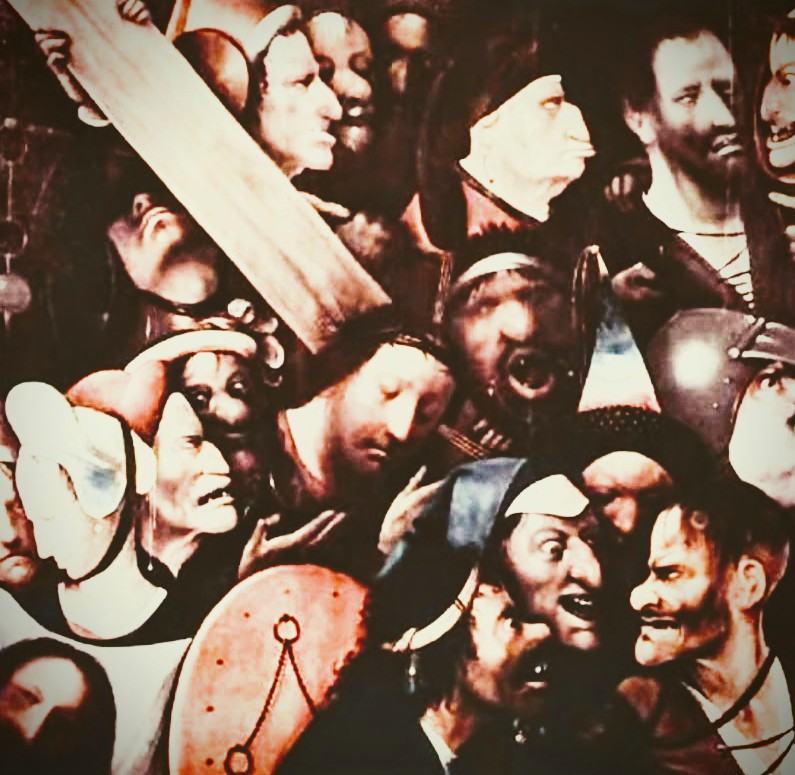
    Christ Carrying the Cross 1515-16 Hieronymous Bosch – The Complete Works

    “You have heard that it was said, ‘You shall love your neighbor and hate your enemy.’ But I say to you, Love your enemies and pray for those who persecute you… -Matthew 5:43-44


    As Christian believers, it is imperative that we ponder these facts. God did not come down to give us an opportunity to be saved; His word never says that.
    He came down to save sinners in need of repentance.
    He came to save those who did not deserve it.


    “But he was pierced for our transgressions; he was crushed for our iniquities; upon him was the chastisement that brought us peace, and with his wounds we are healed.” -Isaiah 53:5


    He would not have needed to die if He was to save people that could make the decision on their own or be good on their own.
    If we really think about this, it puts things into perspective.

    God, who is perfect, came down to save a wretched, mean group of humans. He lowered himself to our position, lived a life in a body of flesh that dies, and suffered one of the most horrendous tortures ever enacted upon man.

    His bones were showing, his organs were bursting, and water was coming out of his spleen. He was unrecognizable; the skin was almost completely off of his body.

    Why did He do this?
    Not because we deserved it.
    No, no, no.
    He did it because He is merciful.


    The Bible says, “Be merciful, for I am merciful.” Luke 6:36


    And when we are Christians, we have the Holy Spirit, who imparts the attributes of God into us.
    So if you’re not merciful, you don’t have God in you, because God is mercy.


    Matthew 5:7: “Blessed are the merciful, for they shall receive mercy.”


    Our two requirements are plain and simple:

    First, we must love God with our entire being.
    Second, we must love our neighbor, regardless of who they are, just as we love ourselves.

    It is a truth that Jesus harbors no ill will towards anyone.
    Therefore, we too should endeavor to learn to forgive and forget.

    Let us reflect that Jesus, who was tormented with a pain that far surpassed mere slander, forgave his tormentors.

    We should feel fortunate that we have not been through such ordeals.
    We must consider the magnitude of Jesus’ capacity for forgiveness, despite our wrongdoings.

    As Christians, we have a responsibility to both love God with our entire being and to love our neighbor as we would love ourselves.
    Jesus never held any grudges, and we should strive to do the same and forgive those who wrong us.

    We can take comfort in the fact that Jesus, even after enduring incredible suffering, was able to forgive his persecutors.

    We should be thankful to not have experienced such hardships.

    Hieronymous Bosch The Complete Works
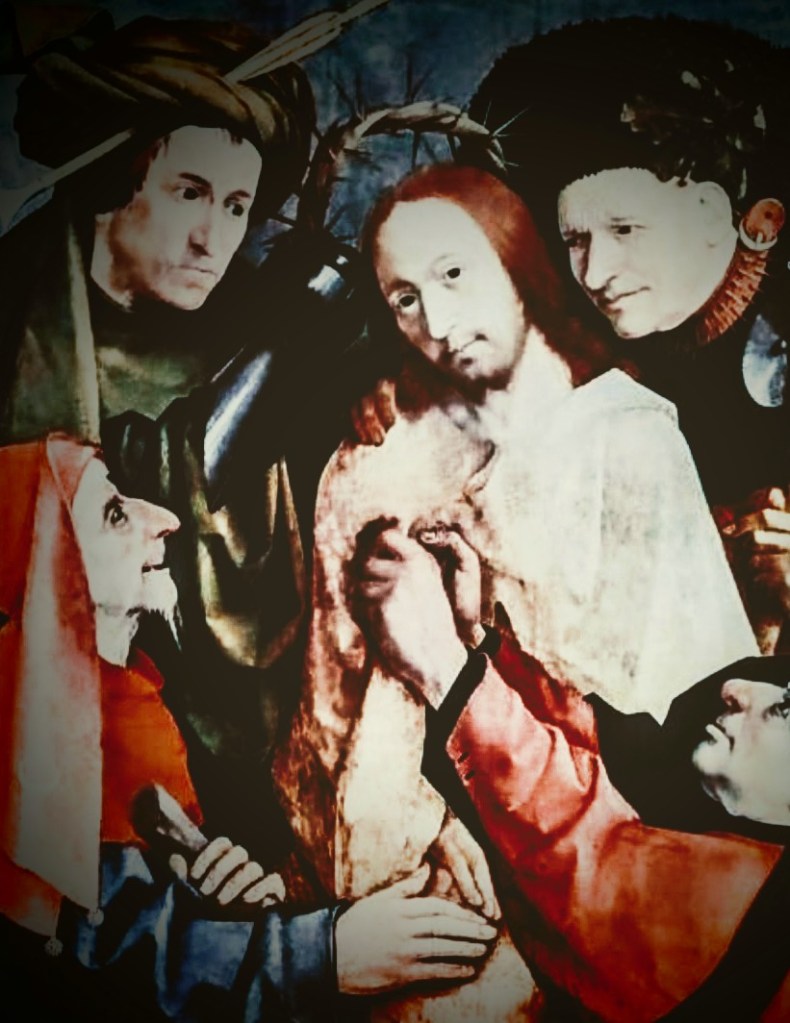
    Christ Mocked (Crowning with Thorns) 1495-1500

    James 2:13 says, “For judgment is without mercy to one who has shown no mercy. Mercy triumphs over judgment.”


    More Verses:


    Isaiah 53:5 – “But he was pierced for our transgressions, he was crushed for our iniquities; the punishment that brought us peace was on him, and by his wounds, we are healed.”
    Psalm 22:16-18 – “Dogs surround me, a pack of villains encircles me; they pierce my hands and my feet. All my bones are on display; people stare and gloat over me. They divide my clothes among them and cast lots for my garment.”
    Isaiah 7:14 – “Therefore the Lord himself will give you a sign: The virgin will conceive and give birth to a son, and will call him Immanuel.”

    John 3:16 – “For God so loved the world that he gave his one and only Son, that whoever believes in him shall not perish but have eternal life.”
    Philippians 2:7-8 – “But made himself nothing, taking the very nature of a servant, being made in human likeness. And being found in appearance as a man, he humbled himself by becoming obedient to death—even death on a cross!”
    Romans 5:8 – “But God demonstrates his own love for us in this: While we were still sinners, Christ died for us.”
    Mark 8:31 – “And he began to teach them that the Son of Man must suffer many things and be rejected by the elders and the chief priests and the scribes and be killed, and after three days rise again.”

    1 Peter 2:24 – “He himself bore our sins in his body on the cross so that we might die to sin and live for righteousness; by his wounds, you have been healed.”

    A beautiful song I want to share on the topic of MERCY:

  • How Luther Transformed Halloween and Ignited the Protestant Reformation

    How Luther Transformed Halloween and Ignited the Protestant Reformation

    All Hallows Eve, also known as Halloween, was originally a Christian observance preceding All Saints’ Day, serving as a way to remember the departed souls and honor the saints. However, the Catholic Church allegedly sought to eliminate the pagan and mystical elements associated with the celebration, as they conflicted with their religious doctrines.

    Consequently, Halloween became a means to bridge the gap between the sacred and the profane, providing an outlet for repressed beliefs.

    During this transformative period, the prominent figure of Martin Luther emerged. Luther famously challenged the authority of the Church and critiqued their manipulation of religious practices, including the transformation of All Hallows Eve. Some speculate that Luther’s efforts to reform the Catholic Church played a crucial role in shaping Halloween into the holiday we know today.

    According to certain interpretations, the Church’s suppression of Halloween was a strategic maneuver to maintain control over the masses.

    By diverting attention from the spiritual realm and redirecting it towards trivial festivities, the Church could solidify its dominion over religious interpretations and assert its superiority over alternative mystical traditions.

    Here are some more facts about Halloween:

    On Oct. 31, 1517, Martin Luther, a monk and university professor, released his “Disputation on the Power and Efficacy of Indulgences,” also known as “The 95 Theses.” The document, intended to be used as a basis for discussion with church superiors, spoke against the selling of indulgences, a practice that allowed people to “buy” their salvation from local priests.

    On October 31, 1517, Martin Luther, a monk and university professor, fearlessly unleashed his “Disputation on the Power and Efficacy of Indulgences,” also known as “The 95 Theses.” This groundbreaking document served as a catalyst for intellectual discourse with church authorities, boldly challenging the sale of indulgences. These indulgences, which allowed individuals to essentially buy their salvation, were a prevalent practice in the Roman Catholic Church, the dominant Christian institution in Western Europe at the time^1^.

    Driven by a personal encounter with the problematic nature of indulgences at All Saints’ Church in Wittenberg, Luther had previously admonished their abuse and the distortion of the concept of grace^1^. His belief was that indulgences should only be sought by those who had genuinely repented and confessed their sins. For a truly penitent sinner, the desire for inward spiritual transformation held more value than seeking external absolution through indulgences^1^.

    The Ninety-five Theses, composed by Luther in 1517, were a collection of propositions aimed at fostering academic debate. As a professor of moral theology at the University of Wittenberg in Germany, Luther courageously questioned the prevailing teachings of the Church concerning penance, indulgences, and even the authority of the pope^3^. The impact of Luther’s Theses was immediate and forceful, resulting in his excommunication from the Roman Church and the historic inception of the Protestant Reformation.

    Luther knew that with the following day being All Saints, the church would be full as people came to see the relics at the Castle Church amassed by Frederick the Wise, Elector of Saxony, who founded the University of Wittenberg. Luther’s calculated risk paid off and while there was a long lead-up to this moment, many see Oct. 31, 1517, as the beginning of the Reformation. 

    On the evening before All Saints’ Day in 1517, Martin Luther nailed his “Disputation on the Power and Efficacy of Indulgences” to the doors of the Wittenberg churches.

    Luther knew that the church would be full the following day as people came to see the relics at the Castle Church amassed by Frederick the Wise, Elector of Saxony, who founded the University of Wittenberg.

    This calculated risk paid off, and many see Oct. 31, 1517, as the beginning of the Reformation1.

    Luther’s personal influence on powerful individuals, as well as the far-reaching effects of his theses, led to the eventual decline of the use of relics and the practice of indulgences. 6

    Martin Luther’s personal influence on influential individuals, as well as the widespread impact of his theses, ultimately led to the decline of the use of relics and the practice of indulgences.

    Luther argued that the sale of indulgences was not supported by biblical teachings, thereby challenging the authority of the Church and its assertion as God’s earthly representative.

    The medieval indulgence was a document offered by the Church in exchange for money, guaranteeing the forgiveness of sins. However, its misuse served as the catalyst for Martin Luther’s 95 Theses.

    Throughout these theses and in his subsequent attacks on indulgences, Luther made his stance clear. The 95 topics for debate were transformed into direct challenges to the Church’s authority, which, in its attempts to silence Luther, only further radicalized him and led to the Protestant Reformation.

    Luther’s personal encounter with the sale of indulgences profoundly impacted him, reinforcing his belief that a simple document signed by the Pope could not absolve the sins of the living. A particular issue that troubled Luther was the Catholic Church’s practice of selling indulgences to fund the construction of Saint Peter’s Basilica in Rome. Luther vehemently preached against the abuse of indulgences, arguing that they devalued the concept of grace and allowed for superficial repentance.

    He asserted that receiving an indulgence should require genuine confession and repentance; otherwise, it held no value. Luther’s position on indulgences aligned with that of Pope Leo X, however, the Theses directly challenged a 14th-century papal decree stating that the pope could employ the treasury of merit and the good deeds of past saints to pardon temporal punishment for sins.

    Moreover, Luther had a negative experience with the indulgences associated with All Saints’ Church in Wittenberg, where followers believed they could obtain an indulgence by venerating the extensive collection of relics.

    Luther’s influence continues to be felt, and he’s credited with various developments, including the rise of secular democracy.

    However, it was theology that primarily concerned him. Luther’s understanding of his beliefs developed after a prolonged internal conflict, during which he agonized and even despaired over his inability to align his will with performing good deeds.

    It was during his contemplation of The Letter of Paul to the Romans (1:17) that Luther experienced a transformative illumination, akin to a conversion. This momentous and deeply personal experience explains why Luther adamantly refused to recant his theological views throughout the indulgences controversy.

  • Salvation’s Trinitarian Mission By The Holy Trinity

    Salvation’s Trinitarian Mission By The Holy Trinity

    Each aspect of God has a purpose in all things, including Salvation.

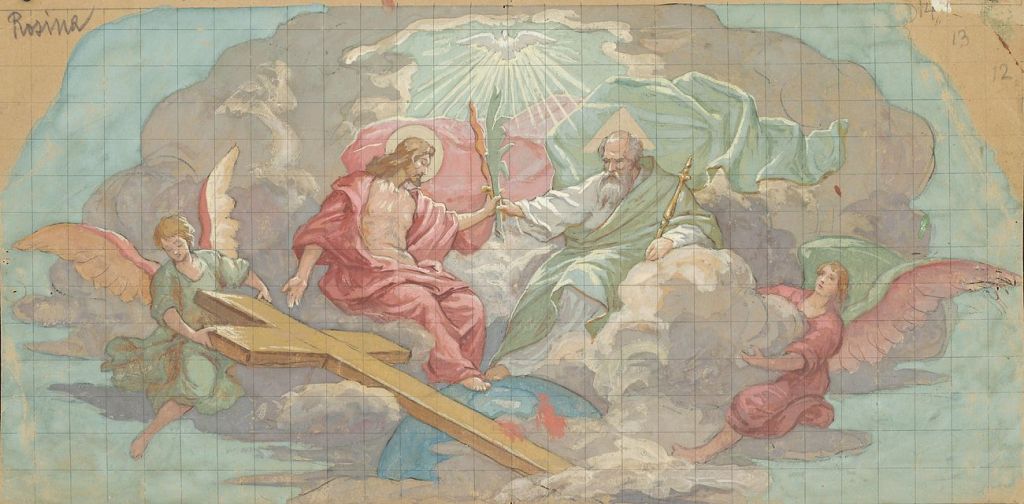
    The doctrine of salvation underscores the unity, sovereignty, and active involvement of the Father, Son, and Holy Spirit in bringing about the redemption of mankind. Let us explore the Trinitarian nature of salvation and the distinct roles each person of the Trinity plays in this divine mission

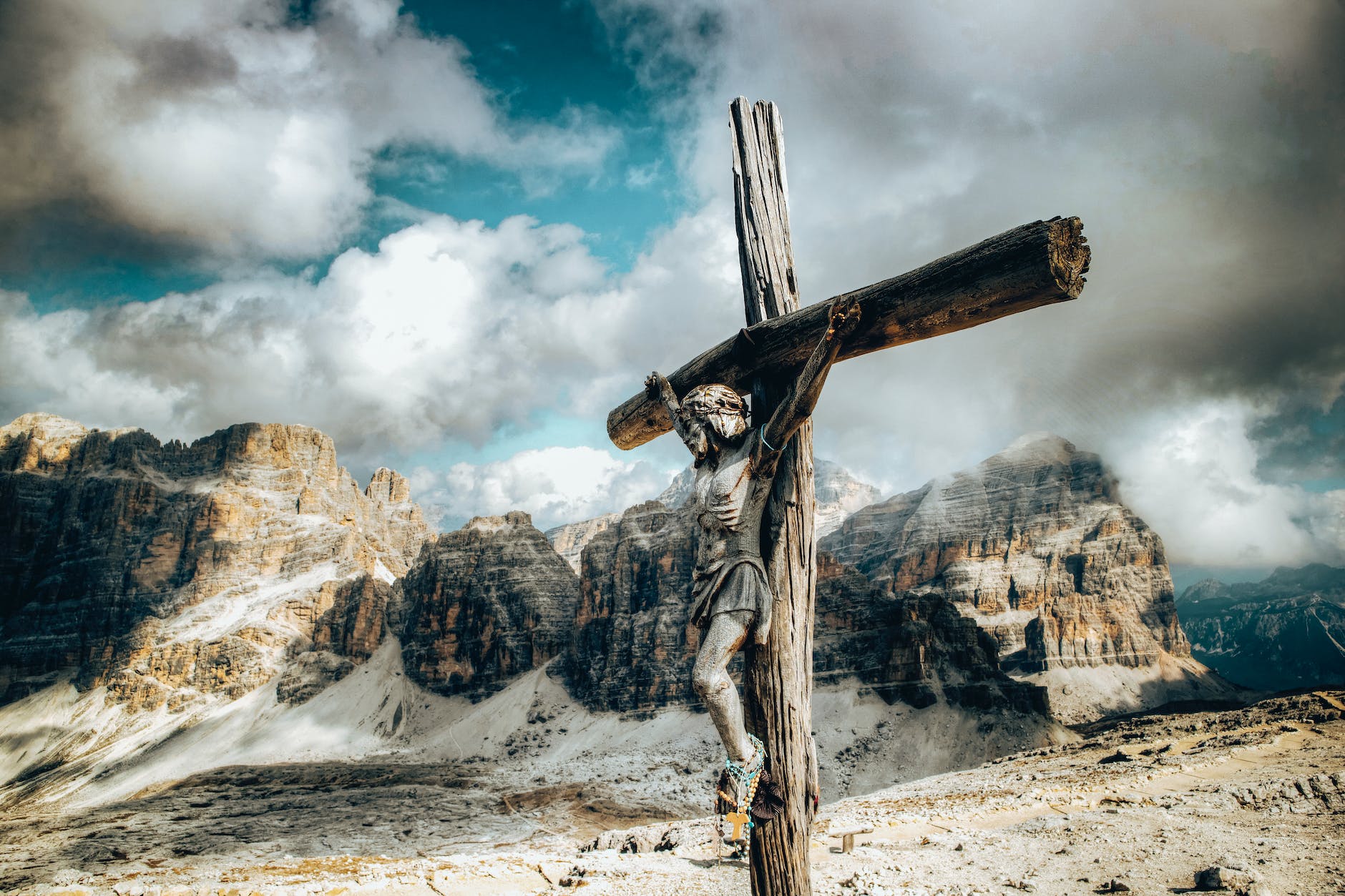
    a wooden crucifix against the rock mountains
    Photo by eberhard grossgasteiger on Pexels.com

    PERSON: The Father

    SALVATION: Sovereign Election/Choice

    “But we ought always to give thanks to God for you, brothers beloved by the Lord, because God chose you as the firstfruits to be saved, through sanctification by the Spirit and belief in the truth.”

    – 2 Thessalonians 2:13

    Salvation’s essence resides in the Father’s unwavering choice and election of individuals. Long before the world’s inception, the Father, in His boundless grace, deliberately chose a people for Himself. This divine selection was not based on their merits, but solely rooted in His infinite mercy and divine decree. As the driving force behind salvation, the Father sets the stage for the magnificent unfolding of His redemptive plan.

    The Father, being the ultimate source and architect of salvation, assumes a paramount role in the Trinity of Salvation. It is He who, guided by His sovereign will and overflowing grace, elects and distinguishes individuals for redemption. The Father’s immeasurable love and grand design establish the unshakable groundwork for the majestic unveiling of salvation’s divine purpose.

    PERSON: The Son

    SALVATION: Perfect Redemption

    “For even the Son of Man came not to be served but to serve, and to give his life as a ransom for many.”

    – Mark 10:45

    The Son, Jesus Christ, plays a crucial role in the accomplishment of salvation. He obediently fulfills the demands of the law, living a flawless life that sets the standard for humanity. Through His sacrificial death on the cross, He offers Himself as a perfect and substitutionary atonement for the sins of the chosen ones. Rising triumphantly from the grave, He conquers sin and secures eternal life for those who place their trust in Him.

    The Son, Jesus Christ, holds a central position in the Trinity of Salvation. He willingly takes on human form, becoming the perfect mediator between God and humanity. Through His incarnation, life, death, and resurrection, Jesus achieves redemption for the chosen ones. His sacrificial death on the cross serves as the ultimate atonement for sin, providing forgiveness and reconciliation with God.

    PERSON: Holy Spirit

    SALVATION: Transformation

    “And I will give you a new heart, and a new spirit I will put within you. And I will remove the heart of stone from your flesh and give you a heart of flesh. And I will put my Spirit within you, and cause you to walk in my statutes and be careful to obey my rules.”

    – Ezekiel 36:26-27

    Completing the Trinity of Salvation is the Holy Spirit. The Spirit is the one who applies the work of Christ to the hearts of individuals. Through the regenerating power of the Holy Spirit, the elect are given new life, enabling them to have faith in Jesus Christ and repent of their sins. The Spirit sanctifies believers, empowering them to grow in holiness and conform to the image of Christ.

    The Holy Spirit, the third person of the Trinity, plays a transformative role in salvation. He regenerates the hearts of the chosen ones, granting them new life and a disposition inclined towards God. Through His work, the Holy Spirit enables individuals to have unwavering faith in Jesus Christ, bestowing the remarkable gift of salvation. He continuously sanctifies believers, decisively conforming them to the image of Christ and empowering them to live a life abundantly pleasing to God.

    Together, the Father, Son and Holy Spirit work harmoniously in the Trinity of Salvation.

    “Go therefore and make disciples of all nations, baptizing them in the name of the Father and of the Son and of the Holy Spirit.”

    – Matthew 28:19

    The Father initiates and chooses, the Son accomplishes redemption, and the Holy Spirit applies and empowers. Their unified work reveals the depth of God’s love, grace, and mercy towards humanity, showcasing the intricate and divine interplay within the Trinity itself.

  • Evil Forces- Unconscious Mind

    Evil Forces- Unconscious Mind

    To be unconscious is to be lacking spiritual understanding & discernment, as if in a state of spiritual sleep.

    Pertaining to behavior or experience not controlled by the ego.The part of the mind, mental functioning, or personality not in the immediate field of awareness.

    McGraw-Hill Dictionary of Scientific & Technical Terms

    The Realm of Spirit, the dark canyons of human existence… Only the Spirit holds the wisdom to know & understand the things of the Spirit.

    “God has revealed the things of the spirit to us …
    … by his Spirit …
    The Spirit searches all things…
    even the deep things of God.

    who knows a person’s thoughts except their own spirit within them? In the same way: no one knows the thoughts of God except the Spirit of God.”

    1 Corinthians 2:10-11

    The depths of the subconscious mind contain a sacred essence, intricately woven with our soul’s essence.

    It is within this realm that darkness resides, symbolizing the presence of Satan, the adversary, the one who confuses.

    Satan operates in the darkness, seeking to cause separation among all that is whole.

    “But your iniquities have separated you from your God; your sins have hidden his face from you, so that he will not hear.”

    Isaiah 59:2

    Mind & Spirituality

    The depths of the unconscious mind are interconnected with our spiritual nature. The presence of both light and darkness are within the unconscious mind, symbolizing good and evil forces.

    Satan and Separation

    Satan is the adversary, representing darkness and seeking to create separation among individuals. This is in line with the traditional Christian belief that Satan is a malevolent spiritual entity opposed to God and goodness.

    Human Sinfulness

    Human sinfulness, is rooted in the biblical narrative of Adam and Eve’s disobedience. All human beings are born with a sinful nature, leading to selfishness, rebellion, and separation from God.

    Broken Relationships

    The inherent sinfulness leads to fractured relationships with both God and other people. This brokenness is attributed to our sinful nature, causing a divide between humanity and the perfect and holy nature of God.

    Influence of Thoughts and Words

    The impact of sinful thoughts and words can distance individuals from a harmonious relationship with God and others. It emphasizes the power of words to build up or tear down and the role of thoughts in shaping behavior.

    Ego and Inner Child

    An “ego of a child” can control an individual who has not achieved integration. Unresolved childhood trauma and the consequences of such experiences on an individual’s psyche.

    God’s Presence and Guidance

    There is a recurring theme of God’s presence and support in times of pain and turmoil. Biblical verses are cited to underscore the importance of guarding one’s heart and recognizing the spiritual battle against unseen forces.

    Deceptive Nature of Satan

    References the deceptive nature of Satan, who can masquerade as an angel of light, luring individuals away from the path of righteousness.

    brunette woman in top with necklace

    In the Bible, it is stated that all human beings are sinful and none are truly good, not even one. The concept of “good” here refers to being holy.

    Integration Is Holy

    To be holy means: to be complete, whole, and integrated.

    Every person carries fragments of themselves hidden within the deep crevices of their minds, concealing their true selves in the shadows of their subconscious.

    The Bible teaches that sin entered the world through the disobedience of Adam and Eve, marking the fall of humanity from its original state of holiness and communion with God.

    As a result, all human beings are born with a sinful nature, inclined towards selfishness, rebellion, and separation from God.

    This inherent sinfulness manifests in various ways in our thoughts, words, and actions, leading to a broken relationship with both God and others.

    The inherent sinfulness within us permeates our thoughts, words, and actions, resulting in a fractured relationship with both God and our fellow human beings.

    This brokenness is a consequence of our sinful nature, which separates us from the perfect and holy nature of God.

    Our thoughts, often tainted by selfishness, pride, and impure desires, can lead us astray from God’s truth and wisdom. We may entertain thoughts of envy, greed, or lust, which ultimately distance us from a harmonious relationship with God and others.

    Our words, influenced by sin, can deceive, hurt, or manipulate others, causing division. Their power can build up or tear down, encourage or discourage, heal or wound.

    When one is not integrated, they are under the control of a child’s ego.

    This refers to being consumed by the ego of a child, seeking solace from the pain of rejection that was inflicted upon them. The experiences that lead to this bewildering state are twisted, unholy, and depraved. A child may be forced to enact actions such as hating, dividing, severing, and locking away certain aspects of their psyche, all in an attempt to soothe the one who should have provided comfort.

    Instead of guiding the child towards healthy functionality, they are left to navigate the turmoil caused by dissociation, resulting from the traumatic experiences imposed upon them by adults. These experiences hinder the child’s ability to understand basic concepts such as colors, numbers, and emotions. Being thrust into the center of adult dysfunction and being subjected to adult problems is a form of torture for a child, regardless of how it may compare to other difficult situations.

    The adult who should have loved and nurtured the child instead manipulates them to love the parent more, while simultaneously denying their memories, gaslighting them, and depriving them of the truth. The inner child is pushed deeper into the shadows, mirroring the same treatment the parent received in their own upbringing. This cycle perpetuates, resulting in an adult who doesn’t need to be as broken as they have become. It now becomes the individual’s responsibility to pick up the shattered pieces of themselves.

    God sees this pain and turmoil, and He is present to offer guidance and support. As the Bible says in Proverbs 4:23:

    “Above all else, guard your heart, for everything you do flows from it.”

    This verse highlights the importance of being mindful of what we allow into our hearts and minds, as our thoughts and emotions deeply influence our actions and behaviors.

    Additionally, Ephesians 6:12 reminds us that our struggle is not merely against other human beings, but against the spiritual forces of evil in the heavenly realms.

    This passage suggests the existence of unseen spiritual forces at work in the world and emphasizes the need for vigilance in protecting ourselves from their influence.

    Satan possesses the ability to control the unconscious mind, as mentioned in various passages of the Bible. In 2 Corinthians 11:14, it is stated, “And no wonder, for Satan himself masquerades as an angel of light.” Satan can appear as something good or desirable, deceiving us in the process.

    The depth of the unconscious mind intertwines with our spiritual nature. It is important to guard our hearts and minds, being mindful of the influences we allow.

    The struggle we face extends beyond the physical realm, involving unseen spiritual forces. Satan has the ability to manipulate and deceive, appearing as something appealing to lead us astray.

  • Spiritual Adultery

    Spiritual Adultery

    Adultery is but a shadow or an Exoteric archetype corresponding with Spiritual Infidelity

    Spiritual adultery is putting anything above the Spirit.

    It is the violation of the sacred Unity between the individual and their Divinity in Heaven.

    It is a betrayal of love, betrayal of grace, and rejection of guidance that God has.

    Just as physical adultery usually damages the trust and intimacy between mates in a union, this isn’t the point, it is the example leading to the point.

    Spiritual adultery damages the intimacy and trust in the relationship between you and yourself, even worse it cuts you off from the God of your soul.

    You can no longer comprehend him as his voice no longer guides you as you have severed that aspect of yourself off.

    MATERIAL WORLD IS TRANSIENT

    Jesus told his followers that the physical world is transient but the spiritual realities He taught about are Eternal.

    ALLEGORICAL COMPREHENSION REVEALS PROFUNDITY

    Throughout scripture, physical phenomena are regularly used as allegories for profound spiritual truths.

    The prophets and apostles understood this well, as their writings are rich with metaphor and symbolism.

    Even acts as serious as adultery have deeper layers of significance, as both the prophets and Christ himself indicated.

    When God called Israel his wife through the prophets Jeremiah and Isaiah, he was illuminating profound mystical realities about humankind’s relationship with the divine. As James wrote, friendship with “the world” makes us enemies of God – and the “world” here refers not just to physical places and people, but the desires and allurements that captivate our hearts and minds.

    By understanding the earthly realities Jesus and the prophets spoke of as representatives of higher spiritual realities, we penetrate beneath surface meanings. We see how God was trying to warn Israel, and all humanity, about straying from intimate connection with our divine Source. Physical adultery reflects humanity’s natural tendency to replace love for God with love of lesser, temporary things that cannot satisfy our souls.

    Christ came to lift our eyes above earthly distractions, to the eternal spiritual verities of which our physical, temporary experiences are but pale foreshadowings. When we discern the fullness of meaning behind biblical passages, we find profound wisdom for nurturing an enduring marriage of spirit with God. May this deeper perspective guide us to cherish what truly endures, now revealed without a veil.

    RESOURCES

    ‡ Jeremiah 3:20- Surely, as a treacherous wife leaves her husband, so have you been treacherous to Me, O house of Israel, declares the LORD.’ ”

    ‡ Isaiah 1:21- How the faithful city has become a whore, she who was full of justice! Righteousness lodged in her, but now murderers.

    ‡ Isaiah 54:5- Your Maker is your husband, the LORD of hosts is His name; and the Holy One of Israel is your Redeemer, the God of the whole earth He is called.

    ‡ Isaiah 57:8- Behind the door and the doorpost you have set up your memorial; for, deserting Me, you have uncovered your bed, you have gone up to it, you have made it wide; and you have made a covenant for yourself with them, you have loved their bed, you have looked on nakedness.

    ‡ James 4:4,5- You adulterous people! Do you not know that friendship with the world is enmity with God? Therefore whoever wishes to be a friend of the world makes himself an enemy of God. Or do you suppose it is to no purpose that the Scripture says, “He yearns jealously over the spirit that He has made to dwell in us”?

    ‡ Revelation 17:5- And on her forehead was written a name of mystery: “Babylon the great, mother of prostitutes and of earth’s abominations.”

    ★ 1 John 2:15,16-

    Do not love the world or the things in the world. If anyone loves the world, the love of the Father is not in him. For all that is in the world—the desires of the flesh and the desires of the eyes and pride of life—is not from the Father but is from the world.

    ‡ Colossians 3:2- Set your minds on things that are above, not on things that are on earth.★

  • Divine Sovereignty

    Divine Sovereignty

    God’s Order in All Things

    Divine discernment: The ability to understand and perceive God’s will.

    God’s sovereignty: God’s complete authority and control over everything.

    Spiritual: Pertaining to the non-physical and transcendent aspects of existence.

    Time and space: Dimensions in which events occur and are measured

    Providence: God’s guidance and care over all creation.

    Wisdom: The ability to make sound judgments based on knowledge and understanding.

    Solace: Comfort or consolation in times of distress or sorrow.

    Finding Divine Discernment & Solace in His Guidance

    In the realm of divine discernment, we delve into the profound understanding of God’s sovereignty and the intricate balance between the physical and the spiritual.

    We explore the notion that God’s complete sovereignty extends to every aspect of His creation, from the tiniest details to the grandest cosmic events.

    This sovereignty not only encompasses the orderly progression of events but also the purposeful disruption of order to fulfill His ultimate plan.

    It is essential to recognize that God’s sovereignty transcends the boundaries of time and space.

    He has already ordained and purposed every action that takes place, as revealed through His prophetic word.

    By acknowledging His complete control, we align ourselves with the divine order established by God.

    Contrary to the notion that the physical world operates independently of the spiritual realm, we understand that all temporal and material aspects of existence are subject to God’s divine power.

    Nothing exists outside of His providential oversight. To deny this truth is to deny the very purpose of God’s account.

    God, as the epitome of order, orchestrates the intricate chain of events necessary to accomplish His divine plan.

    Even in the midst of apparent disorder, we can discern His guiding hand.

    He uses disruptions and challenges to bring everything into subjugation to Himself.

    In His wisdom, God employs disorder as a means to ultimately overcome death itself.

    burning candles at praying place in church

    Let us embrace the profound truth that God’s sovereignty extends to every facet of our lives.

    He holds the reins of creation, bringing order out of chaos and fulfilling His divine purpose.

    By recognizing His sovereignty, we align ourselves with His plan and find solace in the knowledge that every aspect of our existence is governed by His loving hand.

    Scripture

    1. Proverbs 3:5-6 – “Trust in the LORD with all your heart, and do not lean on your own understanding. In all your ways acknowledge him, and he will make straight your paths.”
    2. Romans 8:28 – “And we know that for those who love God all things work together for good, for those who are called according to his purpose.”
    3. Psalm 139:16 – “Your eyes saw my unformed substance; in your book were written, every one of them, the days that were formed for me, when as yet there was none of them.”
    4. Isaiah 46:9-10 – “Remember the former things of old; for I am God, and there is no other; I am God, and there is none like me, declaring the end from the beginning and from ancient times things not yet done, saying, ‘My counsel shall stand, and I will accomplish all my purpose.’”
    5. Proverbs 2:6 – “For the LORD gives wisdom; from his mouth come knowledge and understanding.”
    6. Psalm 34:17-18 – “When the righteous cry for help, the LORD hears and delivers them out of all their troubles. The LORD is near to the brokenhearted and saves the crushed in spirit.”
  • Law Of Materiality VS Spirit

    Law Of Materiality VS Spirit

    Christ is the fulfillment of the law, bringing righteousness to all who believe in Him.

    He, through His Death, revealed the essence of the shadow’s Truth in Life—the Law is the shadow.

    Before Faith came (Faith is Christ), we were held captive (by sin) under the law, imprisoned until the coming Faith would be revealed.

    Faith was Revealed in Christ.

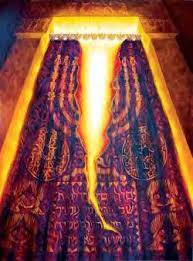
    Christ was revealed; He removed the veil that kept contained the Secret of the true Spiritual dimension, the Heavenly treasures—the Ethereal law…

    There is REAL Peace in His Spirit.

    He Himself is our peace, bringing Unity between The Father and His children through Christ…

    He has broken down in His own sinless flesh the separating wall of hostility and opposition between God and us, His people, by abolishing the law of commandments expressed in ordinances…

    Fisher Digital Publications
    Tearing of the Temple Curtain

    (Expressed in ordinances is how human ACTS) Ordinances are expressed through bodily effort. God got rid of the law of commandments that are expressed with the flesh (the material), but not the law of commands, as He intended from the Spirit. That’s why Paul says over and over: “with the Law of the Spirit”

    In the book of John, Jesus said the flesh is of no profit.

    The Law, being instigated or initiated in the flesh (because the flesh is full of evil), is there to keep us stuck in this dimension (unable to expand into the Heavenly Realm because if we did, we would have been utterly destroyed). We were for a period unable to see the things of God. The law that kept us in constant shame was actually our guardian until Christ came. God gave us the Law as a guardian in order that we might be justified by faith. But now that faith has come, we are no longer under a guardian, for in Christ all who believe are sons of God, through faith.

    Many think God is evil for having His son come down to suffer and die, but that is the only way the flesh – the material – can be reconciled with one another. So Jesus was appointed to go on the cross and take in His flesh and unworthy death, taking what we deserve, so that His Father may be pleased because that’s the only way flesh can be reconciled with Spirit. He might create in Himself one new man in place of the two, so making peace…

    Who do we think we are, being literally matter, physical, temporal, telling the creator of ALL things is wrong or evil? He knows what needs to take place, He did create it. Formulate every formula.

    Bear one another’s burdens, and so fulfill the law of Christ. But now we are released from the law, having died to that which held us captive, so that we serve in the new way of the Spirit and not in the old way of the written code.

    He saved us, not because of works done by us in righteousness, but according to His own mercy, by the washing of regeneration and renewal of the Holy Spirit, so that being justified by His grace we might become heirs according to the hope of eternal life. Titus 3:5‭, ‬7

    So too at the present time, there is a remnant chosen by grace. But if it is by grace, it is no longer on the basis of works; otherwise, grace would no longer be grace. Yet we know that a person is not justified by works of the law but through faith in Jesus Christ, so we also have believed in Christ Jesus, in order to be justified by faith in Christ and not by works of the law because by works of the law, no one will be justified. I do not nullify the grace of God, for if righteousness were through the law, then Christ died for no purpose.

    Galatians 2:16‭, ‬21

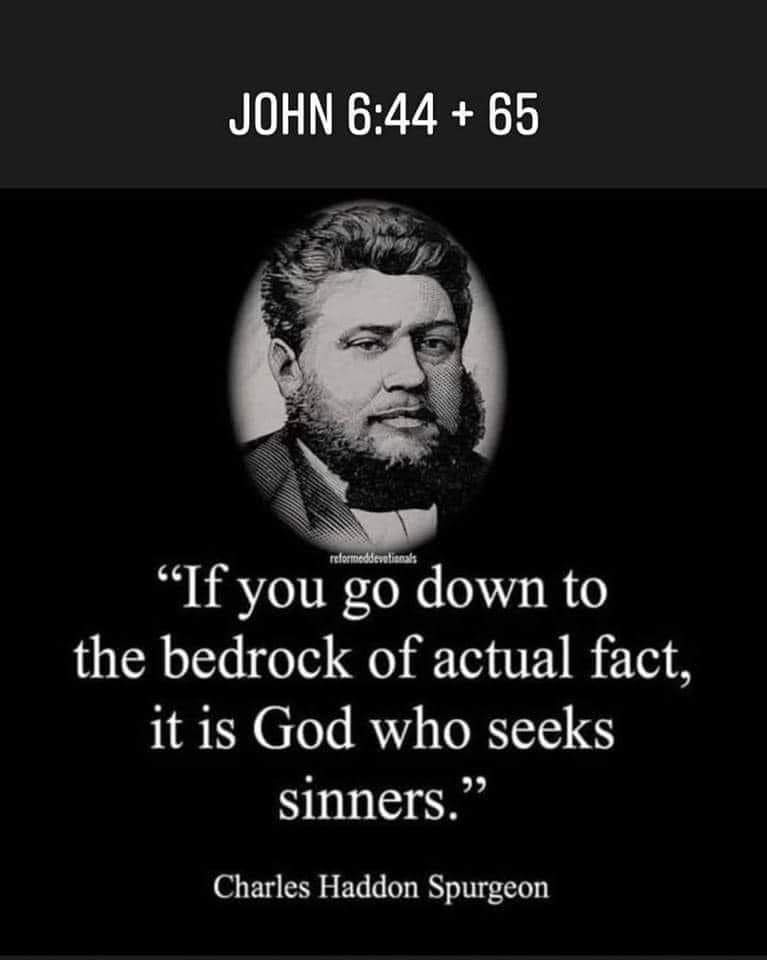
  • Divine Sovereignty by Charles Haddon Spurgeon

    Divine Sovereignty by Charles Haddon Spurgeon

    Click To Read Original Text:

    Divine Sovereignty
    by Charles Haddon Spurgeon
    May 4, 1856
    Source: New Park Street Pulpit Volume 2

    Divine Sovereignty

    “Is it not lawful for me to do what I will with mine own? —Matthew 20:15

     The householder says, "Is it not lawful for me to do what I will with mine own?" and even so does the God of heaven and earth ask this question of you this morning. "Is it not lawful for me to do what I will with mine own?" There is no attribute of God more comforting to his children than the doctrine of Divine Sovereignty. Under the most adverse circumstances, in the most severe troubles, they believe that Sovereignty hath ordained their afflictions, that Sovereignty overrules them, and that Sovereignty will sanctify them all. There is nothing for which the children of God ought more earnestly to contend than the dominion of their Master over all creation—the kingship of God over all the works of his own hands—the throne of God, and his right to sit upon that throne. On the other hand, there is no doctrine more hated by worldlings, no truth of which they have made such a foot-ball, as the great, stupendous, but yet most certain doctrine of the Sovereignty of the infinite Jehovah. Men will allow God to be everywhere except on his throne. They will allow him to be in his workshop to fashion worlds and to make stars. They will allow him to be in his almonry to dispense his alms and bestow his bounties. They will allow him to sustain the earth and bear up the pillars thereof, or light the lamps of heaven, or rule the waves of the ever-moving ocean; but when God ascends his throne, his creatures then gnash their teeth; and when we proclaim an enthroned God, and his right to do as he wills with his own, to dispose of his creatures as he thinks well, without consulting them in the matter, then it is that we are hissed and execrated, and then it is that men turn a deaf ear to us, for God on his throne is not the God they love. They love him anywhere better than they do when he sits with his sceptre in his hand and his crown upon his head. But it is God upon the throne that we love to preach. It is God upon his throne whom we trust. It is God upon his throne of whom we have been singing this morning; and it is God upon his throne of whom we shall speak in this discourse. I shall dwell only, however, upon one portion of God's Sovereignty, and that is God's Sovereignty in the distribution of his gifts. In this respect I believe he has a right to do as he wills with his own, and that he exercises that right.
    
     We must assume, before we commence our discourse, one thing certain, namely, that all blessings are gifts and that we have no claim to them by our own merit. This I think every considerate mind will grant. And this being admitted, we shall endeavour to show that he has a right, seeing they are his own to do what he wills with them—to withhold them wholly as he pleaseth—to distribute them all if he chooseth—to give to some and not to others—to give to none or to give to all, just as seemeth good in his sight. "Is it not lawful for me to do what I will with mine own?"
    
     We shall divide God's gifts into five classes. First, we shall have gifts temporal; second, gifts saving; third gifts honourable; fourth, gifts useful; and fifth, gifts comfortable. Of all these we shall say, "Is it not lawful for me to do what I will with mine own?"
    
     I. In the first place then, we notice GIFTS TEMPORAL. It is an indisputable fact that God hath not, in temporal matters, given to every man alike; that he hath not distributed to all his creatures the same amount of happiness or the same standing in creation. There is a difference. Mark what a difference there is in men personally (for we shall consider men chiefly); one is born like Saul, a head and shoulders taller than the rest—another shall live all his life a Zaccheus—a man short of stature. One has a muscular frame and a share of beauty—another is weak, and far from having anything styled, comeliness. How many do we find whose eyes have never rejoiced in the sunlight, whose ears have never listened to the charms of music, and whose lips have never been moved to sounds intelligible or harmonious. Walk through the earth and you will find men superior to yourself in vigour, health, and fashion, and others who are your inferiors in the very same respects. Some here are preferred far above their fellows in their outward appearance, and some sink low in the scale and have nothing about them that can make them glory in the flesh. Why hath God given to one man beauty and to another none? to one all his senses, and to another but a portion? why, in some, hath he quickened the sense of apprehension, while others are obliged to bear about them a dull and stubborn body? We reply, let men say what they will, but no answer can be given except this, "Even so, Father, for so it seemed good in thy sight." The old Pharisees asked, "Did this man sin or his parents, that he was born blind?" We know that there was neither sin in parents nor child, that he was born blind, or that others have suffered similar distresses, but that God has done as it has pleased him in the distribution of his earthly benefits, and thus hath said to the world, "Is it not lawful for me to do what I will with mine own?"
    
     Mark, also, in the distribution of mental gifts, what a difference exists. All men are not like Socrates; there are but few Platos; we can discover but here and there a Bacon; we shall but every now and then converse with a Sir Isaac Newton. Some have stupendous intellects wherewith they can unravel secrets—fathom the depths of oceans—measure mountains—dissect the sunbeams, and weigh the stars. Other have but shallow minds. You may educate and educate, but can never make them great. You cannot improve what is not there. They have not genius, and you cannot impart it. Anybody may see that there is an inherent difference in men from their very birth. Some, with a little education do surpass those who have been elaborately trained. There are two boys, educated it may be in the same school, by the same master, and they shall apply themselves to their studies with the same diligence, but yet one shall far outstrip his fellow. Why is this? Because God hath asserted his sovereignty over the intellect as well as the body. God hath not made us all alike, but diversified his gifts. One man is as eloquent as Whitfield; another stammers if he but speaks three words of his mother tongue. What makes these various differences between man and man? We answer, we must refer it all to the Sovereignty of God, who does as he wills with his own.
    
     Note, again, what are the differences of men's conditions in this world. Mighty minds are from time to time discovered in men whose limbs are wearing the chains of slavery, and whose backs are laid bare to the whip—they have black skins, but are in mind vastly superior to their brutal masters. So, too, in England; we find wise men often poor, and rich men not seldom ignorant and vain. One comes into the world to be arrayed at once in the imperial purple—another shall never wear aught but the humble garb of a peasant. One has a palace to dwell in and a bed of down for his repose, while another finds but a hard resting-place, and shall never have a more sumptuous covering than the thatch of his own cottage. If we ask the reason for this, the reply still is, "Even so, Father, for so it seemed good in thy sight." So, in other ways you will observe in passing through life how sovereignty displays itself. To one man God giveth a long life and uniform health, so that he scarcely knows what it is to have day's sickness, while another totters through the world and finds a grave at almost every step, feeling a thousand deaths in fearing one. One man, even in extreme old age, like Moses, has his eye undimmed; and though his hair is grey, he stands as firmly on his feet as when a young man in his father's house. Whence, again, we ask is the difference? And the only adequate answer is, it is the effect of Jehovah's Sovereignty. You find, too, that some men are cut off in the prime of their life—the very midst of their days—while others live beyond their threescore years and ten. One departs before he has reached the first stage of existence, and another has his life lengthened out until it becomes quite a burden; we must, I conceive, necessarily trace the cause of all these differences in life to the fact of God's Sovereignty. He is Rule and King, and shall he not do as he wills with his own.
    
     We pass from this point—but before we do so we must stop to improve it just a moment. O thou who art gifted with a noble frame, a comely body, boast not thyself therein, for thy gifts come from God. O glory not, for if thou gloriest thou becomest uncomely in a moment. The flowers boast not of their beauty; be exalted ye sons of comeliness; and O ye men of might and intellect, remember, that all you have is bestowed by a Sovereign Lord; he did create; he can destroy. There are not many steps between the mightiest intellect and the helpless idiot—deep though verges on insanity. Thy brain may at any moment, be smitten, and thou be doomed henceforth to live a madman. Boast not thyself of all that thou knowest, for even the little knowledge thou hast has been given thee. Therefore, I say, exalt not thyself above measure, but use for God what God has given thee, for it is a royal gift, and thou shouldst not lay it aside. But if the Sovereign Lord has given thee one talent, and no more, lay it not up in a napkin, but use it well, and then it may be that he will give thee more. Bless God that thou hast more than others, and thank him also that he has given thee less than others, for thou hast less to carry on thy shoulders; and the lighter thy burden the less cause wilt thou have to groan as thou travellest on towards the better land. Bless God then if thou possessest less than thy fellows, and see his goodness in withholding as well as in giving.
    
     II. So far most men probably have gone with us; but when we come to the second point, GIFTS SAVING, there will a large number who will go from us because they cannot receive our doctrine. When we apply this truth regarding the Divine Sovereignty to man's salvation, then we find men standing up to defend their poor fellow creatures whom they conceive to be injured by God's predestination. But I never heard of men standing up for the devil; and yet I think if any of God's creature have a right to complain of his dealings it is the fallen angels. For their sin they were hurled from heaven at once, and we read not that any message of mercy was ever sent to them. Once cast out, their doom was sealed; while men were respited, redemption sent into their world, and a large number of them chosen to eternal life. Why not quarrel with Sovereignty in the one case as well as the other. We say that God has elected a people out of the human race, and his right to do this is denied. But I ask, why not equally dispute the fact that God has chosen men and not fallen angels, or his justice in such a choice. If salvation be a matter of right, surely the angels had as much claim to mercy as men. Were they not seated in more than equal dignity? Did they sin more? We think not. Adam's sin was so wilful and complete, that we cannot suppose a greater sin than that which he committed. Would not the angels who were thrust out of heaven have been of greater service to their Maker if restored, than we can ever be? Had we been the judges in this matter we might have given deliverance to angels but not to men. Admire then, Divine Sovereignty and love, that whereas the angels were broken into shivers, God hath raised an elect number of the race of men to set them among princes, through the merits of Jesus Christ our Lord.
    
     Note again, the Divine Sovereignty, in what God chose the Israelitish race and left the Gentiles for years in darkness. Why was Israel instructed and saved, while Syria was left to perish in idolatry? Was the one race purer in its origin and better in its character than the other? Did not the Israelites take unto themselves false gods a thousand times, and provoke the true God to anger and loathing? Why then, should they be favoured above their fellows? Why did the sun of heaven shine upon them while all around the nations were left in darkness, and were sinking into hell by myriads? Why? The only answer that can be given is this, that God is a Sovereign, and "will have mercy upon whom he will have mercy, and whom he will he hardeneth."
    
     So, now, also, why is it that God hath sent his word to us while a multitude of people are still without his word? Why do we each come up to God's tabernacle, Sabbath after Sabbath, privileged to listen to the voice of the minister of Jesus, while other nations have not been visited thereby? Could not God have caused the light to shine in the darkness there as well as here? Could not he, if he had pleased, have sent forth messengers swift as the light to proclaim his gospel over the whole earth? He could have done it if he would. Since we know that he has not done it, we bow in meekness, confessing his right to do as he wills with his own.
    
     But let me drive the doctrine home once more. Behold how God displays his Sovereignty in this fact, that out of the same congregation, those who hear the same minister, and listen to the same truth, the one is taken and the other left. Why is it that one of my hearers shall sit in yonder pew, and her sister by her side, and yet that the effect of the preaching shall be different upon each? They have been nursed on the same knee, rocked in the same cradle, educated under the same auspices, they hear the same minister, with the same attention—why is it that the one shall be saved and the other left? Far be it from us to weave any excuse for the man who is damned: we know of none: but also, far be it from us to take glory from God. We assert that God makes the difference—that the saved sister will not have to thank herself but her God. There shall even be two men given to drunkenness. Some word spoken shall pierce one of them through, but the other shall sit unmoved, although they shall, in all respects, be equally the same both in constitution and education. What is the reason? You will reply, perhaps, because the one accepts and the other rejects the message of the gospel. But must you not come back to the questions, who made the one accept it, and who made the other reject it? I dare you to say that the man made himself to differ. You must admit in your conscience that it is God alone to whom this power belongs. But those who dislike this doctrine are nevertheless up in arms against us; and they say, how can God justly make such a difference between the members of his family? Suppose a father should have a certain number of children, and he should give to one all his favors, and consign the others to misery—should we not say that he was a very unkind and cruel father? I answer, yes. But the cases are not the same. You have not a father to deal with, but a judge. You say all men are God's children; I demand of you to prove that. I never read it in my Bible. I dare not say, "Our father which art in heaven," till I am regenerated. I cannot rejoice in the fatherhood of God towards me till I know that I am one with him, and a joint heir with Christ. I dare not claim the fatherhood of God as an unregenerated man. It is not father and child—for the child has a claim upon its father—but it is King and subject; and not even so high a relation as that, for there is a claim between subject and King. A creature—a sinful creature, can have no claim upon God; for that would be to make salvation of works and not of grace. If men can merit salvation, then to save them is only the payment of a debt, and he gives them nothing more than he ought to give them. But we assert that grace must be distinguishing if it be grace at all. O, but some say is it not written that "He giveth to every man a measure of grace to profit withal?" If you like to repeat that wonderful quotation so often hurled at my head, you are very welcome, for it is no quotation from Scripture, unless it be an Arminian edition. The only passage at all like it refers to the spiritual gifts of the saints and the saints only. But I say, granted your supposition, that a measure of grace is given to every man to profit withal, yet he hath given to some a measure of particular grace to make that profit. For what do you mean by grace, which I put out, to profit? I can understand a man's improvement in the use of grace, but grace improved and made use of by the power of man I cannot comprehend. Grace is not a thing which I use; grace is something which uses me. But people talk of grace sometimes as if it was something they could use, and not as influence having power over them. Grace is something not which I improve, but which improves, employs me, works on me; and let people talk as they will about universal grace, it is all nonsense, there is no such thing, nor can there be. They may talk correctly of universal blessings, because we see that the natural gifts of God are scattered everywhere, more or less, and men may receive or reject them. It is not so, however, with grace. Men cannot take the grace of God and employ it in turning themselves from darkness to light. The light does not come to the darkness and say, use me; but the light comes and drives the darkness away. Life does not come to the dead man and say, use me, and be restored to life; but it comes with a power of its own and restores to life. The spiritual influence does not come to the dry bones and say, use this power and clothe yourselves with flesh; but it comes and clothes them with flesh, and the work is done. Grace is a thing which comes and exercises an influence on us.

    “The sovereign will of God alone
    Creates us heirs of grace;
    Born in the image of his Son,
    A new-created race.”

     And we say to all of you who gnash your teeth at this doctrine, whether you know it or not, you have a vast deal of enmity towards God in your hearts; for until you can be brought to know this doctrine, there is something which you have not yet discovered, which makes you opposed to the idea of God absolute, God unbounded, God unfettered, God unchanging, and God having a free will, which you are so fond of proving that the creature possesses. I am persuaded that the Sovereignty of God must be held by us if we would be in a healthy state of mind. "Salvation is of the Lord alone." Then give all the glory to his holy name, to whom all glory belongs.
    
     III. We now come, in the third place, to notice the differences which God often makes in his Church in HONOURABLE GIFTS. There is a difference made between God's own children—when they are his children. Note what I mean: One hath the honourable gift of knowledge, another knows but little. I meet, every now and then, with a dear Christian brother with whom I could talk for a month, and learn something from him every day. He has had deep experience—he has seen into the deep things of God—his whole life has been a perpetual study wherever he has been. He seems to have gathered thoughts, not from books merely, but from men, from God, from his own heart. He knows all the intricacies and windings of Christian experience: he understands the heights, the depths, the lengths, and the breadths of the love of Christ, which passeth knowledge. He has gained a grand idea, an intimate knowledge of the system of grace, and can vindicate the dealings of the Lord with his people.
    
     Then you must meet with another who has passed through many troubles, but he has no deep acquaintance with Christian experience. He never learned a single secret by all his troubles. He just floundered out of one trouble into another, but never stopped to pick up any of the jewels that lay in the mire—never tried to discover the precious jewels that lay in his afflictions. He knows very little more of the heights and depths of the Saviour's love than when he first came into the world. You may converse with such a man as long as you like, but you will get nothing from him. If you ask why is it, I answer, there is a Sovereignty of God in giving knowledge to some and not to others. I was walking the other day with an aged Christian, who told me how he had profited by my ministry. There is nothing humbles me like that thought of yon old man deriving experience in the things of God, receiving instruction in the ways of the Lord from a mere babe in grace. But I expect that when I am an old man, if I should live to be such, that some babe in grace will instruct me. God sometimes shutteth the mouth of the old man and openeth the mouth of the child. Why should we be a teacher to hundreds who are, in some respects, far more able to teach us? The only answer we can find is in the Divine Sovereignty, and we must bow before it, for has he not a right to do as he wills with his own? Instead of being envious of those who have the gift of knowledge, we should seek to gain the same, if possible. Instead of sitting down and murmuring that we have not more knowledge, we should remember that the foot cannot say to the head, nor the head to the foot, I have no need of thee, for God hath given us talents as it hath pleased him.
    
     Note, again, when speaking of honourable gifts. Not only knowledge, but office is an honourable gift. There is nothing more honourable to a man than the office of a deacon or a minister. We magnify our office, though we would not magnify ourselves. We hold there is nothing can dignify a man more than being appointed to an office in a Christian church. I would rather be a deacon of a church than Lord Mayor of London. To be a minister of Christ is in my estimation an infinitely higher honour than the world can bestow. My pulpit is to me more desirable than a throne, and my congregation is an empire more than large enough; an empire before which the empires of the earth dwindle into nothing in everlasting importance. Why does God give to one man a special call by the Holy Ghost, to be a minister, and pass by another? There is another man more gifted, perhaps, but we dare not put him in a pulpit, because he has not had a special call. So with the deaconship; the man whom some would perhaps think most suitable for the office is passed by, and another chosen. There is a manifestation of God's Sovereignty in the appointment to office—in putting David on a throne, in making Moses the leader of the children of Israel through the wilderness, in choosing Daniel to stand among princes, in electing Paul to be the minister to the Gentiles, and Peter to be the Apostle of the Circumcision. And you who have not the gift of honourable office, must learn the great truth contained in the question of the Master, "Is it not lawful for me to do what I will with mine own?"
    
     There is another honourable gift, the gift of utterance. Eloquence hath more power over men than all else besides. If a man would have power over the multitude, he must seek to touch their hearts, and chain their ears. There are some men who are like vessels full of knowledge to the brim, but having no means of giving it forth to the world. They are rich in all gems of learning but know not how to set them in the golden ring of eloquence. They can collect the choicest of flowers, but know not how to tie them up in a sweet garland to present them to the admirer's eye. How is this? We say again, the Sovereignty of God is here displayed in the distribution of gifts honourable. Learn here, O Christian man, if you have gifts, to cast the honour of them at the Saviour's feet, and if you possess them not, learn not to murmur; remember that God is equally as kind when he keepeth back as when he distributeth his favours. If any among you be exalted, let him not be puffed up; if any be lowly, let him not be despised; for God giveth to every vessel his measure of grace. Serve him after your measure, and adore the King of Heaven who doth as he pleaseth.
    
     IV. We notice in the fourth place, the gift of USEFULNESS. I have often done wrong in finding fault with brother ministers for not being useful, I have said you might have been as useful as I have been had you been in earnest. But surely there are others even more earnest, and more efficient: others labouring as constantly, but with far less effect. And, therefore, let me retract my accusation, and in lieu thereof assert that the gift of usefulness is the result of God's Sovereignty. It is not in man to be useful, but in God to make him useful. We may labour ourselves with all our might, but God alone can make us useful. We can put every stitch of canvass on when the wind blows, but we cannot make the wind blow.
    
     The Sovereignty of God is seen also in the diversity of ministerial gifts. You go to one minister and are fed with plenty of good food: another has not enough to feed a mouse; he has plenty of reproof, but no food for the child of God. Another can comfort the child of God, but he cannot reprove a backslider. He has not strength of mind enough to give those earnest home strokes which are sometimes needed. And what is the reason! God's Sovereignty. One can wield the sledge hammer but could not heal a broken heart. If he were to attempt it, you would be reminded of an elephant trying to thread a needle. Such a man can reprove, but he cannot apply oil and wine to a bruised conscience. Why? Because God hath not given to him the gift. There is another one who always preaches experimental divinity; and very rarely touches upon doctrine. Another is all doctrine, and cannot preach much about Jesus Christ and him crucified. Why? God hath not given him the gift of doctrine. Another always preaches Jesus—blessed Jesus; men of the Hawker school—and many say, oh! they do not give us experience enough; they do not go into the deep experiences of the corruption which vexes the children of God. But we do not blame them for this. You will notice that out of the same man will at one time flow streams of living water, while at another time he will be as dry as possible. On one Sabbath you go away refreshed by the preaching, and the next you get no good. There is Divine Sovereignty in all this, and we must learn to recognize and admire it. I was preaching on one occasion last week to a large crowd of people, and in one part of the sermon the people were very much affected; I felt that the power of God was there; one poor creature absolutely shrieked out because of the wrath of God against sin; but at another time the same words might have been uttered and there might have been the same desire in the minister's heart, and yet no effect produced. We must trace, I say, Divine Sovereignty in all such cases. We ought to recognize God's hand in everything. But the present is the most godless generation that ever trod this earth, I verily believe. In our fathers' days there was hardly a shower but they declared that God caused it to fall; and they had prayers for rain, prayers for sunshine, and prayers for harvest; as well when a haystack was on fire, as when a famine desolated the land; our forefathers said, the Lord hath done it. But now our philosophers try to explain everything, and trace all phenomena to second causes. But brethren, let it be ours to ascribe the origin and direction of all things to the Lord, and the Lord alone.
    
     V. Lastly, GIFTS COMFORTABLE are of God. O, what comfortable gifts do some of us enjoy in the ordinances of God's house, and in a ministry that is profitable. But how many churches have not a ministry of that kind; and why then have we? Because God hath made a difference. Some here have strong faith, and can laugh at impossibilities; we can sing a song in all ill weathers—in the tempest as well as in the calm. But there is another with little faith who is in danger of tumbling down over every straw. We trace eminent faith entirely to God. One is born with a melancholy temperament, and he sees a tempest brewing even in the calm; while another is cheerful, and sees a silver lining to every cloud, however black, and he is a happy man. But why is that? Comfortable gifts come of God. And then observe that we ourselves, differ at times. For a season we may have blessed intercourse with heaven, and be permitted to look within the veil? but anon, these delightful enjoyments are gone. But do we murmur on that account? May he not do as he will with his own? May he not take back what he has given? The comforts we possess were his before they were ours.

    “And shouldst thou take them all away,
    Yet would I not repine,
    Before they were possessed by me
    They were entirely thine.”

     There is no joy of the Spirit—there is no exceeding blessed hope—no strong faith—no burning desire—no close fellowship with Christ, which is not the gift of God, and which we must not trace to him. When I am in darkness and suffer disappointment, I will look up and say, he giveth songs in the night; and when I am made to rejoice, I will say, my mountain shall stand fast for ever. The Lord is a Sovereign Jehovah; and, therefore, prostrate at his feet I lie, and if I perish, I will perish there.
    
     But let me say, brethren, that so far from this doctrine of Divine Sovereignty making you to sit down in sloth, I hope in God it will have a tendency to humble you, and so to lead you to say, "I am unworthy of the least of all thy mercies. I feel that thou hast a right to do with me as thou wilt. If thou dost crush, a helpless worm, thou wilt not be dishonoured; and I have no right to ask thee to have compassion upon me, save this, that I want thy mercy. Lord, if thou wilt, thou art able to pardon, and thou never gavest grace to one that wanted it more. Because I am empty, fill me with the bread of heaven; because I am naked, clothe me with thy robe; because I am dead, give me life." If you press that plea with all your soul and all your mind, though Jehovah is a Sovereign, he will stretch out his sceptre and save, and thou shalt live to worship him in the beauty of holiness, loving and adoring his gracious Sovereignty. "He that believeth" is the declaration of Scripture "and is baptized, shall be saved; but he that believeth not shall be damned." He that believeth in Christ alone, and is baptized with water in the name of the Father, the Son, and the Holy Ghost, shall be saved, but he who rejecteth Christ and believeth not in him, shall be damned. That is the Sovereign decree and proclamation of heaven—bow to it, acknowledge it, obey it, and God bless you.

    Nothing More Comforting To Christians Than Divine Sovereignty

    In this text by Charles Spurgeon, he explores the concept of Divine Sovereignty. Spurgeon begins by emphasizing that there is nothing more comforting to believers than the doctrine of God’s sovereignty. He explains that even in adverse circumstances and severe troubles, believers trust that God’s sovereignty ordains and overrules their afflictions, ultimately sanctifying them.

    Divine Sovereignty Hated & Rejected

    Spurgeon acknowledges that the doctrine of Divine Sovereignty is greatly hated and rejected by many worldlings. He highlights that people are comfortable with acknowledging God’s presence and power in the creation of the world and the provision of blessings but become resistant when it comes to God’s sovereignty over His creation. Spurgeon asserts that believers, on the other hand, rejoice in and trust God’s sovereignty over all things.

    Gifts Not Distributed Equally

    The author then delves into the distribution of God’s gifts, dividing them into five categories: temporal, saving, honorable, useful, and comfortable. He argues that in temporal matters, God has not distributed blessings equally to all individuals. Some are born with physical advantages, while others may lack certain senses or physical attributes. Spurgeon attributes these differences to God’s sovereignty, explaining that God has the right to do as He pleases with His own.

    Varying Degrees Of Intelligence

    Regarding mental gifts, Spurgeon maintains that God has given varying levels of intellect to individuals. Similarly, in the distribution of worldly conditions, God has given some people more advantages and privileges than others. The author contends that all these differences are the result of God’s sovereign choices.

    God Chooses

    Moving on to the topic of saving gifts, Spurgeon tackles the controversial issue of God’s election and predestination. He points out that just as God chose to redeem fallen man and not the fallen angels, He also chose a specific people out of the human race for salvation. Spurgeon acknowledges the resistance and objections to this doctrine but emphasizes that God’s sovereignty in salvation should be acknowledged and respected.

    God’s Choice Should Not Be Questioned

    Spurgeon continues by exploring God’s sovereignty in choosing the Israelites over other nations to receive His instruction and salvation. He also reflects on why God chose certain individuals for His ministry and endowed them with specific gifts of knowledge, office, and utterance. Spurgeon asserts that these choices display God’s sovereignty and should not be questioned or disputed.

    Lastly, Spurgeon mentions the gift of usefulness and comforts in the lives of believers. He highlights that God, in His sovereignty, blesses some individuals with more faith, joy, and spiritual experiences than others. Spurgeon urges believers to humbly attribute all their gifts and blessings to God’s sovereign will.

    Overall, Spurgeon’s text emphasizes the divine authority and sovereignty of God in all aspects of life, including the distribution of gifts and salvation. He encourages believers to trust in God’s sovereignty and not to question or resist His choices but rather humbly submit to His will.