Healing, in an emotional context, refers to the process of recovering from emotional pain, trauma, or distress. It involves the acknowledgment of feelings, the understanding of experiences, and the gradual journey towards emotional well-being and resilience.
You thought apathy would be the rest stop. The place after the striving, after the perfecting, after the endless self-correction… a soft landing where nothing was required of you anymore.
But rest didn’t come. Only a different kind of vigilance.
A quieter one.
The kind that watches from behind the eyes, keeping the numbness intact, keeping the caring at bay.
You didn’t know it yet, but not-feeling is a job. It has hours. It has upkeep. It costs.
We speak of burnout as something born of overachievement… the perfectionist collapsing under her own impossible rules.
But there is a second kind of burnout, less spoken of, that comes from the opposite direction.
It is the exhaustion of holding yourself at a distance from your own life.
Of guarding the door so nothing gets in, and nothing gets out.
Survival mode does not feel like survival. It feels like sleep with your eyes open.
Here is the quiet truth beneath it all: apathy is not the absence of effort. It is effort in disguise.
Every time you told yourself it doesn’t matter, some part of you was working overtime to make that lie hold.
Every time you stopped trying, you were still trying… trying not to feel what trying might cost you.
So if you are tired, and you cannot explain why, since you have done “nothing,” look closer.
Nothing is not what you have been doing. You have been managing a collapse in slow motion, and it takes a strange, invisible strength to keep something from falling all the way down.
The rules and the ruin are not opposites. They are two hands on the same rope. Perfection pulls one way, apathy pulls the other, and you are the one standing in the middle, spending yourself either direction you turn.
Maybe the third way is neither. Maybe it is simply this: to stop managing, and start feeling.
To let the exhaustion finally mean something, instead of hiding it inside a performance of not caring.
You were never lazy. You were never weak.
You were just fighting a war no one could see… and calling it rest.
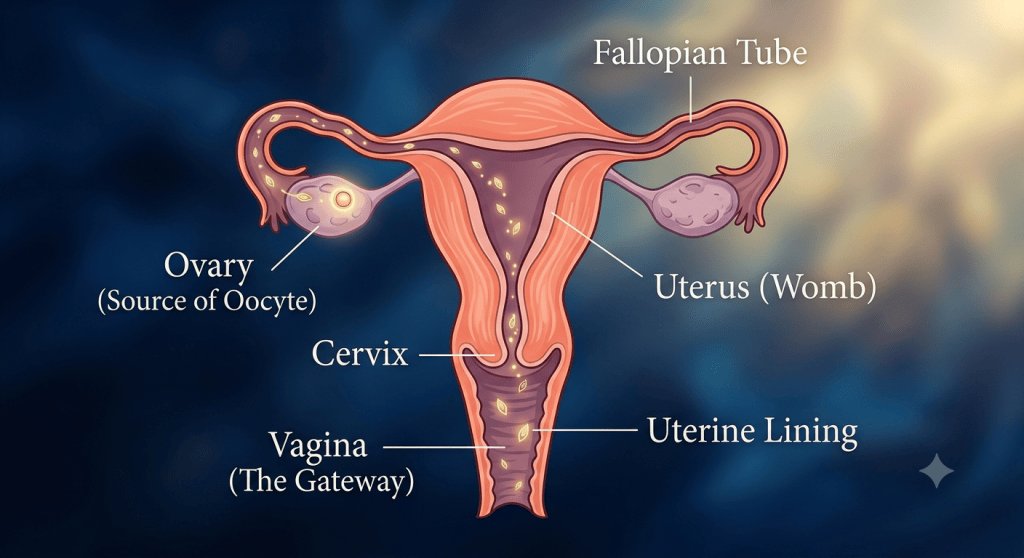
Its muscular walls expand remarkably to allow a baby to pass safely from the uterus into the world during childbirth.
The Menstrual Flow
It provides the necessary exit route for blood and tissue shedding from the uterine lining during menstruation.
Ovulation: Perfecting the Environment
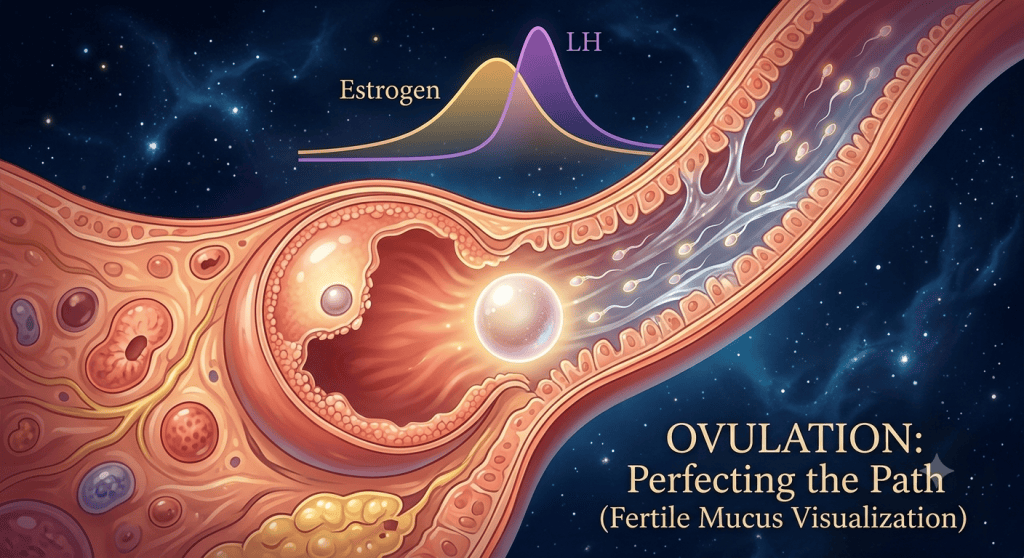
Reproduction cannot happen without the precise timing of ovulation—the release of an oocyte (egg) from the ovary.
This is the moment the body intentionally alters its own internal environment to cultivate life.
We must move past gross anatomy to visualize this perfected environment on a microscopic scale:
This process is governed by a strict, biological order of operations:
Hormonal Regulation
The cycle is commanded by an intricate hormonal dance.
Estrogen and progesterone rise and fall to regulate the maturation of the egg and to thicken the uterine lining, preparing it for the potential implantation of a fertilized egg.
The Fertile Window
Ovulation marks the most critical phase of a woman’s cycle.
Occurring near the midpoint, it is the brief, highly optimized timeframe where conception is biologically possible.
Cervical Mucus Transformation
As ovulation approaches, cervical mucus changes dramatically.
It becomes slippery, clear, and stretchy.
This creates a frictionless, nutrient-rich medium that protects sperm from natural acidity and physically helps propel them through the cervix toward the egg.
Increasing Pleasure and Bodily Ease
Pleasure is not merely a byproduct of human anatomy; it is deeply interwoven with biological success and physiological health. The mechanics of arousal and climax serve distinct, observable purposes.
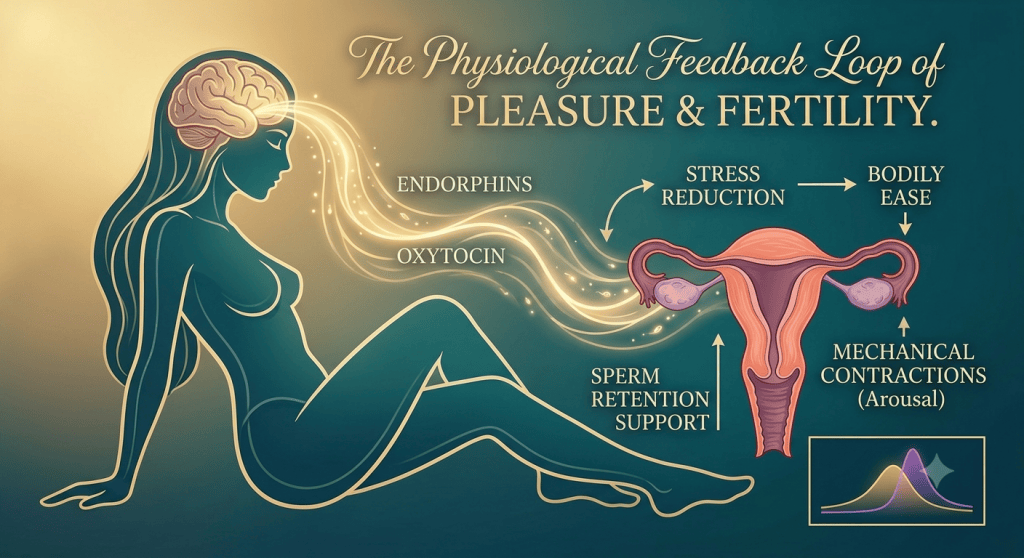
How do these less visible signals (hormones, contractions, relaxation) integrate into a system of ease?
We visualize this feedback loop:
Enhanced Fertility: Biological evidence suggests that the involuntary muscular contractions of the uterus and vagina during female orgasm may function as a retention mechanism, physically aiding the upward movement of sperm toward the egg.
Stress Reduction: Sexual activity and climax trigger a cascade of neurochemicals, including a massive release of endorphins. This chemical flood actively dismantles stress responses, promoting the deep physical relaxation required for an optimal, healthy reproductive environment.
Relational Bonding: Beyond the physical mechanics, shared sexual pleasure releases oxytocin—often called the “bonding hormone.” This cements emotional intimacy and trust between partners, which is a foundational element for overall relationship health and stability.
I plan to go much much deeper in the near future on this… stay tuned for part 2.
References & Source Material
Evolutionary Biology of Pleasure and Fertility
Baker, R.R., & Bellis, M.A. “Human Sperm Competition: Ejaculate Manipulation by Females and a Function for the Female Orgasm.” Animal Behaviour. This foundational paper introduces the mechanical reality of how female climax functions to selectively retain sperm and influence fertility.
Lloyd, Elisabeth A.The Case of the Female Orgasm: Bias in the Science of Evolution. A biological and philosophical critique breaking down the evolutionary arguments surrounding female pleasure, separating biological fact from cultural byproduct.
Gross, Rachel E.Vagina Obscura: An Anatomical Voyage. A heavily researched look at the female reproductive system that strips away outdated medical dogma, presenting the female body as an active, dynamic landscape. Mechanics of Ovulation and the Cervical Environment
Clinical Reproductive Anatomy & Physiology. Standard clinical references regarding Spinnbarkeit (the stretchability of cervical mucus) detail how estrogen transforms the cervix into a highly optimized biological pathway for sperm leading up to the fertile window.
The Billings Ovulation Method Clinical Studies. Research on natural fertility tracking providing extensive biological data on how cervical mucus changes daily in response to hormonal cascades, proving the body communicates its fertility status in real-time. Neurochemistry of Bonding and Ease
Peer-Reviewed Literature on Oxytocin and Bonding (e.g., Evolution and Human Behavior, Psychological Science). Studies detailing the specific hormonal flood during climax, documenting how oxytocin and endorphins actively dismantle cortisol (stress) and facilitate the deep physiological ease required for reproductive success and relational trust.
The Nature of Suffering: A Necessary Element of Existence
As much as we may wish otherwise, the reality is that suffering is an inescapable part of the human experience.
The age-old philosophical and religious observation that “life is suffering” points to a fundamental truth about the human condition.
Embracing Uncertainty and Impermanence
In the face of uncertainty and impermanence, we cultivate the qualities of empathy, humility, and inner strength that are vital for navigating the complexities of life.
It is through our struggles that we learn and grow, transforming our experiences into avenues for personal development.
Seeking Meaning in Suffering
Perhaps, in the end, it is not a life devoid of suffering that we should seek, but rather a life where suffering serves a purpose.
As Viktor Frankl articulated, fulfillment cannot be stripped of struggle; it is through confronting our darkest moments that we can truly experience the richness of life.
High vibration refers to a state of energy characterized by positive feelings, thoughts, and actions, in contrast to low vibration, which is linked to negativity and stress.
Vibrational Targets
People who resonate at a higher frequency often find themselves preyed upon by dark energies.
These negative forces can creep in, using manipulation and emotional depletion to exploit, brought about by those who carry unresolved pain.
This leaves a portal for a deep sense of weariness, causing emotional fatigue, as their bright light becomes a beacon for those who seek to drain their spirit.
PORTALS FOR LOW VIBRATIONAL FREQUENCIES TO ENTER:
1. Criticism & Gossip
High vibrational individuals, with their heightened awareness, can unintentionally stir unease in those around them.
As a result, they frequently endure harsh judgment and whispers behind their backs, feeling the weight of loneliness and misunderstanding.
This stems from deep-seated insecurity or a profound lack of understanding, as their genuine selves can seem like an unwelcome reminder to those who are not prepared to face their own inner struggles.
It’s a painful truth that the authenticity of some can evoke fear in others, revealing a heart-wrenching vulnerability that many are too afraid to acknowledge.
2. Isolation
Individuals with elevated vibrations frequently find themselves in a state of loneliness, as the profound depth of their awareness creates a chasm between them and others.
The struggle for connection leaves them feeling isolated and misunderstood, trapped in a world where their sensitivity and insight can be burdensome rather than a blessing.
3. Sadness
This profound disconnection weighs heavy on their hearts, leading to a sadness that lingers like a shadow, as they yearn for companionship that seems perpetually out of reach.
4. Naive Authenticity
Authentic energy forces others to face parts of themselves they may not want to see, leading to avoidance or rejection.
Their presence compels people to confront the darker corners of their souls, unearthing truths that are often too painful to acknowledge.
This can result in a heartbreaking tendency for others to turn away, retreating into denial or pushing them away in fear of vulnerability.
Protecting Energy
To maintain an elevated state of consciousness, you must prioritize self-care and boundary-setting.
This includes staying surrounded by those who share a similar energy and limiting interactions with those who drain or manipulate them.
While the journey of a high-vibrational person can lead to spiritual growth, it’s essential to acknowledge the difficulties they face, balancing their elevated state with the need for protection and self-preservation.
In my journey as an “alien” on this planet, I have, unwittingly, stumbled upon what had been archaically called the Philosopher’s Stone or the Elixir of Life…
I only realized this after I, through being magnetically attracted toward suffering, embracing the darkness that most fear, had unearthed the Essence of Reality.
This Essence is a Truth so profound, it is woven into the very core of our beings through the quantum dimensions & atmospheric pressure, without such, we would become vacuumed into nothingness.
This truth is unassailable, standing as a lamp of certainty, illuminated by the light of Intuitive Wisdom.
THIS LIGHT IS CHRIST’S LIGHT OF INTUITION FROM ABOVE.
Intuition transcends the limitations of our corporeal senses, for it is birthed from the sacred depths of the spirit.
Intuition is a whisper from the Heavens, a subtle yet ever powerful current that flows through the Ethers of existence.
Intuition is the Blood within the veins of Eternity.
When the HolySpirit stirs, He ignites the flame of Intuition, transforming our sensorial experiences into a Divine Compass.
THE KINGDOM OF GOD IS WITHIN YOU
This guiding Force elevates our conscious awareness, rendering the conventional Five Senses as mere tools in the Macrocosm of our being within this existence and realm.
When this inner awakening is embraced, we align in tandem with the Universal Symphony of Wisdom.
Intuition becomes our most trusted Guide, leading us towards a Life of deeper Understanding and connection with the Infinite.
Shadow:the unconscious part of the human psyche that consists of repressed thoughts, emotions, desires, and characteristics.
Avoidance:the act of keeping away from something or someone, often to prevent negative consequences or conflicts.
What causes shadow avoidance to occur?
Shadow avoidance occurs when we deny or refuse to see aspects of ourselves that make us feel uncomfortable, and instead attribute those unwanted qualities to others.
This defense mechanism allows us to avoid responsibility for how we’ve hurt others and ourselves by misdirecting blame onto external targets.
LETS GO DEEPER INTO SHADOW AVOIDANCE
FEAR OF KNOWING THE ‘SELF’
At a deeper level, shadow avoidance stems from the fear of truly knowing ourselves – afraid of our own…
flaws, unhealed wounds, rejected aspects, dark emotions, and all that fun stuff.
Facing the whole truth of who we are, and acknowledging our shared humanity is terrifying to unhealed people because it chips away at the façade; the false status & self-image.
It means confronting painful experiences from the past, uncomfortable tendencies in the present, and an uncertain future.
More threatening still …
Within the darkness of our shadow something in us knows what’s there.. our inner child – vulnerable, insecure, unloved.
This child holds the parts of our ‘self’ from early life.
If acknowledged, this inner child will demand our time and attention– we don’t have time for that.
The needed healing we carry upon our shoulders is something that we feel ill-equipped to give and the very thought of it, exhausting…
Their hurt (our hurt), having been buried deep for so long, sparks the complex reality behind of our inferioritycomplex .
This reminds us of our powerlessness, insufficiency, and sparks immense guilt.
A guilt that overwhelms us when it reveals the betrayal.
Betrayal of self is the worst kind, forcing us to face the angry disowned child we neglected long ago.
This Is Why We Project
To protect against such fears, it becomes easier to simply deny our shadows exist.
We project outward as a distraction. Projection protects us from facing what lies within.
Tap here for DEFINITION OF PROJECTION
In the field of psychology, projection is a defense mechanism that individuals often use to cope with their own feelings, thoughts, and impulses. This psychological phenomenon involves attributing one’s own undesirable traits, emotions, or thoughts onto another person. For example, if someone is feeling angry but finds it difficult to acknowledge that emotion within themselves, they might perceive others as being angry instead. This mechanism serves to protect the individual from facing uncomfortable truths about themselves, allowing them to avoid dealing with their own issues by externalizing them. Projection can manifest in various ways, affecting interpersonal relationships and one’s self-perception, and it is often explored in therapeutic settings to help individuals gain insight into their behaviors and emotional responses.
In doing so, unfortunately, we miss opportunities for wholeness, self acceptance and compassion – both for ourselves and others.
The lack of self-knowledge, to avoid suffering, keeps us trapped in a continual loop of suffering, and prevents genuine connection with anybody.
IN COMES SHADOW WORK
Shadow work provides a path of liberation. The truth is that -what seems too much to bear holds the most wisdom, but must be approached with care, empathy and non-condemnation.
Our inner child embodied truth- a truth that you know deeply but have not been able to find words to describe. Your inner child has those words.
With patience and compassion, we can listen for what who wants light, and love what who wants to be held.
FEAR TURNS INTO AN ALLY
Fear itself is a messenger. Each uncomfortable truth has a Gift – a peace needed for healing.
There is strength in the human Soul to face what feels too extensive to face.
YOU’RE NEVER ALONE
Remember: You’re not alone in the shadows.
You are there waiting for you to come and save yourself.
This is the thing you are longing for…
the hole in your heart that you have never been able to fill is waiting… in you & for you.
Proceed at your own pace and discover the inner guide that will steer you towards all that you believe you lack.
When we embark on the journey of self-discovery and inner healing, we must confront our inner child that the shadow carries.
This process involves delving into our past, exploring our childhood experiences, and acknowledging the pain and trauma that shaped us.
Our inner child represents the vulnerable, innocent, and authentic parts of ourselves that often gets buried beneath the layers of adulthood and societal expectations.
By connecting with our inner child, we can begin to heal old wounds, release limiting beliefs, and reclaim our authentic selves.
Healing Through Reflection
The act of reflecting holds great power in fostering healing and uncovering the depths of one’s true self.
By reflecting on our past experiences, emotions, and patterns, we can gain insight into our inner child that the shadow carries.
Through reflection, we can uncover the root causes of our fears and insecurities, identify recurring patterns in our behavior, and begin the process of healing and transformation.
Embracing the Inner Child
Recognizing and embracing our inner child is an essential part of the process of self-exploration and emotional healing.
When we acknowledge and accept the existence of our inner child, we open the door to understanding and caring for the most vulnerable aspects of ourselves.
This acknowledgement allows us to start the journey of nurturing and tending to our inner child, supporting our emotional well-being and growth.
By practicing self-compassion, self-acceptance, and creating a safe space for our inner child to express itself, in doubt so can free our inner child from the dark recesses of our unconscious mind.
Self-compassion
Self-compassion is the foundation upon which we can begin to heal our inner child.
It requires us to treat ourselves with kindness, understanding, and empathy, just as we would a dear friend in need. When we extend compassion to ourselves, we are acknowledging the pain and suffering that our inner child has endured. This act of self-compassion allows us to create a sense of safety and security within ourselves, which is crucial for the healing process to begin.
Self-acceptance
Self-acceptance is another key component in nurturing our inner child.
It involves embracing all aspects of ourselves, including the parts that we may have previously rejected or denied.
By accepting ourselves fully, we are sending a powerful message to our inner child that we are worthy of love and belonging.
Inner Child Feels SEEN & HEARD
This acceptance allows our inner child to feel seen, heard, and understood, which is essential for its healing and growth.
Creating a safe space for our inner child to express itself is a vital step in the process of freeing it from the dark recesses of our unconscious mind.
Cultivate Safe Space
This safe space serves as a sanctuary where we can freely express our deepest thoughts, fears, and desires without judgment or inhibition. It is a place where our inner child can feel heard, understood, and validated.
Journaling
One of the most common forms of creating a safe space for our inner child is through journaling.
Writing down our thoughts and feelings allows us to process and make sense of them in a private and non-threatening way. Journaling provides a sense of release and catharsis, as we pour our hearts out onto the pages, knowing that no one else will read them.
It is a form of self-reflection and self-discovery, as we uncover hidden truths and insights about ourselves that we may not have been aware of before.
Talk It Out
Another way to create a safe space for our inner child is by talking it out with a trusted person.
This could be a friend, family member, therapist, or mentor who we feel comfortable opening up to. By sharing our innermost thoughts and feelings with someone we trust, we can gain a new perspective, receive support and guidance, and feel less alone in our struggles. Talking it out allows us to externalize our inner world, making it easier to process and make sense of our emotions.
Creative Expression
Creative expression is also a powerful way to create a safe space for our inner child.
Whether it’s through art, music, dance, or any other form of creative outlet, expressing ourselves creatively allows us to tap into our subconscious mind and connect with our inner child on a deeper level.
Creativity is a way of bypassing the rational mind and accessing the emotions and memories that are stored in our unconscious.
Creativity is therapeutic, healing, and transformative.
Expect Pain To Promote Comfort
The process of inner child integration presents a challenging journey as it necessitates facing and processing painful memories and emotions.
This demands courage, vulnerability, and self-compassion to navigate the depths of our past experiences in order to heal and grow.
Let’s heal old wounds and reclaim our authentic selves.
As I sit here, keyboard in hand, I am reflecting on a feeling that has been haunting me for a while now.
This ominous cloud finally has revealed to me old memories that locked away from memory long ago.
The weight of the truth is pressing down on me. A sensation beyond anxiety, an urgent pull within my solar plexus, a glimmer of hope also.
If I’m brutally honest about my inadequacy, most of my life I lacked true substance and depth.
Yes, I knew and understood substantial things but the essence living within my vessel was a void soul, wandering.
I deluded myself into believing my depth was real, when in truth, it only existed as an abstract idea within my psyche.
For a considerable amount of time, I avoided facing this reflection, consumed by a counterfeit image perfected by the arrogance of my pride filled heart.
I boasted outwardly, eluding my own fears through a facade of confidence.
Inner Child; Age 5
At the mercy of a 5-year-old’s whims and emotional disregulatiom, I found myself behaving as such. Insecure Me, left behind long ago.
The little girl sought safety in my shadow, thinking she was protected, she was unwittingly confined.
She had many gifts and talents that were locked away with her in the dungeon of self abandonment and betrayal.
Her gifts from God were robbed by me, I thought it would be safer, I was a child.
Now she wants out. She’s angry. I’m angry.
She’s spearing a dagger through my heart, dividing bone from marrow as the facade I have spent decades building around myself is falling like a house of cards.
Hidden behind the mask of pretentious self-righteousness insecurities was my shadow, controlling me in every way, dictating every move.
The more I avoided this realization, the more control my shadow ultimately had.
I had denied the true essence of who I was, becoming a coward.
The inner child, who once radiated promise and possibility, has been stifled by my ego. She has been muted by my arrogance, deprived of her innocence and delight.
Now she cries out for freedom, for a chance to break away from the shackles that restrain.
I am torn between the person I have become and the person I know I was designed to be (within my DNA).
Torn between the safety of my familiar facade and the uncertainty of embracing my true self, as it will go against all my comfort.
The comfort of ignorant pride that I find myself in will be replaced by raw vulnerability so profound it is sure to impale my soul, stirring the stagnant waters, unearthing lost treasure and sewage once I jump fully into facing my insecurities head-on.
I know that I cannot continue to hide from my reflection, to avoid the truth that lies within me. Now I know, there’s no going back.
It requires courage, humility, and a strength that can only come from my Maker… to have the strength needed to face these darkest parts of my psyche.
To my inner child:
I promise to listen to you, to honor you, to let the light shine through you.
I will finally uncover the substance I have been thirsting for, the courage I have been missing, and the freedom my soul has been remembering, thanks to your (my) relentless character.
Pathological liars and enablers can engage in behavior that is not only socially harmful but can also have physical and emotional consequences.
One of the tactics they often employ is triangulation, a manipulative strategy that involves deceiving others for their own advantage in social dynamics.
In this blog post, we will delve into the reasons behind their resorting to such tactics and explore the detrimental effects they can have on individuals and relationships.
The Motivation Behind Pathological Liars’ Behavior
Pathological liars are driven by a need for control, power, and a sense of self importance.
By manipulating the emotions and psychological well-being of others, they temporarily alleviate their own anxiety and bolster their inflated self-esteem. Deception becomes an addictive pattern, allowing them to assert dominance over their surroundings.
Triangulation, as a manipulative technique, serves as a means for pathological liars to maintain control.
Through lies and deceit, they aim to influence the emotions and psychological state of those around them, ultimately seeking dominance and power in their relationships.
The Destructive Nature of Enablers
Enablers play a crucial role in perpetuating the harmful dynamics created by pathological liars.
They often turn a blind eye to the lies and manipulations, unwittingly empowering the liar’s behavior.
This can be emotionally and socially abusive, as it allows the pathological liar to continue their destructive patterns without consequence.
The Psychological Driving Forces
Pathological liars resort to deception as a coping mechanism to avoid confronting their own issues and engaging in self-reflection.
Their behavior stems from a combination of narcissism, emotional detachment, and a lack of emotional intelligence.
This leads to a limited capacity for personal growth and an inability to empathize with others.
Breaking Free from the Grip
If you find yourself targeted by a pathological liar or caught in the web of their manipulations, it is vital to remember that there is hope.
The universe has a way of replacing what was lost, often with something even more fulfilling and significant.
By escaping the toxic influence of a pathological liar and their enabling accomplices, you can find healing and regain control over your own life.
The manipulative behavior of pathological liars and enablers is driven by a need for control, power, and a distorted sense of self-importance.
However, by understanding the destructive nature of their tactics, recognizing the role of enablers, and breaking free from their influence, individuals can reclaim their lives and find solace in knowing that the universe has a way of restoring what has been taken away.
If you have been affected by pathological lying or manipulation, consider seeking support from a trusted friend, family member, or professional therapist who can assist you on your journey to healing and self-discovery.
Navigating the complexities of vulnerability and emotional pain can prove to be a formidable feat for both the vulnerable individual and the responder.
Vulnerability is a fundamental aspect of the human experience that often invokes powerful emotions and responses from others. In times of vulnerability, individuals may open themselves up to ridicule, judgment, and rejection as they share their innermost thoughts and feelings.
Why Anger and Denial Perpetuate the Cycle of Trauma
Anger and denial fuel the flames of trauma, burning bridges of healing and growth, leaving behind a trail of emotional wreckage.
People respond with anger when they feel threatened, ashamed, or insecure. Trauma can lead to a sense of powerlessness and vulnerability, which may trigger defensive reactions such as anger and denial. When someone is confronted with experiences or emotions that they find overwhelming, it can be easier to push them away or blame someone else rather than face the pain and vulnerability that comes with acknowledging them. One reason for responding with anger and denial is unresolved trauma and memories that resurface when witnessing someone else’s vulnerability. Instead of dealing with their own emotions, people may project their anger and rage onto the person displaying vulnerability. This response can be damaging and perpetuate the cycle of trauma.
Vulnerability Is Powerful
The beauty of vulnerability lies in the courage to embrace our imperfections, allowing us to connect authentically with ourselves and others.
Being vulnerable means allowing ourselves to expose our genuine emotions and feelings, even when it feels uncomfortable or risky.
Vulnerability demands courage, as it requires being frank and candid about our innermost thoughts and experiences, which may leave us feeling exposed and vulnerable to rejection or judgment. Nevertheless, when we allow ourselves to be vulnerable in a secure and encouraging environment, it can lead to healing and growth.
Invalidating Vulnerability
Invalidating vulnerability is like denying the existence of a fragile butterfly struggling to break free from its cocoon.
Ironically, though anger can offer a fleeting sense of power and control, it also has the potential to perpetuate the cycle of trauma. When individuals react with anger, they may lash out at others, who in turn may respond with anger themselves.
This can create a harmful cycle of hurt and blame, leading to ongoing conflict, resentment, and an inability to move past the initial trauma.
Vulnerable individuals who face anger and hostility may feel invalidated, dismissed, and further traumatized, which can result in a cycle of emotional agony and disconnection that is hard to break.
Promoting Healing and Resilience through Empathy and Compassion
Promoting healing and resilience through empathy and compassion is a beautiful act of humanity that connects us in our shared experiences of pain and growth.
Breaking the cycle of trauma in response to vulnerability requires understanding why people respond with anger and denial and promoting healing and resilience through empathy and compassion.
By acknowledging the emotions of others, we can create an environment of emotional intelligence and view vulnerability as the graceful act that it is. This means recognizing our own discomfort and unresolved traumas that may surface when we witness someone else’s vulnerability and acknowledging that vulnerability is a courageous act that deserves empathy and validation, rather than dismissal or invalidation.
To promote a safe and compassionate response, we can create a space where emotional pain is met with understanding and support, rather than anger and hostility. This can help break the cycle of trauma and promote healing and resilience. Smashing the cycle of trauma also requires a cultural shift towards emotional intelligence and resilience.
We must recognize the importance of emotional well-being and provide resources and support for individuals to process their emotions in healthy ways.


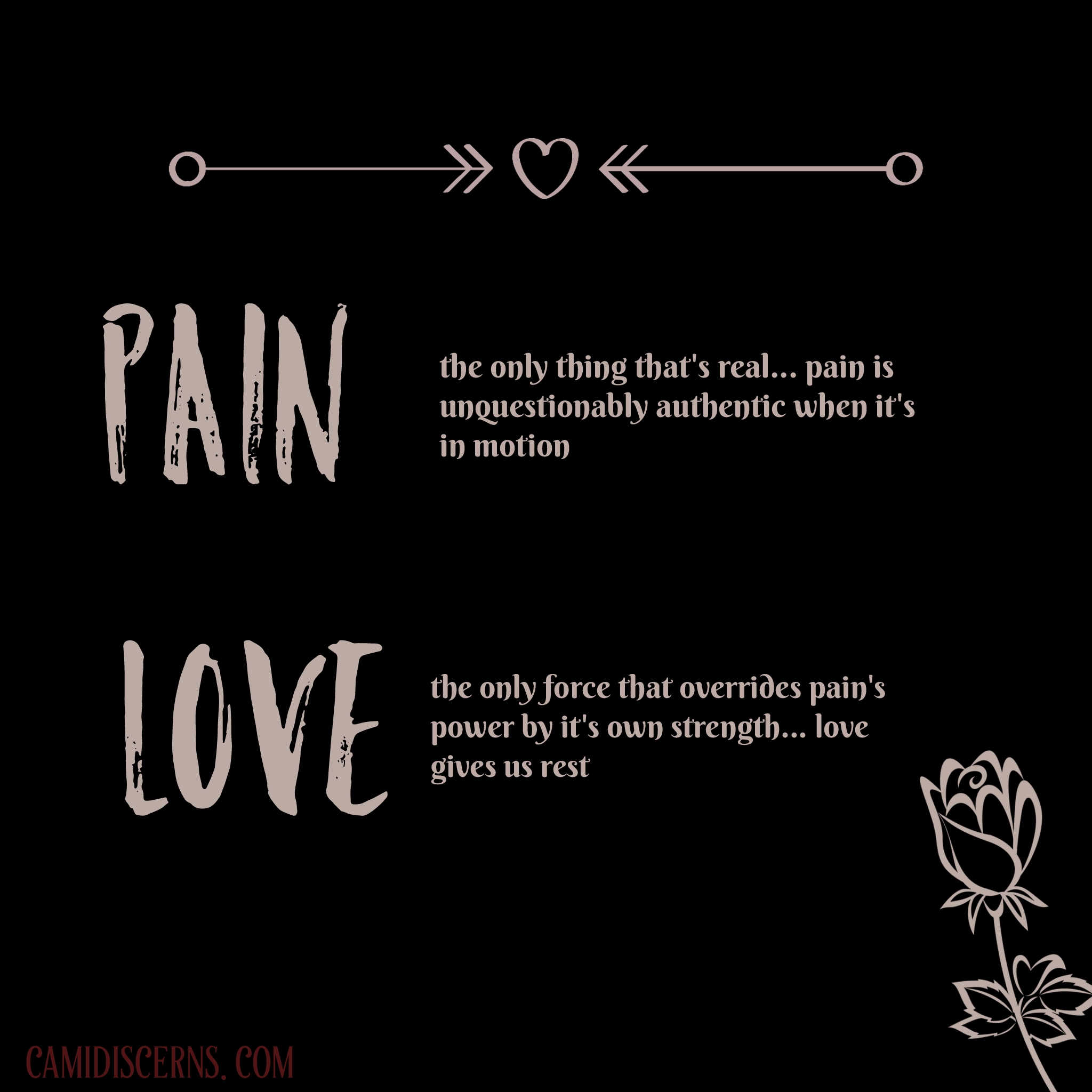 The Nature of Suffering: A Necessary Element of Existence