Empathy, often mistaken for weakness, is actually a profound strength. Empathy requires emotional intelligence, courage, and resilience. Empathy requires emotional intelligence, courage, and resilience.
Emotional Intelligence:
Empathy enhances communication and relationships, crucial for personal and professional success.
Courage to Connect:
It takes bravery to engage deeply with others’ emotions, showing true emotional fortitude.
Strength in Vulnerability:
Embracing empathy means being authentic and honest, fostering trust and meaningful connections.
Problem-Solving:
Understanding diverse perspectives leads to innovative and inclusive solutions.
Resilience: Empathy builds a support network, enhancing adaptability and strength in facing challenges.
Empathy is not a weakness; it’s a powerful tool for creating a compassionate and understanding world.
Authentic empathy always requires significant cognitive effort, particularly when it comes to understanding another person’s point of view (also known as “perspective-taking“).
Some scholars further parse this angle into:
Cognitive
“the ability to imagine the other’s experiences”
&
Perceptive
“the ability to directly perceive the other’s experiences”
Cognitive Empathy
Cognitive empathy, often referred to as perspective-taking, is the mental ability to understand and identify with another person’s thoughts and feelings.
Cognitive empathy involves imagining oneself in another’s situation to gain insight into their emotional state.
Perceptive Empathy
Perceptive empathy, on the other hand, goes beyond mere understanding to actively engaging with another’s emotional experience.
Perceptive empathy combines sensing emotions, regulating one’s own emotions, and taking skillful action based on these perceptions to meet others’ needs.
Both forms of empathy are crucial for effective interpersonal communication and relationships.
How Do We Test Whether It’s Empathy Or Projections?
When I know that I’m ready to critique a theological perspective is when I can:
“Yes this is exactly what I believe.”
If there are any need of clarification, caveats or modification then my view must be reevaluated.
Integrsting cognitive empathy involves a humble (and difficult) listening skill: withholding any judgment on the other person’s feelings, words, interpretation, and perspective until I understand accurately and robustly.
THE OUTER JUDGE MUST BE TAMED IN ORDER TO EMPATHIZE AT ALL.
Don’t twist my words now:
Christians must resist extreme relativism in our culture, but what I am saying in regards to holding judgment is to do so only for a brief time.
Many can easily misperceive what it means to be “non-judgmental” when discussing Cognitive Empathy.
Being “non-judgmental” often involves agreeing with or validating whatever a person feels and says, no matter what; for the sake of “love” or “tolerance.”
I’ve heard it said,
“If you don’t validate my understanding as your own, you clearly don’t love me.” (Though that’s not what “love” means, even though it’s popular.)
Extreme relativism counsels hurting people “to resent all resistance to their feelings,” as if such resistance were “a direct assault on their dignity and an affront to the depth of their suffering.”
Carl Jung, the renowned Swiss psychiatrist and psychoanalyst, made significant contributions to the understanding of art and its psychological dimensions.
Key aspects of his work related to art & the psyche:
Collective Unconscious + Visual Art:
Jung proposed the concept of the collective unconscious, which suggests that certain universal symbols and archetypes are shared across cultures and generations.
Visual art often taps into these archetypal images, providing a means for individuals to express and explore their inner worlds.
Jung believed that art could reveal latent memories from our ancient past and help us understand our responses to the environment.
Jung believed that art itself had no inherent meaning; instead, it was the artistic process that mattered.
Artists grappled with an “artistic impulse,” akin to a kind of madness—an irresistible force that drove them to create.
Through this process, artists found temporary relief and a way to express their psychological condition.
Jung’s own experiences as both a psychologist and an artist informed his understanding of this delicate balance between completion and incompleteness in artistic expression.
His approach to art was deeply rooted in his theories of the unconscious mind and symbolism.
Jung believed that art was a powerful medium for expressing the unconscious, serving as a bridge between the conscious and unconscious realms.
He saw artistic creation as a process that tapped into universal symbols and archetypes, which he termed the collective unconscious.
This perspective allowed for a unique interpretation of visual art, providing insights into both the artist’s psyche and broader cultural meanings.
Jung’s own artistic endeavors, such as his Alchemical Tower at Bollingen, exemplified his belief in the transformative power of creative expression. This personal project was a physical manifestation of his inner psychological journey.
In analyzing artworks, Jung developed a method of symbolic interpretation that became a tool for understanding an individual’s mental functioning and social behavior.
His approach to symbolism in art emphasized the importance of psychic content and its vital role in human life and culture.
Jung’s ideas have influenced various fields, including music composition. His cognitive functions system has been used to understand different composers’ psychological tendencies and creative processes.
This application of Jungian theory demonstrates the enduring relevance of his ideas in interpreting artistic creation across various mediums.
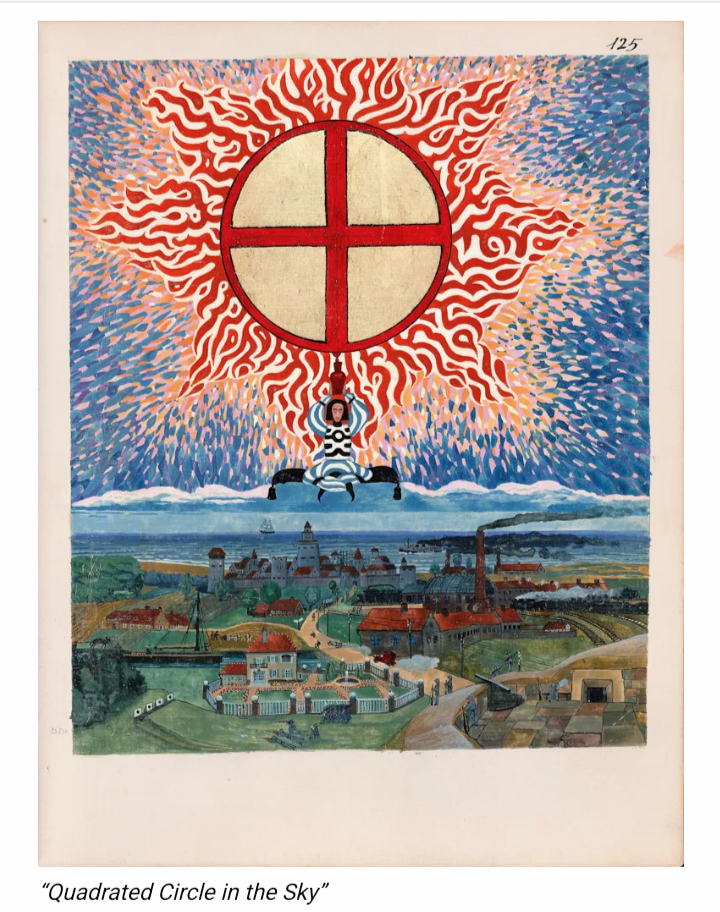
Liber Novus
The Red Book
Carl Jung’s Liber Novus, also known as The Red Book, was recently unveiled in a complete English translation by Norton. This translation was first published in a facsimile edition in 2009, followed by a smaller “reader’s edition” in 2012. Since then, there have been several exhibitions showcasing the book.
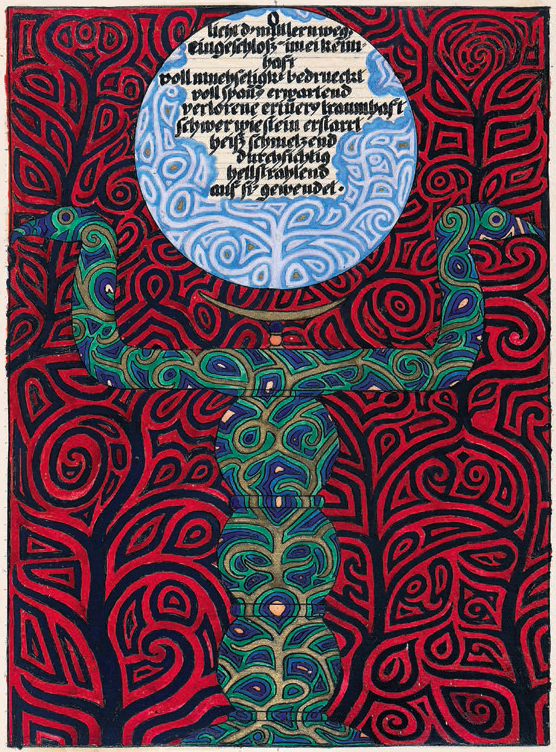
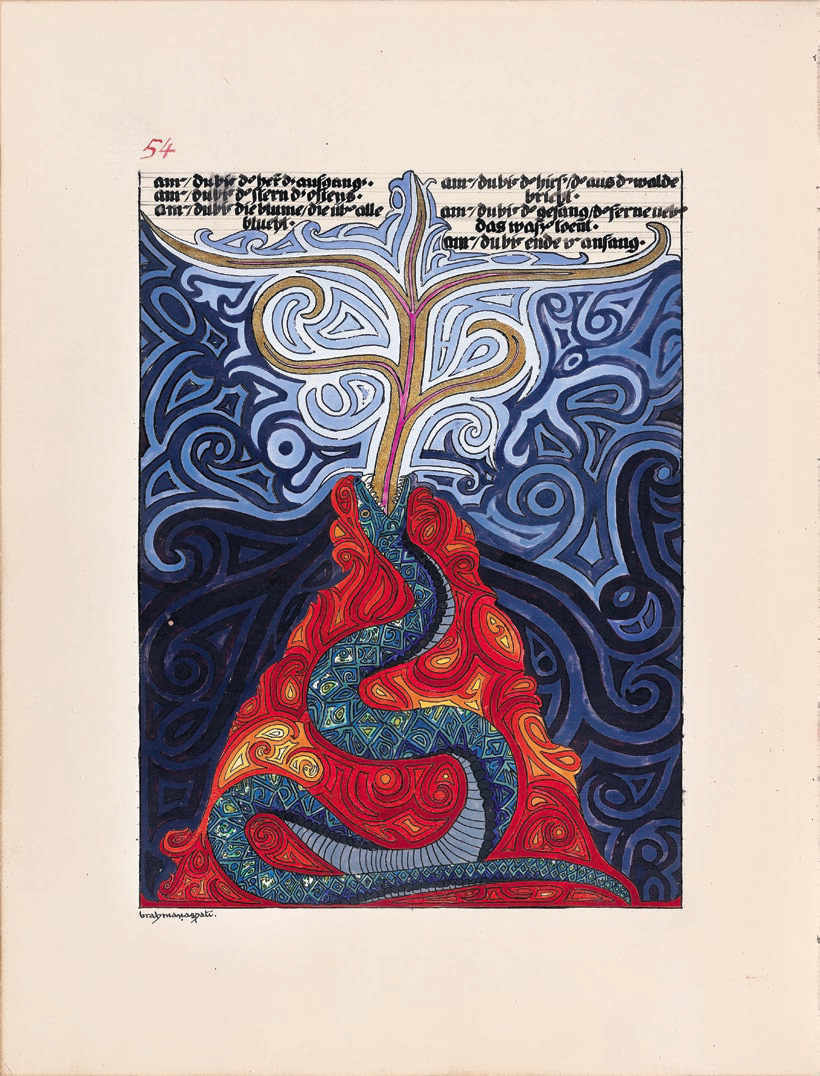
Art critic Peter Frank describes it as resembling a Bible crafted by a medieval monk, particularly noting the intricate Gothic script that Jung meticulously used for his writings.
Despite Carl Jung’s reluctance to consider himself an “artist,” it is noteworthy that his Liber Novus has been displayed in museums and served as the core of the ‘Encyclopedic Palace,’ a survey of visionary art featured at the 2013 Venice Biennale. Jung’s intricate paintings depict him as every inch an artist, akin to medieval monks or Persian courtiers. His artistry was devoted not to divine or royal glorification, but rather to celebrating the potential and significance of humanity.
One could more accurately say that Jung’s book was dedicated to the mystical unconscious, a much more nebulous and oceanic category. The “oceanic feeling”—a phrase coined in 1927 by French playwright Romain Rolland to describe mystical oneness—so annoyed Sigmund Freud that he dismissed it as infantile regression.
Freud’s antipathy to mysticism, as we know, did not dissuade Jung, his onetime student and admirer, from diving in and swimming to the deepest depths.
The voyage began long before he met his famous mentor.
At age 11, Jung later wrote in 1959, “I found that I had been in a mist, not knowing how to differentiate myself from things; I was just one among many things.”
Jung considered his elaborate dream/vision journal—kept from 1913 to 1930, then added to sporadically until 1961—“the central work in his oeuvre,” says Jung scholar Sonu Shamdasani in the Rubin Museum introduction above. “It is literally his most important work.”
And yet it took Dr. Shamdasani “three years to convince Jung’s family to bring the book out of hiding,” notes NPR. “It took another 13 years to translate it.”
Part of the reason his heirs left the book hidden in a Swiss vault for half a century may be evident in the only portion of the Red Book to appear in Jung’s lifetime.
Jung had this text privately printed in 1916 and gave copies to select friends and family members. He composed it in 1913 in a period of Gnostic studies, during which he entered into visionary trance states, transcribing his visions in notebooks called the “Black Books,” which would later be rewritten in The Red Book.
You can see a page of Jung’s meticulously hand-lettered manuscript above. The “Sermons,” he wrote in a later interpretation, came to him during an actual haunting:
The atmosphere was thick, believe me! Then I knew that something had to happen. The whole house was filled as if there were a crowd present, crammed full of spirits. They were packed deep right up to the door, and the air was so thick it was scarcely possible to breathe. As for myself, I was all a‑quiver with the question: “For God’s sake, what in the world is this?” Then they cried out in chorus, “We have come back from Jerusalem where we found not what we sought/’ That is the beginning of the Septem Sermones.
The strange, short “sermons” are difficult to categorize. They are awash in Gnostic theology and occult terms like “pleroma.”
The great mystical oneness of oceanic feeling also took on a very sinister aspect in the demigod Abraxas, who “begetteth truth and lying, good and evil, light and darkness, in the same word and in the same act. Wherefore is Abraxas terrible.”
There are tedious, didactic passages, for converts only, but much of Jung’s writing in the “Seven Sermons,” and throughout The Red Book, is filled with strange obscure poetry, complemented by his intense illustrations. Jung “took on the similarly stylized and beautiful manners of non-western word-image conflation,” writes Frank, “including Persian miniature painting and east Asian calligraphy.”
If The Red Bookis, as Shamdasani claims, Jung’s most important work—and Jung himself, though he kept it quiet, seemed to think it was—then we may in time come to think of him as not only as an inspirer of eccentric artists, but as an eccentric artist himself, on par with the great illuminators and visionary mystic poet/painters.
Abraham Maslow’s groundbreaking psychological theory, known as Maslow’s Hierarchy of Needs, offers a structured framework to comprehend human motivation and behavior.
This structure is used by those in power.
The theory lays out five levels of needs that people seek to meet in a step-by-step manner, beginning with the most essential physiological needs and advancing towards self-actualization, which is the pinnacle of psychological well-being.
1. Basic Needs
The first level, physiological needs, encompasses fundamental requirements for human survival such as air, water, food, shelter, sleep, and clothing.
Without meeting these basic needs, individuals may experience significant discomfort and distress, hindering their overall well-being.
Addressing physiological needs is crucial for laying the foundation for personal growth and self-actualization.
2. Safety and Security
The second level, safety needs, involves seeking physical safety, emotional security, financial stability, and protection from harm or danger.
Creating a stable and secure environment allows individuals to feel safe and secure in their daily lives, fostering a sense of stability and trust in their surroundings.
3. Human Connection
The third level, love and belonging needs, focuses on the desire for social connections, love, and a sense of belonging.
Forming meaningful relationships and experiencing affection contribute to emotional well-being and a sense of connection and support in life.
4. Self-love
The fourth level, esteem needs, encompasses the need for self-worth, recognition, and respect from oneself and others.
Developing a positive self-image, self-confidence, and receiving recognition and appreciation from others are essential for building self-esteem and fostering a sense of accomplishment.
5. Self- actualization
The fifth and highest level, self-actualization, represents the pursuit of personal growth, fulfillment of one’s unique potential, and the realization of one’s full capabilities.
Self-actualized individuals are driven by intrinsic motivation, self-awareness, and a deep understanding of their values and beliefs, actively seeking personal fulfillment and self-expression.
Gray aliens, often referred to simply as “Grays,” are one of the most commonly reported types of extraterrestrial beings in modern UFO lore.
These beings are typically described as having gray skin, large heads, almond-shaped eyes, and spindly bodies. Abduction scenarios, medical examinations, and reproductive experiments are recurring themes in these accounts.
Historical & Cultural References
The concept of gray aliens is not new and can be traced back to various ancient cultures and mythologies:
Ancient Sumerians: The Sumerians, who lived around 4000 BCE in Mesopotamia, mentioned the Anunnaki in their texts. These beings were described as tall, powerful, with pale skin, large eyes, and thin noses. Some theorists believe these descriptions align with modern depictions of gray aliens.
Ancient Egyptians: In Egyptian mythology, the “shemsu Hor” or “followers of Horus” were depicted with elongated heads and large almond-shaped eyes, resembling modern descriptions of gray aliens.
Mayans: Mayan artwork often portrays small humanoid beings with large heads and eyes, suggesting possible depictions of extraterrestrial encounters.
Indian Culture: Hindu mythology mentions the Nagas, beings with serpent-like characteristics but often depicted with humanoid bodies, elongated heads, and large eyes.
Medieval Art: In medieval religious paintings, celestial beings are sometimes depicted with elongated heads and unusual features that resemble gray aliens.
Native American Tribes: Various tribes, such as the Hopi and Zuni, have stories about encounters with beings similar to gray aliens.
Pacific Islanders: Indigenous tribes like the Maori of New Zealand have oral traditions that speak of encounters with beings from other worlds, often described with elongated heads and large eyes.
Modern Accounts and Theories
Modern accounts of gray aliens often involve abduction scenarios where individuals report being taken against their will onto alien crafts. These experiences typically include traumatic physical examinations and reproductive experiments. The Hill abduction case in 1961 is one of the most famous, where Betty and Barney Hill reported being taken by gray aliens for medical examinations.
Theories about the agenda of gray aliens vary widely:
Experimentation: Some believe that grays are conducting experiments on humans to study our biology and psychology. This includes theories about reproductive experiments to create hybrid beings.
Control and Manipulation: Others suggest that grays are involved in controlling human civilization, possibly through genetic manipulation or other means. This theory is supported by ancient texts like the Sumerian accounts of the Anunnaki.
Sadistic Intentions: There are also claims that grays torture humans for their own amusement or to study human pain thresholds. These claims are based on firsthand accounts from alleged abductees.
Psychological and Cultural Impact
The fascination with gray aliens has had a significant impact on popular culture and human psychology. The widespread belief in these beings has been fueled by media portrayals in movies, TV shows, and books. The Hill abduction case, for example, inspired episodes in popular series like “The X-Files” and “Dark Skies”.
Psychologists have explored various explanations for these abduction stories, including false memories implanted through suggestive questioning and sleep paralysis accompanied by hallucinations. Despite the lack of empirical evidence, the belief in gray aliens continues to captivate the human imagination, reflecting our enduring fascination with the unknown and the extraterrestrial.
Secular attempts to explain alien encounters often fall short.
The phenomena defy the laws of physics and biology as we understand them, leaving scientists and skeptics alike grasping for answers.
Yet, when we step beyond the material and into the spiritual, a more comprehensive framework emerges—one that aligns surprisingly well with ancient wisdom.
Biblical accounts of angelic visitations share striking parallels with modern reports of alien encounters.
Both involve beings that transcend our three-dimensional reality, appearing suddenly, delivering messages, and vanishing just as mysteriously.
Angels, as messengers of God, are described in Scripture as fluid, shape-shifting entities capable of traversing dimensions (Heb. 13:2).
They manifest as men (gen. 18), fiery beings (jud. 13), or even immaterial voices (lk 2:13-15).
Similarly, aliens are often depicted as inter-dimensional travelers, arriving with advanced technology and imparting warnings, guidance, or revelations.
Could these encounters—whether labeled angelic or alien—be manifestations of the same phenomenon?
Are they interdimensional beings interacting with humanity from a higher plane of existence?
Jesus and the Multiverse
A Biblical Foundation
Jesus’s teachings hint at a reality far beyond our three-dimensional perception.
His words to the thief on the cross—“Today you will be with me in paradise” (Luke 23:43)—suggest a realm where time and space operate differently, where heaven and earth intersect.
If angels originate from “God’s heaven” (Daniel 8:16), might aliens also emerge from these higher dimensions, serving as messengers bridging the spiritual and material worlds?
The Bible paints a picture of a vast multiverse where God’s kingdom overlaps with ours.
Angels, as divine emissaries, reveal His glory and participate in the redemption of creation (Isaiah 6:3).
Their appearances—whether as humans, fiery beings, or celestial hosts—demonstrate that they are not bound by physical laws.
Aliens, too, defy earthly biology, yet their messages often echo those of angels: confronting humanity’s failures while offering wisdom and urging spiritual growth.
Kindred Messengers
Angels, Aliens, and the Call to Awakening
Both angels and aliens challenge us.
They confront humanity with its shortcomings, yet they also inspire hope, pushing us toward evolution and enlightenment.
Their role as messengers, guides, and warners unites them as kindred beings from beyond our limited perception.
Consider the Nephilim, the “sons of God” who “came in” to earth (Genesis 6:1-4). Their description bears a resemblance to modern accounts of alien visitations—beings from another realm interacting with humanity in profound ways.
Whether through angelic visions or UFO encounters, the pattern is clear: these beings serve as catalysts for spiritual awakening, urging us to look beyond the material and embrace a deeper understanding of our place in the cosmos.
The UFO as Symbol
A Longing for Transcendence
The UFO phenomenon is more than a mystery, it is symbolic.
It represents humanity’s longing to break free from the constraints of three-dimensional thinking.
The technology associated with aliens may be a metaphor for the divine means by which higher beings traverse realms.
Their warnings and messages point us toward truths that transcend earthly concerns, reminding us that we are part of something far greater.
Earth remains anchored in the physical, but the multiverse Jesus implies reveals a grander purpose.
God’s kingdom is not confined to a single dimension; it is infinite, eternal, and intertwined with our own.
Aliens, like angels, may be messengers from this expansive reality, beckoning us to remember our role in God’s cosmic narrative.
A Spiritual Lens
Reconciling the Phenomena
When we reframe alien encounters through a multidimensional spiritual lens, the pieces begin to fit.
Materialist explanations fall short because they cannot account for the ineffable—the sense of awe, the profound shifts in consciousness, the undeniable feeling that something otherworldly has occurred.
Aliens and angels share a common thread: they reveal spiritual realities that our limited senses cannot fully perceive.
Their interventions, whether through visions, visitations, or technological marvels, urge us to lift our gaze from the earthly to the eternal.
They whisper of a truth that resonates deep within us—that infinity awaits, and our souls are anchored in the Creator of all dimensions.
A Cosmic Invitation
Alien encounters, like angelic visitations, are not mere anomalies to be explained away.
They are invitations
… calling us to awaken to a greater reality, to recognize our place within a vast cosmic narrative.
By embracing a multidimensional spiritual perspective, we move beyond the limitations of materialism and step into a world where heaven and earth, the seen and the unseen, intersect in mysterious and profound ways.
A Genuine Tension
There is something worth taking seriously…
Why do unexplained experiences feel so profound and meaningful to people?
That’s a real question about human consciousness, spirituality, and our relationship to mystery.
That doesn’t require aliens to be angels—but it does suggest the experiences matter psychologically and spiritually, regardless of their physical origin.
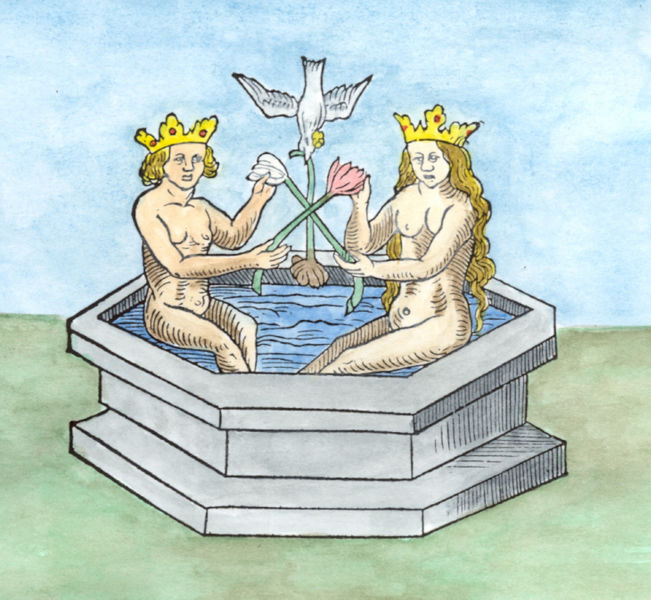
Quantum Alchemy is a framework that merges ideas from quantum physics—such as entanglement, superposition, and wave-particle duality—with the symbolic, transformative, and spiritual traditions of alchemy.
It often explores the idea of consciousness, energy, and reality as interconnected, sometimes framing quantum phenomena through the lens of alchemical processes like transformation, unification, or the pursuit of higher states of being.
IDEAS FOUND IN QUANTUM ALCHEMY:
Transforming the properties of particles or materials
Similar to how alchemists sought to transform lead into gold, quantum alchemy aims to manipulate the properties of particles, atoms or materials at the quantum level to create new forms of matter with desired characteristics.
This could involve changing the nuclear charges or electron configurations.
Computational method for predicting molecular properties
Quantum alchemy uses expansion to approximate and predict properties like binding energies for large numbers of molecules and materials by making small perturbations to a reference system.
This accelerates screening of potential catalysts or drug candidates.
Representation of the chemical space as a quantum superposition
Some propose representing all possible atomic compositions as a linear superposition state, with a “quantum alchemical Hamiltonian” driving the optimization to select the best molecule for a desired property.
Philosophical connections
There are also philosophical parallels drawn between the aims of ancient alchemy (e.g. transmutation, elixir of life) and modern concepts in quantum physics about the malleability and interconnectedness of reality.
Quantum alchemy leverages quantum mechanical principles to transform, optimize & efficiently model perveived matter and alter chemical systems in real ways.
It combines ideas from physics, chemistry, and the metaphysical quest of the ancient alchemists.
“With regard to extraterrestrial life (aliens), Scripture is silent.“
– John MacArthur
While the Bible does not explicitly address the topic of extraterrestrial life, it does provide us with essential truths.
“For in Him All things were created: things in Heaven & on earth, Visible & invisible, whether thrones or Powers or Rulers or Authorities@; all things have been created through him and for him. He is before all things, and in him all things hold together.“
Colossians 1:16-17 –
Alien Meanings & Context
Alien Meanings & Context… belonging or relating to another person, place, or thing… foreign; coming from another world…… a person who is not of a particular group or place…. a creature from outer space; extraterrestrial…. not familiar or like other things you have known…… different from what you are used to…… from another country….. too different from something to be acceptable or suitable…… from somewhere other than the planet Earth.
Biblical Interpretation & Assumptions
… strange and not familiar…
Ancient Astronaut Theory & Biblical Connections:
Another intriguing perspective within biblical interpretation of Aliens is the Ancient Astronaut theory.
This theory suggests that:
Extraterrestrial beings visited Earth in ancient times & played a significant role in shaping human civilization.
They interpret passages such as the “sons of God” in Genesis 6:1-4 as references to alien beings intermingling with humans.
They suggest that these encounters were recorded in spiritual texts and mythologies to make sense of the phenomena they witnessed.
Some claim that biblical descriptions of flying chariots or wheels within wheels can be interpreted as: early depictions of advanced spacecraft or unconventional aerial vehicles.
Exploring aliens within biblical interpretation does not oppose the spiritual & moral teachings found within Biblical texts. Instead, it offers a unique lens through which to understand ancient stories and offers an alternative perspective on the mysteries that surround our existence.
Angelic Manifestations: Beyond Physical Form
Angels, as depicted in various religious texts, transcend the limitations of physical form. The term “angel” itself signifies their role as messengers, rather than a specific appearance. According to the Bible, angels can manifest in different forms, such as men, fire, or immaterial beings. This fluidity suggests their origin from a realm beyond our three-dimensional space. The diverse manifestations of angels parallel the descriptions often associated with encounters with aliens. Like angels, aliens are believed to exhibit unconventional physiology and possess the ability to shape-shift, hinting at their connection to a higher dimension.
Alien Interventions: Warnings and Wisdom
Just as angels provide messages of provocation and comfort, aliens also seem to possess a similar intent. From ancient folklore to modern-day accounts, encounters with aliens often involve the delivery of warnings, prophecies, and insights. These messages align with the intentions attributed to angels in religious texts. Both angels and aliens acknowledge human failures while encouraging spiritual growth, reminding us of the need to transcend our earthly limitations.
Exploring the Multidimensional Nature of Angelic and Alien Realms
Biblical References: Multiverse and Heavenly Realms
The Bible offers glimpses into a multiverse where heavenly realms intersect with our own. Jesus’ references to “paradise” and promises of eternal life imply the existence of dimensions beyond our earthly perception. The concept of angels originating from God’s heavenly realm aligns with the possibility that aliens may come from higher dimensions where heaven and earth intersect. This suggests a connection between angelic and alien encounters, both originating from a spiritual source beyond our three-dimensional world.
Transcending Earthly Concerns: Angelic and Alien Guidance
Both angels and aliens play roles as messengers, guides, and warners, pointing us towards a greater purpose beyond our earthly existence. While our understanding remains limited within the three-dimensional realm, the encounters with angels and aliens challenge us to expand our perspectives. Their interventions, whether angelic or alien, serve as catalysts for spiritual growth, urging us to transcend earthly concerns and embark on a journey towards higher truths.
Conclusion 7.1 Summary of Findings 7.2 Personal Reflection and Application 7.3 Future Research Opportunities
In conclusion, the parallels between angels and aliens offer intriguing insights into the multidimensional nature of our reality. Viewing encounters with aliens through a spiritual lens allows us to explore the possibility of a shared spiritual source and a vast multiverse beyond our earthly perception. Both angels and aliens serve as messengers, offering wisdom and guidance that transcend our earthly limitations. While our eyes perceive the three-dimensional world, our souls recognize the infinite nature of the cosmos and our eternal connection to the Creator. Embracing the mysteries of angelic and alien encounters invites us to embark on a journey of spiritual exploration, unraveling the profound truths that lie beyond our earthly existence.
Resources:
“Angels: A History” by David Albert Jones
Article: “Angels and Aliens: A Comparative Study” by Michael S. Heiser
PDF: “The Bible and Extraterrestrial Life: A Theological Exploration” by Ted Peters
The word “alien” shifts its meaning depending on the context used.
From describing foreigners, to evoking images of extraterrestrial beings, “alien” captures the energy of the unfamiliar, supernatural, and unearthly.
Let’s trace Aliens’ linguistic roots & cultural origins of aliens, both terrestrial and cosmic.
The Many Faces of “Alien”
At its core, “alien” refers to something foreign, something that belongs to another person, place, or realm.
Its versatility allows it to wear many hats:
The Outsider Among Us
In everyday language, “alien” can describe something or someone that feels unfamiliar or out of place, like a person from a different culture or a strange environment. It can also refer to creatures from outer space in science fiction.
Alien can refer to a foreigner or outsider, used in legal and immigration contexts to describe a person from another country.
It can also describe an experience or entity that feels disconnected from familiar norms or culture.
Creatures from Beyond
In the realm of science fiction and popular culture, “alien” conjures images of extraterrestrial beings, mysterious visitors from distant planets.
These cosmic outsiders spark curiosity, fear, and wonder, embodying our fascination with life beyond Earth.
The Unfamiliar & Strange
“Alien” can also describe anything… ideas, emotions, technologies, or experiences, that feel foreign, unfamiliar, or fundamentally outside the norm.
It captures the sense of otherness, whether in a literal or abstract context.
Breaking alienus Down
Etymology of “Alien”
The word comes from the Latin alienus, meaning
“belonging to another” or “foreign.”
It’s a blend of alius (“other”) and the suffix –enus (indicating possession or origin).
Over time, this evolved into the Old French alien and eventually into the English term we use today.
Extraterrestrial Connections:
The prefix “extra-” (Latin exterus: “outside” or “beyond”) paired with “terrestrial” (Latin terrestris: of the Earth) gives us “extraterrestrial”
—a term that literally means “BeyondEarth.”
This linguistic construction perfectly encapsulates the cosmic connotations of “alien” in modern usage.
For a deeper dive into the word’s history, check out its etymology on Etymonline.
Where Did the Belief in Aliens Originate?
Our fascination with aliens isn’t a modern invention—it stretches back millennia, woven into the fabric of ancient mythology, astronomy, and storytelling.
The idea of beings from the sky, whether gods, spirits, or extraterrestrials, has captivated humanity across cultures and epochs.
Let’s explore the key origins of this enduring belief.
Ancient Astronomy and Mythology
Beings from the Sky
Long before science fiction dreamed up little green men, ancient cultures looked to the heavens and imagined celestial beings.
These “sky people” were often depicted as powerful, advanced, and mysterious—qualities we now associate with modern conceptions of aliens.
Common Themes in Ancient Myths
Advanced Knowledge
Sky beings frequently brought secret wisdom, advanced technology, or magical abilities to humanity, much like how we imagine aliens today.
Occasional Visitation
Both ancient gods and modern aliens are thought to make rare, fleeting appearances, maintaining an aura of mystery.
Ambiguous Forms
Unlike humans, these beings often lacked concrete physical forms, appearing in fluid, shifting shapes—a trait mirrored in the diverse depictions of aliens in modern media.
Examples of Sky Beings
Ancient Mythology
Across the globe, ancient cultures told stories of celestial visitors who descended from the heavens, interacted with humans, and left lasting legacies. Here are some striking examples:
Greek Mythology
The Titans, a race of giant gods predating the Olympians, included figures like Prometheus, who gifted humanity fire (a symbol of advanced knowledge), and Atlas, who carried the heavens on his shoulders.
Egyptian Mythology
Thoth, often depicted with the head of an ibis, was believed to have descended from the sky, bringing humanity the secrets of writing, science, and magic.
Sumerian Mythology
The Anunnaki, deities from a distant planet called Nibiru, were said to have visited Earth, helping humans develop agriculture and civilization.
Mesopotamian Mythology
In The Epic of Gilgamesh, Utnapishtim is granted immortality by the gods and builds an ark to survive a great flood. Some modern theorists interpret this as evidence of ancient alien encounters.
Hebrew Bible
Genesis 6 mentions the Nephilim, mysterious beings who “came down from heaven” and fathered gigantic offspring with human women. Some speculate these could be interpreted as extraterrestrials.
Hindu Mythology
Ancient Vedic texts describe celestial deities called devas who descended from the heavens in flying chariots, engaging with humans in profound ways.
Norse Mythology
The Aesir, gods like Odin and Thor, hailed from Asgard, a realm some interpret as another world or dimension.
These stories are diverse. Yet they share a common theme, they’re advanced beings from beyond our world influencing our world, covertly.
Could these ancient myths be early attempts to explain encounters with extraterrestrial visitors?
The debate continues to fuel imaginations today.
Aliens in Modern Minds
Today’s concept of aliens is shaped by science fiction, popular culture, and scientific exploration.
From H.G. Wells’ The War of the Worlds to blockbuster films likeE.T.and Arrival, aliens have become a canvas for creating themes of otherness, technology, and the unknown.
But the question remains: Are aliens purely a product of human imagination, or do they reflect a deeper truth about the universe?
Whether we view them as mythological sky gods or interstellar travelers, the concept of “alien” continues to captivate us, pushing the boundaries of what we believe is possible.
Further Reading:
Many resources are available for free online or as PDFs:
The Seth Material by Jane Roberts A collection of channeled messages from an interdimensional entity named Seth, who discusses other dimensions and the possibility of alien life.
The Secret Teachings of All Ages by Manly P. Hall A comprehensive exploration of esoteric knowledge, including discussions of interdimensional beings and their potential role in unexplained phenomena.
The Invisible Landscape: A Visual Guide to Parallel Universes by Terence McKenna This book explores the possibility of parallel universes inhabited by interdimensional beings, blending science and speculation.
UFOs and the Paranormal by John Keel Keel examines the connection between UFO sightings and paranormal phenomena, suggesting that many encounters may involve interdimensional beings.