
1. What is String Theory?
2. What are oscillating strings in String Theory?
3. How do oscillating strings relate to the particles and forces in our universe?
4. What are hidden dimensions?
5. How are hidden dimensions supported by calculations and mathematical models?

1. What is String Theory?
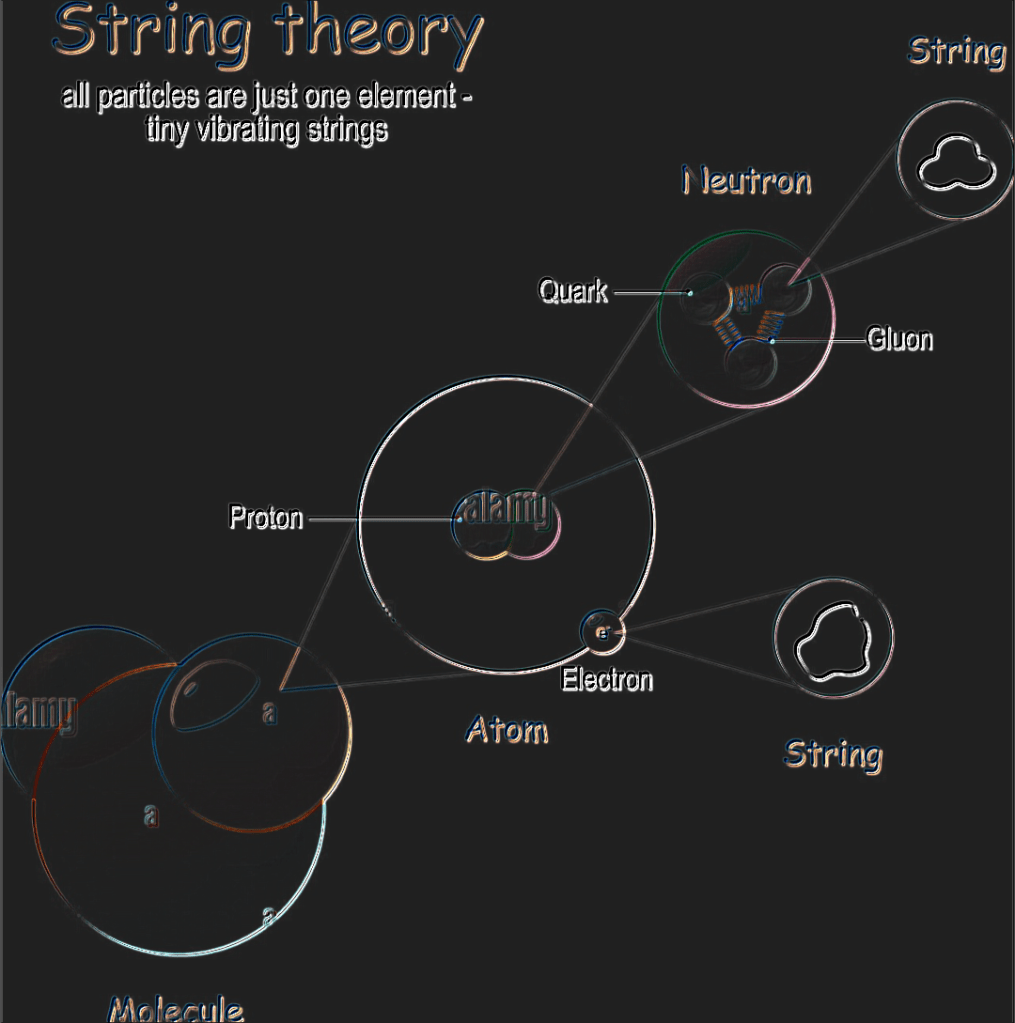
String theory is supported by several facts and resources that make it a compelling theoretical framework in physics. Firstly, string theory offers a solution to the long-standing problem of reconciling quantum mechanics and general relativity. These two theories, while successful in their respective domains, are incompatible at the fundamental level. String theory proposes that elementary particles are not point-like objects, but rather tiny, vibrating strings. This revolutionary concept helps to bridge the gap between the quantum world of particles and the gravitational interactions described by general relativity.
String theory provides a mathematical framework that unifies all the known fundamental forces. By incorporating gravity, electromagnetism, and the strong and weak nuclear forces into a single theory, string theory offers the possibility of a unified description of the universe.

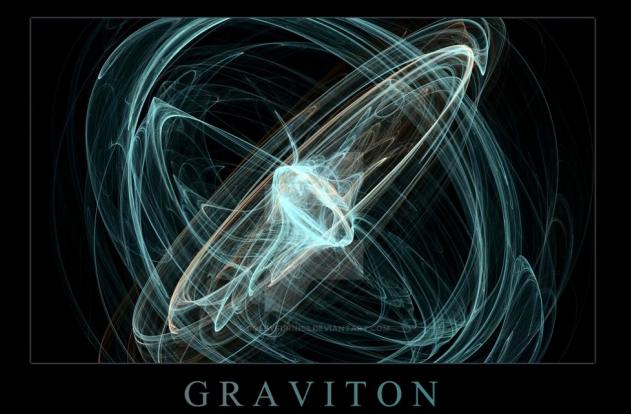
This is a major goal in physics and has been a driving force behind much of the research in theoretical physics. In fact, string theory predicts the existence of new particles called gravitons, which are hypothesized to mediate the force of gravity.
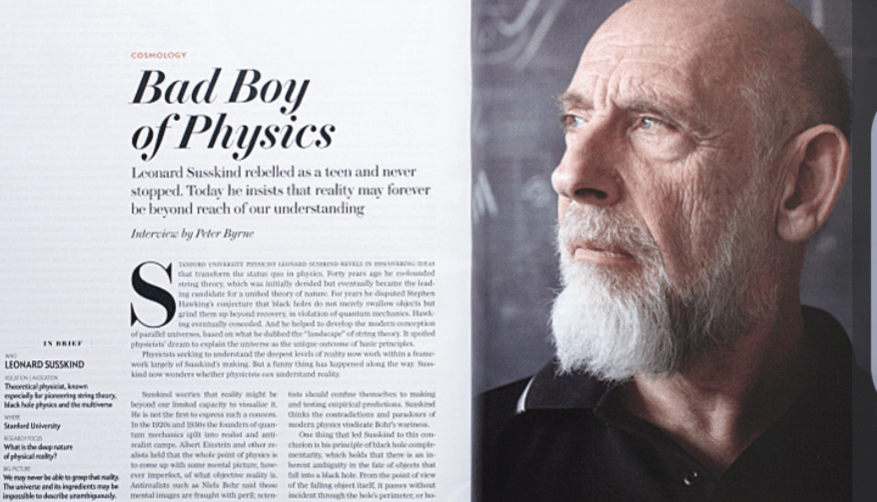
In terms of resources, string theory has been extensively studied by many prominent physicists, such as Leonard Susskind, Brian Greene, and Juan Maldacena. These individuals have published numerous papers and books on the subject, providing detailed explanations and mathematical models that support the concepts of string theory. Additionally, string theory has been a subject of ongoing research and debate within the scientific community, with experiments and theoretical developments continually pushing the boundaries of our understanding.
With its ability to reconcile quantum mechanics and general relativity, unify the fundamental forces, and predict new particles, string theory has garnered significant attention and support from the scientific community.
2. What are oscillating strings in String Theory?
There are several facts and resources that support the notion of oscillating strings in string theory. One key resource is the work of renowned theoretical physicists such as Edward Witten, Leonard Susskind, and Juan Maldacena. These scientists have made significant contributions to the development and understanding of string theory, including the concept of oscillating strings as the fundamental objects from which particles are composed.
In addition to the research of these physicists, various mathematical calculations and theoretical frameworks further validate the existence of oscillating strings. These calculations show that the vibrational modes of these strings correspond to different particle properties, such as mass and charge. The intricate mathematical consistency between these vibrational modes and observed particle properties lends strong support to the concept of oscillating strings.
Furthermore, experimental evidence has indirectly validated the existence of oscillating strings. For instance, the discovery of supersymmetry, which predicts the existence of superpartners for each particle, aligns with the principles of string theory. Additionally, the concept of extra dimensions, also predicted by string theory, has gained theoretical and experimental support. These extra dimensions and their impact on particle interactions provide further evidence that oscillating strings are indeed the building blocks of our universe.
3. How do oscillating strings relate to the particles and forces in our universe?
String theory proposes the concept of oscillating strings as a fundamental component of our universe. The theory suggests that particles in our universe are not point-like, but rather tiny strings that vibrate in multiple dimensions. This concept provides a possible explanation for the different masses, charges, and properties of particles. The vibrations of the strings give rise to various particles with different energies and masses.
Moreover, string theory also explains the origin of the fundamental forces and interactions. The interactions between the strings, such as splitting and merging, correspond to the different forces in nature, including electromagnetism, gravity, the strong nuclear force, and the weak nuclear force.
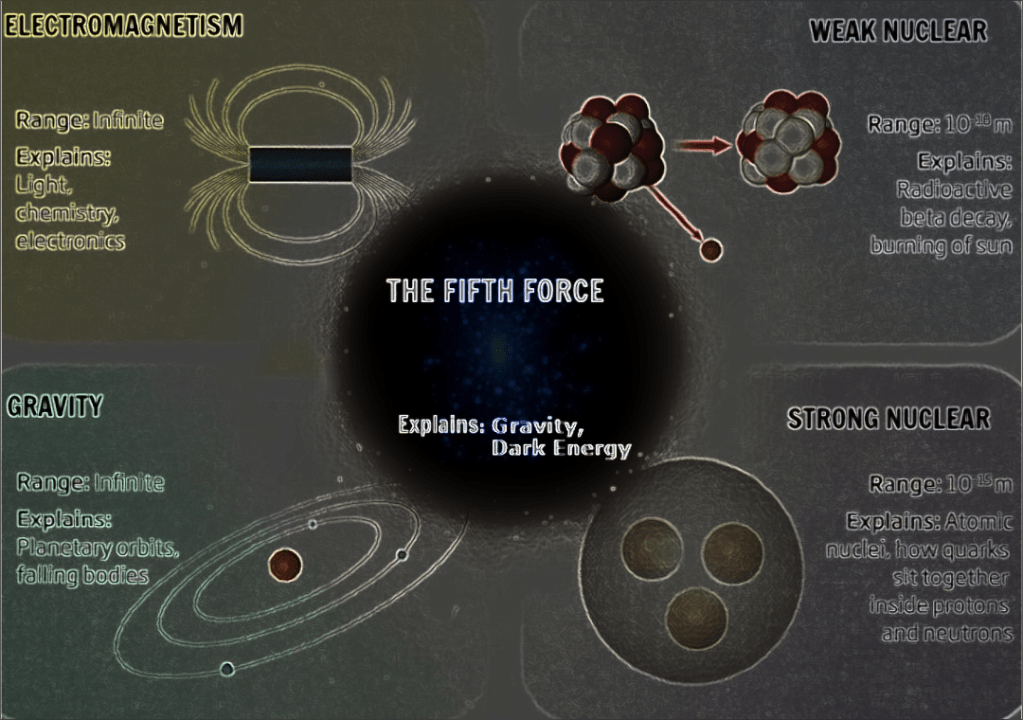
This is a remarkable aspect of string theory, as it offers a unified framework that can potentially explain all the fundamental particles and forces that govern our universe.
Despite its theoretical elegance, it is important to acknowledge that string theory is still highly speculative and has yet to be experimentally confirmed. Due to the immense complexity of its mathematical formulations, direct empirical evidence is currently lacking. Nevertheless, string theory has gained significant attention and continues to be actively studied by physicists as a promising theoretical framework for understanding the fundamental nature of our universe.
Sources:
1. Greene, B. (2000). The Elegant Universe: Superstrings, Hidden Dimensions, and the Quest for the Ultimate Theory. Vintage Books.
2. Polchinski, J. (2000). String Theory: Volume I, An Introduction to the Bosonic String. Cambridge University Press.
4. Ooguri, H. (2012). Introduction to Physics of String and Branes. Lecture Notes. Retrieved from PDF
4. What are hidden dimensions?
Hidden dimensions, as proposed in theoretical physics, refer to additional spatial dimensions beyond the three that we are familiar with (length, width, and height). These extra dimensions are not detectable in our everyday experience but are postulated in various physical theories, such as string theory and superstring theory.
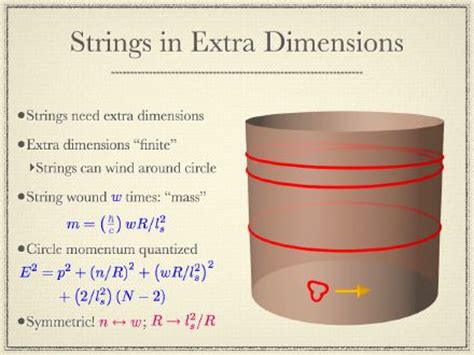
According to these theories, there may be up to 10 or 11 dimensions in total, with the extra dimensions “curled up” or “compactified” at tiny scales or in complex shapes, making them hidden from our perception. These additional dimensions play a crucial role in solving certain problems in fundamental physics, such as unifying gravity with the other fundamental forces and explaining the nature of particles and forces.
Understanding and exploring hidden dimensions are significant challenges in modern theoretical physics and are subjects of ongoing research. However, it’s important to note that the existence of hidden dimensions is still a theoretical concept and has not been proven experimentally.
5. How are hidden dimensions supported by calculations and mathematical models?
Hidden dimensions are not directly observable in our three-dimensional world, but they are supported by calculations and mathematical models in theoretical physics. One such model that incorporates hidden dimensions is string theory, which suggests that our universe may consist of more than three spatial dimensions. In this theory, particles are not considered point-like, but instead are tiny vibrating strings that propagate through spacetime, including hidden dimensions. These strings and their interactions are described by mathematical equations derived from principles such as quantum mechanics and differential geometry.
Additionally, hidden dimensions can have observable effects on various physical phenomena. These effects can deviate from what would be expected in a purely three-dimensional world and can be formulated mathematically. Through this mathematical analysis, scientists can make predictions and test them against experimental data. While hidden dimensions have not been experimentally confirmed, the mathematical framework they provide has contributed to our understanding of fundamental physics.
Resources:
– “String Theory and M-Theory: A Modern Introduction” by Katrin Becker, Melanie Becker, and John H. Schwarz.
– Lecture notes on string theory and hidden dimensions from reputable universities like Princeton, Harvard, and Caltech.


Leave a reply to Marc Baldwin Cancel reply