…even as he has chosen us in him before the foundation of the world, that we should be holy and blameless before him. In love
Ephesians 1:4
1:4 “Chosen”–
Mark 13:20 is a passage from the Bible that reads, “And except that the Lord had shortened those days [1][2], no flesh should be saved: but for the elect’s sake, whom he hath chosen, he hath shortened the days.” ; John 15:16 “You did not choose me, but I chose you and appointed you so that you might go and bear fruit–fruit that will last–and so that whatever you ask in my name the Father will give you.”
Romans 8:33 is a Bible verse that says: “Who shall bring any charge against God’s elect? It is God who justifies.”
2 Thessalonians 2:13 says “But we ought always to give thanks to God for you [1][2], brothers beloved by the Lord, because God chose you as the firstfruits to be saved [1][2], through sanctification by the Spirit and belief in the truth.”;
1 Pet 2:9.”But you are a chosen race, a royal priesthood, a holy nation, a people for his own possession, that you may proclaim the excellencies of him who called you out of darkness into his marvelous light.”
John 6:37 says “All that the Father gives me will come to me, and whoever comes to me I will never cast out.” John 17:6 says “I have manifested your name to the people whom you gave me out of the world [1][2]. Yours they were, and you gave them to me, and they have kept your.”
These verses are both from the Gospel of John in the New Testament of the Bible. They describe the relationship between Jesus and those who believe in him. John 6:37 indicates that all those who the Father gives to Jesus will come to him and he will never reject them. John 17:6 speaks of those whom the Father gave to Jesus out of the world, and how they were faithful in keeping his word.
Both verses emphasize the idea of divine election, that is, the belief that some are chosen by God to be saved. They also suggest that faith in Jesus is the sign of being among those who are chosen by God.
Ephesians 1:4-6 “For he chose us in him before the creation of the world to be holy and blameless in his sight [1]. In love he predestined us for adoption to sonship through Jesus Christ [2][1], in accordance with his pleasure and will— to the praise of his glorious grace, which he has freely given us in the One he loves.”
⬆️ Here, in vs 4-6, Paul speaks of three reasons for God’s choosing and predestining believers.
1️⃣ First, God wanted us to be “holy and blameless before him” – v 4;
John 17:17-19 is a passage from the Bible: Sanctify them through thy truth: thy word is truth. As thou hast sent me into the world, even so have I also sent them into the world. And for their sakes I sanctify myself, that they also might be sanctified through the truth.
Philippians 2:15 is a verse from the New Testament of the Bible. It reads: “so that you may become blameless and pure [1][2], children of God without fault in a warped and crooked generation [2][3]. Then you will shine among them like stars in the sky.”
“Who gave himself for us [1], that he might redeem us from all iniquity [2][1], and purify unto himself a peculiar people [1][3], zealous of good works.”
2️⃣ Second, God wanted us to be His children (v 5).
“Sanctify them by the truth; your word is truth [1][2]. As you sent me into the world, I have sent them into the world. For them I sanctify myself, that they too may be truly sanctified.”
3️⃣ Third, God wanted praise to come to His grace –
Romans 8:29-30 is a passage from the Bible that talks about God’s plan of salvation for humanity. The passage states that those whom God foreknew, he also predestined to become conformed to the image of his Son, Jesus Christ. This means that God has a predestined plan for those he knows will come to believe in him and that he will work in their lives to make them more like Jesus. The passage also speaks of the “golden chain of grace,” which refers to the idea that God’s grace is a linked chain that begins with foreknowledge, leads to predestination, and ends in glorification. This passage has led to much theological debate and discussion about the relationship between God’s sovereignty and human free will.
; Titus 2:14. The words “in love” may be joined either with the phrase before it or the phrase after it. The Greek has no punctuation.
Compare John 1:12-13; Rom 8:15; 2 Cor 6:17-18; 1 John 3:1-2. On “adoption” see Rom 8:23 and notes. Believers are God’s children by spiritual birth (John 3:3-8). They will be adopted as His children at their resurrection from the dead. That is, He will in that way openly declare them to be His children.
If men could save themselves by what they do, then praise for their salvation would be due to them. In the way God chose to save people He eliminated any such possibility of boasting. The glorious grace of God alone saves believers, and so all praise goes to that, and not to believers.
Grace is something freely given, not something that can be earned by our efforts or so-called works of merit (
And we know that God causes all things to work together for good to those who love God, to those who are called according go his purpose. For whom he foreknew, he also predestined to become conformed to the image of his Son, that he might be the first-born among many brethren; and whom he predestined, these he also called; and whom he called, these he also justified; and whom he justified, these he also glorified. Romans 8:29
Four Parts of Romans 8:29
The connection with verse 28. “FOR whom he foreknew . . . “
The meaning of God’s foreknowledge. “For whom he FOREKNEW, he also predestined . . . “
The aim of predestination for our good. ” . . . to become conformed to the image of his Son . . . “
The aim of predestination for Christ’s glory. ” . . . that he might be the first-born among many brethren.”
“Dead”– no one separated from Christ has true spiritual life. Because everyone has sinned (Rom 3:23) every person is spiritually dead until Christ gives him new life. This death means separation from God’s life and fellowship – 4:18; Isa 59:1-2. See Gen 2:17; John 5:24; Rom 7:5; 8:6; Col 2:13; 1 Tim 5:6; Jam 1:15; 1 John 3:14. This is the reason the new birth is essential for salvation. See John 1:12-13; 3:3-8
All that the Father gives me will come to me, and the one who comes to me I will not at all send away.
For the wages of sin is death; but the gift of God is eternal life in Jesus Christ our Lord. Romans 6:23
“For I came down from heaven, not to do my own will, but the will of him who sent me. And this is the will of the Father who has sent me, that of all whom he has given me I should lose none, but should raise them up again at the last day. John 6:37-39
No man can come to me unless the Father who has sent me draws him. And I will raise him up at the last day. John 6:44
For what does the Scripture say? Abraham believed God, and it was put to his account as righteousness. Now to him who works his wage is not reckoned as grace, but as something owed. But to him who does not work but believes in him who justifies the ungodly, that faith is put to his account as righteousness. Romans 4:3-5
Only let your conduct be worthy of the gospel of Christ, so that whether I come and see you, or be absent, I may hear about you that you are standing firmly in one spirit, with one mind striving together for the faith of the gospel, and not at all afraid of your opponents. This is a clear sign to them of their destruction, but to you of your salvation, and that of God. For it has been given to you on behalf of Christ, not only to believe on him, but also to suffer for his sake, Philippians 1:27-29
But as many as received him, to those who believed in his name, to them he gave the right to become the sons of God, who were born, not of blood, nor of the will of the flesh, nor of the will of man, but of God. John 1:12-13
“Dead”– no one separated from Christ has true spiritual life. Because everyone has sinned (Rom 3:23) every person is spiritually dead until Christ gives him new life. This death means separation from God’s life and fellowship – 4:18; Isa 59:1-2. See Gen 2:17; John 5:24; Rom 7:5; 8:6; Col 2:13; 1 Tim 5:6; Jam 1:15; 1 John 3:14. This is the reason the new birth is essential for salvation. See John 1:12-13; 3:3-8
Prescience is a concept that has been revered and debated for centuries. It is defined as the ability to know the future or to have knowledge of things before they occur. In the Bible, prescience is attributed to God and is part of His omniscience, which is His perfect knowledge of all things. This ability to know the future is not based on speculation or guesswork, but on His perfect and infallible wisdom.
The idea of God’s prescience is deeply rooted in the biblical text. Throughout the Old Testament, we see numerous examples of God’s prescience through His prophecies. For instance, in the book of Isaiah, God prophesies that a virgin will give birth to a son and that he will be called Immanuel (Isaiah 7:14). This prophecy was fulfilled hundreds of years later when Jesus Christ was born of a virgin in Bethlehem.
Another example of God’s prescience can be found in the book of Daniel. In this book, God gives Daniel a vision of the rise and fall of various empires. This vision includes the rise of the Babylonian Empire, the Medo-Persian Empire, the Greek Empire, and the Roman Empire. Each of these empires rose and fell exactly as God had prophesied through Daniel.
The New Testament also contains many examples of God’s prescience. For instance, Jesus prophesied that he would be betrayed by one of his disciples, that he would be crucified and resurrected on the third day. All of these events came to pass exactly as he had predicted.
It is important to note that God’s prescience is not limited to the events described in the Bible. Rather, God’s knowledge of the future extends to all of creation. God knows the outcome of every decision we make and every event that occurs in the world. This means that nothing happens outside of God’s will or His knowledge.
In conclusion, the concept of prescience is an essential aspect of the Christian faith. It reminds us that God is in control of all things and that nothing happens outside of His will or His knowledge. As we reflect on God’s prescience, we are reminded of His
Anthropomorphic forms are physical objects or designs that take on
human-like characteristics or qualities. This can refer to objects that
physically resemble human forms, such as anthropomorphic robots or
figurines, but it can also refer to the use of human-like movements,
gestures, or expressions in products or designs. Anthropomorphism has
been used in design and art throughout history, with examples ranging
from ancient Greek statues to contemporary product designs.
The appeal
of anthropomorphic forms may stem from a natural human tendency to find
forms that appear humanoid or exhibit human-like characteristics
appealing [1],
as described by the universal principle of design known as
Anthropomorphic Form. Overall, anthropomorphic forms can serve
functional and cultural purposes in artifacts and can also express
deeper cultural or psychological meanings.
God’s foreknowledge of Christ’s sacrifice on the cross was not just a passive awareness, but an active plan to redeem humanity from the grip of sin and death. Through Christ’s death and resurrection, God’s sovereign plan of salvation was fulfilled, and those who believe in him are saved from eternal separation from God.
God’s foreknowledge is not limited to the grand scheme of salvation history, but extends to the intimate details of our lives. He knows our past, present, and future, and his plans for us are good and perfect ( Jer 29:11 ). Even when we face trials and hardships, we can trust that God is working all things for our good ( Rom 8:28 ).
In light of God’s foreknowledge, we can have confidence in his sovereignty and trust that his plans will ultimately prevail. We can rest in the assurance that nothing can separate us from his love ( Rom 8:38-39 ), and that he will guide us through every step of our journey. May we seek to align our will with his, trusting in his perfect knowledge and wisdom.
Determinism
Determinism, the philosophical concept that all events and actions are predetermined by a higher power, is deeply rooted in the biblical teachings of divine sovereignty and providence.
The scriptures speak of God’s absolute control over the universe and His ability to orchestrate events according to His will.
From the creation of the world to the redemption of humanity, every aspect of existence is subject to God’s sovereign plan.
This profound truth invites us to trust in the wisdom and goodness of God, even in the midst of trials and uncertainties.
We find comfort in the knowledge that our lives are not aimless or random, but rather part of a grand design that leads to our ultimate purpose and destiny.
De-villianize Determinism
Determinism is a philosophical concept that suggests that all events, including human actions, are determined by prior causes and cannot be altered by free will. This idea can be seen as a challenge to the traditional religious belief in free will, which is often seen as a cornerstone of spiritual life. However, I believe that determinism can be de-villainized and even spiritualized when viewed through a scriptural lens.
One way to approach determinism from a scriptural perspective is to look at the concept of predestination. In many religious traditions, predestination is the idea that God has already determined the fate of each individual, including their salvation or damnation. This concept can be seen as a form of determinism, as it suggests that our ultimate destiny is predetermined and cannot be altered by our own actions.
However, predestination can also be seen as a source of comfort and assurance for believers. Knowing that God has already determined our fate can provide a sense of security and peace, as we trust in God’s plan for our lives. This can be seen in the Christian concept of election, which suggests that God has chosen certain individuals for salvation before the foundation of the world.
Another way to spiritualize determinism is to view it as a reminder of our interconnectedness with all of creation. If all events are determined by prior causes, then our actions are not isolated events, but rather part of a larger web of causality. This can be seen as a reflection of the Buddhist concept of dependent origination, which suggests that all phenomena
Deterministic
The book of Romans delves into the profound struggle between the deterministic forces of the flesh and the spirit. It highlights the transformative power of the deterministic Holy Spirit, which determines our salvation and transformation through our unwavering faith in Jesus Christ. Our own efforts and works are futile in comparison to the deterministic sacrifice of Christ on the cross.
Paul emphasizes the deterministic importance of living a life of obedience to God, guided by the deterministic Holy Spirit. We must not allow deterministic sin to reign in our mortal bodies, but rather offer ourselves as deterministic instruments of righteousness to God.
As deterministic beings, we are called to focus our minds on the things of the Spirit and live a life of deterministic faith and obedience to God. The book of Romans reminds us that our salvation and transformation are determined by our faith in Jesus Christ and the deterministic power of the Holy Spirit.
While some may find it difficult to accept, the Scriptures make it clear that Jesus’ life, work and death had been preordained by God from before the beginning of time.
The Gospel of Mark provides an example in which we can see this truth being expressed:
“For even the Son of Man did not come to be served, but to serve, and give his life as a ransom for many” Mark 10:45
This verse reveals that Jesus was destined from eternity past to serve mankind through His sacrificial death on our behalf.
In addition, there are numerous other passages throughout Scripture which point towards God’s predestined plan for Christ’s coming into this world.
IT PLEASED THE LORD TO BRUISE HIS SON
Isaiah 53 is filled with prophecies about what would happen when He came—His suffering and death—all written hundreds years prior!
Yet it pleased the LORD to bruise him. He put him to grief. When you make his soul an offering for sin, He will see his offspring, He will prolong his days, and the pleasure of the LORD will prosper in his hand. Isaiah 53:10
Those who afflicted and killed the Lord Jesus were instruments in God’s hands.
Those who made Christ suffer: God was behind them, working out His will through their transgressions.
He was delivered up by the determined purpose and foreknowledge of God, and you took him and by wicked hands crucified and killed him. Acts 2:23
God was works through the actions of wicked men in order to make fulfill His Will; Christ was a guilt offering for the sins of men.
“MY GOD, MY GOD, WHY HAVE YOU FORSAKEN ME?”
In Psalm 22 David speaks prophetically about how Jesus would suffer at Calvary long before it ever happened.
My God, my God, why have you forsaken me? Why are you so far from helping me, and from the words of my groaning? Psalms 22:1
And about three Jesus cried out with a loud voice, saying, “Eli, Eli, lama sabachthani?” That is to say, “My God, my God, why have you forsaken me?” Matthew 27:46
RULER OF ISRAEL FROM ANCIENT OF DAYS
Then there is Micah 5:2 where we read details concerning Bethlehem being His birthplace hundreds of years beforehand!
Therefore he will give them up, until the time that she who travails has given birth. Then the remnant of his brethren will return to the children of Israel. And he will stand and shepherd his flock in the strength of the LORD, in the majesty of the name of the LORD his God; and they will remain, for now he will be great to the ends of the earth. Micah 5:3-4
It Was The Father’s Will
And he went a little farther, and prostrated himself and prayed, saying, “My Father, if it is possible, let this cup pass from me. Nevertheless not as I will, but as you will”. Matthew 26:39
The act of bowing down showed immense restlessness, a feeling of upheaval, and a desperate yearning for assistance.
Jesus, during the days of his earthly life in the body, when he had offered up prayers and requests with strong crying and tears to him who was able to save him from death, was heard because of his reverence. Hebrews 5:7 He who did not spare his own Son but gave him up for us all, how will he not also with him graciously give us all things? Romans 8:32
The word “foreknowledge” is a term used in theology to denote the prescience or foresight of God, that is, His knowledge of the entire course of events which are in the future, at least from the human’s point of view.
DEFINITION:
Foreknowledge is the knowledge of something before it occurs or is known by others.
God did not elect us because He foreknew, but the truth is He foreknew because He elected us. First God chooses, that is, He unconditionally sets His favor on whom He wills, then He destines them for their future role in eternity.
"We love because he first loved us." 1 John 4:19
"You did not choose me, but I chose you and appointed you that you should go and bear fruit." John 15:16
"Before I formed you in the womb I knew you, and before you were born I consecrated you; I appointed you a prophet to the nations.” Jeremiah 1:5
God’s foreknowledge is an essential part of His divine nature, which means that it is an inherent quality of His being that has always been present. It is not something that He has acquired or discovered “in times past,” as it is not something that is outside of Himself. Rather, it is something that is part of His very essence. God’s foreknowledge is a reflection of His omniscience, which is the ability to know all things. God’s foreknowledge is also a reflection of His sovereignty. He is the ultimate authority in the universe and has complete control over all things. He is not limited by time or space, and so His knowledge of the future is not limited by the constraints of time.
In other words, God’s knowledge is not limited by time or causality, but rather is eternal and encompassing. Therefore, it can be argued that God’s foreknowledge is not dependent on His creation, but rather is an inherent aspect of His being.
Is Election Based On Foreknowledge?
Many say that election is based on foreknowledge, that God looks down the broad avenue of the future and sees those who will respond to His gracious offer, and so elects them…
Whom He foreknew, he also predestined to be conformed to the image of his Son, that he might be the firstborn among many brethren. Whom he predestined, he also called; and whom he called, those he also justified; and whom he justified, those he also glorified. Romans 8:29-30
It is a mistake to read it merely as ‘perceiving beforehand’.
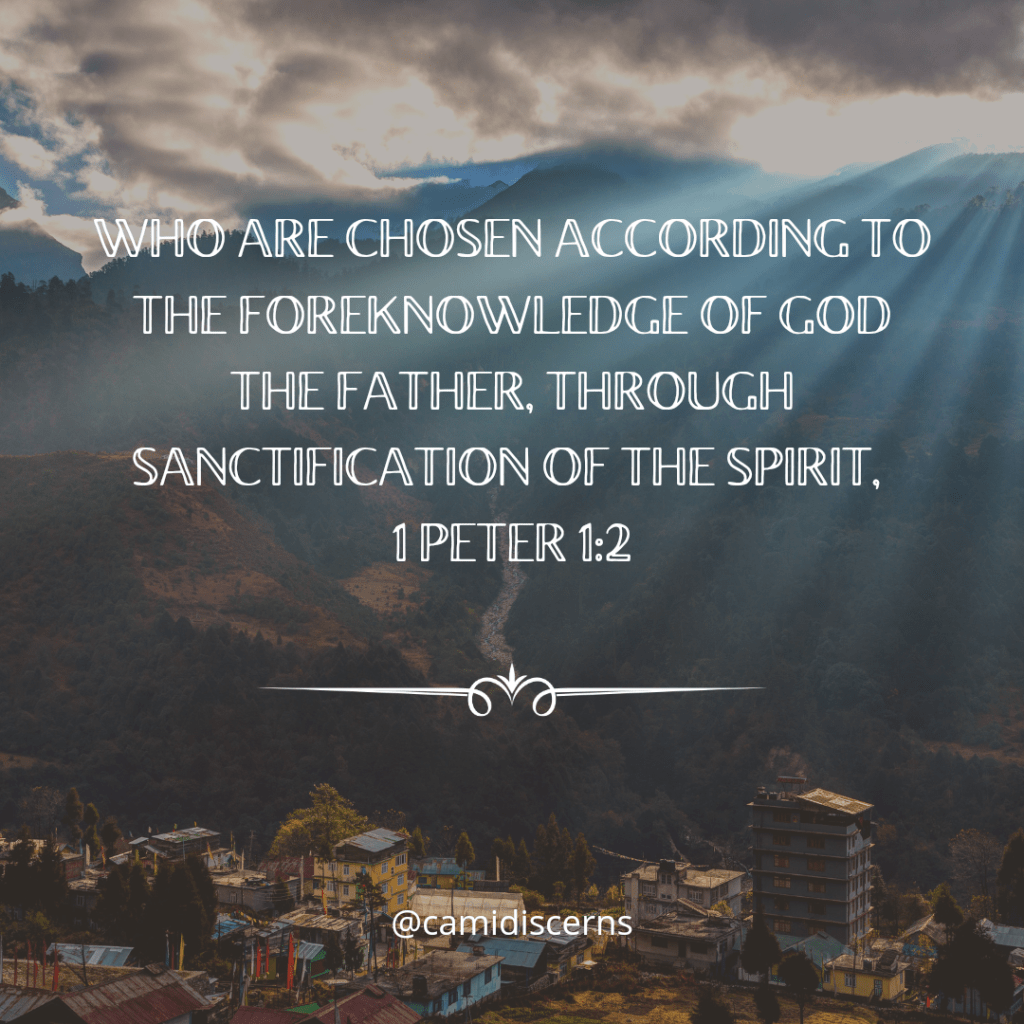
"...who are chosen according to the foreknowledge of God the Father, through sanctification of the Spirit, for obedience and sprinkling by the blood of Jesus Christ: Grace to you, and peace, be multiplied." 1 Peter 1:2
Many things are said in 1 Peter 1:2 about our salvation. The three persons of the Trinity in this verse.
We can see the cause and the origin of it (Cause & Effect) God’s choice.
God’s Will is the primary cause.
The manner and process:
The Spirit’s work.
The purpose and goal:
Obedience to Christ.
The means and basis:
The blood of Christ.
“… God has from the beginning chosen you to salvation through sanctification of the Spirit and belief in the truth.” 2 Thessalonians 2:13
Biblical Definitions
Here are examples of how the Biblical text uses the term which is translated “foreknowledge.”
In the Old Testament the word used is the Hebrew word “yada” which means “know.”
“You only have I known (Hebrew equivalent: chosen) of all the families of the earth…” Amos 3:2 KJV
This is the way God speaks of foreknowing in the sense that he set His special saving love upon us from before the foundation of the world.l
“Before I formed you in the womb, I knew [meaning “chose”] you, and before you were born I consecrated you; I appointed you a prophet to the nations.” Jer 1:5
Thus God foreknew God predestined God called God justified, and God glorified
They aren't separated.
Rom 8:30 puts it in the past tense, since what God set out to do is as good as done! This is precisely the point of the passage.
Let us take a look at the view of foreknowledge that says that God simply knew beforehand who would believe and therefore called them to be His children.
As noted above, the false belief that ” God does not preordain any individual to anything; but the individual actually ordains himself. God in effect complies with the individual’s choice.”
What does Scripture tell us of man's condition?
- It tells us that man is "dead in transgressions and sins" Eph 2:1.
- It says, "there is no one...who seeks God" Rom 3:10-11.
- Jesus declared, "No one can come to me unless the Father who sent me draws him" John 6:44.
In view of what Scripture teaches, what did (or would) God see beforehand looking down the corridors of time?
- He saw people "dead" spiritually, who rejected him (Rom 1:18-23)
People who, if left to themselves would never choose to come to Him.
A dead person cannot come up with a response of any kind.
A spiritually dead person, similarly, cannot generate faith so as to believe.
No, in eternity past, before the creation, the Fall, the covenants, or the Law, we were sovereignly predestined by God to be His.
God's purpose?
That we might be holy & blameless.
His motivation? Love.
"In love He predestined us to adoption as sons."
His goal & reason?
"to the praise of the glory of His grace."
“Before I formed you in the womb, I knew you, and before you were born I sanctified you, and I ordained you a prophet to the nations”. Jeremiah 1:5
Note: The same Hebrew word translated “knew” in this verse is translated “chosen” in Gen 18:19 and Amos 3:2
Jesus Foreordained Before The Foundation Of Earth
He was indeed foreordained before the foundation of the world, but was revealed in these last times for you. 1 Peter 1:20
Before He created the world, before mankind fell into sin God had a plan for the salvation of man, and Christ was at the heart of that plan. Eph 1:4; Acts 2:23.
God has not cast away his people whom he foreknew. Do you not know what the Scripture says about Elijah? This is how he pleads with God against Israel and says,
"Lord, they have killed your prophetsand torn down your altars,and I alone am left, and they seekmy life."
But what does the answer of Godsay to him?"I have reserved for myselfseven thousand men who havenot bowed the knee to Baal."Paul goes on:So also at this present time there is a remnant according to the choice of grace.And if by grace, then it is no longer by works.Otherwise grace would no longer be grace. But if it is by works, then it is no longer by grace. Otherwise work would no longer be work.What then? Israel did not obtain what it sought, but the chosen ones obtained it. And the rest were blinded.Romans 11:2-7
…even as he has chosen us in him before the foundation of the world, that we should be holy and blameless before him. In love he predestined us to the adoption as children to himself, by Jesus Christ, in accordance with the good pleasure of his will, to the praise of the glory of his grace, by which he has made us accepted in the Beloved.