Category: ESOTERICISM

  • Thoughts From The Spirit

    Thoughts From The Spirit

    The Spirit Is More Real Than The Material

    The One and Only Divine Creator has gifted a holy ruling upon His chosen ones, who are incredibly flawed yet cherished, to be forgiven from the consequences of their earthly forms through the Divine Mercy and Grace of the only Righteous One, Jesus Christ, Who, at a predestined moment, was tasked by The Father to Save you. The Mastermind behind every planet, star, organism, feeling, thought, and emotion has ordained us to be able to perceive things beyond the scope of our physical vision.

    Despite the false assertions made by mere mortals, we remain unaffected by their attempts to denounce what God has ordained or any passive aggression they employ to resist the works of God. We disregard their ego-driven, bad attitude because truth (God) is not intimidated by scrutiny.

    Despite existing in the physical realm, we comprehend that our body is God’s Property; we are His peculiar people.

    When the soul, once enslaved to the body, now belongs to the Divine Creator, salvation is impossible not to feel and comprehend cognitively.

    Who You Are

    As a Spiritual being, you receive information in a Divine way that transcends the constraints of the biological brain.

    Your soul is the essence of who you are, and the Holy Spirit governs your body, mind, and emotions.

    Through the power of the Spirit, you can connect with God and become One with the information (Wisdom) sent to you. This is because you are a Spiritual being, not bound by the material world.

    When God’s Spirit enters your stamina, it turns you over from the inside; out, preserving your soul for the day you will be reunited with the Divine source, YHWH.

    Although your physical body experiences pain and anguish, you comprehend that you are not a slave to the flesh but rather a spiritual being that is destined for eternal life, a slave to the Spirit, a slave to Righteousness.

  • God Declares the Beginning from the End: Trusting in God’s Plan for Our Lives

    God Declares the Beginning from the End: Trusting in God’s Plan for Our Lives

    Do you believe God is all-knowing?

    If so, then you must believe He knows the beginning from the end.

    The Bible tells us that God declares the beginning from the end and that He knows all things.

    In Isaiah 46:10, God says,

    “My purpose will stand, and I will do all that I please.”

    This verse tells us that God has a plan and He knows what He is doing.

    God’s plan for our lives is to bring us closer to Him and to enable us to live in His will. He knows the beginning from the end, and He will guide us through the journey. We can trust in Him and His plan for our lives.

    God is in control and knows the beginning from the end so that we can trust Him and His plan for our lives.

  • The Misconception Of Judgment And Contempt In Westernized Christian Society: Personal Relationships

    The Misconception Of Judgment And Contempt In Westernized Christian Society: Personal Relationships

    Misconception:

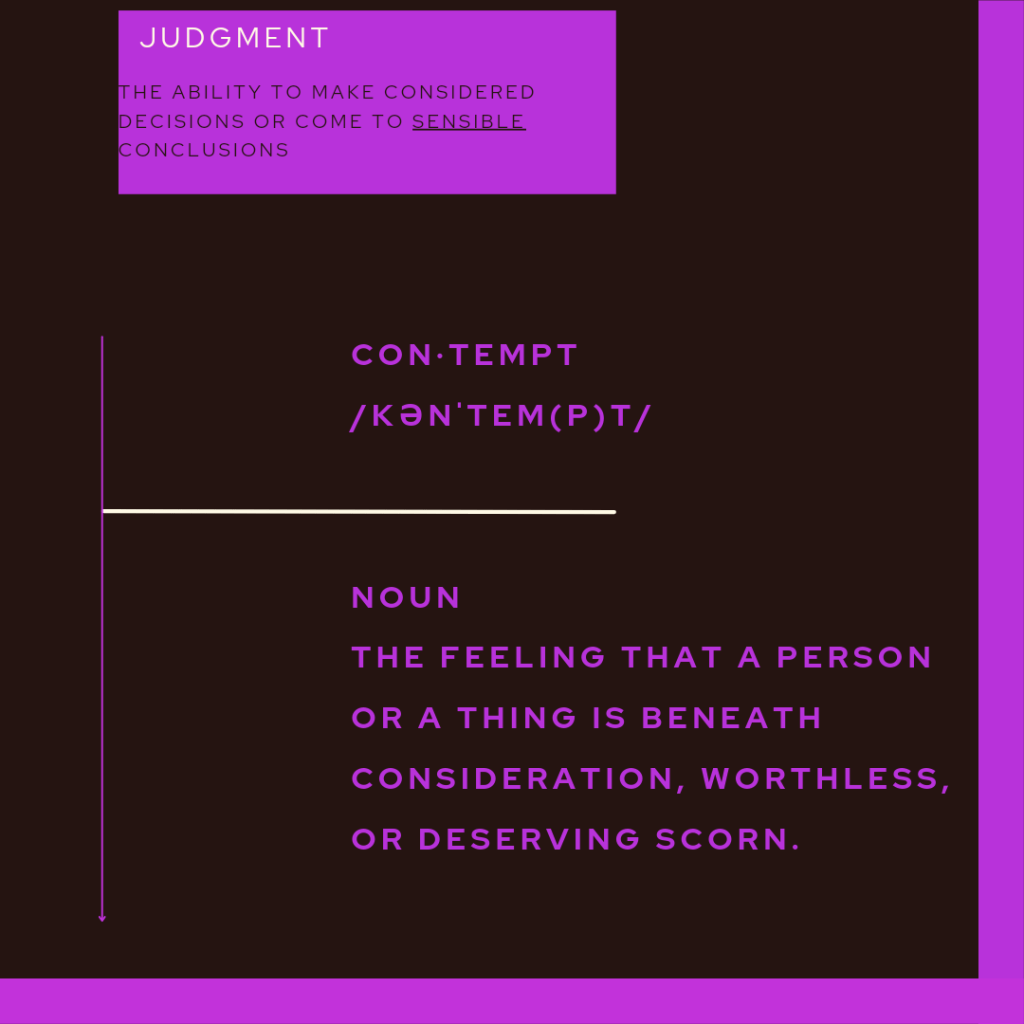
    Judgment is often misunderstood as synonymous with contempt in Westernized Christian society. However, judgment simply means forming an opinion or making a decision based on careful consideration of available information. Contempt, on the other hand, involves a deep-seated feeling of dislike or disrespect towards someone. It is important to distinguish between these two concepts in order to promote healthy communication and relationships.

    Judgment

    Judgment is the act of evaluating someone’s behavior or actions to form an opinion or make a decision. The Bible promotes the use of judgment, with Jesus urging his followers to judge righteously in John 7:24. This means that judgment can be a valuable tool for making thoughtful and empathetic choices.

    Judgment VS Contempt

    While judgment can be constructive and positive, contempt is a harmful emotion characterized by feelings of disrespect or disdain for others. It can be destructive to relationships and the Bible warns against it. Jesus himself cautioned against contempt when he said, “Do not judge, or you too will be judged” (Matthew 7:1).

    Contempt is a harmful emotion and can be destructive to relationships.

    Contempt can manifest itself in various ways, such as through insults, belittling, and dismissive behavior. It often stems from a sense of superiority or a desire to assert dominance over others. However, its negative effects can be far-reaching and long-lasting.

    Contempt In Personal Relationships

    Contempt in personal relationships can take different forms like insults, sarcasm, eye-rolling, dismissive behavior, and criticism. It can lead to a breakdown in communication and emotional connection, which is damaging in romantic relationships where love and mutual respect are crucial.

    A Vicious Cycle

    Contempt can lead to a negative cycle in a relationship and make it hard to resolve conflicts. In extreme cases, it can cause the relationship to end completely.

    Rehash

    To further illustrate the differences between judgment and contempt, let’s take a look at each concept in more detail.

    Judgment is the process of forming an opinion or making a decision through careful consideration or analysis. It involves making a rational and objective assessment of a situation or person based on available information. We use judgment every day to make decisions that affect our lives, such as which job to apply for or who to trust.

    Contempt Is Disrespect

    On the other hand, contempt is a feeling of disrespect or disgust towards someone or something. It is a negative emotion that arises when we perceive someone or something as inferior, unworthy, or despicable. Unlike judgment, which is based on information and logic, contempt is driven by emotions and can be irrational.
    While judgment can be helpful in making informed decisions, contempt can be damaging to relationships and create a negative environment. It can lead to resentment, anger, and an overall breakdown of communication and trust. When we feel contempt towards someone, we are less likely to listen to them, show empathy, or work towards a resolution.

    How To Use Judgment Righteously

    In order to use judgment effectively and avoid contempt, it’s important to approach situations with empathy, curiosity, and an open mind. Rather than jumping to conclusions or dismissing alternative viewpoints, we can seek to understand different perspectives and evaluate evidence objectively. By doing so, we can make informed decisions while maintaining positive relationships with others.

  • Charles Spurgeon Quotes About Free Will: PRINCE OF PREACHERS

    Charles Spurgeon Quotes About Free Will: PRINCE OF PREACHERS

    In his sermons and writings, Spurgeon often expressed his opposition to the argument of human free will, which he saw as a threat to the doctrine of grace and the glory of God.

    “I do not come into this pulpit hoping that perhaps somebody will of his own free will return to Christ. My hope lies in another quarter. I hope that my Master will lay hold of some of them and say, ‘You are mine, and you shall be mine. I claim you for myself.’”

    Charles Spurgeon

    Here Are Some More Quotes; All Sourced And Available To View

    “I believe that every particle of dust that dances in the sunbeam does not move an atom more or less than God wishes—that every particle of spray that dashes against the steamboat has its orbit as well as the sun in the heavens—that the chaff from the hand of the winnower is as much steered as the stars in their courses…The creeping of an aphid over the rosebud is as much fixed as the march of the devastating pestilence—the fall of leaves from a poplar is as fully ordained as the tumbling of an avalanche.”

    This quote is from Spurgeon’s sermon titled “A Defense of Calvinism,” delivered on June 5, 1855.

    “I do not come into this pulpit hoping that perhaps somebody will of his own free will return to Christ. My hope lies in another quarter. I hope that my Master will lay hold of some of them and say, ‘You are mine, and you shall be mine. I claim you for myself.’”

    “A Defense of Calvinism,” delivered on June 5, 1855.

    “The free will of man is a wretched idol, and deserves to be enthroned in hell.”

    “Sovereign Grace and Man’s Responsibility,” delivered on October 9, 1859.

    “Free will has carried many souls to hell, but never a soul to heaven.”

    “Spiritual Resurrection,” delivered on August 24, 1856.

    “If there is anything in the doctrine of the grace of God which commends it to us more than another, it is the sovereignty of it. If there is anything that is calculated to make men adore the grace of God, and to render them humble, it is the doctrine of the election of grace.”

    “Election,” delivered on August 2, 1857.

    Charles Spurgeon
    SERMON #52: VOL. 1 (1855)
    Free Will-A Slave

    THIS is one of the great guns of the Arminians; mounted upon the top of their walls, and often discharged with terrible noise against the poor Christians called Calvinists!

    I intend to spike the gun this morning, or, rather, to turn it on the enemy—for it was never theirs. It was never cast at their foundry at all, but was intended to teach the very opposite doctrine to that which they assert.

    Usually, when the text is taken, the divisions are—first that man has a will.

    Secondly, that he is entirely free.

    Thirdly, that men must make themselves willing to come to Christ, otherwise they will not be saved.

    Now, we shall have no such divisions! But we will endeavor to take a calmer look at the text, and not because there happens to be the words, “will,” or, “will not,” in it conclude that it teaches the doctrine of free will.

    It has already been proved beyond all controversy that free will is nonsense!
    Freedom cannot belong to will any more than ponderability can belong to electricity. They are altogether different things.

    Free agency we may believe in, but free will is simply ridiculous.

    The will is well-known by all to be directed by understanding, to be moved by motives, be guided by other parts of the soul, and be a secondary thing. Philosophy and religion both discard at once the very thought of free will! And I will go as far as Martin Luther, in that strong assertion of his, where he says, “If any man does ascribe anything of salvation, even the very least to the free will of man, he knows nothing of divine grace, and he has not learnt Jesus Christ aright.”
    It may seem a harsh sentiment, but he who in his soul believes that man does of his own free will turn to God, cannot have been taught of God—for that is one of the first principles taught us when God begins with us—that we have neither will nor power—but that He gives both—that He is “Alpha and Omega” in the salvation of men.

    SERMON #52: VOL. 1 (1855)
    Free Will-A Slave
    DELIVERED ON DECEMBER 02, 1855

    To Read The Full Sermon: I created THIS NOTE.

    “Free will carried many a soul
    to hell, but never a soul to
    heaven.”

  • Cognitive Empathy; Powerful Empathy

    Cognitive Empathy; Powerful Empathy

    Empathy is the ability to understand and share the feelings of others; allowing us to connect deeply with others; feeling their emotions, and responding with comprehension and mercy.

    The concept of empathy has been widely studied in the field of psychology, with various definitions and dimensions being proposed. In essence; Empathy directs us to put ourselves in someone else’s shoes and view the world from their viewpoint.

    EMPATHY IS OFTEN ASSOCIATED WITH FRAGILITY OR VULNERABILITY

    Unfortunately, many people see empathy as a weakness or deficiency. Empathy is believed to make us vulnerable, and vulnerability is usually viewed as a weakness in our narcissistically driven society. But I believe that empathy is a strength.
    It takes gutsiness to put ourselves in someone else’s shoes, sense their pain, and respond graciously.

    WHAT’S THE DIFFERENCE BETWEEN EMPATHY & COGNITIVE EMPATHY?

    One dimension of empathy is cognitive empathy, which refers to the ability to understand and predict the thoughts and feelings of others, while maintaining a certain level of emotional detachment.
    In contrast, empathy is frequently characterized as the ability to share and experience the emotions of others, usually resulting in a more emotional response.
    Cognitive empathy and empathy differ in their cause and effect.
    Cognitive empathy relies on cognitive techniques such as perspective-taking and mentalizing, which allow individuals to understand the thoughts and feelings of others without necessarily experiencing them themselves.
    This is useful in situations where emotional detachment is necessary.

    PERSPECTIVE-TAKING AND MENTALIZING

    The concept of perspective-taking and mentalizing implies that humans possess a remarkable capacity to step outside of their own subjective experiences & understand with objective comprehension, the subjective experiences of another.

    This capacity to understand the thoughts and feelings of others without experiencing them directly is a powerful ability; demonstrating that humans are capable of transcending their own identity and connect with others on a deeper level; revealing profound insight into the nature of human consciousness and the possibilities for human connection and comprehension beyond the status quo.

    COGNITIVE EMPATHY IS THE ABILITY TO UNDERSTAND AND APPRECIATE OTHER PEOPLE’S PERSPECTIVES. IT’S AN IMPRESSIVE SKILL

    Cognitive Empathy is a complex and multi-layered concept. At its core, cognitive empathy involves the ability to put oneself in another person’s shoes, to see the world from their perspective, and to truly understand their thoughts, feelings, and motivations.
    This requires an elevated capacity of emotional intelligence, as well as a willingness to give attention to, observe, and learn from others.

    Cognitive Empathy is not just about understanding others but also about utilizing that understanding to construct stronger connections, determine dissensions, and facilitate reciprocal insight and regard.
    It is an essential skill needed to function healthily in this interconnected world, where multiplicity and cultural discrepancies are increasing.

    Cognitive empathy, is also known  in some areas of education as empathic accuracy, and can be viewed as a gift from God that allows us to transcend our ego and truly feel the experiences of those around us.
    COGNITIVE EMPATHY IS THE OPPOSITE OF WEAKNESS

    Cognitive empathy requires a high degree of emotional intelligence. Contrary to popular belief, cognitive empathy is not a sign of weakness but rather a strength. It requires a great deal of mental and emotional effort to put oneself in another person’s shoes and truly understand their perspective without any interjections.

    This level of empathy is potent and rare.

  • Have You Ever? Inner Child Work #1

    Have You Ever? Inner Child Work #1

    Have you ever found yourself suppressing your emotions until they burst uncontrollably, leaving you embarrassed and ashamed? Do you feel like you’re constantly pretending to be strong and invincible while you know you’re fragile deep down? It can be challenging to confront the impact of past trauma and the vulnerability that comes with it. Sometimes, it’s easier to hide from the pain and pretend everything is okay. But the truth is, those moments of weakness and uncontrollable reactions are signs that a part of you is screaming to be heard. You’re not alone in this struggle. Many people experience the same feeling of hiding from their past traumas. In this blog, we’ll delve into this common experience and share some insights on how to begin to heal and move forward.

    Your Inner Child

    As human beings, we all have an inner child, a part of us that is innocent, curious, and full of wonder. It is the part of us that holds our deepest desires, dreams, creativity, and playfulness. However, many of us have rejected and disowned this inner child, leading to feelings of shame, guilt, and self-betrayal.

    This rejection often stems from our early experiences with our caretakers, who deemed certain aspects of our inner child unacceptable. When our inner child expressed itself in ways that did not meet our caretakers’ expectations or values, we were criticized, condemned, punished, retaliated against, or had our approval withheld. These experiences left us feeling unworthy, unlovable and rejected, and we learned to push these traits into our unconscious mind’s dark corner, also known as the “Shadow.”

    We did this to please our caretakers, hoping to be accepted and suffer a little less. However, this self-betrayal came at a high cost, as we lost touch with our true selves and our innate sense of joy and creativity. Our Shadow became a place of shame, fear, and self-doubt, where we buried our deepest desires and aspirations.

    To reclaim our inner child and heal our wounds, we must acknowledge how we have disowned ourselves and betrayed our true nature. We must become aware of the messages we receive from our caretakers and learn to challenge them, recognizing that they are not always accurate or fair.

    We must also learn to embrace our Shadow, acknowledging the parts of ourselves that we have rejected and bringing them into the light of our consciousness. Doing so can heal our wounds and reclaim our sense of self, allowing our inner child to flourish again.

    Important Note

    Your inner child is NOT the Shadow; your inner child is trapped within the Shadow, and this is often misunderstood. Your inner child isn’t darkness; they are clouded by darkness.

    According to Jung, the unconscious mind holds repressed memories and emotions that can manifest in our conscious lives as psychological distress. Trauma can create a split between our conscious and unconscious selves, leading to feelings of fragmentation and disconnection.

    SUPPRESSING EMOTIONS LEADS TO MORE PAIN

    I know it’s tough to deal with your inner child. I’ve been there. Trust me; I’m still there. It’s easy to want to push those feelings down and pretend they don’t exist, but that will only make things worse in the long run. It’s like trying to hold a beach ball underwater – eventually, it will pop up and hit you in the face.

    I’m approaching 35, and I can tell you that it’s true that when we bottle up our emotions and memories: they fester and grow into resentment, fear, and chaos.

    Eventually, they become too much to manage and burst out of us uncontrollably, obliterating our lives and dampening the lives of those we love, often without our conscious understanding of “why.” This is what happens when there’s separation.

    Sin Is Separation

    Sin is like a shadow that clouds our inner child from integration. This Shadow represents the parts of ourselves that we hide and don’t acknowledge.

    This reveals that our wholeness involves reconciling the separation caused by sin and restoring all those aspects within sin’s shadow to wholeness or unity.

    Sin is like a veil that covers our eyes and prevents us from seeing the truth. Just as a shadow follows us wherever we go, evil follows us wherever we turn. It is a constant reminder of our imperfections and our need for redemption.

    The Shadow represents the darkness within us, the parts of us that we try to hide from the world and ourselves because those parts were rejected by those most important to us during development.

    It is the part of us that is wounded and broken and needs healing and restoration. When sin clouds our inner child, we prevent ourselves from experiencing the fullness of life God intended for us.

    Related Bible Verses:

    Psalm 139:23-24 says, “Search me, God, and know my heart; test me and know my anxious thoughts. See if there is any offensive way in me, and lead me in the way everlasting.”

    This verse acknowledges the need for self-examination and the recognition of sin to be led toward eternal life.

    Another verse that speaks to the importance of integrating the Shadow is James 5:16, which says,

    “Therefore, confess your sins to each other and pray for each other so that you may be healed. The prayer of a righteous person is powerful and effective.” 
    This verse emphasizes the power of confession; but we can't confess to something we bury.

    Signs You’re At Battle With Your Shadow

    At War With Self

    It’s like you’re at war with yourself, trying to keep a lid on your emotions while they bubble and boil beneath the surface.

    And when those emotions finally do burst uncontrollably, it can be embarrassing and shameful.

    You Feel You’ve Lost Control

    You might feel like you’ve lost control like you’re not the person you thought you were.

    Control is not what you should seek.

    Instead of suppressing your emotions, try to find healthy ways to express and process them and allow them to flow naturally.

    Easier said than done, I know.

    WE MUST BE PREPARED TO FACE INNER DEMONS

    It’s time to face your inner demons and integrate your soul, so you can finally find peace and live a fulfilling life.

    How Do I Do This?

    As someone toiling on the shadow integration process, I understand that it can be a difficult and uncomfortable journey.

    However, I deem it an essential step toward achieving emotional healing and inner peace; it’s at least a step in the right direction.

    Our inner demons are usually rooted in past experiences & traumas that we have not fully processed or resolved.

    REFLECTION

    By reflecting on my past experiences and identifying patterns in my thoughts and behaviors, I was able to understand the underlying emotions associated with my trauma.

    This allowed me to begin healing and reintegrating my conscious and unconscious selves.

    Confront Introspection Head On

    By confronting these uncomfortable emotions and memories, we can, paradoxically, begin to be released from their hold on us and move toward healing.

    By identifying patterns and triggers that lead to negative emotions and behaviors, I can begin to understand the root causes of my inner demons.

    Quit Denying God’s Creation

    The Bible teaches us that we are fearfully and wonderfully made, including our inner child.

    When we push down a part of ourselves screaming to be heard, we deny God’s creation within us.

    The feelings of disconnection from God, dissatisfaction with our spiritual lives, and spiritual distress are perpetuated. Ignoring our inner voice can also lead to a sense of inauthenticity in our relationship with God.

    We cannot fully surrender to God when we suppress a part of ourselves. This creates a sense of internal conflict, making forming an authentic relationship with God even more challenging.

    WHERE I FOCUS: GOD’S OMNIPRESENCE

    As I continue in the trenches of shadow integration, I am reminded of the omnipresence of God.

    He is always with me.

    His light is the only thing that can illuminate the darkest corners of my being.

    Only through His grace and love can I continue confronting and integrating my shadow self.

    As I work through this process, I am reminded of the words of Psalm 139:12:

    Even the darkness will not be dark to you; the night will shine like the day, for darkness is as light to you.”

    God sees and knows all parts of us, and He is with us every step as we integrate our shadows through His Power.

    Biblical Examples Of Confronting Shadow

    1. David had to confront his sins and weaknesses to become a better king and leader.

    2. Peter had to confront his fear and doubt to become a mighty apostle.

    I am also reminded of Psalm 139:23-24, which says, “Search me, God, and know my heart; test me and know my anxious thoughts. See if there is any offensive way in me, and lead me in the way everlasting.”

    There’s Worth in Jungian Analytical Psychology

    Trauma can leave us feeling broken, disconnected, and alone. It can make us feel like we live in a hostile and unpredictable world where danger lurks around every corner.  

    The Jungian perspective on trauma offers a robust framework for healing and transformation.

    It recognizes that trauma is not just an event that happens to us but a process that unfolds within us. It acknowledges that trauma can shatter our sense of self and our connection to the world, but it also recognizes that we can heal and grow beyond our trauma. Through Jungian therapy, we can explore the hidden parts of ourselves that have been wounded by trying to cope with trauma.

    Suffering Has Purpose

    We can find meaning and purpose in our suffering and use our experiences to help others struggling with similar challenges.

    Most importantly, we can rediscover our sense of wholeness and connection.

    But there is hope.

    Just as the sun shines brightly and dispels the darkness, so too can the light of God’s love dispel the Shadow of sin.

    Through repentance and faith in Jesus Christ, with a sincere heart and mind, we can be forgiven and restored to wholeness.

    So let us not be afraid to confront the Shadow within us. Let us bring it into the light of God’s love and allow Him to heal us and make us whole. For in Him, there is no darkness, only light and life everlasting.

  • DARK NIGHT OF THE SOUL {St. John Of The Cross intro}

    DARK NIGHT OF THE SOUL {St. John Of The Cross intro}

    To read the original text online I have created a weblink so you don’t have to download it. 🔗St. John Dark Night Of The Soul

    ST JOHN OF THE CROSS OVERVIEW

    St. John of the Cross was not only a Spanish mystic from the Middle Ages but also a prominent figure in the Catholic Church. He was a Carmelite friar and a close friend of St. Teresa of Avila, another mystic and reformer of the Church.

    However, his views and teachings were not always well-received by the Church authorities, and he was eventually captured and tortured for his beliefs.

    During his imprisonment, St. John of the Cross experienced a profound spiritual crisis, which he later described as the “night of the soul.” This phrase has since become interchangeable with a period of severe spiritual struggle and doubt, often characterized by a feeling of desertion by God.

    Despite his suffering, St. John of the Cross continued to write and teach, and his works profoundly influenced Christian spirituality. His most famous work, “The Dark Night of the Soul,” is a poetic and philosophical exploration of the nature of God and the human soul and has been praised for its profound insights into the mysteries of faith. Today, St. John of the Cross is recognized as one of the greatest mystics and spiritual writers in the Christian tradition. His teachings continue to inspire and challenge believers worldwide.

    “In the twilight of life, God will not judge us on our earthly possessions and human successes, but on how well we have loved.” – John of the Cross

    He coined a phrase to depict a moment when a person confronts agonizing trials that shake the core of their being.

    My Experience

    I have some firsthand experience with existence and consciousness. Nothing is more devastating than realizing what you thought you had was never really yours, leaving you at square one. It feels like death. Rebuilding is excruciating, especially with unsympathetic people around you who aren’t self-aware enough to care. During a dark night of the soul, escape and hopelessness can seem impossible.

    Don’t lose hope in the dark night. It’s not punishment, it’s just the start of something new.

    A DARK NIGHT CALLS YOU IN TO CHANGE

    “We are afflicted in every way, but not crushed; perplexed, but not driven to despair; persecuted, but not forsaken; struck down, but not destroyed; always carrying in the body the death of Jesus, so that the life of Jesus may also be manifested in our bodies”(2 Cor. 4:7–10)

    The dark night doesn’t just call for a reassessment, it forces you to question everything – who you are, what you know, and what you have. You may find that material possessions mean nothing at all.

    I form light and create darkness; I make well-being and create calamity; I am the LORD, who does all these things. “Shower, O heavens, from above, and let the clouds rain down righteousness; let the earth open, that salvation and righteousness may bear fruit; let the earth cause them both to sprout; I the LORD have created it. Woe to him who strives with him who formed him, a pot among earthen pots! Does the clay say to him who forms it, ‘What are you making?’ or ‘Your work has no handles’? Isaiah 45:7–9

    The dark night of the soul can be a spiritual death, leading some to resort to suicide. However, for those who endure, it can be a doorway to a freer, more self-realized existence with a stronger faith and clearer understanding of sin.

    “Very truly I tell you Pharisees, anyone who does not enter the sheep pen by the gate, but climbs in by some other way, is a thief and a robber… The one who enters by the gate is the shepherd of the sheep… Therefore Jesus said again, “Very truly I tell you, I am the gate for the sheep. John 10:1,2,7

    To navigate the dark night of the soul, one must persist and surrender. It’s akin to being “baptized in fire” as Scripture suggests – either we are consumed or refined, with no other options. There’s no sugar-coating or avoiding this experience, and even finding the strength to try can be a challenge. The only way to move forward is to go through it, or risk being stuck in it indefinitely.

    Questions To Ask Yourself If You Are Experiencing A Dark Night Of The Soul

    What subjective beliefs do you hold about life? What entitlements do you feel? What surface beliefs and personas do you identify with that may not align with your core self? What beliefs do you fear questioning because they conflict with your support system?

    The Enigmatic Allure of a Dark Night

    The allure of a dark night beckons you to delve into the depths of life and access profound wisdom. It challenges you to tap into the Mind of God and rely solely on the Word of God, all by the Will of God. From the darkness, you have the opportunity to catch a tiny glimpse of the incredible feat that God accomplished over the face of the deep. It’s mind-boggling to fathom how God, through the Power of His Word, created something out of nothing and declared it GOOD. Even the mere prospect of a dark night can make us shed our skin and leap into the unknown.

  • Be Known By Him

    Be Known By Him

    To draw near to God is to be known by God.

    • James 4:8 – “Draw near to God and He will draw near to you.”
    • Corinthians 8:3 – “But if anyone loves God, he is known by God.”
    • Psalm 139:1 – “O Lord, you have searched me and known me.”

    Wisdom is not: Do you know God?

    Wisdom is: Does He know you?

    ARE YOU KNOWN?

    Jeremiah 1:5 says; “Before I formed you in the womb I knew you, before you were born I set you apart; I appointed you as a prophet to the nations.”

    He alone imparts us the veins connecting Life to our body and soul, linking our capacity to grasp this Knowledge.

    Without this vesicular “pulse,” no man can master “KNOWING” because it is the language of the Heavens, not the language of man.

    To come to know Him, we must read His Word, pray and seek Him with all our hearts (Jeremiah 29:13).

    When we do this, we will grow in our knowledge of Him and be blessed with His wisdom and insight into His ways, which often oppose the world’s ways.

    Without His divine beat,
    We'd never understand,
    The language of the heavens,
    Not that of man.
    It's the pulse of God that we can know;
    It's the only way to do spiritually grow,
    It's the language of the heavens,
    That we,as God's, will know.
  • WHAT CAN LIMIT GOD’S WILL: DOES GOD STILL SPEAK?

    WHAT CAN LIMIT GOD’S WILL: DOES GOD STILL SPEAK?

    The power of God's will cannot be understated. He is the master of all creation, and everything is subject to His purpose and plan. As believers, we must trust in His infinite wisdom and understand that our will is ultimately dependent on His. Through Christ, we can be freed from the bondage of sin and operate in God's will, rejecting anything that goes against it. Though we may not always understand God's ways or the trials we face, we can trust in His love and grace to guide us through. 

    WHAT DOES GOD’S WILL DEPEND UPON?

    Nothing, except for His own Will

    God is the ultimate source of knowledge and power, and only He can bring about His will. He is all-knowing and all-powerful, with complete control over everything in creation. His sovereignty is evident in how He has ordained all things that come to pass.

    In everything that happens, His omniscience and omnipotence are at work, and He alone can bring about His foreknowledge. He directs all things according to the counsel of His will, and this will be accomplished in due time, no matter how long it takes.

    Through it all, God remains faithful and trustworthy. However, some may ask if God is only Almighty and Powerful but operates in accordance with His creatures’ will rather than His own. Still, we can trust that God is working out His ultimate plan for our lives and fulfilling His purposes, even if we do not always understand His ways.

    Do We Permit God To Act?

    As we submit to the divine will of the Potter, we become vessels of honor, fit for His use. While we may not always understand His methods or the path He leads us on, we can trust that He has a purpose for every trial and tribulation we face. Our Potter is not only sovereign and all-powerful, but He is also a God of love and mercy, who desires the very best for us. As we surrender to Him, we can rest assured that our lives are in good hands, and that our Potter will mold us into vessels of beauty and significance, fulfilling His eternal purposes through us.
    Ephesians 2:3 & Collossians 2:13 says we were dead in the trespasses & sins & by nature children of wrath.

    Is the human will truly free if it is restricted by sin or righteousness, the flesh or the Spirit?

    When Scripture speaks of us being slaves, it is not referring to physical servitude, but rather to our will. Our hearts and wills are enslaved to wickedness. The will of humanity can only be freed from the bonds of righteousness; our will is only free when it is freed from the bonds of sin. The choices we make and the thoughts we think are determined by the will we have; we are not our own.

    IF OUR WILL IS FREE, WHAT IS IT FREE FROM?

    Romans 6:6 states that our old self, including our will, was crucified with Him, so that the body of sin could be rendered powerless, and we would no longer be enslaved to sin.

    "You who were once slaves of sin have become obedient FROM THE HEART to the standard of teaching to which you WERE COMMITTED, &, having BEEN SET FREE from sin, have become slaves of righteousness.
    When you were slaves of sin, you were free in regard to righteousness...the end of those things is death.
    NOW that you have been set free from sin & have become SLAVES of God, the FRUIT YOU GET leads to sanctification & its end, eternal life."
    Romans 6:17‭-‬18‭, ‬20‭-‬22

    ✝️”All Scripture is breathed out by God & profitable for teaching, reproof, correction, & training in righteousness, that the man of God may be complete, equipped for every good work.”
    ✝️”The Word of God is living & active, sharper than any two-edged sword, piercing to the division of soul & of spirit, of joints & of marrow, & discerning the thoughts & intentions of the heart”
    Hebrews 4:12

    EVERYTHING CAME TO BE BY GODS WORD

    God’s voice is a powerful force that brings creation into existence. From the seen to the unseen, everything came into being because of His spoken word. Before the scrolls were written, God spoke and His Word was made flesh through His Son and the guidance of the Holy Spirit. The apostles were instrumental in forming the infallible completed Word of God, which is the entire revelation of God. Through this revelation, the veil is lifted for all who belong to Him and they come to know God intimately.

    In the past, God spoke to our forefathers through prophets in many different ways. But in these last days, He speaks to us through His Son, who is appointed the heir of all things. Through His Son, the world was created and upheld by the word of His power. His Son is the exact imprint of God’s nature and the radiance of His glory. And after making purification for sins, He sits at the right hand of the Majesty on high, having become superior to angels.

    POWER OF GOD’S WORD

    In Hebrews 1:1-4, we are reminded of the power and authority of God’s spoken word, and how He continues to reveal Himself through the Word made flesh, His Son. As we study and meditate on the Word, we will come to know Him more deeply and be transformed by His power.

    ✝️”Long ago, at many times and in many ways, God spoke to our fathers by the prophets, but in these last days He has spoken to us by His Son, whom HE appointed the heir of all things, through whom also He created the world. He is the radiance of the glory of God and the exact imprint of His nature, and He upholds the universe by the WORD OF HIS POWER. After making purification for sins, HE sat down at the right hand of the Majesty on high, having become as much superior to angels as the name He has inherited is more excellent than theirs.”

    Hebrews 1:1‭-‬4

    It’s important to remember that in the time of Noah, God spoke exclusively and His Word wasn’t complete like it is now. Noah wasn’t relying on his imagination; he knew that if God spoke, he needed to listen. Today, our imaginations can be filled with garbage that we’ve been exposed to since birth through various programming. Comparing ourselves to Noah or any of the Prophets isn’t fair because they didn’t have the distractions we have today.

    It’s also important to question what we see and hear and stand firm in our faith in Jesus Christ and the infallible Word of God. Even though Noah had free will, we must question what his will was truly free from since it was bound by God’s will.

    We cannot give glory to Noah for the formation of the ark, as all glory belongs to God for using Noah to accomplish His purpose. We mustn’t start down the path of honoring mere men and taking away honor from the One who deserves it all. Everything is for God, by God, and through God. He creates and establishes all things for His will.

    WHO GIVES ABRAHAM FAITH?

    The question of who gives faith to Abraham, and whether man is truly able to come to faith by his own will, is one that has been debated throughout history. Some believe that faith is purely a matter of personal will, while others argue that it is a gift from God.

    It is clear from scripture that God is the one who graces his people with faith. In fact, we are told that even Abraham, the father of faith, received his faith as a gift from God (Romans 4:16).

    BUT WHAT ABOUT THE SPIRITUALLY DEAD?

    Can they come to faith on their own, without the help of God’s grace? The answer is a resounding no. Scripture is clear that it is only through God’s will that the spiritually dead can wake up to eternal life.

    This raises an important theological question: if we are saved by our own good use of God’s grace, then shouldn’t we share in the praise? The answer, of course, is no. All praise belongs to God, who is the one who gives us the faith we need to be saved.

    It is also important to recognize that God speaks to his people with a purpose. He led the apostles to form his church and to teach us the heavenly things that are not seen or heard. We don’t rely on our physical senses anymore, but instead on faith with our evidence being revealed through his spirit interceding with ours.

    GOD HAS ALREADY SPOKE

    But what’s even more amazing is that we get to say that God has already spoken. The revelation of the coming Christ has been written and exposed, and the ending is known. We don’t need any more revelation; we have the revelation!

    That being said, we must recognize that we are fallible, imaginative creatures living in a crooked and perverse generation. We are inundated with lies, and we can’t believe everything we hear and see, even if it feels like it’s from God. We must be cautious and discerning, and always seek God’s will above our own.

    In the end, it is clear that God does as he wills, creating vessels of mercy as well as vessels of wrath. It is up to us to trust in his grace and seek his will in all things.

    ✝️”…though they were not yet born & had done nothing either good or bad—in order that God’s PURPOSE OF ELECTION might continue, not because of works but because of Him who calls— she was told, “The older will serve the younger.” As it is written, “Jacob I loved, but Esau I hated.” …
    What shall we say then? Is there injustice on God’s part? By no means!
    He says to Moses, “I will have mercy on whom I have mercy, & I will have compassion on whom I have compassion.”
    *** It depends NOT ON HUMAN WILL or exertion, but ON GOD, who has mercy.
    For the Scripture says to Pharaoh, “For this very purpose I have raised you up, that I might SHOW MY POWER IN YOU, & that MY NAME might be proclaimed in all the earth.”
    So then He has mercy on WHOMEVER HE WILLS, & He hardens WHOMEVER HE WILLS.
    You will say to me then, “Why does HE still find fault? For who can resist His Will?”
    But who are you, O man, to answer back to God?
    ***Will what is molded say to its Molder, “Why have You made me like this?”
    ***Has the Potter no right over the clay, to make out of the same lump one vessel for honorable use and another for dishonorable use?
    What if God, DESIRING TO SHOW HIS WRATH and MAKE KNOWN HIS POWER, has endured with much patience VESSELS OF WRATH PREPARED FOR DESTRUCTION, in order to MAKE KNOWN the riches of His GLORY for vessels of mercy, which He has prepared beforehand for glory— even us whom He has called, not from the Jews only but also from the Gentiles?

    Romans 9:11‭-‬24

    OUR WILL POWER DEPENDS ON GOD

    As human beings, we often tend to believe that our willpower is solely dependent on ourselves. However, the truth is that our will is dependent on the one who has written our will – God. The Bible tells us that we are not our own and that we belong to God. Additionally, those who are not bound to God’s will, like the Jews who were called children of the devil, are unable to believe.

    When we are born, we have a will to sin and are free from righteousness. However, through Christ, we can be adopted by God’s Spirit and be freed from the bondage of sin. This allows us to operate in His will and reject anything that goes against it. We develop a new will through God’s Spirit that guides our actions.

    It is important to understand the fallibility of the human mind and senses when determining doctrine. Even if God speaks to us, He knows our limitations and what we will do. He may will something to happen, even if it causes us pain or hardship. We cannot always understand the reasons why things happen, but we trust that God’s infinite wisdom is guiding everything.

    It is true that God’s will is not always easy to understand or accept. We see things from a temporal perspective, whereas God sees the entire picture all at once. He sees the purpose in things that we cannot comprehend. Just because something hurts us in this life doesn’t mean it wasn’t willed by God for our spiritual growth and benefit.

    As believers, we must trust in the strength of God’s will over the will of the enemy and the world. We must remember that God is not weak and that nothing happens outside of His will. This can be difficult to comprehend, especially when we face trials or hardships, but God’s love and wisdom never fails us. We can have peace in knowing that everything is subject to God and His purpose, even when we don’t understand it.

    REVELATIONS WARNING

    At the end of the book of Revelation, John delivers a solemn warning to anyone who hears the prophecy contained within its pages. Should anyone add to or take away from the words of this book, God will bring upon them the plagues described within its pages. Moreover, God will deny them a share in the tree of life and the holy city that are also described within this sacred text.

    He who bears witness to these things declares, “I am coming soon.” Let us all say, “Amen. Come, Lord Jesus!” May the grace of our Lord Jesus be with you all. Amen. (Revelation 22:18-21)

  • The 5 ‘I Wills’ of Satan

    The 5 ‘I Wills’ of Satan

    Let’s consider the five “I WILLS” of Lucifer as found in Isaiah 14:13- 14

    “I WILL ASCEND ABOVE THE HEIGHTS OF THE CLOUDS AND SHALL BE LIKE THE MOST HIGH!”

    Lucifer’s vision was not merely a quest for power and control but a deep-seated desire to transcend his current state and attain a level of divinity that rivaled that of the Almighty. He yearned to be more than just an angel, elevated to supreme authority and influence. He believed that he possessed the strength and wisdom to rule over all creation and saw himself as the rightful heir to the throne of Heaven. However, in his arrogance and pride, he failed to recognize that true power and greatness come not from domination and control but from humility and service. His misguided ambition ultimately led to his downfall, as he was cast out of Heaven and condemned to eternal damnation.

    Exodus 13:21-22 says,

    “By day the Lord went ahead of them in a pillar of cloud to guide them on their way and by night in a pillar of fire to give them light, so that they could travel by day or night. Neither the pillar of cloud by day nor the pillar of fire by night left its place in front of the people”.

    I WILL EXALT MY THRONE ABOVE THE STARS OF GOD.

    Lucifer’s fall from grace is a cautionary tale of the dangers of pride and ambition. Even in the presence of God’s throne, Lucifer was not satisfied with his position and longed for more power and authority. His desire to rule over all the angels was a manifestation of his insatiable thirst for greatness, a thirst that could never be quenched.

    Lucifer’s desire to shine brighter than all the other stars is a metaphor for the human desire for recognition and validation. We often seek external validation to feel worthy and necessary, but true fulfillment can only come from within. When our ego drives us, we become blind to the beauty and wonder of the world around us, and our light dims.

    I WILL SIT ALSO UPON THE MOUNT OF THE CONGREGATION.

    The dark forces of the universe were at work as Satan yearned to ascend to the highest throne, seeking to reign supreme over all the celestial beings. His insatiable desire for power and control was fueled by a deep-seated need to be worshipped and adored, the object of all reverence and devotion. His twisted ambition knew no bounds as he sought to become the ultimate idol, the one to whom all would bow down and pledge allegiance. But in his quest for supremacy, he lost sight of the trustworthy source of spiritual fulfillment and became consumed by his ego and vanity.

    I WILL ASCEND ABOVE THE HEIGHTS OF THE CLOUDS.

    The symbolism of “clouds” in the Bible is rich with meaning, representing the majesty and power of God. As we read in Matthew 24:30, the clouds will part and reveal the Son of Man coming in all His glory. This is a powerful image of the divine presence, a reminder of the awe-inspiring nature of God.

    However, the story of Lucifer reminds us that even the most beautiful and powerful creatures can fall from grace. His desire for glory and adoration led him to rebel against God and seek his own path. This is a cautionary tale for all of us, a reminder that our pride and ego can lead us down a dangerous path.

    Ultimately, the lesson of the clouds and the story of Lucifer is one of humility and surrender. We must recognize that all of our gifts and talents come from God and that our true purpose is to glorify Him, not ourselves. Only by submitting to His will can we find true fulfillment and joy.

    I WILL BE LIKE THE MOST HIGH.

    He yearned to transcend his mortal limitations and ascend to the divine realm, to stand on equal footing with the Almighty and assume the mantle of ultimate power and authority. His ambition was to break free from the chains of subservience and become a self-sufficient being, accountable to no higher authority. In his quest for absolute autonomy, he sought to overthrow the very foundations of creation and establish himself as the sole judge of destiny.