Category: Psychology

Dive into the fascinating world of psychology with CamiDiscerns.

  • Synchronicity

    Converging matter and mind

    Synchronicity is a force that links the inner world of the mind (psyche) and the outer world of matter (physis) through meaning rather than direct cause-and-effect. 

    1234]

    So synchronicity is an acausal connecting principle, meaningful coincidence, acausal parallelism, or meaningful coincidence — of two or more events where something other than the probability of chance is involved.
    -Carl G. Jung (1960), Synchronicity: An Acausal Connecting Principle, Princeton University Press, 2012, p. 44.

    Understanding Jung’s Theory

    Carl Jung developed this concept to describe a simultaneous occurrence of a psychic state with one or more external events.

    Unlike linear causality (where A causes B), synchronicity suggests a deeper order in the universe where the inner subjective event is mirroredby an objective one. Jung’s ideas were famously influenced by his collaboration with physicist Wolfgang Pauli, leading to the Pauli-Jung Conjecture, which explores the bridge between physics and psychology.

    Core Elements of a Synchronistic Event

    To be considered a true synchronicity in the Jungian sense, three components usually align:

    • Internal State: A specific thought, dream, or emotion.
    • External Event: An objective occurrence in the physical world.
    • Acausal Connection: The two are linked by meaning, not by any detectable physical cause.

    One of the most famous historical examples is Jung’s Golden Scarab story, where a patient’s dream of a piece of jewelry was immediately followed by a real beetle tapping on the windowpane during their session.

    Perspectives and Interpretations

    While many find these events to be transformative or a sign of being on the right path, there are various ways to interpret them:

    Common Examples

    Beyond the scenarios you mentioned, other frequently reported instances include:

    Experiences related to dreams manifesting in waking 

    Seeing repeating numbers or specific symbols across different contexts.

    Having an intuitive hunch that later proves to be accurate.

    Encountering the exact information or resource you need at a critical moment of doubt.

    “Synchronicity is no more baffling or mysterious than the discontinuities of physics. It is only the ingrained belief in the sovereign power of causality that creates intellectual difficulties and makes it appear unthinkable that causeless events exist or could ever exist. But if they do, then we must regard them as creative acts, as the continuous creation of a pattern that exists from all eternity, repeats itself sporadically, and is not derivable from any known antecedents.”

    –Carl Jung

    They challenge the conventional view that consciousness is solely a product of ‘brain activity’ suggesting that there are more than likely, non-physical aspects to consciousness that we have yet to entirely explore.

    This aligns with consciousness as being a fundamental aspect of the universe, similar to matter and energy.

    A PATHWAY

    Synchronistic experiences are a pathway to understanding the collective unconscious, a concept introduced by Jung.

    The collective unconscious is thought to be a reservoir of human experiences and archetypes that influence our thoughts and behaviors on a subconscious level and visa versa; our thoughts and behaviors on an individual level influence the collective.

    These experiences might be driven by this collective unconscious, suggesting that our individual consciousnesses are interconnected in ways we are only beginning to comprehend.

    In addition to their psychological implications, synchronistic experiences also have social and personal growth implications.

    They can affirm one’s life direction and provide a sense of purpose and meaning.

    For many, these experiences are not just random occurrences but are deeply significant and can lead to profound personal insights and transformations.

    These experiences point towards a deeper interconnectedness in the universe and challenge our current understanding of consciousness.

    They also highlight the potential for personal growth and transformation through these meaningful coincidences.


    RELATED RESOURCES

    synchronicity.org
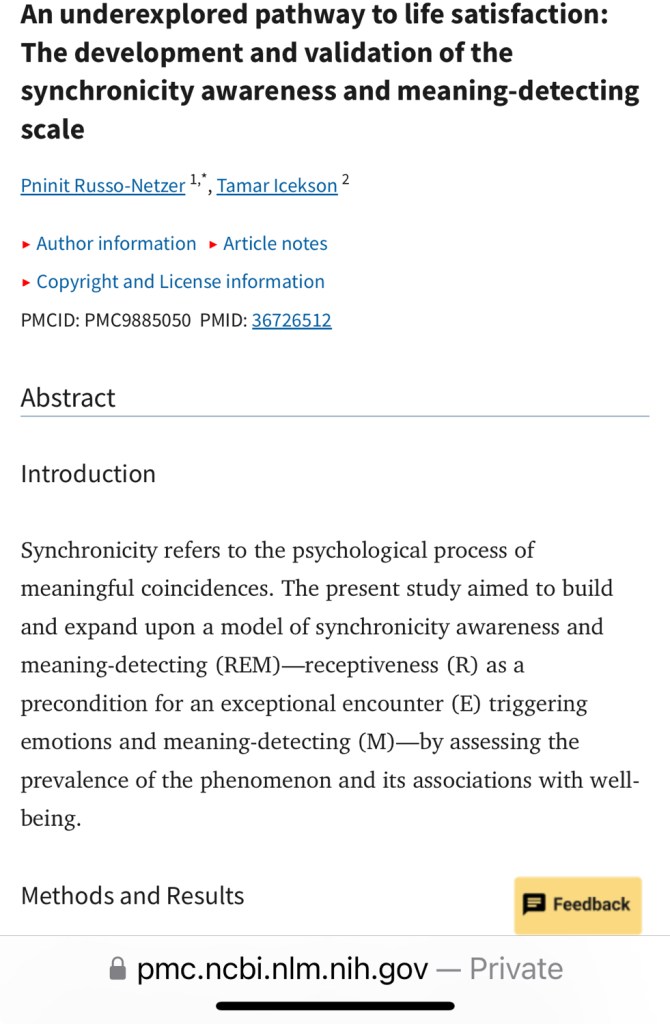
    pmc.ncbi.nlm.nih.gov/articles/PMC9885050/

    Synchronicity: The bridge between matter and mind

    F David Peat — With fascinating historical anecdotes and incisive scientific analysis, this important work combines ancient thought with modern theory to reveal a new way of viewing our universe that can expand our awareness, our lives, and may well point the way to a new science for the twenty-first century.

  • Surveillance Resources

    Surveillance Resources

    As the times get dark, we in the light must shine it. An esoteric perspective.

    What is Surveillance?

    Surveillance is the monitoring of behavior, activities, or information to influence, manage, direct, or observe individuals or groups.

    It has evolved from simple observation into a complex, pervasive infrastructure that affects everyone.

    Protecting the Inner Sanctuary

    For the esoteric-minded people like myself, surveillance is not merely a political or technical issue; it is a violation of the sacred.

    The increasing pervasiveness and sophistication of surveillance technology raises philosophical questions both epistemic (to do with the acquisition of knowledge) and ethical (concerned with living the good life). Surveillance Asymmetry Epistemic considerations preoccupy the CCTV users: governments, law enforcement agencies and businesses.

    Surveillance Ethics | Issue 110 | Philosophy Now

    The drive to monitor and predict human behavior is a pursuit of total transparency that seeks to eliminate the “shadow”—the mysterious, unmapped, and creative depths of the psyche.

    Esoteric traditions emphasize the cultivation of the inner self, a space that must remain private, sovereign, and unknown to the external observer to maintain its transformative power.

    The Surveillance of the Spirit

    Modern tracking systems attempt to commodify the human experience, turning the spontaneous, chaotic, and sacred expressions of life into predictable data points.

    This is an attempt to fix the “flux” into a static, controlled reality.

    The Sovereignty of the Unseen

    Just as the “Hermetic seal” protects the work from outside interference, maintaining a barrier between your inner life and the digital panopticon is essential for spiritual autonomy.

    If your thoughts, movements, and expressions are constantly mapped, your ability to “transmute” yourself into new states of being is compromised.

    Shining the Light

    To “shine the light” as these times grow darker is to act as a witness.

    By understanding these systems, you deny the hidden power they rely on.

    You reclaim your agency by refusing to be a readable, predictable element in their grand design.

    Eyes Are On Everyone

    The AI Paradigm

    This is not merely a question of data privacy; it is a fundamental shift in the logic of governance.

    Systems designed for administration have become tools for tracking and predicting human behavior, often with minimal oversight or accountability.

    Inferences replace facts

    AI interprets behavioral patterns at scale without verification.

    Correlations replace testimony

    Decisions are made based on data probabilities rather than direct evidence.

    Universal Risk

    While often deployed first against marginalized groups, this infrastructure expands its reach into the lives of all citizens.

    Recommended Reading
    Surveillance Technologies

    Electronic Eavesdropping & Audio

    Spy Bugs: Covert devices hidden in everyday objects (pens, USBs, lamps, sockets) to record or transmit audio.

    GSM Bugs: Operate like mobile phones; perpetrators dial in to silently listen from anywhere in the world.

    Mobile Phone Hijacking: Devices can be turned into remote microphones via malicious software, allowing attackers to “hot on the hook” listen to conversations.

    RF & Bluetooth Bugs: Transmit audio signals via radio frequency or Bluetooth to a remote receiver.

    Visual & Imaging Technology

    CCTV & Drones: Automated monitoring in public and private spaces.

    Advanced Optics: High-zoom lenses, infrared, and night-vision devices.

    Satellite/Aerial: Persistent monitoring capability from above, including indoor spaces.

    Data & Sensor Networks

    Sensor Arrays: Magnetic, seismic, infrared, and strain sensors detect movement, vibration, and even keystrokes.

    Pattern Recognition: AI-driven analysis of movement, voice, and thought-to-computer interfaces.

    Infrastructure: Global intelligence systems (e.g., ECHELON) that scan communications for keywords and phrases.

    Detection & Mitigation

    To protect against unauthorized monitoring, consider these layers of defense:

    Physical Inspections

    Thoroughly check environments for concealed hardware.

    Electronic Scanning

    Utilize specialized equipment to identify active radio transmissions.

    Professional Services

    Engage experts in Technical Surveillance Countermeasures (TSCM) for comprehensive bug sweeps.

    Information Hygiene

    Be cautious of suspicious attachments and links that can compromise mobile devices.

    Note: Surveillance tools, while used by law enforcement and intelligence agencies for security, frequently raise significant ethical and constitutional concerns. This resource aims to inform the public on the realities of these technologies.

    More Disturbing Resources

    E-3 Sentry (AWACS) > Air Force > Fact Sheet Display

    The E-3 Sentry is an airborne warning and control system, or AWACS, aircraft with an integrated command and control battle management, or C2BM, surveillance, target detection, and tracking platform.

  • Mind Trap

    Mind Trap

    We like to think of our minds as tools of clarity, but more often than not, they are cages.

    Cognitive Rigidity and Perceptual Limitations

    Cognitive rigidity and perceptual limitations are not abstract ideas—they are the invisible bars that confine how we see, think, and act in the world.

    Phrenology, doctrine mind : relations“/ CC0 1.0

    CAGE OF THE MIND

    Cognitive rigidity is the stubborn insistence that our way of thinking is the only way.

    It shows up in small, everyday ways:

    • refusing to consider another perspective
    • dismissing evidence that challenges our beliefs
    • or sticking to habitual responses when flexibility is required.

    It is mental inflexibility masquerading as certainty.

    This rigidity is rarely neutral. It filters experience, allowing only what aligns with our preconceptions to pass through.

    What we notice and refuse to notice is determined less by reality and more by the contours of our existing beliefs. The mind becomes its own jailer.

    FILTERED VISION

    Perceptual limitations compound this problem. Our senses, our expectations, and our biases shape what we perceive.

    Two people can witness the same event and walk away with entirely different “realities,” each convinced theirs is the truth.

    Culture, language, upbringing, and personal trauma all function like lenses, coloring everything we see.

    When cognitive rigidity meets these perceptual filters, the feedback loop begins: our beliefs dictate what we perceive, and our perceptions reinforce our beliefs.

    We become prisoners of our own limited frameworks, blind to the complexity—and often the truth—of the world around us.

    Breaking the Loop

    Escaping this loop is not about acquiring more information. It is about retraining the mind to see what it usually ignores:

    Observe without judgment. Watch your thought patterns and notice when you shut down possibilities automatically.

    Seek what challenges you. Engage with ideas and perspectives that make you uncomfortable.

    Question your perception. Ask yourself what you might be missing, what biases are filtering your experience.

    Embrace intellectual humility. Accept that your understanding is provisional, incomplete, and subject to correction.

    The moment we recognize that perception is always partial, and thought is always provisional, the bars of the cage begin to loosen.

    Clarity is not a gift; it is a discipline.

    The Work of Liberation

    This is the work of liberation: not avoiding rigidity, but confronting it; not denying perceptual limits, but piercing them.

    The mind can be trained to perceive more, think more flexibly, and respond more intelligently.

    It is uncomfortable, but truth always is.

    We cannot see everything, but we can see more than we did yesterday.

    And that is where freedom begins.

  • Feminine Archetypes

    What is an archetype?

    The word “archetype” comes from the Greek word ἀρχή (arche), meaning “origin” or “beginning”.

    In literature, an archetype is a recurring pattern, motif, or symbol that appears in stories, myths, and folklore.

    These archetypes can take the form of characters, settings, or plot elements, and they often represent universal themes and ideas.

    According to Jungian psychology, there are seven feminine archetypes that play significant roles in modern society:

    • the Mother
    • the Maiden
    • the Queen
    • the Huntress
    • the Wise Woman
    • the Sage
    • the Lover
    ⬆️READ FOR FREE ⬆️

    These archetypes illustrate various dimensions of the feminine experience and play a significant role in the diversity of individuality and expressions of women in contemporary society.

    The Maiden Archetype

    The Maiden Archetype symbolizes youth, innocence, and potential; she embodies the qualities of exploration and discovery.

    She represents new beginnings and the pursuit of dreams, often characterized by a sense of adventure and curiosity about the world.

    With an open heart and a mind ready to embrace the unknown, the Maiden invites us to step out of our comfort zones and seek out the experiences that shape our lives, reminding us that every journey holds the promise of growth and transformation.

    The most famous maiden archetype in Greek mythology is Princess Andromeda, who was chained to a rock as a sacrifice to a sea monster. She is saved by the hero Perseus and marries him.

    The Queen Archetype

    The Queen archetype represents authority, power, and responsibility.

    She is a leader and a figure of confidence, embodying traits such as:

    • decisiveness
    • strength
    • the ability to inspire others.

    The Queen is often associated with:

    • the pursuit of justice  
    • the welfare of her domain

    The Huntress Archetype

    This archetype embodies:

    • independence
    • self-sufficiency
    • the pursuit of goals.

    The Huntress is often portrayed as a warrior or a protector who:

    • values freedom
    • Has the courage to break societal norms
    • Has ambition
    • Has the determination to forge her own path.

    The Wise Woman Archetype

    Representing wisdom and intuition, the Wise Woman:  

    • Embodies ancient knowledge
    • A healer and mentor
    • Insightful
    • Introspective
    • shares her wisdom

    The Sage Archetype

    Closely related to the Wise Woman, the Sage represents intellectual depth and understanding.

    The Sage archetype often seeks knowledge and truth, embodying the pursuit of enlightenment and the dissemination of ideas that can empower others.

    The Lover Archetype

    The Lover archetype is associated with passion, intimacy, and connection.

    This archetype values relationships and emotional expression, emphasizing the importance of love, romance, and sensuality in a fulfilling life.

    Together, these archetypes account for the major differences among women, as each woman may resonate more strongly with specific archetypes based on their personal experiences, values, and choices.

    Understanding these archetypes can help us navigate our identities to better embrace the multifaceted nature of femininity in contemporary society.

    LEAVE A COMMENT DOWN BELOW

    3 responses to “Feminine Archetypes”

    1.  Avatar
      Anonymous

      I love this format you are using – concise rundown of the archetypes delivered with an image heavy style that compels me forward. The images conjure great emotion appropriate to the subject matter and complement the individual stories without fail. More like this please!

    2. Catherine Kuria Avatar
      Catherine Kuria

      I feel that we have the ability to embody all archetypes, each appropriate for each setting.

      1. Metacognitive Avatar

        Absolutely. 💯
        I believe we all embody various archetypes within us, each manifesting in different degrees depending on the context. As you mentioned, these archetypes emerge appropriately for each setting.

        Carl Jung spoke much on this:

        “The archetypes are the living system of reactions and aptitudes that determine the individual’s life in invisible ways.” — Carl Jung

        I LOVE THIS JUNG QUOTE:

        “Archetypes are like riverbeds which dry up when the water deserts them, but which it can find again at any time. An archetype is something like an old watercourse along which the water of life has flowed for centuries, digging a deep channel for itself.”
        — Jung, The Archetypes and the Collective Unconscious

        Thank you for your comment; it inspired deeper insight.

    Leave a Reply

    This site uses Akismet to reduce spam. Learn how your comment data is processed.

  • Find Meaning in Suffering

    Find Meaning in Suffering

    The Nature of Suffering: A Necessary Element of Existence


    As much as we may wish otherwise, the reality is that suffering is an inescapable part of the human experience.

    The age-old philosophical and religious observation that “life is suffering” points to a fundamental truth about the human condition.

    Embracing Uncertainty and Impermanence

    In the face of uncertainty and impermanence, we cultivate the qualities of empathy, humility, and inner strength that are vital for navigating the complexities of life.

    It is through our struggles that we learn and grow, transforming our experiences into avenues for personal development.

    Seeking Meaning in Suffering

    Perhaps, in the end, it is not a life devoid of suffering that we should seek, but rather a life where suffering serves a purpose.

    As Viktor Frankl articulated, fulfillment cannot be stripped of struggle; it is through confronting our darkest moments that we can truly experience the richness of life.

    In this light, suffering can become a source of strength and wisdom, enabling us to connect deeply with ourselves and others.

    Learn to engage with suffering in a way that allows us to become more whole, more alive.

  • Alchemy Of Redemption

    Alchemy Of Redemption

    SIN + SUFFERING — REDEMPTIVE ALCHEMY

    When first confronted with awareness into my sinful nature, I lacked the level of discernment needed to grasp its weight.

    The corruption within is not merely a moral failing nor a series of poor preferences; it is the State of Human Beings—a distortion of what we see in the mirror…

    Face to face with the soul- you find a deformed reflection looking back at you. Something your waking mind never saw.

    You are disobedient and rebellious, torn between your conflicting desires, double-minded in your ways.

    2 Oppositional Forces

    For me, one part yearned for deep and meaningful purpose, yet another aspect was incessantly seduced by chaos, easily bated by danger, pain, and fearful things.

    I was repulsed by who I thought I was in comparison to this monstrosity. This was the truth. In that moment, every bit of evil’s horrific vices surfaced; I despised my compulsion toward gore, a freak for intensity.

    I hated it. I loved it.

    Many decades ago, when all of this happened, I had no relationship with God, the Creator of Spirit. I didn’t grasp what such a connection would involve.

    The extremes I experienced transformed my perspective.

    Looking back, I can clearly see that before my descent into the depths of Hell, I was being prepared for something Holy.

    I need to be reassembled correctly, but first, we must disassemble.

    Looking back, I can see.

    I was primed for my humiliation ritual, a necessary step for someone with such inflated pride.

    Transmutation is Suffering

    Without pain there cannot be growth.

    When suffering is truly understood, it can either transmute the soul from flesh to spirit or lead it toward total entropy as the body decays.

    Give me anguish then..

    Under the loudened silence and heavy weight of invisible sufferring, the lowness is trifling.

    Key🔑

    How to Transcend Suffering: A Step-by-Step Process

    1. Step Back to Observe

    Begin by positioning yourself at the periphery of your conscious awareness.

    Detach slightly from your immediate thoughts and emotions, allowing you to observe your inner landscape without judgment.

    2. Embrace the Essence:

    Transition into a state of deep presence by surrendering to the very essence of existence. In this space, open your mind to the subtle resonances of Being Raptured—recognize that even your suffering carries an illuminating quality that elevates it from mere pain to profound transformation.

    3. Reframe Negative Polarity:

    Understand that the challenges you face, the Negative Polarity, serve a purposeful role. Rather than resisting these forces, see them as essential tools that refine your spirit and prepare you for the transformative Gift of Duality.

    4. Acknowledge the Paradox:

    Accept the inherent paradox in Duality. Realize that by embracing both light and darkness, the Soul comes to recognize that the physical form is not separate but merely a temporary expression. This awareness guides you toward the understanding that your body—and all forms—inevitably returns to its original source, marking the end of dualistic separation.

    5. Internalize and Reflect:

    Continually return to this process. Reflect on each step and integrate this awareness into your daily life. Over time, allow this practice to transform suffering into a catalyst for spiritual growth and enlightenment.

    By following these steps, you actively engage in a process that not only alleviates suffering but also deepens your understanding of your self and the greater scheme of existence.


    More notes on next page:

    Pages: 1 2

  • Maslow’s Hierarchy

    Maslow’s Hierarchy

    Abraham Maslow’s groundbreaking psychological theory, known as Maslow’s Hierarchy of Needs, offers a structured framework to comprehend human motivation and behavior.

    This structure is used by those in power.


    The theory lays out five levels of needs that people seek to meet in a step-by-step manner, beginning with the most essential physiological needs and advancing towards self-actualization, which is the pinnacle of psychological well-being.

    1. Basic Needs

    The first level, physiological needs, encompasses fundamental requirements for human survival such as air, water, food, shelter, sleep, and clothing.

    Without meeting these basic needs, individuals may experience significant discomfort and distress, hindering their overall well-being.

    Addressing physiological needs is crucial for laying the foundation for personal growth and self-actualization.

    2. Safety and Security

    The second level, safety needs, involves seeking physical safety, emotional security, financial stability, and protection from harm or danger.

    Creating a stable and secure environment allows individuals to feel safe and secure in their daily lives, fostering a sense of stability and trust in their surroundings.

    3. Human Connection

    The third level, love and belonging needs, focuses on the desire for social connections, love, and a sense of belonging.

    Forming meaningful relationships and experiencing affection contribute to emotional well-being and a sense of connection and support in life.

    4. Self-love

    The fourth level, esteem needs, encompasses the need for self-worth, recognition, and respect from oneself and others.

    Developing a positive self-image, self-confidence, and receiving recognition and appreciation from others are essential for building self-esteem and fostering a sense of accomplishment.

    5. Self- actualization

    The fifth and highest level, self-actualization, represents the pursuit of personal growth, fulfillment of one’s unique potential, and the realization of one’s full capabilities.

    Self-actualized individuals are driven by intrinsic motivation, self-awareness, and a deep understanding of their values and beliefs, actively seeking personal fulfillment and self-expression.

  • High-Vibrational

    High-Vibrational

    High vibration refers to a state of energy characterized by positive feelings, thoughts, and actions, in contrast to low vibration, which is linked to negativity and stress.

    Vibrational Targets

    People who resonate at a higher frequency often find themselves preyed upon by dark energies.

    These negative forces can creep in, using manipulation and emotional depletion to exploit, brought about by those who carry unresolved pain.

    This leaves a portal for a deep sense of weariness, causing emotional fatigue, as their bright light becomes a beacon for those who seek to drain their spirit.

    PORTALS FOR LOW VIBRATIONAL FREQUENCIES TO ENTER:

    1. Criticism & Gossip

    High vibrational individuals, with their heightened awareness, can unintentionally stir unease in those around them.

    As a result, they frequently endure harsh judgment and whispers behind their backs, feeling the weight of loneliness and misunderstanding.

    This stems from deep-seated insecurity or a profound lack of understanding, as their genuine selves can seem like an unwelcome reminder to those who are not prepared to face their own inner struggles.

    It’s a painful truth that the authenticity of some can evoke fear in others, revealing a heart-wrenching vulnerability that many are too afraid to acknowledge.

    2. Isolation

    Individuals with elevated vibrations frequently find themselves in a state of loneliness, as the profound depth of their awareness creates a chasm between them and others.

    The struggle for connection leaves them feeling isolated and misunderstood, trapped in a world where their sensitivity and insight can be burdensome rather than a blessing.

    3. Sadness

    This profound disconnection weighs heavy on their hearts, leading to a sadness that lingers like a shadow, as they yearn for companionship that seems perpetually out of reach.

    4. Naive Authenticity

    Authentic energy forces others to face parts of themselves they may not want to see, leading to avoidance or rejection.

    Their presence compels people to confront the darker corners of their souls, unearthing truths that are often too painful to acknowledge.

    This can result in a heartbreaking tendency for others to turn away, retreating into denial or pushing them away in fear of vulnerability.

    Protecting Energy

    To maintain an elevated state of consciousness, you must prioritize self-care and boundary-setting.

    This includes staying surrounded by those who share a similar energy and limiting interactions with those who drain or manipulate them.

    While the journey of a high-vibrational person can lead to spiritual growth, it’s essential to acknowledge the difficulties they face, balancing their elevated state with the need for protection and self-preservation.

  • Propaganda + Trauma

    Propaganda + Trauma

    Altered Perspective

    Perspective refers to a particular attitude or way of viewing something.

    It can also mean the art of representing three-dimensional objects on a two-dimensional surface to give the right impression of their height, width, depth, and position relative to each other.


    Trauma

    … is a deeply distressing or disturbing experience.

    It can refer to emotional shock following a stressful event or physical injury.

    Trauma’s impact on our perspective makes us vulnerable to manipulation.

    In the past decade, increased exposure to traumatic experiences has intensified this issue, causing many to develop a strong attachment to their trauma.

    It’s crucial to address this through personal growth, open dialogue, and professional support to create a healthier, more resilient society.


    Trauma & Propaganda

    Propaganda frequently capitalizes on pre-existing trauma or insecurity, skillfully manipulating the fears, anxieties, and emotional vulnerabilities of individuals who have endured distressing experiences.

    WAR TIME PROPAGANDA USE

    For example, in wartime, propaganda can intensify fears of adversaries to garner public backing for military initiatives.

    FEAR MONGERING CAMPAIGNS

    Similarly, political campaigns may employ fear-driven messaging to influence voters by emphasizing possible threats to their safety and well-being.

    COERSION — EXPLOITATION — COMPLIANCE

    By invoking intense negative emotions, propaganda seeks to coerce individuals into compliance and allegiance, exploiting their emotional reactions to fulfill its objectives.

    Invokes deep rooted fears.

    This strategy proves effective as it resonates with deeply rooted fears and insecurities, rendering individuals more amenable to persuasion.


    Propaganda can itself CAN CAUSE TRAUMA

    When propaganda is effective in spreading hatred, division, and misinformation on a wide scale, it can be psychologically traumatic for large groups of people.


    Trauma can make people more susceptible to propaganda.

    TRAUMA + PROPAGANDA

    Individuals who have gone through traumatic experiences frequently find themselves feeling more distrustful of others.

    They also have a strong desire for straightforward explanations and narratives that can make sense of their experiences.

    They often have an intensified need for security and a sense of belonging to a group, which is something that propaganda can readily

    Propaganda takes advantage of these vulnerabilities for its own purposes and objectives.


    Both propaganda + traumatic events create :

    • short-circuit rational thinking
    • appeal to emotions
    • fan the flames of fear
    • trigger “us vs. them” tribal mentalities

    With enough repetition, propaganda can start to feel indistinguishable from reality.


    When a person becomes trauma-bonded:

    When a civilization persistently follows a rigid path, without self-reflection, it can inadvertently lay the groundwork for its own subjugation, eroding its own liberties.

    It is like constructing a theater where the civilization unknowingly acts out its own enslavement.

    Each short-sighted decision and action incrementally shapes a future where external forces exert control and suppress freedom.

    This serves as a sobering reminder of how profound an impact our choices can have on the fate of societies.

    How Can This Happen?

    The trauma bonding of a nation to its government is a gradual process, built through a combination of fear, hopelessness, manipulation and habit.


    contributing factors

    HOW A SOCIETY BECOMES TRAUMA BONDED:

    OVERWHELMED BY CRISIS

    Major crises that overwhelm citizens’ sense of security and control.
    These could be:

    • wars
    • economic disasters
    • natural catastrophes
    • pandemics.

    The larger the crisis, the greater people’s need for protection and reassurance from authority.

    EXPLOITING FEARS

    Governments that actively exploit citizens’ fears and insecurities through

    • propaganda
    • threat exaggeration
    • misinformation,

    governments condition people to see the state as the only source of security and order.

    Citizens come to associate the government with survival.

    The suppression of dissenting voices

    As governments consolidate power in the wake of crises, they discourage opposition- making alternative perspectives seem non-existent, cementing the dominance of the official narrative.
    They accompany this through:

    • censorship
    • surveillance
    • imprisonment
    • coercion.

    Gradual erosion of freedoms.

    As citizens comply out of perceived necessity, governments expand their authority and weaken checks on their power.

    Over time, these changes become normalized through repetition and habituation.


    A diminishing of citizens’ sense of agency

    Facing immense threats, people stop believing they can effect real political change.

    They become passive subjects rather than active citizens.

    This learned helplessness further traps them in the traumatic status quo.


    We have been Placed Into Position

    Every role we occupy seems to be carefully arranged, akin to performers in a grand theatrical production. Each individual has embraced their specific role, creating a harmonious ensemble that operates in perfect synchrony.


    End Of America’s Great Experiement

    The melancholy surrounding America’s decline is rooted in the recognition that the monumental experiment that has defined its principles and values is reaching a conclusion. This sadness emerges from the understanding that the American experiment, rich with aspirations and ideals, is moving into unfamiliar territory, evoking a complex mix of pride and trepidation.


    Elite VS Citizens

    This ongoing conflict can be seen as a significant struggle between the influential elite, who hold substantial power and resources, and the general public, who represent a much larger demographic.

    At its core, this battle is fundamentally about control and influence within society. The elite are determined to preserve their privileged status and maintain their dominance, whereas the wider population is actively advocating for greater equality and justice.

    This clash highlights the deep-seated tensions and disparities that exist between those at the top and those who seek to challenge the status quo in pursuit of a fairer and more equitable society.


    Citizens Fighting With Opressors

    This war encompasses physical clashes alongside ideological debates, as societal structures and hierarchies of power are fiercely contested.

    The outcome of this war will determine the fate of the people and shape the future of society and the distribution of power.

  • Nuance vs. Discernment

    Nuance vs. Discernment

    Subtle yet imperative difference between discernment and nuance and it is of consequence showing the proof.

    Discernment involves making sound judgments, while nuance focuses on perceiving subtle differences. If you claim to have discernment but do not truly understand, you may not grasp the meaning of your own words. Acknowledging our shortcomings is the first step toward improvement.

    There’s Power in Simple Recognition

    Recognizing the distinction allows the path way for critical thinking, allowing the analysis of information to be an objectively balanced perspective. If no distinction is made, and there is no discernment, just words, blah blah, blah You’ll find yourself having clearer communication, experiencing fewer misunderstandings. You’ll find yourself within a deeper intellectually advanced position. This causes an appreciation of complex complexities where confusion would prior be.

    Essence of Nuance

    Nuance refers to the subtle differences in meaning, sound, or appearance.

    Nuance deals with fine details and gradations.

    Nature of Discernment

    Discerners have the ability to make wise judgments and see things clearly.

    Discerning involves perception, insight, and understanding.

    For example, “The critic showed great discernment in analyzing the film.”

    Discernment encompasses the skill of evaluating & understanding the deeper implications of a thing or thought.

    Linguistic Differences

    While nuance is strictly a noun, discernment can function both as a noun and a verb.

    One can describe something as having subtle nuances, but it’s often redundant since nuances are inherently subtle.

    Discernment Requires Nuance

    To offer righteous judgments one must be attuned to the subtle differences and complexities within the subject at hand. If not they simply cannot fit the definition of discerning.

    Nuance

    Void Discernment Paralysis

    The overemphasis on fine details can hinder decisive action, especially in times of crisis.

    Nuance is meticulously un contained without discernment to allow fordecisions to be made.

    Navigating ambiguity and constructing considered sections is a Nuanced action.

    NUANCE: Fine Detail

    DISCERNMENT Ability to

    Quality of Object vs Subject

    Perceiving & Choosing pertains to the fine details and understanding the difference between subjective and objective qualities can be quite enlightening.

    Objective Qualities ( nuance) are attributes inherent to an object, independent of personal feelings or opinions. For example, saying “The cake contains 250 calories per serving” is an objective statement; it’s a measurable fact. 

    Subjective Qualities, on the other hand, are based on personal perspectives, feelings, or opinions. For instance, stating “The cake is delicious” is subjective; it’s based on individual taste. 

    Objective qualities are about factual data that remain constant regardless of who observes them, while subjective qualities can vary from person to person based on individual experiences and feelings.