
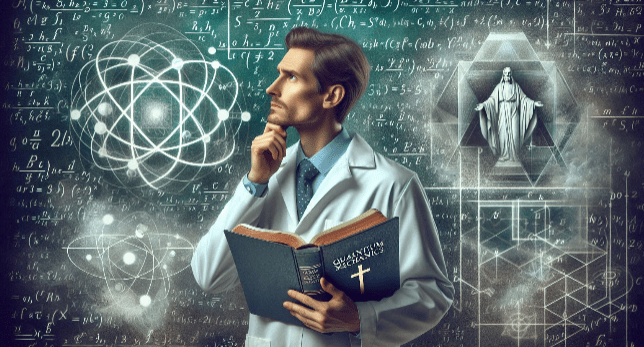
Scripture obviously doesn’t describe God in quantum terms, as these terms are contemporary, several Bible verses and theological concepts do align with the idea of Spirit being Light and Energy.
God in Scripture

Light & Energy
1 John 1:5: “God is light; in Him there is no darkness at all.” This verse directly describes God as light, emphasizing purity and the absence of darkness.
1 Timothy 6:16: “He alone is immortal and dwells in unapproachable light, whom no man has seen or can see.” This verse speaks to the transcendent nature of God’s light, which is beyond human comprehension.
John 8:12: “When Jesus spoke again to the people, he said, ‘I am the light of the world. Whoever follows me will never walk in darkness, but will have the light of life.’” Jesus, as the manifestation of God, is described as the light of the world.
Genesis 1:3: “And God said, ‘Let there be light,’ and there was light.” This verse illustrates the power of God’s word to create light, a fundamental element of the universe.
Sound & Light in Creation
The Bible also contains references to creation through God’s spoken word, which can be interpreted as sound and light:
Genesis 1:3: “And God said, ‘Let there be light,’ and there was light.”
The act of speaking light into existence suggests a connection between sound and light in creation.
John 1:1: “In the beginning was the Word, and the Word was with God, and the Word was God.”
The term “Word” (Logos) implies the creative power of God’s speech.
Revelation 4:5: “From the throne came flashes of lightning, rumblings, and peals of thunder.”
This imagery combines light and sound to depict the divine presence.
God’s Breath & Human Life
Genesis 2:7: “Then the Lord God formed a man from the dust of the ground and breathed into his nostrils the breath of life, and the man became a living being.”
Job 33:4: “The Spirit of God has made me; the breath of the Almighty gives me life.”
Psalm 104:29: “When you hide your face, they are terrified; when you take away their breath, they die and return to the dust.”
Quantum Theories
in Relation to Scripture
Quantum mechanics, a branch of physics that deals with the behavior of matter and energy at the smallest scales, has profound implications that can intersect with theological concepts.
While quantum theories are primarily scientific, they offer intriguing parallels and insights that can enrich our understanding of certain scriptural themes.
Key Concepts in Quantum Mechanics
- Wave-Particle Duality: Particles such as electrons exhibit both wave-like and particle-like properties. This dual nature challenges our classical understanding of physics.
- Quantum Entanglement: When particles become entangled, the state of one particle instantaneously influences the state of another, regardless of distance. This phenomenon suggests a deep interconnectedness within the universe.
- Uncertainty Principle: Proposed by Werner Heisenberg, this principle states that certain pairs of properties, like position and momentum, cannot both be measured precisely at the same time.
- Superposition: Particles can exist in multiple states simultaneously until observed or measured, at which point they collapse into one state.
God’s Omnipresence & Omniscience
Quantum entanglement, which allows particles to influence each other instantaneously over vast distances, can be seen as a metaphor for God’s omnipresence and omniscience.
The Bible speaks of God being everywhere and knowing all things:
- Psalm 139:7-10: “Where can I go from your Spirit? Where can I flee from your presence? If I go up to the heavens, you are there; if I make my bed in the depths, you are there.”
Quantum entanglement illustrates a form of connection that transcends physical space, much like the theological concept of God’s omnipresence.
Creation & the Nature of Reality
The concept of wave-particle duality and superposition aligns with the idea that reality is not always as it appears.
This can be related to the biblical creation narrative, where God’s word brings forth existence from nothing:
- Genesis 1:3: “And God said, ‘Let there be light,’ and there was light.”
This act of creation by divine command suggests a reality that is fundamentally responsive to God’s will, much like how quantum particles exist in a state of potential until observed.
The Multidimensional Universe

Quantum physics suggests the possibility of multiple dimensions and parallel universes, which can be seen as aligning with biblical descriptions of spiritual realms:
- Ephesians 6:12: “For our struggle is not against flesh and blood, but against the rulers, against the authorities, against the powers of this dark world and against the spiritual forces of evil in the heavenly realms.”
The existence of unseen dimensions and realms in quantum theory parallels the biblical concept of a spiritual dimension that interacts with our physical world.
Theological Implications
1. Compatibility with Faith
Quantum mechanics does not contradict the existence of God; rather, it can be seen as revealing the complexity and wonder of God’s creation.
Many early pioneers of quantum physics, such as John Polkinghorne, were theists who saw their discoveries as illuminating God’s methods rather than eliminating His presence.
2. Free Will and Predestination
Quantum indeterminacy, where outcomes are probabilistic rather than deterministic, can offer a framework for understanding the coexistence of free will and divine sovereignty. The Bible speaks of God’s foreknowledge and predestination, yet also affirms human responsibility and choice:
- Romans 8:29-30: “For those God foreknew he also predestined to be conformed to the image of his Son.”
- Deuteronomy 30:19: “This day I call the heavens and the earth as witnesses against you that I have set before you life and death, blessings and curses. Now choose life, so that you and your children may live.”
Quantum theory’s probabilistic nature can be seen as a metaphor for the balance between God’s sovereign plan and human free will.
Quantum mechanics, with its counterintuitive and profound insights into the nature of reality, offers fascinating parallels to scriptural themes.

While it remains a scientific discipline, its concepts can enrich theological discussions about God’s nature, the creation of the universe, and the interplay between divine sovereignty and human free will.
Far from being incompatible, quantum theories can provide a deeper appreciation of the mysteries and wonders described in the Bible.
