Tag: SCIENTIFIC

  • Do We Live In A Multiverse? Parallel Universe Theory

    Do We Live In A Multiverse? Parallel Universe Theory

    The multiverse theory is a fascinating and controversial topic that explores the possibility of parallel universes existing alongside our own. It has attracted the attention of scientists, philosophers, and even Christians who wonder how it relates to their faith.

    In this blog post, I will briefly explain what the multiverse theory is, how it differs from other theories of reality, and what implications it may have for Christian theology.

    What is the multiverse theory?

    The multiverse theory is a term that encompasses various hypotheses that propose the existence of multiple realities or universes beyond our own. Some of these hypotheses are based on quantum physics, while others are based on cosmology or string theory.

    One of the most popular versions of the multiverse theory is the Many Worlds Interpretation (MWI) of quantum mechanics. According to MWI, every time a quantum event occurs, such as the measurement of an electron’s spin or the decay of an atom, the universe splits into two or more branches, each representing a different possible outcome. These branches are inaccessible to each other and form parallel universes that coexist with ours.

    Another version of the multiverse theory is the Bubble Universe Theory, which is derived from the concept of cosmic inflation. According to this theory, our universe is one of many bubble-like universes that emerged from a larger multiverse. Each bubble has its own physical laws and constants and may differ drastically from ours. Some bubbles may have more dimensions, different forces, or even different kinds of matter.

    How does the multiverse theory differ from other theories of reality?

    The multiverse theory is different from other theories of reality in several ways. First, it challenges the idea that our universe is unique and special. Instead, it suggests that our universe is one of many possible universes in a vast and diverse multiverse.

    Second, it challenges the idea that our universe has a single history and a single future. Instead, it suggests that our universe has multiple histories and futures that branch off from each other with every quantum event.

    Third, it challenges the idea that our universe is governed by a single set of physical laws and constants. Instead, it suggests that our universe is governed by a local set of laws and constants that may vary from one bubble to another.

    What implications does the multiverse theory have for Christian theology?

    The multiverse theory raises some interesting questions for Christian theology.

    For example:

    • How does the multiverse theory affect our understanding of God’s creation and sovereignty? Does God create and sustain every possible universe? Does God have a purpose for every possible universe? Does God intervene in every possible universe?
    • How does the multiverse theory affect our understanding of human free will and moral responsibility? Do we have free will in every possible universe? Do we have moral responsibility for our actions in every likely universe? Do we face consequences for our actions in every likely universe?
    • How does the multiverse theory affect our understanding of salvation and eschatology? Is Jesus Christ the Savior of every possible universe? Is there only one way to salvation in every possible universe? Is there a final judgment and a new creation in every possible universe?

    These are some questions that Christians interested in the multiverse theory may want to explore.

    However, we should not let these questions distract us from the core truths of our faith. We should also not let these questions create a false dilemma between God and the multiverse. Rather, we should approach these questions with curiosity, humility, and reverence for God’s infinite wisdom and power.

    As Christians we should NOT avoid such topics, we should NOT be afraid or dismissive of scientific explanations such as the multiverse theory.

    Instead, we should engage with them critically and respectfully, and seek to understand how they relate to our worldview. We should also be ready to challenge atheists who use such explanations as an alternative to God’s existence or involvement in reality.

    We should also be open to exploring the potential theological significance of an expansive multiverse. We should not limit God’s creativity or glory to our own universe but acknowledge that God may have created more than we can imagine or comprehend. We should also affirm that God is the loving and faithful Creator of every aspect of his amazing creation, regardless of our understanding.
  • Conscious and Subconscious: Microcosm versus Macrocosm

    Conscious and Subconscious: Microcosm versus Macrocosm

    Explore your consciousness and its different dimensions by looking within your 3-dimensional reality with truth and brutal honesty about yourself and your Creator.

    KEYWORDS

    MATERIAL: The physical world that we can see, touch, and feel. It is the world of matter, space and time. The material world is often seen as a reflection of the spiritual world, in the sense that it is a manifestation of the God.

    SPIRITUAL: The spiritual world is the non-physical world of spirits, energy, and consciousness. It is the world that we cannot see, touch, or feel, but that we may be able to experience through other means, such as intuition, dreams, and revelation.

    CONSCIOUS MIND: The aspect of the mind that we are aware of. It is the part of the mind that we knowingly use to think, feel, and make decisions. The conscious mind is a reflection of the subconscious mind, in the sense that it is a product of the subconscious mind.

    SUBCONSCIOUS MIND: The subconscious mind is the part of the mind that is not directly accessible to our awareness. It is the part of the mind that stores memories, emotions, and experiences that we are not consciously aware of.

    MICROCOSM: The microcosm is the small world, such as the human body, plants, dirt, etc.

    MACROCOSM: The macrocosm is the large world, such as the universe. They (Macro & Micro) are both part of the same reality, but they exist on different scales.

    Reflection: Reflection is the process by which light or sound waves bounce off an object’s surface. When light reflects off a smooth surface, it returns to the observer, generating an image beyond the surface.

    We, are that reflection, in our physical form.

    All of these different aspects of reality are interconnected and interdependent. They are all part of the same whole, and they all play a role in the unfolding of the universe.

    Conscious and Subconscious Minds

    Our conscious and subconscious minds mirror one another, revealing the truth when they function in their natural state.

    Aspects of consciousness, both within and beyond our physical selves, exist indistinguishably.

    However, worldly standards, mind manipulation, and trauma fracture our perception of these interconnected elements.

    Identical facets of consciousness always exist within our bodies and outside our bodies, although they may be fragmented in human perception due to society and trauma.

    These facets exist within each living organism and outside of them.

    Dimensions of Consciousness

    These two seemingly opposing dimensions of consciousness are mirroring each other within our minds.

    The mind, when accessed and run in its original settings, reveals to itself (yourself) the cosmically objective reality that is truth.

    As we ascend to higher dimensions, our ability to perceive the ethereal and spiritual realms becomes more potent, unlocking the fullness of clear vision.

    By examining ourselves within the confines of our three-dimensional reality, we effortlessly transition into the fifth dimension, embracing a heightened state of consciousness.

    The spirit world, existing beyond the 4th dimension, envelops us.

    Ethereal and Physical Dimensions

    To unlock the secrets of the Kingdom, it’s crucial to fuse the Ethereal and Physical perceptions.

    This exploration brings rapid growth, approaching the mysteries of reality.

    Bridging this divide is essential to expand your perspective, see the big picture and push the boundaries of consciousness.

    If ready to embrace the journey of a lifetime, uncover the universe’s secrets.

    The microcosm and macrocosm concept reflects the relationship between the conscious and subconscious minds.

    The conscious mind focuses on immediate thoughts and actions, while the subconscious mind influences our beliefs and behaviors without our full awareness.

    The subconscious shapes our thinking, and understanding this helps us gain insights for personal growth and self-awareness.

    The microcosm, or conscious mind, embodies the tangible manifestation of the vast and hidden macrocosm dwelling within the recesses of the mind.

    It continuously gathers data, whether intentionally or unintentionally.

    As one ascends to higher dimensions, their vision becomes more capable of perceiving the spirit world, which exists beyond the fifth dimension.

    The microcosm, synonymous with our conscious mind, captures the essence of the intangible and expansive macrocosm hidden within our mind’s depths, gathering information ceaselessly.

    The interconnectedness of different dimensions allows us to explore diverse facets of reality, expanding our understanding of ourselves and the world.

    By embracing this concept, we can delve into intriguing ideas such as parallel universes, alternate realities, and the possibility of unseen dimensions coexisting with our own.

    This exploration broadens our perspective, fostering a sense of curiosity and wonder that fuels our intellectual and spiritual growth.

    Embracing the freedom of God’s will and aligning with the natural, predestined order can bring profound transformation to our lives.

    While it may initially seem in opposition to the ego and our human nature, this journey leads us towards rebirth and transcendence.

    In this process, the ego and subjectivity dissolve, giving way to a greater understanding of our true selves.

    Through this metamorphosis, we ultimately overcome the cycle of death and experience a profound awakening.

    Armageddon, symbolizing the culmination of this transformative process, brings an end to the limitations of our mortal existence, opening doors to new possibilities and infinite spiritual growth. As death is put to death.

  • Human Will | Quantum Geometry

    Human Will | Quantum Geometry


    Key Words:

    • General Relativity: Einstein’s theory of gravity that describes the curvature of spacetime caused by massive objects
    • String Theory: a theoretical framework that attempts to explain all particles and forces of nature in terms of tiny one-dimensional strings
    • Loop Quantum Gravity: a theory that attempts to reconcile general relativity with quantum mechanics by quantizing spacetime itself
    • Quantum Gravity: the field that attempts to unify general relativity and quantum mechanics to create a consistent description of the universe at all scales.
    • Human Will: The human will refers to the ability of individuals to make conscious choices and decisions, exerting control over their actions and behavior. It encompasses factors such as desires, motivations, intentions, and the capacity to act in accordance with one’s goals. The study of the human will is primarily within the realms of psychology, philosophy, and cognitive science. Researchers in these fields investigate the neural mechanisms, cognitive processes, and psychological factors that influence decision-making and voluntary action.

    Human Will + Quantum Geometry | The Connection

    The concept of the human will and its connection to quantum geometry offers a captivating intersection of philosophy and science.

    This topic has ignited debate among scientists and philosophers, as it explores the nature of consciousness and its possible implications for the fabric of reality.

    Some theorists propose that human will may influence quantum events, implying a deep connection between subjective experience and the objective world. + link

    nature of consciousness |fabric of reality

    It raises questions about free will and the role of consciousness in shaping reality.

    QUANTUM GEOMETRY

    Quantum Geometry merges Quantum Mechanics and Geometry to study Space at the smallest scale.

    Quantum Geometry re-evaluates the structure of space and time, suggesting they are discrete rather than continuous, which challenges classical geometry.


    Quantum Geometry investigates the fundamental makeup of spacetime at very small scales where quantum effects are important.

    Source

    Space time's mathematical model merges : 

    three dimensions of space
    +
    one dimension of time
    =
    a four-dimensional continuum.

    Scientists seek to unify general relativity and quantum mechanics through approaches like:

    • string theory
    • quantum gravity
    • other quantum gravity models.

    The goal is to develop a consistent understanding of the fundamental structure of spacetime.

    Deeper Into Quantum Geometry

    Quantum geometry studies the tiny-scale structure of spacetime, blending quantum mechanics and geometry.

    It investigates the behavior of particles and fields within a quantum framework.

    There is compelling evidence that proposes a strong connection between our thoughts and quantum phenomena.

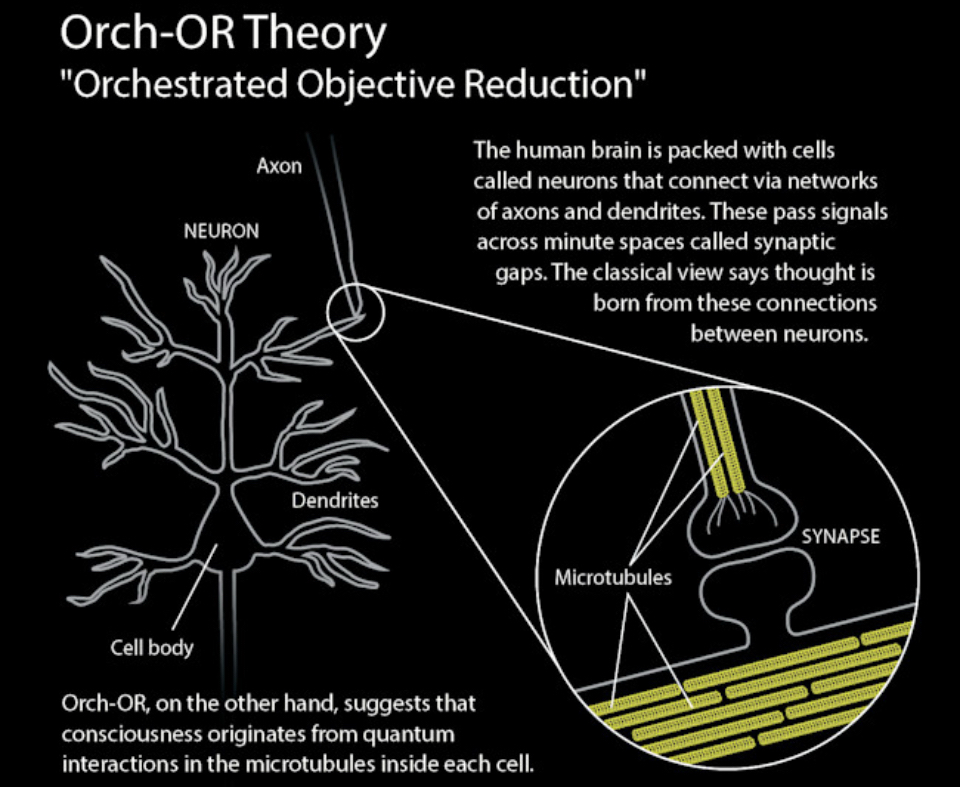
    Orch-OR theory

    The Orch-OR theory proposed by Roger Penrose and Stuart Hameroff suggests that consciousness arises from quantum processes occurring in microtubules within brain cells.

    This theory remains controversiacontroversial.

    It suggests that our consciousness, including our thoughts and feelings, is significantly influenced by intricate quantum processes occurring within our brain cells.


    Orch-OR Theory

    This theory proposes a connection between thoughts and quantum phenomena, claiming that consciousness is influenced by intricate brain cell processes.

    Orch-OR theory, proposed by physicists, Sir Roger Penrose and Stuart Hameroff, suggests an intriguing link between consciousness and quantum mechanics.

    THIS THEORY POSITS THAT:

    Consciousness arises from quantum processes occurring within neuronal microtubules.

    Meanings that the brain operates not just as a traditional information processor, but also experiences quantum effects that affect our conscious experiences.

    So if true, these quantum vibrations play a crucial role in the coherence and organization of neural activity in the brain, ultimately giving rise to consciousness.

    This geometry relies on the principles of quantum mechanics, which explores how matter and energy behave at the smallest levels.

    With the aid of this geometry, we can visually represent the intricate structure of the human will in a manner that is both reflexive and scientifically grounded.

    QUANTUM GEOMETRY IS GAINING POPULARITY BECAUSE IT ACCURATELY VISUALIZES THE STRUCTURE OF THE HUMAN WILL USING SCIENTIFIC PRINCIPLES.

    The quantum geometry of the human will can be visualized as a complex network of interconnected circles, each representing a distinct aspect of the will.

    These circles are connected by lines of varying lengths and widths, illustrating the diverse pathways of conscious perception.

    Additionally, the circles are filled with a variety of colors, symbolizing the different energies associated with the will.

    At the center of this network lies a single, large circle that represents the core of the human will, where all other circles converge.

    Understanding the structure of the human will is essential for comprehending the influence of the quantum field on our decisions and actions.

    Understanding the structure of the human will enables us to grasp how the quantum field influences our decisions and actions.

    The quantum geometry of the human will also aids in examining the effects of quantum entanglement, which occurs when two particles become interconnected, regardless of the distance between them.

    On the quantum "self-teleportation" probability of a human body

    The geometry of quantum events

  • Quantum Theory: Light is A Component Of God…

    Quantum Theory: Light is A Component Of God…

    “LET There BE Light! & There WAS Light.

    Gen 1:3

    Light holds EVERYTHING together. Light is SOUND & VIBRATION.

    My argument is that Light is a manifestation of God’s power, providing us with the ability to see and understand the world around us.

    The Speed of Light is:
    1. One of the Fundamental constants of ALL Physics
    2. The limiting factor in the universe
    3. Binds everything in the Universe together
    4. Transfers ALL information


    Light is the Force in which the knowledge of God is manifested and implemented in this material from Heaven.

    What is this Force?
    I say, “God” or “God’s Hand.”

    (more…)