Tag: Faith

Faith – a deeply held conviction or trust in something that may not be immediately provable or visible. Faith often transcends mere belief and involves an emotional and experiential connection. Faith is even the heart and mind align. Faith can manifest in many contexts, such as religious belief, personal relationships, or even faith in oneself. Faith is a guiding force that influences decisions and shapes our worldview, providing comfort and meaning in life’s complexities and seemingly void moments.

  • Kingdom 0f Heaven & Faith: Like Mustard Seeds

    A BIBLICAL SEED IS–

    Biblical seed: A generative center connecting the soul to higher spiritual forces, manifesting in physical reality. It refers to God’s creative and original thought, the mind of the universe and the limitless Word. The Word, also known as Logos, reveals God and shows His divine nature.

    “Mustard Seed”: Symbolize the Word of Spiritual Truth…

    Mustard plants grow amazingly fast and prolific, reaching 6-10 feet tall in one season and producing abundant yellow flowers and seeds. In Jesus’ time in Israel, mustard plants grew extremely dense and tall, reaching 10-15 feet high – making the metaphor of tiny mustard seeds becoming huge shrubs a striking one for Jesus’ listeners.

    KINGDOM OF HEAVEN: LIKE A MUSTARD SEED

    One day he was speaking to a group of people and asked them, “What is the kingdom of God like?” -Luke 13:19

    The Pharisees and Scribes had many differing opinions about the Kingdom of God. Some thought it would come suddenly and visibly, with God sending His Messiah King to establish an earthly empire in Israel. However, they were all mistaken; none of them could answer the question correctly.

    Jesus Spoke Another Parable:

    “The Kingdom of Heaven is like a mustard seed that a man planted in his field. Although it is the smallest of all seeds, yet it grows into the largest of garden plants and becomes a tree, so that the birds of the air come and nest in its branches.” Matthew 13:31-32

    'Then Jesus asked, “What is the kingdom of God like? 
    To what can I compare it?
    It is like a mustard seed that a man tossed into his garden.
    It grew and became a tree, & the birds of the air nested in its branches.” ' Luke 13:18-19

    What Is The Kingdom of God? (in context)

    … a state of consciousness in a human in which mind, soul, and body are in harmony with God’s Mind… Many have a basic understanding of the concept of a kingdom, but there is so much more to it:

    It goes beyond mere intellectual knowledge — Heaven is not confined to man’s consciousness. It is everywhere present. When a person’s mind and body are in harmonious relation to God’s ideas, their true thoughts flow into their realm and bring forth the Kingdom on earth, through them, as in heaven.

    What Is The Seed?

    The word of truth is like a seed that, when planted in our minds, grows and transforms us spiritually. Jesus compared the kingdom to a seed because it hides potential and needs the right conditions to flourish. To enter the kingdom of Heaven, we must understand and believe in the truth of our existence and align our actions accordingly.

    Jesus taught the Kingdom of Heaven begins inside you…

    • Heaven’s Kingdom establishes Truth in our conscious Minds.
    • Heaven aligns our mentalities within His Kingdom.

    To illustrate this inner spiritual Kingdom, Jesus spoke of a farmer sowing good seeds in His field. But while he slept, an enemy planted weeds among the crop:

    “A sower went out to sow. 
    As he sowed, some seeds fell along the path, and the birds came and devoured them.
    Other seeds fell on rocky ground, where they did not have much soil, and immediately they sprang up, since they had no depth of soil,
    but when the sun rose they were scorched.
    And since they had no root, they withered away.
    Other seeds fell among thorns, and the thorns grew up and choked them. Other seeds fell on good soil and produced grain, some a hundredfold, some sixty, some thirty. He who has ears, let him hear.”
    Matthew 13:4

    THE FIELD

    … represents our minds… The good seeds are our God’s thoughts, sown when we are affirmed by the Spirit.

    THE WEEDS…

    … are our self-centered thoughts that sneak in when we are unconscious or ignorant. We cannot safely uproot our own weeds, as we lack the Light to distinguish them wisely. We must leave judgment to “the harvester” when higher consciousness (God’s sovereign determined choice) dawns.

    TARES…

    … are worthless (said to be poisonous) weeds that grow in grain fields. They represent destructive thoughts that not only are dead, but toxic.

    THE ENEMY …

    … is the sense consciousness, which sows them when we are not on the alert spiritually (“while men slept”). 

    When asked by his servants if they should gather the tares, the householder said, “Nay; lest haply … ye root up the wheat with them.” This means God does the rooting up, not us.

    Jesus exemplifies the transformative power of even the tiniest spiritual truth, blossoming into an immense and life-giving force within us.

    Tiny Seed Of Insight To Mighty Tree

    He taught the Kingdom of Heaven starts as a tiny seed of insight within, but with nurturing thoughts and Holy action, it blooms into a mighty tree of spiritual understanding that shelters many.

    ‘“Because you have so little faith,” He answered. “For truly I tell you, if you have faith the size of a mustard seed, you can say to this mountain, ‘Move from here to there,’ and it will move. Nothing will be impossible for you.” ‘ Matthew 17:20

    Jesus uses the metaphor of a Mustard Seed to teach about the Power of His own Faith.

    Faith is more than mere belief.

    It is the very substance of that which is believed. It works through Love, Who is God. Thoughts of condemnation, enmity, and resistance are released, and God’s love is declared; Faith will work. Jesus is the Creator and Perfector of our Faith (not just the Perfector, but the FOUNDER)

    What is the Kingdom of God: Why a Mustard Seed?

    The Kingdom of God is the Divine presence of God that resides within us. The HOLY Spirit indwells our Vessel, this is the Kingdom. The Kingdom is the Source of wisdom, healing, and Life.

    The mustard seed parable teaches us that a small truth can grow into something great.

    Both Faith & God’s Kingdom are compared with the mustard seed.

    Faith is the ability of the mind to open up and perceive reality.

    The outer, material “factual” world is not the real world… To be real, something must be eternal and unchanging. All appearances are constantly changing. Reality is that which is true in principle and not what we want to be true.

    Hebrews defines faith as the “substance of things hoped for, the evidence of things not seen.” (Heb. 11:1)

    Jesus said no signs would be given when He was asked to “give them a sign to prove that He was the Messiah”.

    We often look for evidence of things we hope to get in the outer world. We look for signs about how our lives will turn out, hoping the signs will be good. We keep looking outside, getting distracted with frivolous nothingness.

    Truth Needs No Acceptance

    Faith grows when our minds are opened to truth, even if it’s something we struggle to accept. Truth isn’t measured by our willingness to believe it.

    Jesus had profound insights about faith. He said, “According to your faith be it done unto you.”

    You will be done unto according to your perspective (Faith)…

    Everyone’s spiritual journey is unique. Some may seem to be in a state of darkness, but we should not condemn. Salvific awakening happens at different speeds, and what may appear as darkness to one person can be a blessing to another. Our role is to share the Truth with devotion and trust in Godly wisdom.

    Faith is not something we can earn or achieve through our own efforts, so how can we judge anyone for not having it?

    It is a gift that is freely given by Jesus Christ, without any expectation of compensation. This gift of faith is part of God’s plan of salvation, which is available to all who believe in Jesus Christ. We cannot manipulate or control this gift of faith, nor can we use our works or good deeds to earn it. Instead, we must rely on God’s grace, which is freely given to us through the redemption that is in Christ Jesus.

    It’s important to remember that our faith is not about our own abilities or works, but about our relationship with God. We must trust in His plan of salvation and rely on His grace to guide us on our journey. It’s also important to avoid false teachings that suggest we can earn God’s grace through our own efforts or works.

    The Mustard Seed is like the Kingdom of Heaven & Faith: Both a Powerful force of God Himself.
  • Faith is Not Contrary to Understanding or Reason – Faith Gives Understanding

    Faith is Not Contrary to Understanding or Reason – Faith Gives Understanding

    Faith and reason are often viewed as conflicting concepts, as if they exist on opposite ends of a spectrum. However, this notion fails to acknowledge the profound relationship between faith and understanding.

    In fact, faith can be seen as a pathway to true understanding, just like the eye that allows light to illuminate the world. For believers, their understanding of the universe’s origin is not rooted in speculation or guesswork; rather, it is grounded in the divine revelation that God has graciously bestowed upon them.

    My Aim

    This blog post aims to explore how faith and understanding are intertwined, emphasizing that faith can provide deep insights into the mysteries of existence.

    Faith

    A Source of Understanding

    The idea that faith is opposed to understanding or reason is a fallacy. Faith is not blind acceptance or irrationality; rather, it is a deeply rooted confidence and trust in something beyond our immediate comprehension. By embracing faith, believers open themselves to a higher realm of understanding, where divine revelation can shed light on the deepest questions of existence.

    God’s Revelation and Creation

    According to biblical accounts, God’s revelation offers believers a profound understanding of how the universe came into being. In the book of Genesis, we read that God spoke, and creation began. “In the beginning, God created the heavens and the earth” (Genesis 1:1). Through His divine word, God brought order out of chaos, initiating the magnificent tapestry of the universe.

    The Power of God’s Word

    The power and authority of God’s word are further echoed throughout the Scriptures. In Psalm 33:6, we are reminded, “By the word of the Lord, the heavens were made, and all their host by the breath of his mouth.” This verse emphasizes that God’s spoken word has the creative power to bring the universe into existence. Similarly, Isaiah 40:26 declares, “Lift up your eyes on high and see: who created these? He who brings out their host by number, calling them all by name; by the greatness of his might and because he is strong in power, not one is missing.” These passages highlight the majesty and wisdom inherent in God’s act of creation.

    The Divine Logos

    In the New Testament, the Gospel of John proclaims that Jesus Christ, the Son of God, played a pivotal role in creation. John 1:3 states, “All things were made through him, and without him was not anything made that was made.” This verse unveils the profound connection between Jesus, the divine Logos, and the act of creation. Moreover, Colossians 1:16 affirms, “For by him all things were created, in heaven and on earth, visible and invisible, whether thrones or dominions or rulers or authorities—all things were created through him and for him.” These verses reinforce the idea that faith in Christ as the creative force behind the universe leads to a deeper understanding of our place within it.

    Faith and Speculation

    Unlike unbelievers who must rely on speculation and theories regarding the origin of the universe, believers possess the invaluable gift of divine revelation. Faith liberates them from the limitations of human understanding, allowing them to embrace the profound truth that God is the ultimate source and sustainer of all things. By grounding their understanding in God’s revealed word, believers can explore the intricacies of creation with awe and reverence, recognizing that they are glimpsing the beauty of their Creator.

    Faith and understanding are not mutually exclusive but rather intricately connected.

    Faith enables believers to perceive the world through a lens illuminated by divine revelation. The understanding gained through faith surpasses mere human speculation, allowing believers to comprehend the origins and intricacies of the universe. Just as the eye receives light and grants vision, faith opens the door to profound insights.

  • Salvation Through Faith Alone

    Salvation Through Faith Alone

    As believers in Jesus Christ, we are humbled by the promise of salvation through God’s grace alone. This promise is not something we can earn or achieve on our own, but rather a gift given freely out of love. This realization fills us with a deep sense of gratitude and awe.

    THE POTTER & HIS CLAY

    The metaphor of God as a potter and human beings as clay is a powerful image that speaks to the idea of divine providence. It suggests that God has a plan or purpose for each of our lives and that He is in complete control of how He shapes and constructs us. However, it also acknowledges the possibility of human agency, suggesting that we might be co-creators with God in some sense.

    RECOGNIZING OUR OWN SIN

    The recognition of human sinfulness and the need for a savior is a central belief in Christian theology. It acknowledges that we are all guilty of our sinful actions and that we fall short of the perfection of a Holy God. This is why a savior is necessary, and why Jesus Christ is seen as the one who offers redemption and salvation to believers.

    PATTERNED ACCORDING TO HIS OWN THOUGHTS

    The idea that God patterns us according to His own thoughts suggests a belief in divine sovereignty. It suggests that God is in control of all things and that there is a comprehensive and all-encompassing divine plan. This is reinforced by the assertion that there is nothing outside the Mind of God, which suggests that all of reality is ultimately shaped by God’s will.

    The distinction between material reality and spiritual reality is an important one in Christian theology.

    FULLY DEPENDENT

    As vessels, we are entirely dependent on our Operator. We have no exceptional qualities that make us stand out from others. Our worth is neither greater nor lesser than anyone else’s. All praise and glory belong to God, and if our understanding deprives Him of even a speck of glory, it is a false doctrine designed to deprive Him of His glory.

    ALL THINGS FOR HIS GLORY

    God’s glory is through all things. When we think of the destiny of the damned, we give God glory, praising and honoring the strong power of His steady wrath that’s enforced with precise justice on vessels of wrath. The penalty of God’s wrath is what we all deserve because of the gravity and burden of sin’s depravity, which makes man’s heart corrupt.

    He demonstrates His majestic grace’s ability in revealing God’s glory. It’s grace because it’s unearned, not a reward, and a pardon. If you earned any portion of your salvation and grace, it isn’t grace that saved you, and you’re not saved at all.

    He lavishes His grace and mercy upon whomever He ordains. He is an impartial judge and not a respecter of persons. In all things, He is the essence and foundation, commanding His declaration to be respected by speaking that which is nothing into existence and making it something by His Word. His will is perfect, and a perfect will can’t be incomplete or unfinished, which means He fulfills His will, and His will was written before your first or last decision.

    PERFECTION

    To be perfect is to be exact, complete, accurate, and valid; a completed “will” lacks nothing, it is perfection. A perfect will achieves and fulfills itself without any missing aspects. His Spirit provides us with the capacity to discern His will. He is our illumination in the fog. The Spirit illuminates what materiality darkens.

    VEIL LIFTED

    He determines to lift the veil from the eyes of all that see in His Spirit. We are developed beyond the shadow, no longer limited to the diagram, but integrated with the substance. We are rescued from the death we deserve, saved from our flesh’s reward. We don’t deserve to be saved; we have no merit, not even a little bit. But thanks to God, we who see are completely free, only by the power of the Holy Spirit. Without Him, we’re just weeds, assuming we’re wheat, but we have no substance and die out like a flower.

  • Defending the Faith: Why It Matters in Today’s World

    Defending the Faith: Why It Matters in Today’s World

    “You don’t need to debate Theology, God doesn’t need us to defend Him.”

    And to that, I say;

    Amen! While it is true that God does not require anything from me, or anyone else, it is undeniable that we are in need of Him.

    As a believer:

    Defending My Faith and Beliefs

    As a spirited follower of Christ, any untrue or defamatory statements about my Faith and Redemption (Who is Christ) cannot be tolerated.

    The mere mention of disparaging comments about my Savior sparks a hunger within me, fueled by the divine presence of God. The Holy Spirit urges me to defend His name, as my devotion to Him is steadfast and unwavering. My belief in the gospel and the salvation it brings is absolute, and any attempts to tarnish it will be met with determined opposition. I stand firm in my Faith and remain committed to defending it against all forms of persecution.

    Discovering that God chose me and continues to keep me despite my flaws was a moving experience. This revelation has sparked an unquenchable desire within me to learn more about Him and His ways, and to share this message with others.

    UNQUENCHABLE THIRST FOR HIS WISDOM

    As I reflect on the profound influence of God’s divine intervention in my life, I am overcome with a sense of intellectual stimulation. Despite my inherent weaknesses, I have reached a resolute understanding that God has chosen me and is the sole source of my preservation. This realization has ignited an unquenchable thirst within me to delve deeper into the limitless depths of His character and teachings.

    SATISFIED IN HIS WORD, ALONE

    Certainly, this newfound desire to gain spiritual knowledge and share it with others brings me immense joy and satisfaction.

    SUPERNATURAL KNOWLEDGE

    I was compelled by a supernatural force to intimately know the Almighty when He revealed to me His choice of me despite my unworthiness, and in His mercy and grace, He has supported me despite my inherent flaws.

    CAN’T RESIST GOD

    Despite the reluctance and resistance I had towards worshiping God exclusively as my Creator and Sustainer, He compelled me to surrender my entire soul to Him, even against my own will. Although some may find it hard to believe, God has the power to do this.

    I WAS FULL OF PRIDE

    I realize that I used to take pride in my ability to comprehend and retain “Gnosis” from various Ancient texts. However, I have come to acknowledge that these texts are the works of other gods, mere imitations from foreign sources, albeit much is true; the serpent tells the truth to trick us.

    It took me a while to accept the truth, but after undergoing numerous trials by God’s spirit, I yearned for a deeper connection.

    HE LEAD ME TO HIS WORD

    He led me to study His Word more intently, to get to know Him profoundly. Through this process, I have experienced a transformation, moving from one level of glory to the next in truth. If you, too, are seeking a deeper understanding of God’s Word, I encourage you to embrace the journey and allow His spirit to guide you. With dedication and perseverance, you, too, can experience the transformative power of hermeneutics.

    GOD’S LOVE IS AN ACTION

    If you still don’t understand, you need to realize that the One Love of God is not an emotion but rather an action – God’s action.

    So, no, He needs nothing from me. I’m the one who needs Him. I have to defend His name, and I’m relentlessly compelled to do so.

    GOD WORKS GOOD THINGS IN US, NOT US

    It is not me who works righteousness, but God alone. We are sheer vessels to be used by our Creator.

    When I think about how unworthy I am, He still loves me unconditionally. This revelation has transformed my life and my philosophy on everything. 
    I am constantly seeking to deepen my relationship with Him and learn more about His character and will for my life.

    Scriptural Inspiration:

    Sanctify the Messiah as Lord in your hearts. Always be ready to give a defense to anyone who asks you for a reason for the hope that is in you.
    1 Peter 3:15

    The word Sanctify in context means we set the Lord apart from everyone else, making Him be the only one we worship, adore, and obey.

    He is Lord of Life.

    I felt compelled to write and urge you to contend for the faith that was once for all entrusted to God’s holy people.
    Jude 1:3

    He must be devoted to the trustworthy message we teach. Then he can use these accurate teachings to encourage people and correct those who oppose the word.
    Titus 1:9

    "For the word of God is alive and active. Sharper than any double-edged sword, it penetrates even to dividing soul and spirit, joints and marrow; it judges the thoughts and attitudes of the heart."
    Hebrews 4:12
    We destroy arguments and every lofty opinion raised against the knowledge of God, and take every thought captive to obey Christ.
    2 Corinthians 10:5
  • Is It Right To Be Confident  In Your Self?

    Is It Right To Be Confident In Your Self?

    Jesus shared a parable with people who were self-assured of their righteousness and tended to look down on others. The parable was meant to challenge their perspective and reveal the true nature of God’s grace and mercy.

    Jesus Knew That These Individuals Were Prideful & Judgmental

    The parable that Jesus shared was about two men who went to the temple to pray. 
    One of the men was a Pharisee: a member of a religious group known for their strict adherence to the law and their outward displays of piety.
    The other man was a
    Tax collector: a profession that was despised by many in Jewish society at the time.

    The Pharisee stood up and prayed, thanking God that he was not like other people, including the tax collector who was standing nearby. He boasted about his own righteousness and his strict adherence to the law.

    In Contrast

    The tax collector stood at a distance and would not even look up to heaven. He beat his chest and prayed, “God, have mercy on me, a sinner.”

    Jesus then revealed that it was the tax collector, not the Pharisee, who went home justified before God.

    Those Who Exalt Themselves Will Be Humbled

    He explained that those who exalt themselves will be humbled, but those who humble themselves will be exalted.

    This parable was a powerful reminder that true righteousness is not found in outward displays of righteousness or strict abidance to the law. Rather, it is found in a humble and contrite heart that recognizes its need for God’s grace and mercy.

    The Importance Of Humility

    The parable that Jesus shared about the Pharisee and the tax collector is a powerful reminder of the true nature of righteousness and the importance of humility and compassion.

    At its core, the parable is a critique of the self-righteous attitudes and behaviors of the Pharisees, who were known for their strict adherence to the law and their outward displays of piety.

    The Pharisee in the parable represents those who are confident in their own righteousness and look down on others who they perceive as less righteous.

    He stands up and prays, thanking God that he is not like other people, including the tax collector who is standing nearby.

    He boasts about his own righteousness and his strict adherence to the law, believing that he is justified before God because of his own efforts.

    In contrast, the tax collector represents those who recognize their own sinfulness and their need for God’s grace and mercy.

    He stands at a distance and would not even look up to heaven. He beats his chest and prays, “God, have mercy on me, a sinner.”

    He recognizes that he is not justified before God because of his own efforts, but rather because of God’s grace and mercy.

    Jesus reveals that it is the tax collector, not the Pharisee, who goes home justified before God.

    Challenging Human Nature

    The depth of this parable lies in its challenge to our human nature. It is easy to fall into the trap of self-righteousness and judgmental attitudes, especially when we compare ourselves to others.

    Jesus is reminding us that true righteousness is not found in our own efforts, but rather in our recognition of our need for God’s grace and mercy.

    God’s Idea Of Righteousness, Not Our Own

    The parable

    This challenges our understanding of who is considered righteous in God’s eyes. and reminds us that God’s grace and mercy are available to all who recognize their need for it.

    Call To Humility

    In essence, this parable is a call to humility, compassion, and a recognition of our need for God’s grace and mercy. It challenges us to let go of our pride and judgmental attitudes and to embrace a spirit of humility and compassion towards others.

    These verses remind us that our salvation and righteousness are not based on our own efforts or good works, but rather on God’s grace and mercy:

    • “For it is by grace you have been saved, through faith—and this is not from yourselves, it is the gift of God— not by works, so that no one can boast.” – Ephesians 2:8-9
    • “But the tax collector stood at a distance. He would not even look up to heaven, but beat his breast and said, ‘God, have mercy on me, a sinner.’ I tell you that this man, rather than the other, went home justified before God. For all those who exalt themselves will be humbled, and those who humble themselves will be exalted.” – Luke 18:13-14
    • “But when the kindness and love of God our Savior appeared, he saved us, not because of righteous things we had done, but because of his mercy. He saved us through the washing of rebirth and renewal by the Holy Spirit.” – Titus 3:4-5
    • “Therefore no one will be declared righteous in God’s sight by the works of the law; rather, through the law we become conscious of our sin.” – Romans 3:20

    We cannot earn our salvation through our own actions, but rather it is a gift from God that we receive through faith. This recognition of our need for God’s grace and mercy should lead us to humility and a dependence on Him, rather than pride in our own accomplishments.

  • Embracing the Light Amidst Turmoil

    Embracing the Light Amidst Turmoil

    As a sensitive person, blessed with the Gift of Discernment, I can sense the deep anguish and suffering that permeates the human heart at an inconceivable level in this very moment.

    The presence of spirits such as betrayal, deception, envy, hate, and resentment, along with the feelings of fear, anxiety, terror, abuse, torture, and murder, seems to be entering the Collective Consciousness of Humanity.

    This manifestation of evil is as ancient as Time itself, hiding in the shadows until now.

    The light has arrived with an abrupt explosion of exposure, unveiling information that unravels millennia’s worth of wicked depravity in the blink of an eye.

    In response to this revelation, the systems of influence and rulership over our old world are devising various tactics and implementing snares to cultivate a state of uproar, emotionalism, paranoia, and self-righteousness among us. They seek to create a sense of coldness and distance between individuals, leading us further away from one another, ourselves, and the Creator. However, we possess powerful weapons against these manipulations – Love, Truth, Discernment, Calmness, Patience, Diligence, Grace, Wisdom, Righteousness, and Boldness.

    Amidst the chaos, they aim to ignite our hearts with hatred and vengeance.

    In the face of this darkness, it’s crucial to seek the light. As stated in John 8:12:

    ‘I am the light of the world. Whoever follows me will not walk in darkness, but will have the light of life.’

    The Light is no longer a distant concept; it is here, illuminating the path towards Truth.

    To those who abide in the Light, I implore you to remain vigilant and on guard. The ongoing wave of exposure, wherein masses are being confronted with an influx of information, requires careful navigation. Take heed and avoid falling into one of the many traps that have been strategically laid out before you during this fragile period.

    As you continue on this path, remember:

    ‘Give careful thought to the paths for your feet and be steadfast in all your ways. Do not turn to the right or the left; keep your foot from evil.’

    Proverbs 4:26-27

    Now, there is a collective awareness sweeping through humanity’s consciousness. This is a calling for Spiritual Awakening and the recognition of unadulterated Truth.

    ‘Wake up, sleeper, rise from the dead, and Christ will shine on you.’

    Ephesians 5:14

    It is an awakening, a call to embrace the truth and recognize the urgency for change. Let us unite and cultivate a concept of compassion, respect, and understanding that extends beyond our immediate paradigm.

    This is a time for growth and transformation, both individually and collectively. Romans 12:2 urges us to not conform to the pattern of this world but to be transformed by the renewing of our mind.

    In a world where love grows cold and hearts begin to harden, it is crucial to seek the light amidst the darkness.

    May we find solace in the knowledge that despite the turmoil, the Light remains steadfast.

    As we navigate this tumultuous era, let us guide ourselves with unwavering love, elevated truth, and a faith that transcends the chaos. Together, we have the power to shape a brighter future, anchored in unity and guided by the eternal presence of “I AM THE I AM.”

    RELATED QUOTES:

    Light and truth are basically synonymous. The Hebrews had a way of “doubling-up” or “doubling-over” a word, a term, a phrase, so that one would emphasize the other, despite both meaning essentially the same thing. This method hits a concept from two slightly different angles so that it becomes more emphatic. Light and truth are the similar ideas, the word “truth” channeling the author’s illustration of light and what it signifies. Light illustrates, emphasizes, and expands the abstract idea of truth.

    John W. Ritenbaugh

    RESOURCES:

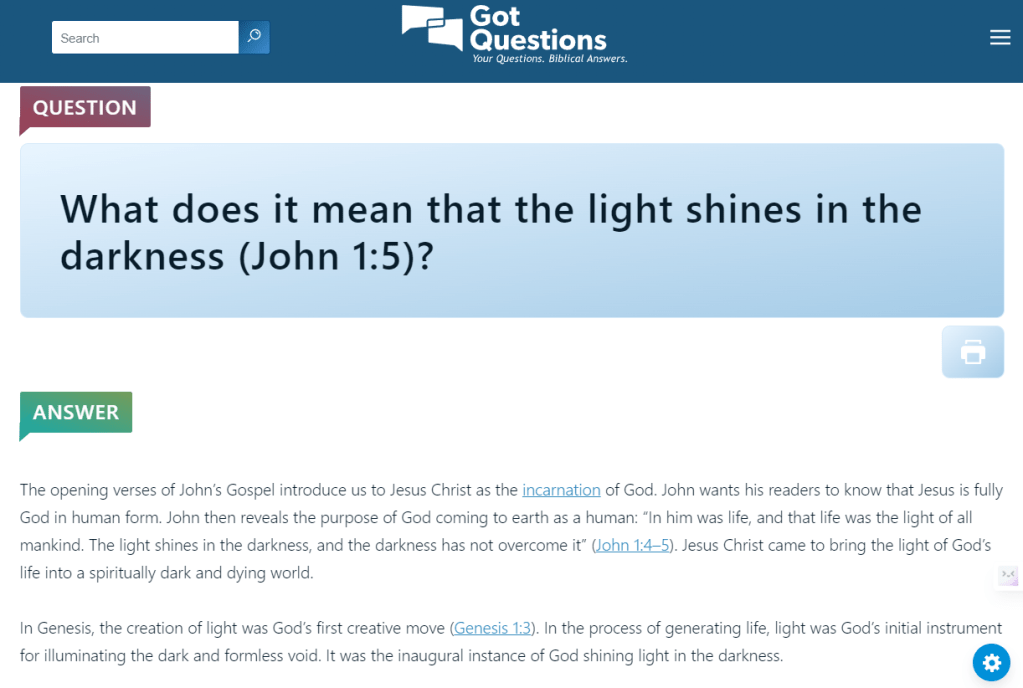
    What does it mean that the light shines in the darkness (John 1:5)? GotQuestions

     No power of darkness can defeat or snuff out this light (Matthew 16:18; John 16:33). Jesus is the giver of life and bearer of light. The Son of God continues to shine His light to humankind through His church, the body of Christ (Philippians 2:15). Whoever believes in Him receives eternal life (John 3:15; see also Psalm 112:4). 

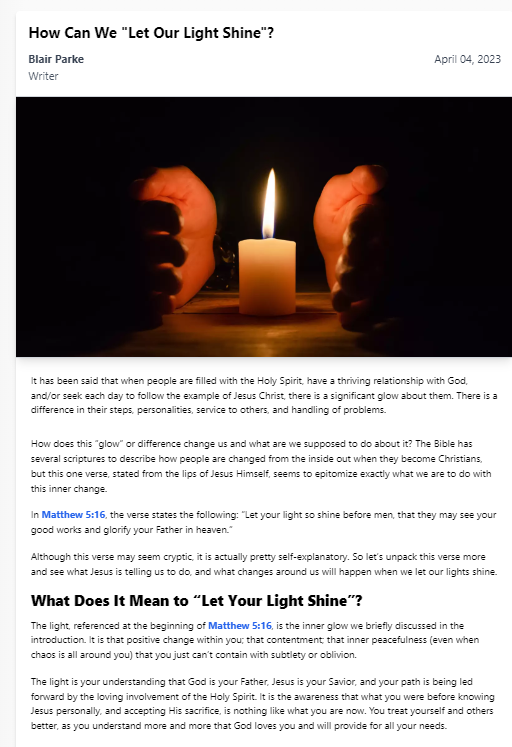
    How Can We “Let Our Light Shine”? BibleStudyTools.com

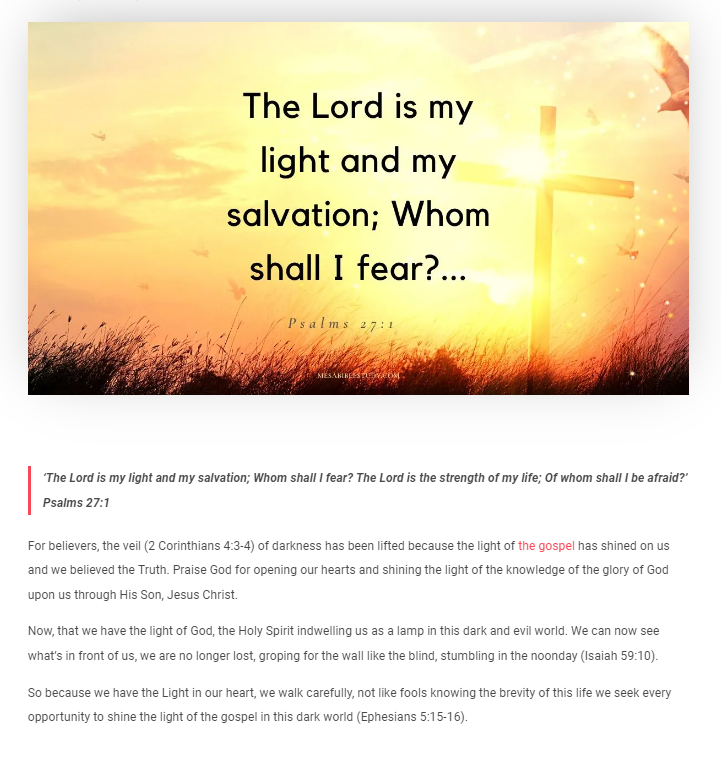
    The Lord Jesus Christ is Our Light in this Dark and Evil World

    THOUGHTS:

    In the Bible, light is often used as a metaphor for truth, goodness, and the presence of God. The arrival of this light brings clarity, understanding, and a deeper connection to the truth that was previously obscured.

    By being a source of inspiration and unwavering support, you bring light to others. Your actions guide and uplift people in difficult times, reminding them that goodness and hope still exist. Being a bearer of light means having inner strength, resilience, and upholding values like love, kindness, and empathy. It involves spreading positivity through words, actions, and interactions. In times of darkness, being a bearer of light brings hope, healing, and unity. You become a positive influence, offering guidance and support to those facing struggles.

  • Understanding Salvation

    Salvation is the act of being saved or delivered from sin and its consequences through God’s grace and acceptance of Jesus Christ as Savior. It is a gift that guarantees both eternal existence, and it is not dependent on our works or wavering faith, but on the sure foundation of Christ.

    John 10:28: “I give them eternal life, and they will never perish, and no one will snatch them out of My hand.”

    This verse emphasizes that those who believe in Christ will receive eternal life and will be secure in God’s hand.

    Ephesians 4:30: “Do not grieve the Holy Spirit of God, by Whom you were sealed for the day of redemption.”

    The Holy Spirit plays a vital role in salvation by convicting individuals of their need for Jesus Christ and sealing them as God’s children.

    Romans 8:38–39: “For I am sure that neither death nor life, nor angels nor rulers, nor things present nor things to come, nor powers, nor height nor depth, nor anything else in all creation, will be able to separate us from the love of God in Christ Jesus our Lord.”

    This verse reassures believers that nothing can separate them from God’s love.

    Salvation is a profound and transformative concept that encompasses the deliverance of sinners from the clutches of sin and its consequences. It is solely through God’s boundless grace and the acceptance of Jesus Christ as our Savior that we can attain salvation. Our ultimate salvation does not rest on our own works or wavering faith, but on the sure foundation of Christ and His sacrificial love.

    A Journey of Redemption and Grace

    Salvation is the act of being saved or delivered from the bondage of sin and its dire consequences. This profound transformation is made possible through the unfathomable grace of God. Through His divine decree, we receive the invaluable gift of eternal life, ensuring our existence not only in this temporal world but also in the eternal realm.

    The Holy Spirit plays a pivotal role in the journey of salvation.

    He convicts individuals of their need for Jesus Christ, regenerates and transforms their hearts, and seals them as beloved children of God. Ephesians 4:30 reminds us not to grieve the Holy Spirit, as it is through this divine seal that we are protected until the day of redemption.

    Our salvation rests firmly on the foundation of Christ, rather than our transient works or inconsistent faith.

    Through His selfless sacrifice, Jesus redeemed us from the chains of sin, offering us forgiveness and reconciliation with God. Therefore, we can be assured that not a single soul, redeemed by His grace, will be lost. This assurance provides a solid anchor for our faith, comforting us with the knowledge that our eternal life is secure in Christ.

    Salvation is not a one-time event or a simple transaction, but rather, it encompasses a comprehensive journey. It is a process in which we are justified, called, and ultimately glorified, as stated in Romans 8:30. This progression, orchestrated by God Himself, reveals His divine plan and purpose for each individual.

    One important aspect of salvation is the irrevocability of the gifts bestowed upon us by God. Once God selects and assigns spiritual gifts such as grace, faith, salvation, and redemption, they become immutable and inseparable from His love.

    Romans 11:29 affirms this truth, stating, “For the gifts and the calling of God are irrevocable.”

    This understanding brings a sense of assurance, knowing that God’s gifts are not subject to revocation.

    However, it is crucial to emphasize that genuine saving faith is not a superficial profession, but a sincere and heartfelt surrender to the lordship of Christ.

    If someone were to abandon their professed belief, it becomes evident that they never truly held it.

    As 1 John 2:19 elucidates, “They went out from us, but they were not of us; for if they had been of us, they would have continued with us.”

    This truth highlights the authenticity and permanence of true saving faith.

    In the realm of theology and biblical teachings, a resounding truth emerges: God’s elect, those chosen by Him, will persevere until the end and cannot lose their salvation.

    The scripture in John 10:28 reaffirms this, assuring us that no one can snatch us out of God’s hand.

    This assurance stems from the understanding that our salvation is not dependent on our own efforts or strength, but is upheld by the unwavering love and faithfulness of God.

    The profound comfort lies in the knowledge that our salvation is entirely dependent on God’s boundless grace and not on our own works. It is His unwavering commitment to His chosen ones that ensures their safe passage to heaven. As we journey through life, let us find solace in the understanding that the gift of eternal life, bestowed upon us by God, is a testament to His immeasurable love and grace.

    Resources:

    1. “Systematic Theology” by Wayne Grudem – This book provides an in-depth exploration of various theological topics, including salvation.
    2. “The Gospel According to John” – This Gospel provides insights into the teachings of Jesus regarding salvation and eternal life.
    3. “The Epistle to the Romans” – This letter by the Apostle Paul delves into the theological aspects of salvation and God’s grace.
    4. “The Holy Bible” – The ultimate source of wisdom and guidance, the Bible contains numerous passages that explore the concept of salvation and its implications.