
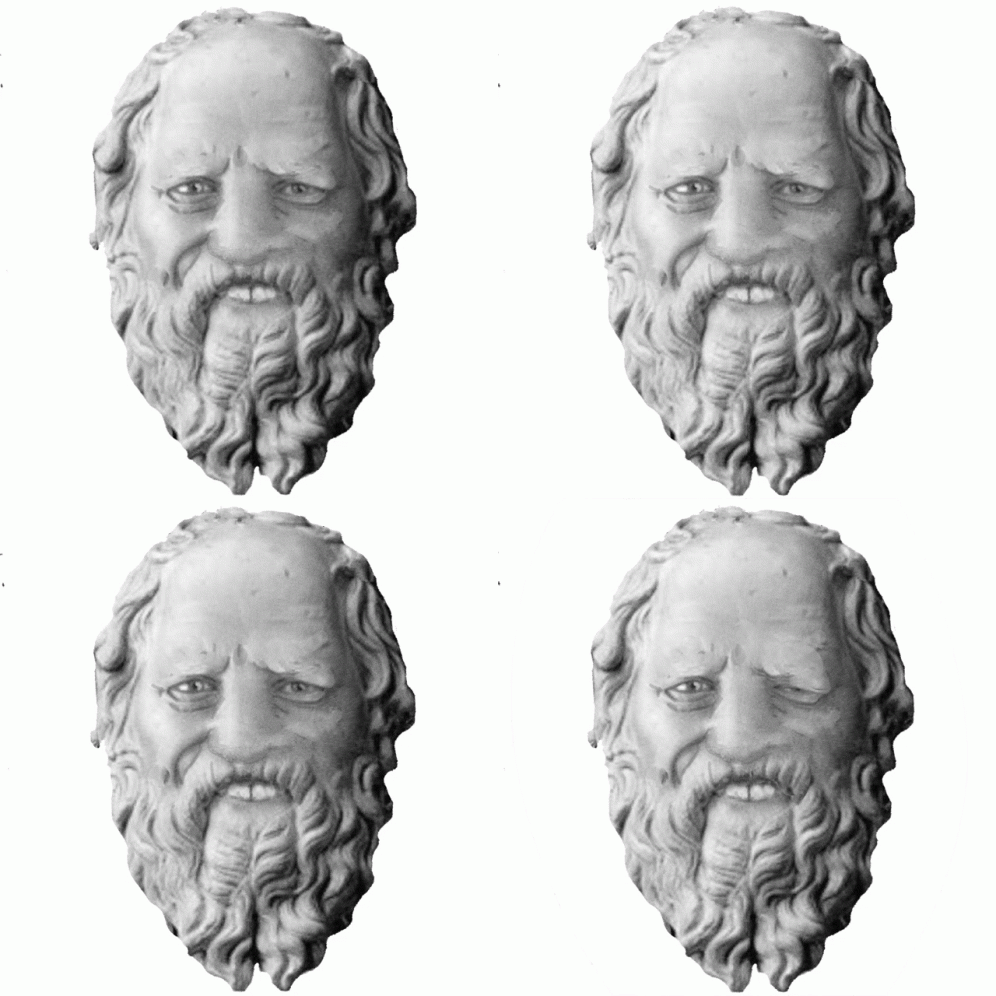
Socrates, a revered ancient Greek philosopher, met a tragic end at the hands of his own government.
Socrates fearlessly challenged the established order and traditional beliefs in Athens, primarily employing his unique Socratic method of questioning.
What Was The Established Order In Athens?
The established order was very similar to ours today in America.
Athens was a democracy.
Citizens directly participated in the decision-making process, collectively governing the city-state.

The government of Athens comprised various institutions, such as the popular assembly allowing adult male citizens to voice opinions and vote. Additionally, the city-state had the Boule council, made up of 500 randomly selected citizens who proposed laws and managed administrative affairs.
His Socratic Method, coupled with his unabashed criticism of authority, drew accusations of impiety and corrupting the youth, ultimately leading to his trial in 399 BCE.

When put on trial in 399 BCE in Athens, Socrates presented his defense by arguing that he had “not corrupted Athenian youth“, as his accusers claimed.
He argued that his “philosophy actually aimed to improve the moral and intellectual character of individuals, rather than leading them astray“.
Socrates began his defense by stating that he was “ignorant of the influence he had on other people and that he had never claimed to possess any wisdom or knowledge“.
He related a story in which the Oracle of Delphi described Socrates as the wisest man, leading him to conclude that:
True wisdom lies in acknowledging one’s own ignorance.
Socrates explained that his “primary goal was to engage in dialogue and question others in order to encourage critical thinking and self-examination“.
Furthermore, he argued that his “role as a philosopher was not to teach or indoctrinate, but to encourage individuals to think for themselves“.
He claimed that he “questioned and exposed the ignorance and inconsistencies of those who were regarded as wise in order to help others recognize their own lack of knowledge“.
Socrates believed that by questioning others, he was “helping them to seek wisdom and knowledge for themselves“.
Despite his defense, Socrates was found guilty by a jury of 500 Athenian citizens and sentenced to death by drinking poisonous hemlock.
Hemlock is a highly poisonous plant often used as a herbal remedy or poison, belonging to the coniferous family and characterized by small white flowers and feathery leaves.

His defense and subsequent execution became known as one of the most enduring stories of intellectual and philosophical martyrdom.

Choosing to adhere to the Athenian legal system, Socrates willingly drank hemlock, a widely recognized execution method of that time.
Socrates’ defiance of convention and his relentless pursuit of truth have left an indelible mark on the world of intellectual discourse.

Through his Socratic method, he revolutionized the way people approached questions, encouraging critical thinking and introspection.
Through his Socratic method, he revolutionized the way people approached questions, encouraging critical thinking and introspection.
Socratic Method
The Socratic method involves a dialogue between a questioner and a responder, where the questioner poses thought-provoking questions to the responder in order to elicit a deeper understanding of a topic or to challenge the responder’s beliefs and assumptions. The Socratic method encourages active participation and critical examination of ideas, leading to a more thorough exploration of a subject and the development of logical and reasoned arguments.
By challenging governmental authority and traditional beliefs, Socrates sparked important discussions that exposed the flaws in societal norms and fostered intellectual growth.
Despite his tragic fate, Socrates’ influence transcends time.
His ideas, recorded by his students Plato and Xenophon, continue to shape the foundations of Western philosophy.
Socrates’ emphasis on self-examination, the pursuit of truth, and the questioning of established beliefs paved the way for subsequent philosophers to build upon his legacy.
Socrates’ wisdom and teachings have served as a catalyst, encouraging generations of thinkers to challenge the status quo and seek the inherent truth in matters of ethics, morality, and knowledge.
The impact of his ideas on subsequent philosophers such as Aristotle, Descartes, and Kant cannot be overstated.
Even in the modern era, Socrates’ principles of critical thinking and self-reflection hold great relevance, guiding us in our quest for knowledge and personal growth.
In conclusion, Socrates paid the ultimate price for his relentless pursuit of truth and his challenge to established beliefs.
His trial and execution serve as reminders of the power struggle between conformity and intellectual progress.

His uncompromising quest for wisdom and his commitment to independent thought continue to inspire and shape the world of philosophy to this day and is a reminder to me why democracy sucks and America’s Constitutional Republic is so important to uphold.

Leave a Reply