

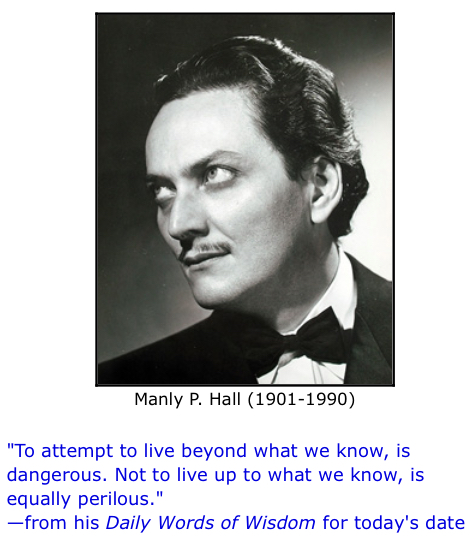
Canadian writer and mystic (1901–1990)
| Born | 18 March 1901, Peterborough Ontario |
| Died | 29 August 1990, Los Angeles |
Manly P. Hall (1901-1990) was a renowned authority on comparative religion and ancient philosophy, known for his extensive library and public lectures that reached millions.
Hall authored over 200 books and founded the Philosophical Research Society in 1934, focusing on the dissemination of knowledge in philosophy, comparative religion, and psychology.
Throughout his 70-year career, Hall delivered thousands of lectures worldwide, emphasizing the importance of philosophy in improving individual thought and living.

Esoteric Wisdom
Hall dedicated his life to uncoveringo and sharing the hidden knowledge passed down through secret societies and mystery schools.
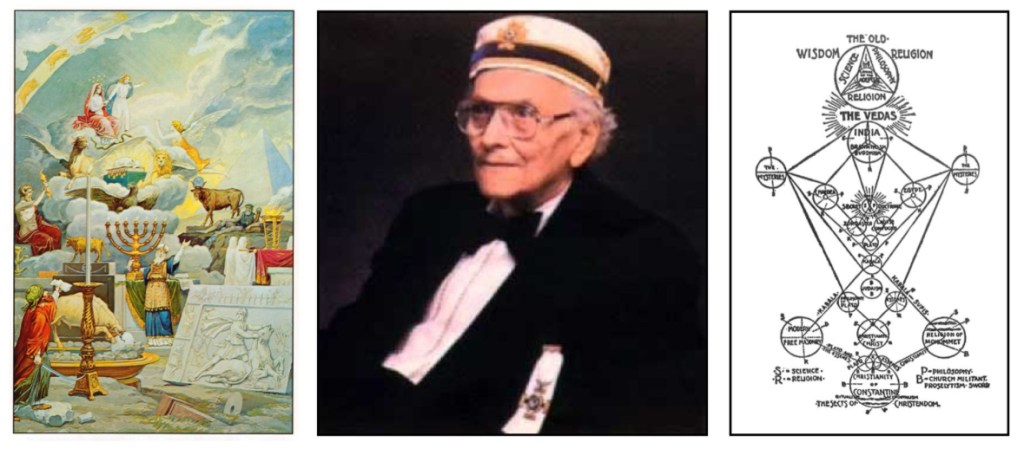
Hall delved into ancient texts, symbols, rituals, and teachings, aiming to decode the esoteric wisdom they held.
Hall believed this knowledge, once understood, could guide individuals on their path towards self-discovery and spiritual enlightenment.
Philosophy
Hall’s philosophical views were eclectic, drawing inspiration from a diverse range of traditions such as Platonism, Hermeticism, Rosicrucianism, and Eastern philosophies.
from manlyphall.info
Manly P. Hall was an inspired and prolific philosopher of the 20th century whose books, journals, and lectures are still available to a world-wide audience.
From this site you can download and read issues from a complete PDF collection of Mr. Hall’s Journals (published 1923-1990). The site also offers his “on the lighter side” Contributors’ Bulletins, a list of his book titles including their topics, and all article titles in his Journal runs: The All-Seeing Eye(1923-1931), Horizon (1941-1958), and PRS Journal(1958-1990). Also presented are all of his Monthly Letters to Students, dated May 1934-July 1941.
He emphasized the importance of understanding universal principles like:
the law of attraction, the interconnectedness of all things, and the cyclical nature of life.

Hall believed that by delving into these philosophical concepts, individuals could gain a deeper understanding of themselves, the world around them, and their place in the grand scheme of things.
Symbolism
Hall viewed symbols as a universal language, a way for the subconscious mind to communicate with the conscious mind.

He meticulously analyzed symbols found in mythology, religion, art, and architecture, believing they held hidden meanings that could unlock profound insights into the human psyche and the mysteries of the universe.
Hall’s interpretations of these symbols often focused on themes of transformation, rebirth, and the journey towards enlightenment.
Ancient Cultures and Traditions
Hall’s insatiable curiosity led him to explore a vast array of ancient cultures and traditions, including Egyptian, Greek, Roman, Mayan, Chinese, and Indian.
He believed these cultures held valuable knowledge about the human condition, spiritual practices, and the secrets of the universe.
Hall’s studies aimed to bridge the gap between ancient wisdom and modern understanding, offering contemporary interpretations of these traditions that resonated with a wider audience.
Self-knowledge
Hall considered self-knowledge to be the cornerstone of personal growth and spiritual development.
He encouraged individuals to embark on a journey of introspection, to delve into their thoughts, emotions, and motivations, and to confront their shadow selves.
Hall believed that by understanding their inner workings, individuals could break free from limiting beliefs, heal emotional wounds, and ultimately connect with their true essence.
Spiritual Growth
Hall’s teachings ultimately aimed to guide individuals towards spiritual awakening and enlightenment.
He believed that through self-knowledge, understanding universal principles, and connecting with the divine, individuals could transcend their egoic limitations and achieve higher levels of consciousness.
Hall’s vision of spiritual growth was not confined to a specific religion or doctrine but encompassed a broader, more inclusive understanding of spirituality.
