Month: August 2023

  • 7 Things God Hates & Their Implications

    7 Things God Hates & Their Implications

    In Proverbs 6:16-19, the Lord expresses His detestation for certain actions and attitudes. These seven traits are haughty eyes, a lying tongue, hands that shed innocent blood, a heart that devises wicked schemes, feet quick to rush into evil, a false witness who pours out lies, and a person who stirs up conflict in the community.

    Each of these represents a departure from the virtues that God values, such as humility, honesty, righteousness, and peace. Let us explore the meaning behind these detestable actions and the contrasting qualities that God cherishes.

    Haughty Eyes

    The Destructive Power of Arrogance

    Hebrew: Ayinayim Ramot: This refers to a proud and arrogant gaze, symbolizing a sense of superiority and disdain for others. It represents a lack of humility and an inflated self-image.

    Haughty eyes, filled with superiority. An air of arrogance, looking down upon others with disdain. A reflection of deep-rooted pride, blinding us to our shared humanity.

     “For all those who exalt themselves will be humbled, and those who humble themselves will be exalted.” –Luke 18:14

    Lying Tongue

    Spreading Falsehood and Deceit

    Hebrew: Lashon sheker: This signifies the act of spreading falsehood and deceit through speech. It reflects a lack of integrity and honesty, leading to the erosion of trust in relationships.

    A lying tongue refers to deceitful and dishonest speech, intentionally spreading falsehoods and manipulating others. It is the opposite of honest and trustworthy communication.

    Your words hold enormous power and carry weighty consequences. Every word we utter will ultimately be judged by God.

    “Death and life are in the power of the tongue,
    and those who love it will eat its fruits.” – Proverbs 18:21

    The Hands That Shed Innocent Blood

    Violence and Oppression: The Tragic Consequences of Shedding Innocent Blood

    Hebrew: Yadayim Shofekhot Dam Naki: The act of causing harm or taking the life of an innocent person. It represents violence, oppression, and a disregard for the sanctity of life.

    The act of shedding innocent blood represents a profound violation of the divine order, where human authority was never meant to have dominion over one another. Life is a sacred gift bestowed by the Creator, who imbues each individual with intrinsic worth.

    Prematurely ending a life, especially one defenseless, usurps the prerogative of God and goes against the fundamental philosophy of respecting the sanctity of life

    “Acquitting the guilty and condemning the innocent — the Lord detests them both.” -Proverbs 17:15

    Heart Devising Wicked Schemes

    The Corrupt Intentions of the Mind

    Hebrew: Lev Yozev Machashavot Ra’ot: This signifies a mind that constantly plans and devises evil actions, reflecting a corrupt and malicious intent. It represents a lack of moral conscience and a willingness to harm others.

    The concept of a heart devising wicked schemes refers to the inner intentions and thoughts of an individual inclined towards planning and executing malicious actions. It represents a mindset focused on developing and carrying out harmful or immoral plans.

    “The heart is deceitful above all things, and desperately sick; who can understand it?” -Jeremiah 17:9

    “For out of the heart come evil thoughts, murder, adultery, sexual immorality, theft, false witness, slander.” – Matthew 15:19

    Feet Quick To Rush To Evil

    Unveiling Impulsive Sinful Behavior

    Hebrew: Raglayim Mahirot l’dalchet Ba’ra: This refers to a person who eagerly and willingly engages in sinful activities. It represents a lack of self-control and a tendency to pursue immoral and destructive paths.

    A “quick to rush to evil” refers to someone who eagerly engages in wicked or harmful actions without considering the consequences or ethical judgment. It signifies a hasty and impulsive nature and goes against God’s teachings, as He expects us to distance ourselves from evil.

     “Do not set foot on the path of the wicked or walk in the way of evildoers. Avoid it, do not travel on it; turn from it and go on your way.” – Proverbs 4:14-15

    A False Witness Who Speaks Lies

    Embracing God’s Valued Virtues and Rejecting Detestable Actions

    Hebrew: Ed sheker mashqeh Kesef: This signifies someone who gives false testimony or spreads lies about others. It represents a betrayal of trust, causing harm and injustice through deceitful words.

    A false witness deliberately provides false testimony, distorting the truth for personal gain or manipulation. Their words lack credibility and integrity, as they are built upon lies and dishonesty. This concept also extends to the failure to align with divine truth in making truthful confessions.

    “You shall not bear false witness against your neighbor.” – Exodus 20:16

    A Person Who Stirs Conflict

    Embracing God’s Valued Virtues and Rejecting Detestable Actions

    Hebrew: Ish medinim mazor: Someone who actively provokes strife, discord, and division within a community or society. It refers to an individual who intentionally fosters disagreement, animosity, and disharmony among people, sowing seeds of conflict wherever they go.

    Medinim signifies strife or disputes.

    Mazor conveys the idea of stirring or causing trouble.

    A person who stirs conflict is someone who intentionally creates tension and disagreements among others. They enjoy causing problems and try to control and provoke arguments. This behavior disrupts peace and can harm relationships within a group or community.

     “What causes fights and quarrels among you? Don’t they come from your desires that battle within you?” – James 4:1 

    IN THIS- IT SHOWS WHAT GOD CHERISHES

    Humility/modesty of eyes –

    Not being prideful or arrogant, giving honor to others.

    He takes great joy in those whose eyes see with clarity unburdened by arrogance or self-importance. In humility we find truth – truth in who God made us to be, and truth in how we ought relate to one another.

    A truthful tongue – Speaking truthfully and honestly.

    “Therefore each of you must put off falsehood and speak truthfully to your neighbor, for we are all members of one body.” – Ephesians 4:25

    God finds delight in those who speak with integrity, sincerity, and righteousness. Honest words are like refreshing water for the soul, fostering understanding and trust among individuals.

    Hands that protect the innocent –

    Protecting the vulnerable from harm.

    “Defend the weak and the fatherless;
    uphold the cause of the poor and the oppressed.
    Rescue the weak and the needy;
    deliver them from the hand of the wicked.”
    – Psalm 82:3-4

    A heart that devises righteous plans –

    Crafting plans and intentions focused on goodness.

    “Create in me a clean heart, O God, and renew a right spirit within me.” – Psalm 51:10

    Feet that are quick to do good –

    Eagerly running toward righteousness.

    “Your word is a lamp to my feet and a light to my path.” – Psalm 119:105

    A truthful witness –

    Bearing honest testimony and avoiding falsehoods.

    “A truthful witness does not deceive, but a false witness pours out lies.” – Proverbs 14:5

    A peacemaker –

    Bringing people together in harmony rather than creating conflict.

    “Blessed are the peacemakers, for they will be called children of God.” – Matthew 5:9

    In conclusion, Proverbs 6:16-19 reveals the detestable actions and attitudes that the Lord hates, which contrast with the virtues that God cherishes.

    These actions include haughty eyes, a lying tongue, hands that shed innocent blood, a heart that devises wicked schemes, feet quick to rush into evil, a false witness who pours out lies, and a person who stirs up conflict in the community.

    On the other hand, God values humility, truthfulness, protecting the innocent, righteous plans, eagerness to do good, truthful testimony, and being a peacemaker. These qualities reflect a heart that pleases God and embodies integrity, justice, and compassion.

    As we seek to align our lives with God’s values, let us strive to reject arrogance, deceit, violence, wickedness, impulsive sinful behavior, dishonesty, and causing conflicts.

    Instead, let us cultivate humility, truth, compassion, righteousness, eagerness to do good, honesty, and a spirit of peace. By embracing these virtues, we can honor and please God, and contribute to a harmonious and loving community.

     “Speak up for those who cannot speak for themselves, for the rights of all who are destitute. Speak up and judge fairly; defend the rights of the poor and needy.” – Proverbs 31:8-9

  • Christian’s Have Received Unjust Demonization

    Christian’s Have Received Unjust Demonization

    Historical Misconceptions of Christians: The Distinction Between Christians and the Roman Catholic Church

    Throughout history, followers of the Way, known as Christians, have faced unjust demonization and persecution. However, it is important to clarify that the wrongdoings often attributed to Christians were actually carried out by the Roman Catholic Church, rather than true believers themselves. In fact, historical records highlight that the actions of the Catholic Church were aimed at those who unwaveringly held onto their faith in Scripture and Christ, rather than targeting non-believers. In order to understand the complexities of this distinction, we must delve into the historical context, the actions of the Roman Catholic Church, and the resilience of early Christians in the face of persecution.

    The Historical Context:

    During the time of the Roman Empire, the rise of Christianity posed a challenge to the polytheistic society prevalent at the time. Christians faced significant persecution and pressure to renounce their faith in Jesus Christ, the proclaimed Son of the only true God. The Roman authorities saw these Christians as a threat to their power and attempted to suppress them through public persecution and violent execution.

    The Actions of the Roman Catholic Church:

    While early Christians faced persecution from the Roman authorities, it is important to note that the actions attributed to Christians throughout history were predominantly orchestrated by the Roman Catholic Church. The Catholic Church, with its immense power and influence, shaped the course of religious, social, and political events. However, with such power also came corruption and abuses that deviated from the teachings of Christianity.

    Medieval Period

    During the medieval period, the Catholic Church became deeply entwined with political affairs, leveraging its authority to control rulers, governments, and even entire nations. The Church amassed vast wealth and property, often through questionable means such as indulgences. This led to accusations of exploitation and manipulation of the faithful, while perpetuating social inequalities.

    Furthermore, the Church’s interpretation and implementation of religious doctrine were subject to its authority, which was often abused. Certain clergy members used their positions to advance personal agendas or suppress dissenting views. This divergence from biblical principles sparked criticism from reformist movements, ultimately leading to the Protestant Reformation in the 16th century.

    The Persecution of True Believers:

    Contrary to popular belief, history reveals that it was the true believers, those who unwaveringly held onto their faith in Scripture and Christ, who often bore the brunt of persecution by the Roman Catholic Church. Early Christians courageously refused to participate in the polytheistic practices of the time, even at the cost of their lives.

    Polytheistic: Term used to describe a belief system or religious practice that recognizes and worships multiple gods or deities.

    These individuals are martyrs and symbols of inspiration, as they played a significant role in the development and spread of Christianity.

    The Distorted Historical Narrative:

    The prevailing historical narrative often overlooks the distinction between Christians and the actions of the Roman Catholic Church. It is essential to recognize that history is often shaped by those in power, resulting in a biased portrayal of events. The victims of Catholic infiltrators have been unjustly depicted as instigators, raising concerns about the accuracy and impartiality of historical accounts.

    Uncovering the Truth:

    To gain a more accurate understanding of history, it is crucial to approach narratives with a discerning eye. Examining alternate accounts, dissenting perspectives, and lesser-known sources can help unveil hidden truths and challenge the accepted narrative. By delving deeper into historical complexities, we can shed light on the distinction between Christians and the actions of the Roman Catholic Church, while appreciating the resilience and unwavering faith of early believers.

    It is vital to understand; the wrongdoings and injustices often attributed to Christians were primarily carried out by the Catholic Church, rather than true believers themselves.

  • The Manna From Heaven; Have You Tasted?

    The Manna From Heaven; Have You Tasted?

    The workings of the Divine transcend our limited understanding as we exist within the boundaries of finite perception, constrained by the illusion of time and space. However, it is crucial not to misconstrue this truth as a call to passively surrender to our material limitations and indulge in earthly desires. You may ask: How am I indulging in my earthly, fleshly desires? By merely embracing our human limitations in matters of the Spirit and coalescing with the limitations, we demonstrate our worldly, materialistic bondage, as it is rooted in the realm of the flesh and obeys the laws of materiality.

    Our true calling lies in the pursuit of the spiritual realm.

    As beings born of Spirit, it is essential for us to direct our efforts towards seeking the profound aspects of existence. Through aligning our will with the Divine and opening ourselves to the pure desire to come into union with divine revelation, we can attain a genuine understanding as Willed by our Creator, if we embrace the profound beauty and purpose that permeates all aspects of Life.

    True wisdom is comparable to precious pearls, both valuable and costly. It encapsulates the essence of the Holy Creator and should not be frivolously thrown around and laid upon those who don’t care, as they will trample this treasure with disregard, and you will share in that disregard for ignoring the discernment.

    By Wisdom I mean…

    The Secret Wisdom, Given in Secret by the Father Who is in the Secret place.

    The wisdom bestowed upon us by the Divine is indeed profound and transcendent, surpassing the limits of human imagination. It is akin to the language of angels, a divine download of profound understanding that elevates us to heights uncharted by our limited perception. In those transformative moments, we are transported beyond the boundaries of our ordinary existence, allowing us to glimpse the vast realms of divine wisdom and experience a profound shift in our consciousness.

    The acquisition of wisdom cannot be accomplished through the mere use of human intelligence, cleverness, or the performance of righteous deeds. Wisdom is a divine gift bestowed upon us by the grace of the Divine God Who sits on the throne with Dominion over all things.

    It is through our connection with the spiritual realm and our being made willing to seek truth that we are able to access the profound wisdom that surpasses the capabilities of human faculties.

    It is the Divine who bestows wisdom upon His creation, irrespective of our knowledge or self-righteousness. In fact, it is bestowed upon us in spite of such attributes.

    So, who then receives wisdom?

    It is the Holy Creator, the embodiment of Spirit, who implants His wisdom in those individuals who possess sincere hearts, driven by a genuine and uncomplicated love for truth, unadulterated.

    Christians, there is no need to remain in confusion or darkness unless one willingly embraces ignorance as a state of bliss, in which; i suppose your reward is in this Life, not ideal.

    Godly Wisdom is grown through a genuine, insatiable thirst for the living water, a hunger for the heavenly manna, and a recognition of the power of God, wating to Know Him deeper and deeper; so, we incessantly seek wisdom from the Divine Father out of Love.

    This thirst, this hunger, drives us to persistently seek wisdom through prayer, for we are aware of the indwelling Spirit that allows us to comprehend wisdom and receive discernment from realms beyond our own. Wisdom is a treasure promised by the Creator of Spirit to all who earnestly and wholeheartedly seek it. Let us emphasize the keyword: earnestly.

    The wisdom does not come in an easily digestible form. True wisdom, originating from the heavenly realms, often confronts us as mortal beings with profound intensity. It has the power to disrupt our fleshly desires and shock our system, instilling a reverential fear within our physical bodies, while simultaneously fostering resilience within our souls. Spiritual truths, by their very nature, prove challenging for humans to comprehend and impossible to fully embrace without the guidance and presence of the Spirit of God, as the flesh HATES the Spirit.

    The Wisdom of God can be likened to a tough piece of meat that necessitates thorough chewing and contemplation. It is only through this deliberate process that we can fully internalize and integrate it into our lives. Just as one would risk choking by hastily consuming food without proper chewing, rushing through the understanding and application of God’s truth can lead to spiritual indigestion. Therefore, it is vital to approach the truths of God with patience and diligence, taking the time to chew thoroughly and savor the nourishment they provide, alse you WILL CHOKE.

    The wisdom bestowed upon us by the Divine Sovereign is resilience integrated into our Soul and nourishing, sustaining us on our material journey into death, a portal into Eternal Life. Although others cant see, nor understand, we Know, intimately, this is a satisfaction that cant be manufactured and is not for show, its genuine and cant be resisted.

    HERE ARE SOME SCRIPTURES TO EDIFY YOUR DESIRE TO WALK WITH THE FATHER, IN SECRET.

    “But when you pray, go into your room, close the door and pray to your Father, who is unseen. Then your Father, who sees what is done in secret, will reward you” – Matthew 6:6

    “For God, who said, ‘Let light shine out of darkness,’ made his light shine in our hearts to give us the light of the knowledge of God’s glory displayed in the face of Christ” – 2 Corinthians 4:6

    “But you, when you pray, go into your room, and when you have shut your door, pray to your Father who is in the secret place; and your Father who sees in secret will reward you openly” – Matthew 6:6

    “I will give you hidden treasures, riches stored in secret places, so that you may know that I am the LORD, the God of Israel, who summons you by name” – Isaiah 45:3

    “But when you give to the needy, do not let your left hand know what your right hand is doing, so that your giving may be in secret. Then your Father, who sees what is done in secret, will reward you” – Matthew 6:3-4

  • Demystifying the Basics of String Theory: Questions. Answered.

    Demystifying the Basics of String Theory: Questions. Answered.

    1. What is String Theory?
    2. What are oscillating strings in String Theory?
    3. How do oscillating strings relate to the particles and forces in our universe?
    4. What are hidden dimensions?
    5. How are hidden dimensions supported by calculations and mathematical models?

    1. What is String Theory?

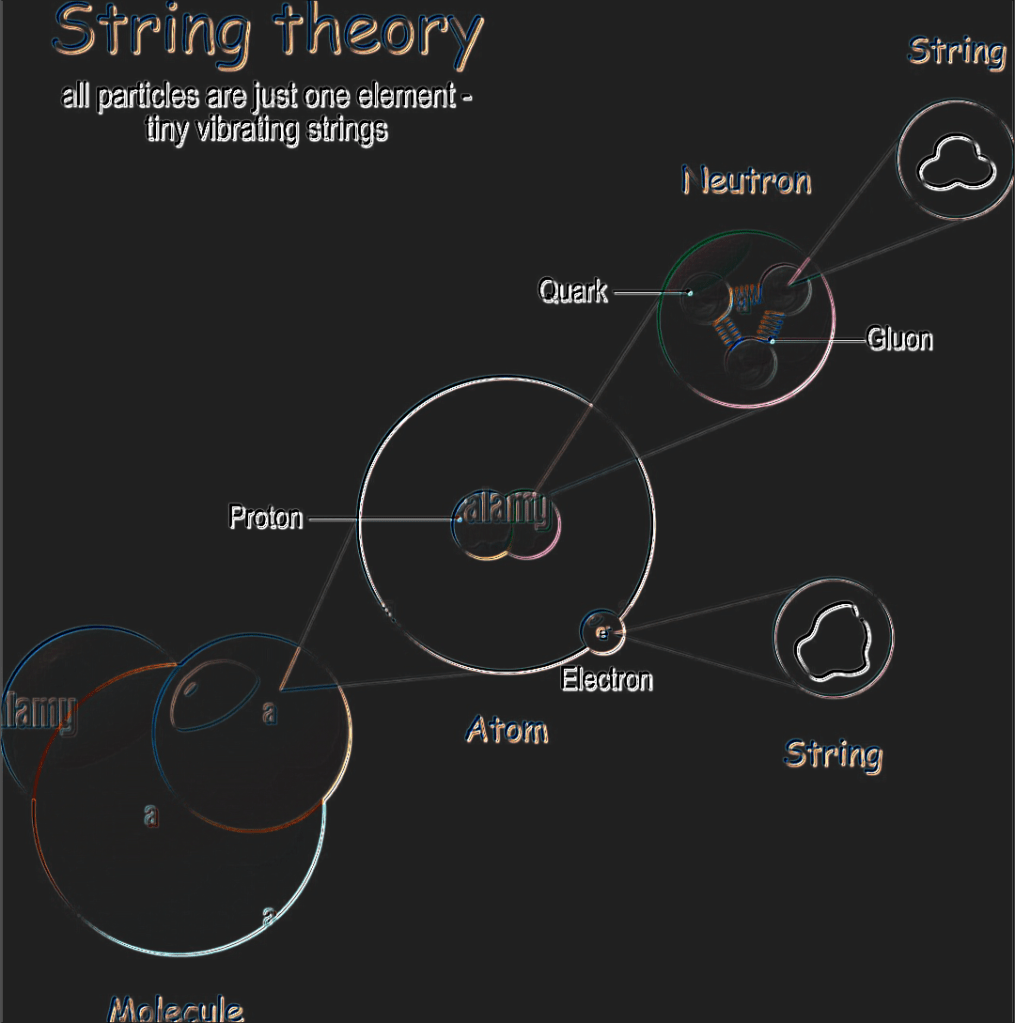
    String theory is supported by several facts and resources that make it a compelling theoretical framework in physics. Firstly, string theory offers a solution to the long-standing problem of reconciling quantum mechanics and general relativity. These two theories, while successful in their respective domains, are incompatible at the fundamental level. String theory proposes that elementary particles are not point-like objects, but rather tiny, vibrating strings. This revolutionary concept helps to bridge the gap between the quantum world of particles and the gravitational interactions described by general relativity.

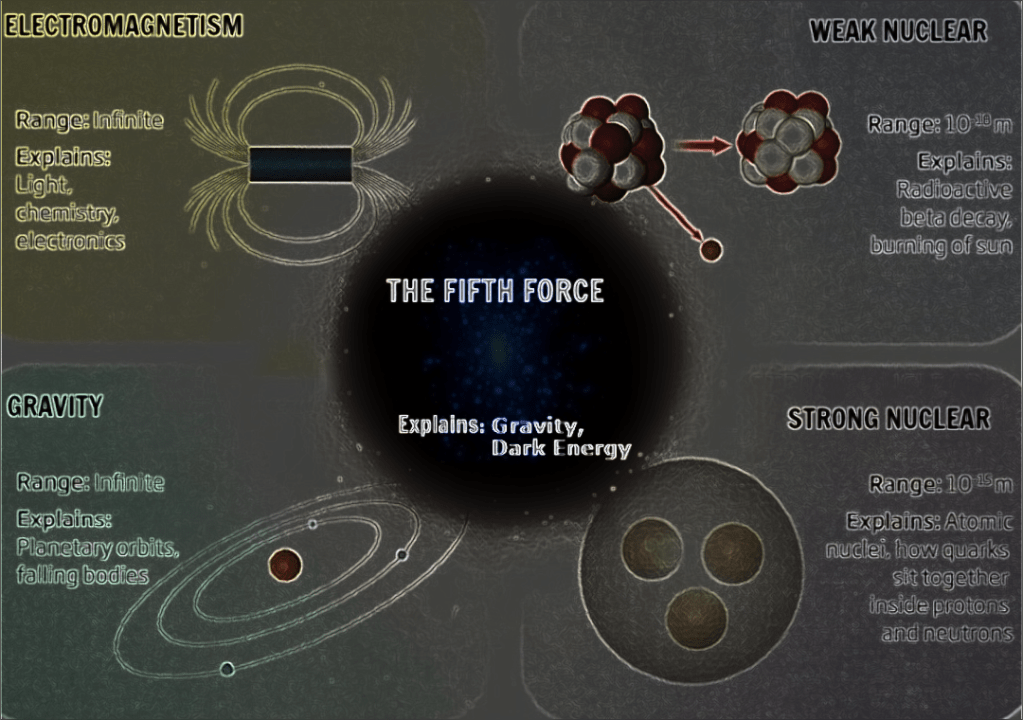
    String theory provides a mathematical framework that unifies all the known fundamental forces. By incorporating gravity, electromagnetism, and the strong and weak nuclear forces into a single theory, string theory offers the possibility of a unified description of the universe.

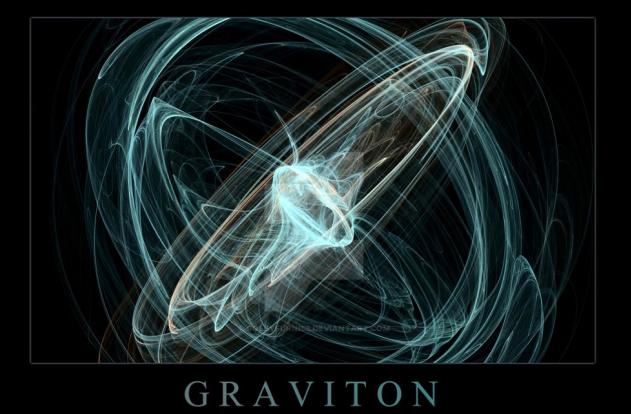
    This is a major goal in physics and has been a driving force behind much of the research in theoretical physics. In fact, string theory predicts the existence of new particles called gravitons, which are hypothesized to mediate the force of gravity.

    The ghost particle


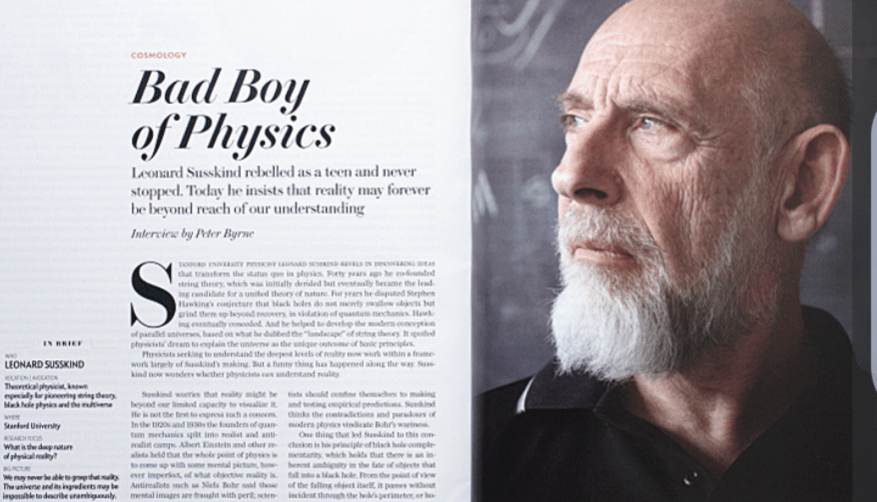
    In terms of resources, string theory has been extensively studied by many prominent physicists, such as Leonard Susskind, Brian Greene, and Juan Maldacena. These individuals have published numerous papers and books on the subject, providing detailed explanations and mathematical models that support the concepts of string theory. Additionally, string theory has been a subject of ongoing research and debate within the scientific community, with experiments and theoretical developments continually pushing the boundaries of our understanding.

    With its ability to reconcile quantum mechanics and general relativity, unify the fundamental forces, and predict new particles, string theory has garnered significant attention and support from the scientific community.

    2. What are oscillating strings in String Theory?

    There are several facts and resources that support the notion of oscillating strings in string theory. One key resource is the work of renowned theoretical physicists such as Edward Witten, Leonard Susskind, and Juan Maldacena. These scientists have made significant contributions to the development and understanding of string theory, including the concept of oscillating strings as the fundamental objects from which particles are composed.

    In addition to the research of these physicists, various mathematical calculations and theoretical frameworks further validate the existence of oscillating strings. These calculations show that the vibrational modes of these strings correspond to different particle properties, such as mass and charge. The intricate mathematical consistency between these vibrational modes and observed particle properties lends strong support to the concept of oscillating strings.

    Furthermore, experimental evidence has indirectly validated the existence of oscillating strings. For instance, the discovery of supersymmetry, which predicts the existence of superpartners for each particle, aligns with the principles of string theory. Additionally, the concept of extra dimensions, also predicted by string theory, has gained theoretical and experimental support. These extra dimensions and their impact on particle interactions provide further evidence that oscillating strings are indeed the building blocks of our universe.

    3. How do oscillating strings relate to the particles and forces in our universe?

    String theory proposes the concept of oscillating strings as a fundamental component of our universe. The theory suggests that particles in our universe are not point-like, but rather tiny strings that vibrate in multiple dimensions. This concept provides a possible explanation for the different masses, charges, and properties of particles. The vibrations of the strings give rise to various particles with different energies and masses.

    Moreover, string theory also explains the origin of the fundamental forces and interactions. The interactions between the strings, such as splitting and merging, correspond to the different forces in nature, including electromagnetism, gravity, the strong nuclear force, and the weak nuclear force.

    This is a remarkable aspect of string theory, as it offers a unified framework that can potentially explain all the fundamental particles and forces that govern our universe.

    Despite its theoretical elegance, it is important to acknowledge that string theory is still highly speculative and has yet to be experimentally confirmed. Due to the immense complexity of its mathematical formulations, direct empirical evidence is currently lacking. Nevertheless, string theory has gained significant attention and continues to be actively studied by physicists as a promising theoretical framework for understanding the fundamental nature of our universe.

    Sources:
    1. Greene, B. (2000). The Elegant Universe: Superstrings, Hidden Dimensions, and the Quest for the Ultimate Theory. Vintage Books.


    2. Polchinski, J. (2000). String Theory: Volume I, An Introduction to the Bosonic String. Cambridge University Press.


    4. Ooguri, H. (2012). Introduction to Physics of String and Branes. Lecture Notes. Retrieved from PDF

    4. What are hidden dimensions?

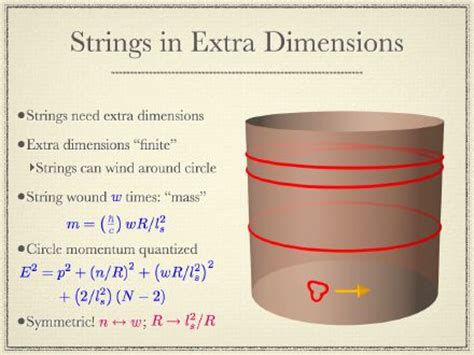
    Hidden dimensions, as proposed in theoretical physics, refer to additional spatial dimensions beyond the three that we are familiar with (length, width, and height). These extra dimensions are not detectable in our everyday experience but are postulated in various physical theories, such as string theory and superstring theory.

    According to these theories, there may be up to 10 or 11 dimensions in total, with the extra dimensions “curled up” or “compactified” at tiny scales or in complex shapes, making them hidden from our perception. These additional dimensions play a crucial role in solving certain problems in fundamental physics, such as unifying gravity with the other fundamental forces and explaining the nature of particles and forces.


    Understanding and exploring hidden dimensions are significant challenges in modern theoretical physics and are subjects of ongoing research. However, it’s important to note that the existence of hidden dimensions is still a theoretical concept and has not been proven experimentally.

    5. How are hidden dimensions supported by calculations and mathematical models?

    Hidden dimensions are not directly observable in our three-dimensional world, but they are supported by calculations and mathematical models in theoretical physics. One such model that incorporates hidden dimensions is string theory, which suggests that our universe may consist of more than three spatial dimensions. In this theory, particles are not considered point-like, but instead are tiny vibrating strings that propagate through spacetime, including hidden dimensions. These strings and their interactions are described by mathematical equations derived from principles such as quantum mechanics and differential geometry.

    Additionally, hidden dimensions can have observable effects on various physical phenomena. These effects can deviate from what would be expected in a purely three-dimensional world and can be formulated mathematically. Through this mathematical analysis, scientists can make predictions and test them against experimental data. While hidden dimensions have not been experimentally confirmed, the mathematical framework they provide has contributed to our understanding of fundamental physics.


    Resources:
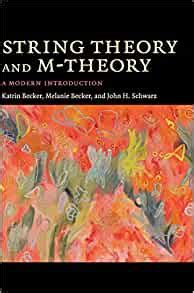
    – “String Theory and M-Theory: A Modern Introduction” by Katrin Becker, Melanie Becker, and John H. Schwarz.


    – Lecture notes on string theory and hidden dimensions from reputable universities like Princeton, Harvard, and Caltech.

  • What Is A Deterministic Worldview?

    What Is A Deterministic Worldview?

    Do I have a deterministic perspective?

    Yes.

    The Foundation of My Perspective

    The perspective I maintain is not derived from unfounded belief or arbitrary convictions.

    Instead, it is rooted in a comprehensive understanding of the subject matter. This understanding is the result of careful study, thoughtful analysis, and a commitment to seeking truth and clarity.

    My perspective aligns biblical teachings, logical reasoning, and physics principles to support determinism.

    The Bible emphasizes God’s sovereignty and foreknowledge guiding all events, aligning with determinism’s premise that external forces shape outcomes 3.

    Logical reasoning examines cause and effect, concluding that all events have preceding causes. This supports determinism’s view that factors beyond our control govern lives 3.

    Physics laws demonstrate the deterministic nature of phenomena. Objects’ motions are precisely predicted based on forces acting on them. Quantum mechanics and relativity provide evidence for physical

    Deterministic- Biblical Teachings:

    In the passages of Romans 8:29-30, Ephesians 1:5, and 2 Timothy 1:9, the Scriptures reveal God’s profound foreknowledge and predestining of individuals for their ultimate salvation. These verses affirm the all-knowing and all-powerful nature of God, who has already predetermined the eternal fate of every individual.

    God, who is all-knowing and just, has predetermined the eternal fate of every individual based on their choices and actions in which He already Orchestrated prior to fulfillment.

    Those whom God foreknew, He has predestined to be conformed to the image of His Son, Jesus Christ.

    Romans 8:29-30:
    “For those whom he foreknew he also predestined to be conformed to the image of his Son, in order that he might be the firstborn among many brothers. And those whom he predestined he also called, and those whom he called he also justified, and those whom he justified he also glorified.”
    Ephesians 1:5:
    “He predestined us for adoption to himself as sons through Jesus Christ, according to the purpose of his will.”

    God, in His will and for His purpose, predestined His Sheep to be adopted as His children through Jesus Christ.

    Paul reminds Timothy (and believers) that our salvation and calling is not based on our own merit or works, but on God’s purpose and grace.

    2 Timothy 1:9:
    “Who saved us and called us to a holy calling, not because of our works but because of his own purpose and grace, which he gave us in Christ Jesus before the ages began.”

    God’s control is over all events: He is the orchestrator of all things.

    Isaiah 46:9-11:
    “Remember the former things, those of long ago;
    I am God, and there is no other;
    I am God, and there is none like me.
    I make known the end from the beginning,
    from ancient times, what is still to come.
    I say, ‘My purpose will stand,
    and I will do all that I please.’
    From the east I summon a bird of prey;
    from a far-off land, a man to fulfill my purpose.
    What I have said, that I will bring about;
    what I have planned, that I will do.”


    Daniel 4:35:
    All the peoples of the earth
    are regarded as nothing.
    He does as he pleases
    with the powers of heaven
    and the peoples of the earth.
    No one can hold back his hand
    or say to him: “What have you done?”


    In Isaiah 46:9-11, God declares that He is unique and unlike any other. He knows the past, present, and future, and His plans will be accomplished. He has the authority to bring about events according to His purpose and there is no one who can hinder or question His actions.

    In Daniel 4:35, King Nebuchadnezzar of Babylon acknowledges the supreme power of God. He acknowledges that all the people of the earth are nothing compared to God. God has complete control over the heavens and the earth and no one can resist His will or challenge His actions.

    The theologian John Calvin, who played a key role in the development of Protestantism, extensively discusses the concept of divine providence.

    He emphasizes that God’s plan guides all events, including salvation. In his work “Institutes of the Christian Religion,” Calvin presents thorough theological arguments for predestination and divine sovereignty. He constructs a logical framework that explains God’s providence, asserting that everything occurs according to God’s will and purpose. Calvin cites numerous biblical references to support his arguments. He lays out a systematic framework that logically explains the concept of God’s providence, arguing that everything happens according to God’s will and purpose.

    Main Argument I face: The Bible also speaks of God’s desire for all people to be saved (1 Timothy 2:3-4) and emphasizes the responsibility humans have to respond to God’s grace (John 3:16, Romans 10:9). MY RESPONSE TO THIS, CLICK TO READ

    Determinism- Logical Reasoning:

    If every event is a result of a prior cause, then our lives are governed by forces beyond our control, prior to our serial at this point in time.

    Determinism finds support in logical reasoning by examining cause and effect relationships.

    Cause & Effect: The idea is that every event and action in the world has a preceding cause that determines its occurrence.

    Psychological research has also contributed to the argument for determinism.

    Studies on decision-making and behavior have demonstrated that our choices and actions are heavily influenced by factors beyond our conscious control, such as genetics, upbringing, and societal influences. Study

    The field of behavioral genetics, has shown that certain traits and behaviors have a genetic basis, further reinforcing the idea that our lives are governed by forces beyond our control. Study

    Philosophers such as David Hume and Immanuel Kant have presented compelling arguments for determinism based on the principles of causality and the uniformity of nature. Read

    Determinism- Principles from Physics:

    One of the key proponents of determinism is the field of physics. The laws of physics define how objects and forces interact in the universe.

    These laws are deterministic in nature, meaning that based on the initial conditions of a system, the outcome can be accurately predicted. This notion is supported by the principles of classical mechanics, quantum mechanics, and general relativity, all of which provide ample evidence for the deterministic nature of physical phenomena.

    Newton’s laws of motion demonstrate how an object’s motion is determined by the forces acting upon it. This cause and effect relationship can be observed and measured with precision, providing empirical evidence for the deterministic nature of physical phenomena.

    Classical physics posits that the entire universe operates according to fixed laws and that every event has a cause.

    Quantum Physicist who argue FOR Determinism

    1. David Bohm: Bohm proposed an alternative interpretation of quantum mechanics called the pilot wave theory or the hidden variable theory. According to his theory, particles have definite positions and velocities at all times, contradicting the uncertainty principle.

    Bohm argued for a deterministic worldview where the apparent randomness of quantum measurements is a result of our lack of knowledge about the underlying hidden variables.

    2. Roger Penrose: Penrose is a renowned physicist and mathematician who has argued against the prevailing interpretation of quantum mechanics as purely probabilistic. He suggests that another unknown factor, possibly related to consciousness or gravity, could be responsible for the seemingly indeterministic behavior of quantum systems. Penrose believes that a deeper theory, incorporating both quantum mechanics and general relativity, will reveal determinism at a fundamental level.

    3. Gerard ‘t Hooft: ‘t Hooft is a Dutch theoretical physicist who has been critical of the Copenhagen interpretation of quantum mechanics. He proposes a hidden variable theory that retains determinism by allowing for the existence of deterministic trajectories for particles, even at the quantum level. ‘t Hooft argues that there may be yet undiscovered fundamental equations that can describe such deterministic behavior.

    Determinism- Convergence of Knowledge:

    When biblical teachings, logical reasoning, and principles from physics are combined, they converge to support determinism. The Bible often emphasizes the concept of divine providence and God’s sovereignty over all creation.

    Numerous verses, such as Proverbs 16:9 and Jeremiah 10:23, suggest that our steps are directed and controlled by a higher power. This aligns with the deterministic view that external forces, in this case, God, are governing our lives.

    Proverbs 16:9: The heart of man plans his way, but the Lord establishes his steps.
    Jeremiah 10:23 says, “LORD, I know that people’s lives are not their own; it is not for them to direct their steps.”

    If we deconstruct the concept of cause and effect, it becomes apparent that all events are influenced by preceding events.

    Determinism admits that the present state of the universe, including our thoughts and actions, is a consequence of a series of causalities that can be traced back to the inception of time. This comprehension aligns seamlessly with the principle of logical reasoning that posits every effect is preceded by a cause.

    Determinism- Criticisms and Counterarguments:

    While critics argue that determinism undermines free will and personal responsibility, it is important to acknowledge and address these counterarguments to maintain a balanced perspective.

    Many argue that although our choices may be influenced by external factors, we still have the ability to make decisions and take actions.

    A study conducted by Nahmias et al. (2005) investigated the relationship between determinism and free will, concluding that the belief in determinism does not necessarily undermine one’s sense of free will or personal responsibility.

    Additionally, research in neuroscience suggests that although our actions may be influenced by subconscious processes and external factors, the brain still possesses the capacity for conscious decision-making.

    Furthermore, it is important to recognize that personal responsibility can still be upheld within a deterministic framework. Even if our choices are influenced by prior causes, individuals can still be held accountable for their actions based on the consequences of their decisions.

    In fact, the recognition of how external factors impact our choices can lead to a more nuanced understanding of what personal responsibility really means and come to an understanding of the interdependent nature of life.

    Engaging with criticisms and counterarguments leads to refinements of your worldview.

    Our lives are influenced and controlled by external forces that are beyond our control.

    Scientific research shows that both biological and environmental factors have a profound impact on human behavior. Genes play a significant role in shaping our personality traits and preferences, while our early childhood experiences have a lasting effect on our behavior and decision-making skills. Sociological research also demonstrates that social structures and institutions, such as education systems and economic policies, heavily influence our opportunities and outcomes.

    Scholars like Pierre Bourdieu have emphasized the concept of social capital, which emphasizes how our social networks and access to resources affect our success and social mobility.

    Before rejecting something, make sure that you understand it, whether it is an idea, a perspective, or even a person. Take the time to explore and gather information. Seek to comprehend the complexities and nuances of the matter at hand. By doing so, you will be able to make informed judgments rather than basing your decision on ignorance or preconceived notions.

  • Deterministic Worldview

    Deterministic Worldview

    A deterministic worldview asserts that external factors, beyond our control, govern our existence.

    My perspective is not based on blind faith or arbitrary beliefs, but rather on a comprehensive understanding.

    Blind faith refers to a strong belief or trust without any reasoning. Arbitrary beliefs refer to beliefs that are not based on rational thinking, but rather on personal preference, conditioning, or other subjective factors.

    My belief integrates biblical teachings, logical reasoning, and principles from physics.

    Deterministic- Biblical Teachings:

    In the passages of Romans 8:29-30, Ephesians 1:5, and 2 Timothy 1:9, the Scriptures reveal God’s profound foreknowledge and predestining of individuals for their ultimate salvation.

    God foreknew believers before they existed.

    Romans 8:29 states “For those God foreknew he also predestined…”

    God predestined believers to be conformed to the image of Christ.

    Romans 8:29 continues “…he also predestined to be conformed to the image of his Son.”

    God chose believers in Christ before the foundation of the world.

    Ephesians 1:4-5 says “For he chose us in him before the creation of the world…He predestined us for adoption to sonship through Jesus Christ.”

    God’s purpose and grace were given to believers before the beginning of time.

    2 Timothy 1:9 states “He has saved us and called us to a holy life—not because of anything we have done but because of his own purpose and grace. This grace was given us in Christ Jesus before the beginning of time.”

    These verses affirm the all-knowing and all-powerful nature of God, who has already predetermined the eternal fate of every individual.

    God, who is all-knowing and just, has predetermined the eternal fate of every individual based on their choices and actions in which He already Orchestrated prior to fulfillment.

    Those whom God foreknew, He has predestined to be conformed to the image of His Son, Jesus Christ.

    Romans 8:29-30:
    “For those whom he foreknew he also predestined to be conformed to the image of his Son, in order that he might be the firstborn among many brothers. And those whom he predestined he also called, and those whom he called he also justified, and those whom he justified he also glorified.”


    Ephesians 1:5:
    “He predestined us for adoption to himself as sons through Jesus Christ, according to the purpose of his will.”

    God, in His will and for His purpose, predestined His Sheep to be adopted as His children through Jesus Christ.

    Paul reminds Timothy (and believers) that our salvation and calling is not based on our own merit or works, but on God’s purpose and grace.

    2 Timothy 1:9:
    “Who saved us and called us to a holy calling, not because of our works but because of his own purpose and grace, which he gave us in Christ Jesus before the ages began.”

    God’s control is over all events: He is the orchestrator of all things.

    Isaiah 46:9-11:
    “Remember the former things, those of long ago;
    I am God, and there is no other;
    I am God, and there is none like me.
    I make known the end from the beginning,
    from ancient times, what is still to come.
    I say, ‘My purpose will stand,
    and I will do all that I please.’
    From the east I summon a bird of prey;
    from a far-off land, a man to fulfill my purpose.
    What I have said, that I will bring about;
    what I have planned, that I will do.”


    Daniel 4:35:
    All the peoples of the earth
        are regarded as nothing.
    He does as he pleases
        with the powers of heaven
        and the peoples of the earth.
    No one can hold back his hand
        or say to him: “What have you done?”


    In Isaiah 46:9-11, God declares that He is unique and unlike any other. He knows the past, present, and future, and His plans will be accomplished. He has the authority to bring about events according to His purpose and there is no one who can hinder or question His actions.

    In Daniel 4:35, King Nebuchadnezzar of Babylon acknowledges the supreme power of God. He acknowledges that all the people of the earth are nothing compared to God. God has complete control over the heavens and the earth and no one can resist His will or challenge His actions.

    The theologian John Calvin, who played a key role in the development of Protestantism, extensively discusses the concept of divine providence.

    He emphasizes that God’s plan guides all events, including salvation. In his work “Institutes of the Christian Religion,” Calvin presents thorough theological arguments for predestination and divine sovereignty. He constructs a logical framework that explains God’s providence, asserting that everything occurs according to God’s will and purpose. Calvin cites numerous biblical references to support his arguments.

    He lays out a systematic framework that logically explains the concept of God’s providence, arguing that everything happens according to God’s will and purpose.

    Main Argument I face: The Bible also speaks of God’s desire for all people to be saved (1 Timothy 2:3-4) and emphasizes the responsibility humans have to respond to God’s grace (John 3:16, Romans 10:9).

    MY RESPONSE TO THIS, CLICK TO READ

    Determinism- Logical Reasoning:

    If every event is a result of a prior cause, then our lives are governed by forces beyond our control, prior to our serial at this point in time.

    Determinism finds support in logical reasoning by examining cause and effect relationships.

    Cause & Effect: The idea is that every event and action in the world has a preceding cause that determines its occurrence.

    Psychological research has also contributed to the argument for determinism.

    Studies on decision-making and behavior have demonstrated that our choices and actions are heavily influenced by factors beyond our conscious control, such as genetics, upbringing, and societal influences. Study

    The field of behavioral genetics, has shown that certain traits and behaviors have a genetic basis, further reinforcing the idea that our lives are governed by forces beyond our control. Study

    Philosophers such as David Hume and Immanuel Kant have presented compelling arguments for determinism based on the principles of causality and the uniformity of nature. Read

    Determinism- Principles from Physics:

    One of the key proponents of determinism is the field of physics. The laws of physics define how objects and forces interact in the universe.

    These laws are deterministic in nature, meaning that based on the initial conditions of a system, the outcome can be accurately predicted. This notion is supported by the principles of classical mechanics, quantum mechanics, and general relativity, all of which provide ample evidence for the deterministic nature of physical phenomena.

    Newton’s laws of motion demonstrate how an object’s motion is determined by the forces acting upon it. This cause and effect relationship can be observed and measured with precision, providing empirical evidence for the deterministic nature of physical phenomena.

    Classical physics posits that the entire universe operates according to fixed laws and that every event has a cause.

    Quantum Physicist who argue FOR Determinism

    1. David Bohm: Bohm proposed an alternative interpretation of quantum mechanics called the pilot wave theory or the hidden variable theory. According to his theory, particles have definite positions and velocities at all times, contradicting the uncertainty principle.

    Bohm argued for a deterministic worldview where the apparent randomness of quantum measurements is a result of our lack of knowledge about the underlying hidden variables.

    2. Roger Penrose: Penrose is a renowned physicist and mathematician who has argued against the prevailing interpretation of quantum mechanics as purely probabilistic. He suggests that another unknown factor, possibly related to consciousness or gravity, could be responsible for the seemingly indeterministic behavior of quantum systems. Penrose believes that a deeper theory, incorporating both quantum mechanics and general relativity, will reveal determinism at a fundamental level.

    3. Gerard ‘t Hooft: ‘t Hooft is a Dutch theoretical physicist who has been critical of the Copenhagen interpretation of quantum mechanics. He proposes a hidden variable theory that retains determinism by allowing for the existence of deterministic trajectories for particles, even at the quantum level. ‘t Hooft argues that there may be yet undiscovered fundamental equations that can describe such deterministic behavior.

    Determinism- Convergence of Knowledge:

    When biblical teachings, logical reasoning, and principles from physics are combined, they converge to support determinism. The Bible often emphasizes the concept of divine providence and God’s sovereignty over all creation.

    Numerous verses, such as Proverbs 16:9 and Jeremiah 10:23, suggest that our steps are directed and controlled by a higher power. This aligns with the deterministic view that external forces, in this case, God, are governing our lives.

    Proverbs 16:9: The heart of man plans his way, but the Lord establishes his steps.
    Jeremiah 10:23 says, “LORD, I know that people’s lives are not their own; it is not for them to direct their steps.”

    If we deconstruct the concept of cause and effect, it becomes apparent that all events are influenced by preceding events.

    Determinism admits that the present state of the universe, including our thoughts and actions, is a consequence of a series of causalities that can be traced back to the inception of time. This comprehension aligns seamlessly with the principle of logical reasoning that posits every effect is preceded by a cause.

    Determinism- Criticisms and Counterarguments:

    While critics argue that determinism undermines free will and personal responsibility, it is important to acknowledge and address these counterarguments to maintain a balanced perspective.

    Many argue that although our choices may be influenced by external factors, we still have the ability to make decisions and take actions.

    A study conducted by Nahmias et al. (2005) investigated the relationship between determinism and free will, concluding that the belief in determinism does not necessarily undermine one’s sense of free will or personal responsibility.

    Additionally, research in neuroscience suggests that although our actions may be influenced by subconscious processes and external factors, the brain still possesses the capacity for conscious decision-making.

    Furthermore, it is important to recognize that personal responsibility can still be upheld within a deterministic framework. Even if our choices are influenced by prior causes, individuals can still be held accountable for their actions based on the consequences of their decisions.

    In fact, the recognition of how external factors impact our choices can lead to a more nuanced understanding of what personal responsibility really means and come to an understanding of the interdependent nature of life.

    Engaging with criticisms and counterarguments leads to refinements of your worldview.

    Our lives are influenced and controlled by external forces that are beyond our control.

    Scientific research shows that both biological and environmental factors have a profound impact on human behavior. Genes play a significant role in shaping our personality traits and preferences, while our early childhood experiences have a lasting effect on our behavior and decision-making skills. Sociological research also demonstrates that social structures and institutions, such as education systems and economic policies, heavily influence our opportunities and outcomes.

    Scholars like Pierre Bourdieu have emphasized the concept of social capital, which emphasizes how our social networks and access to resources affect our success and social mobility.

    Before rejecting something, make sure that you understand it, whether it is an idea, a perspective, or even a person. Take the time to explore and gather information. Seek to comprehend the complexities and nuances of the matter at hand. By doing so, you will be able to make informed judgments rather than basing your decision on ignorance or preconceived notions.

  • Determinism: Interplay of Wisdom and Logic

    Determinism: Interplay of Wisdom and Logic

    In a world filled with uncertainties, the concept of determinism offers a compelling perspective on the nature of causality and human agency.

    From the philosophical debates among thinkers to discussions within the scientific community, determinism has sparked curiosity and controversy alike.


    The term “determinism” originates from the Latin word “determinare,” which means “to limit” or “to set boundaries.”

    It can be traced back to the 17th century when it was first used in the context of metaphysics.

    Every event or action is caused by prior events or actions, and there is a predetermined sequence of cause and effect in the universe. As we cannot comprehend the fullness of this reality because of our spatial bodily limits, yet it’s clear that all events, actions, thoughts, and creations are ultimately determined by the creator of His creation. The ultimate determiner and decider of fate is not the “free” human will or personal choice of man, but God’s Will, in whom is actually free and who created the ability to make decisions, forming every brain synapse and calculation that transpires within our mind. Apart from His fabric, nothing is.

    Determinism has been a subject of debate among philosophers, scientists, and theologians because man insists that his will is powerful.

    We are in a constant power struggle, not with each other, but with our God.

    We effeminate Him and weaken Him into a puppy dog who is only gushy, spineless, and lovey-dovey when our God is a Lion, a Shepherd, a Force that can’t be overcome.

    Many different variations and interpretations of determinism exist, ranging from strict determinism, which asserts that all events are fully predetermined and predictable, to compatibilism, which argues that determinism can coexist with free will.

    I am a strict determinist if I had to give my beliefs a “label” when I am speaking from a spiritual perspective. From Heaven, all of Earth is determined. Any freedom in the will of man, in actuality, is giving free will to the lost, free will to the blind, stupid, and attributing free will to the determining factors of the spiritually dead humans. If this were actually true, definitively, it would be, in my opinion, one of the worst things God could do to us… it would cause all men to be annihilated quicker than we would know what happened.

    God is the God of Order.

    He has ownership and control. We can trust Him; His hands are never tied.

    Determinism is, to this day, a central topic of inquiry in philosophy, science, theology and other fields of study.

    All events on the earth are predetermined and guided by causal laws, God is in charge, if He is not, we cant trust Him and we cant be sure of the finsl outcome> God is beyond comprehension in not only love but POWER.

    Causal laws are fundamental principles that explain the cause-and-effect relationships between events or phenomena in the universe.

    Determinism challenges free will and asserts that all actions are ultimately governed by external factors, even if internally manifested. However, some argue that the Spirit of God within man is the driving force behind our actions. According to this perspective, God performs the work, and we simply act it out.

    My journey Towards Embracing Determinism:

    The Argument for Determinism: Understanding the Interplay of Wisdom and Logic

    There is an underlying order to the universe where every action is the inevitable result of prior causes. God is a God of what?? ORDER.

    The Principle of Causality: At the heart of determinism lies the principle of causality, which suggests that every event has a cause. By comprehending this fundamental principle, we can observe that the entire universe operates based on a series of interconnected causes and effects. Applying wisdom and logical reasoning, one can understand that if everything is caused by something else, our choices and actions must also be a consequence of prior causes.

    The Chain of Determination: Consider the complex web of causes and effects that shape our lives. Every decision we make, every action we take, is the outcome of a myriad of preceding factors, such as genetics, upbringing, education, environment, and personal experiences. Wisdom dictates that these factors greatly shape our thoughts, behaviors, and ultimately, our decisions. Thus, it can be argued that our actions are not solely products of our free will but rather part of an intricate chain of determination.

    The Illusion of Free Will: Reflecting upon the concept of free will, we encounter some thought-provoking questions. Can we genuinely claim to possess free will when our choices are influenced by a multitude of external factors beyond our control? Can we truly act independently of the predispositions and circumstances that shape us? By logically analyzing the conditions that govern our decision-making process, wisdom reveals the illusion of complete autonomy and reinforces the deterministic viewpoint.

    Scientific and Philosophical Perspectives: The deterministic argument finds support from various scientific and philosophical disciplines. In physics, for instance, the principles of causality and determinism are embedded in classical mechanics and its successor, quantum mechanics. From a philosophical standpoint, renowned thinkers such as Spinoza, Laplace, and Nietzsche have all expounded upon the idea of determinism, offering persuasive arguments anchored in reason and wisdom.

    Appreciating the Sovereignty of God:

    God’s sovereignty is the divine attribute that highlights His unmatched authority and dominion, signifying His supreme power and complete control over all aspects of creation.

    The compatibility of determinism and God’s sovereignty:

    God’s sovereignty and determinism do not negate God’s love. Just because God knows how events will unfold and how humans will act does not mean that God does not genuinely love and care for His creation. God’s love can still manifest in creating a world with order and purpose, in providing guidance and support, and in offering redemption and forgiveness for human actions.

    Even if human actions are determined, individuals still experience a sense of choice and responsibility for their actions. They still make decisions, have intentions, and bear the consequences of their choices. In this sense, while individuals may not have ultimate control over their actions, they still have relative control and can make moral choices.

    Even if everything is predetermined, the love and compassion humans show towards each other can still hold value and significance. The actions of individuals can still have real and tangible effects on the lives of others, and God works in and through these actions to bring about His purposes.

    Biblical support for God’s sovereignty:

    1) Psalm 115:3- “Our God is in the heavens; he does all that he pleases.”

    This verse clearly states that God does whatever he desires, indicating his complete sovereignty over all things.

    2) Isaiah 46:9-10- “I am God, and there is no other; I am God, and there is none like me, declaring the end from the beginning and from ancient times things not yet done, saying, ‘My counsel shall stand, and I will accomplish all my purpose.’”

    These verses emphasize God’s unique nature and his ability to declare and bring about his plans from the beginning to the end.

    3) Proverbs 19:21- “Many are the plans in the mind of a man, but it is the purpose of the Lord that will stand.”

    This verse highlights how human plans may exist, but ultimately it is God’s purpose that will prevail, reinforcing his sovereign control.

    4) Ephesians 1:11- “In him we have obtained an inheritance, having been predestined according to the purpose of him who works all things according to the counsel of his will.”

    This verse speaks of God’s predestined plan and his ability to work all things in accordance with his will, illustrating his sovereignty.

    5) Daniel 4:35- “All the inhabitants of the earth are accounted as nothing, and he does according to his will among the host of heaven and among the inhabitants of the earth; and none can stay his hand or say to him, ‘What have you done?’”

    This passage emphasizes God’s authority and power, indicating that no one can hinder or question his actions.

    6) Romans 9:15-16- “For he says to Moses, ‘I will have mercy on whom I have mercy, and I will have compassion on whom I have compassion.’ So then it depends not on human will or exertion but on God, who has mercy.”

    These verses emphasize God’s right to show mercy and compassion as he sees fit, indicating his sovereignty over human will and actions.

    7) Job 42:2- “I know that you can do all things, and that no purpose of yours can be thwarted.”

    This statement by Job acknowledges God’s ability to accomplish all things and affirms that his purposes cannot be hindered, highlighting his sovereignty.

    8) Matthew 19:26- “But Jesus looked at them and said, ‘With man this is impossible, but with God all things are possible.’”


    Skepticism I Face In Others When Defending God’s Total Sovereignty

    Some believers struggle with the concept of an all-powerful God who allows suffering and evil to exist in the world and even utilizes said evil for His purposes. They may question why God, who is believed to be loving and just, would allow these things to happen.

    Others may feel uncertain about God’s sovereignty because they have experienced personal hardships or unanswered prayers, leading them to doubt God’s control over their lives.

    Additionally, skepticism may arise from theological debates or differing interpretations of Scripture, with believers holding different views on the extent of God’s sovereignty and human free will.

    Skepticism of God’s sovereignty among fellow believers can be a natural result of wrestling with complex theological questions and grappling with personal experiences.

    Common objections to determinism

    Free Will

    The objection to determinism lies in the belief in free will. Critics argue that if determinism is true, human beings lack genuine choices and the ability to make autonomous decisions. This challenges the existence of free will, which is seen as a necessary condition for determinism. Another concern raised by believers is how determinism aligns with a love for God. If all choices and actions are predetermined, believers argue, we lack true freedom to choose or love God.

    An authentic love for God requires the ability to consciously choose and commit to Him, but determinism uncovers that our choices are predetermined by God, and causality but as long as we are conscous we are accountable.

    Personal Identity

    Determinism also raises questions about personal identity and individuality. If our entire lives are predetermined, it implies that our actions, thoughts, and experiences are predestined. This objection challenges the concept of personal autonomy and the uniqueness of each individual. I will continue on this topic coming soon.

    Creativity and Innovation

    Detractors argue that determinism undermines the possibility of creativity and innovation. If all events are determined, there is no room for genuine novelty or originality. Critics claim that creativity depends on the ability to break free from determinism and introduce new ideas and actions. I will elaborate in another article.

    Scientific Indeterminacy

    Some objections to determinism are rooted in quantum physics. Quantum indeterminacy suggests that at the fundamental level of reality, certain events are random and unpredictable. Critics argue that this randomness undermines the deterministic understanding of the universe. This is nonsense, explanation coming soon.

    Human Experience

    Another objection stems from the subjective experience of human beings. Critics argue that our experience of making choices, deliberating on options, and having a sense of agency contradicts the notion of determinism. They suggest that this subjective element of human experience cannot be reconciled with a deterministic worldview. This is materialistic.

    Practical Implications

    Determinism also raises concerns regarding its practical implications. If all events are predetermined and beyond human control, it may lead to a fatalistic attitude, resignation, and a lack of motivation to strive for change or improvement.

    Reconciling determinism and personal relationship with God

    For anyone ewho has embraced determinism have not only deepened our understanding of God’s love and providence but has also revealed the intricate ways in which divine plans unfold, guiding our lives with unwavering precision and purpose.

    It is important to note that my convictions are not based on blind faith or arbitrary beliefs. They are firmly grounded in both biblical teachings and logical reasoning. Determinism aligns perfectly with the core principles of the Bible, recognizing that God alone deserves worship. Furthermore, it harmonizes with the logical and scientific concept of cause and effect. This principle suggests that every event has a cause, and every cause has an effect. By accepting determinism, I must reject the notion of free will and the idea that we possess independent control over the course of our lives.

    My unwavering commitment to a deterministic worldview is the result of a comprehensive understanding that integrates biblical teachings, logical reasoning, and even principles from the field of physics. These diverse sources of knowledge converge to support the conclusion that our lives are governed by external forces beyond our control. Determinism asserts that every state of affairs, including human events, actions, and decisions, is the inevitable consequence of antecedent states of affairs. In other words, all events and actions are determined by predetermined causes and conditions. With complete knowledge of all relevant factors and conditions at a given moment, one can accurately predict future events according to determinism.

    Now, the question arises: How do determinists reconcile personal responsibility? We recognize that individuals are indeed responsible for their actions, even if those actions are influenced by external factors. Personal responsibility involves understanding and accepting the consequences of our choices and behaviors, which are shaped by various factors such as genetics, environment, past experiences, and societal conditioning.

    Determinism emphasizes the role of causality and acknowledges that every action has a cause. We understand that choices are made based on unique circumstances and are influenced by factors beyond an individual’s control. However, personal responsibility extends beyond mere acknowledgment of external influences. It also entails considering the impact of our actions on others and society as a whole.

    Determinism does not excuse individuals from the consequences of their actions; instead, it encourages a deeper understanding of the complex web of causality in our lives. By recognizing the multitude of factors that contribute to our actions, we can cultivate empathy, compassion, and a sense of accountability for our choices.

  • Why I Am A Determinist…

    I have undergone an enlightening and intellectually stimulating journey in my quest to comprehend and fully embrace the concept of determinism. By engaging in thorough and meticulous exploration and analysis, I have acquired a profound admiration for the absolute sovereignty of God and the inherent veracity encapsulated within the sacred scriptures of the Bible. However, it is not uncommon for this ideology to be met with skepticism, particularly within the ranks of fellow faithful, who often question the feasibility of harmonizing a belief in determinism with an unwavering devotion to the Almighty.

    The expedition towards comprehending and fully embracing the intricate concept of determinism has proven to be a deeply transformative and thought-provoking odyssey.

    Through rigorous investigation and analysis, I have arrived at a profound understanding and reverence for the supreme authority of God and the undeniable veracity enshrined within the sacred texts of the Bible. Strikingly, this perspective is frequently met with skepticism, particularly among those who share a similar faith, as they grapple with the notion of reconciling determinism with a devout love for the Divine.

    My convictions are grounded in both biblical teachings and logical reasoning.

    Determinism aligns perfectly with the core principles of the Bible, acknowledging that God alone deserves worship, and apart from Him nothing is, at all. For more in depth: READ: DETERMINISTIC WORLD VIEW

    Determinism resonates with the logical and scientific fact of cause and effect: every event has a cause, and every cause has an effect.

    I reject the notion of free will and the idea that we possess independent control over the course of our lives.

    My unwavering commitment to a deterministic worldview is not based on blind faith or arbitrary beliefs; instead, it is the result of a comprehensive understanding that integrates biblical teachings, logical reasoning, and principles from the field of physics. All these sources of knowledge converge to support the conclusion that our lives are governed by external forces beyond our control.

    Determinism, in its essence, asserts that every state of affairs, including human events, actions, and decisions, is the inevitable consequence of antecedent states of affairs. It is the philosophical belief that all events and actions are determined by predetermined causes and conditions. According to determinism, if one possesses complete knowledge of all relevant factors and conditions at a given moment, they can accurately predict future events.

    Determinism emphasizes the role of causality and the understanding that every action has a cause.

    How do determinists reconcile personal responsibility?

    We recognize that individuals are responsible for their actions, even if those actions are influenced by external factors.

    Personal responsibility involves understanding and accepting the consequences of our choices and behaviors. These behaviors are shaped by factors such as genetics, environment, past experiences, and societal conditioning, but as the law of responsibility goes: we are accountable for every thing we do in the body.

    We acknowledge that choices are made based on unique circumstances and are influenced by factors beyond an individual’s total control. Personal responsibility also extends to considering the impact of our actions on others and society as a whole.

    Determinism does not excuse individuals from their actions or their consequences; instead, it encourages a deeper understanding of the complex web of causality in our lives, leading to true repentance.

    Although we are responsible, we don’t have to carry such a heavy load or burden anymore, when we realize Who’s we are, we can finally begin to die, die to self and realize the yolk is light, truly.

  • Unveiling the Enigmatic Tapestry: Delving into the Profound Interplay between Mythology and Extraterrestrial Enigmas

    Unveiling the Enigmatic Tapestry: Delving into the Profound Interplay between Mythology and Extraterrestrial Enigmas


    From the very inception of human civilization, the art of storytelling has served as a profound tool to elucidate the enigmatic facets of our world. These narratives, often woven into the intricate tapestry of mythology, have captivated our collective imagination with tales of divine beings, epic battles, and mystical realms.

    However, what if these myths transcended the realm of fiction?

    What if they held within them profound hints that bridge our connection with extraterrestrial beings and the existence of ethereal domains?

    While the notion of intertwining mythology with extraterrestrial possibilities may initially appear fanciful, a deeper exploration reveals striking parallels and tantalizing connections. Across diverse ancient cultures, mythologies share uncanny resemblances, prompting us to question whether these tales possess deeper meanings beyond face value.

    Throughout numerous mythologies, we encounter the concept of gods and goddesses descending from celestial realms.

    Mesopotamian texts, ancient and revered, speak of the Annunaki, divine entities believed to have originated from the stars themselves. Similarly, the Hindu religion offers a captivating narrative, intertwining gods and celestial beings. Deities like Indra, wielding the power of lightning, resided in the celestial realm of Svarga, showcasing an undeniable connection between divinity and the cosmos.

    The mythologies of the Ancient Greeks and Romans paint a vivid picture of gods dwelling atop Mount Olympus and interacting with humankind.

    The revered figures of Egyptian mythology, such as Osiris and Isis, are said to have descended from the heavens, bringing forth advanced knowledge in agriculture, medicine, and various societal advancements.

    Critics may dismiss these myths as mere products of human imagination, attempts to rationalize natural phenomena. However, the convergence between mythology and contemporary accounts of extraterrestrial encounters is too compelling to overlook.

    Ancient cave paintings, intricate carvings, and archaic texts often depict enigmatic beings with elongated heads or humanoid figures clad in attire that could be interpreted as space suits.

    Furthermore, these ancient texts frequently recount encounters with beings possessing knowledge and technology far surpassing the understanding of their time. In the pages of the Mahabharata, an ancient Indian epic, descriptions of flying chariots known as Vimanas emerge, capable of traversing the skies and even space. Strikingly reminiscent of modern-day UFO sightings, these accounts push us to reconsider the boundaries of our understanding.

    Beyond mere physical resemblances, the connection between mythology and contemporary extraterrestrial encounters extends to the realms of intellect and spirituality. Both mythological deities and present-day extraterrestrial entities are often portrayed as possessing advanced intellectual and spiritual prowess. They possess the ability to traverse vast distances and wield knowledge far beyond human grasp.However, it is crucial to approach these connections with a discerning eye. Drawing definitive conclusions based solely on mythology and anecdotal evidence would be imprudent. Yet, the exploration of these enthralling possibilities compels us to challenge the limits of our comprehension and contemplate the profound notion that we may not be alone in the vast expanse of the universe.

    Perhaps, instead of relegating science and mythology to separate domains, it is time to converge these realms of knowledge. By intertwining the threads of these captivating narratives, we may unravel new insights into our own origins and the potential existence of extraterrestrial beings.

    In essence, the ethereal interplay between mythology and extraterrestrial possibilities beckons us towards an enthralling avenue of exploration. Through the examination of the remarkable parallels between ancient myths and contemporary encounters, we can transcend our preconceived notions and venture into the vast expanses of reality’s limits. While the answers may elude us for now, the profound journey of unraveling the mysteries of heavenly realms unveils the boundless potential of human curiosity and our relentless desire to comprehend the enigmas of the cosmos.

    However, it is crucial to approach these connections with a discerning eye. Drawing definitive conclusions based solely on mythology and anecdotal evidence would be imprudent. Yet, the exploration of these enthralling possibilities compels us to challenge the limits of our comprehension and contemplate the profound notion that we may not be alone in the vast expanse of the universe.

    Perhaps, instead of relegating science and mythology to separate domains, it is time to converge these realms of knowledge. By intertwining the threads of these captivating narratives, we may unravel new insights into our own origins and the potential existence of extraterrestrial beings.

    In essence, the ethereal interplay between mythology and extraterrestrial possibilities beckons us towards an enthralling avenue of exploration. Through the examination of the remarkable parallels between ancient myths and contemporary encounters, we can transcend our preconceived notions and venture into the vast expanses of reality’s limits.

    While the answers may elude us for now, the profound journey of unraveling the mysteries of heavenly realms unveils the boundless potential of human curiosity and our relentless desire to comprehend the enigmas of the cosmos.

  • God’s Nature Is Not Limited

    God’s Nature Is Not Limited

    “I am the Lord, I change not; therefore, ye sons of Jacob are not consumed.”

    —Malachi 3:6
    The Infinite Nature of God

    God’s infinite nature can be seen in His attributes of Spirit, all-knowingness, and all-powerfulness.

    God’s Spirit

    As a spirit, He is not limited by the physical world or constrained by time and space.

    All-knowingness

    Furthermore, God’s all-knowing nature means that He knows everything that has happened, is happening, and will happen.

    All-powerfulness

    His all-powerfulness ensures that nothing is beyond His capabilities.

    When we truly grasp and embrace these truths, we can start to understand how limited our own understanding and comprehension are in comparison.

    Implications of God’s Infinite Nature

    God cannot be manipulated by our schemes or plans. He sees through our hearts and motives, and His wisdom surpasses our understanding. We cannot view God as a means to an end; He is sovereign and in control.

    As the all-knowing Creator, He alone sees the deepest intentions of our hearts and motives in a way that transcends our limited understanding. We ought not presume to use God as a tool to achieve our own purposes or ends. Rather, we must recognize and submit to His perfect lordship and control over all things. His plans will be accomplished not by human effort or manipulation, but by His power according to His eternal purposes. Our role is to humbly seek to know and do His will, trusting that He causes all things to work for the good of those who love Him.

    Submission to God’s Will

    Trusting in God’s wisdom and guidance is crucial. Even when circumstances are challenging, we must remember that God knows what is best for us. It requires faith to obey, but in doing so, we align ourselves with His perfect will.

    Trust in God’s Love

    God’s love is unconditional, and we must rest in His care, knowing that He will never abandon us. This reassurance allows us to let go of our ego-driven desires for validation and seek solace in His limitless love.

    Trust in God’s Control

    Despite life’s uncertainties, we can trust that God is in control of all things. His omnipotence ensures that He will never let us down. As we surrender to His will, we can find peace and security in His refuge.

    As the Almighty Creator who upholds all things by the word of His power, He will never fail or forsake those who have placed their faith in Him. When we surrender our lives fully to His will and purpose, seeking first His kingdom and righteousness, we can find true peace, security and contentment – even in the midst of life’s storms – under the shelter of His almighty arm and watchful care. By anchoring our hope firmly in God’s unchanging character and promises, we can weather whatever difficulties this world brings, assured that He causes all things to work together for good for those who love Him.


    Ambassadors for Christ

    As ambassadors, our mission is to faithfully represent the kingdom and interests of our King, Jesus Christ. Our allegiance is to Him alone, not any earthly power or authority.
    We proclaim the message of reconciliation that God was in Christ reconciling the world to Himself.
    Though earthen vessels, we have been entrusted with the treasure of the gospel.
    As diplomats of heaven, our citizenship is in the new Jerusalem above.

    While in the world, we are not to conform to it but be transformed by renewal of our minds.

    – Our reward is not of this world but the age to come. Faithful stewardship of our calling, not success by worldly measures, will be rewarded by our King at His return.

    When we rest in God’s election by Grace, it frees us from relying on our own abilities or effectiveness. Our duty is simply to faithfully declare the unsearchable riches of Christ as revealed in Scripture, leaving the increase to God. As we surrender our fears of man and insecurities to Him, finding our worth and identity in His unconditional love and approval, we can spread the message of the gospel with joy, assured that the Holy Spirit will draw to Himself all whom the Father has given to the Son. The results are in God’s hands; our responsibility is to spread abroad the savor of the knowledge of Christ everywhere we go.


    2 Corinthians 5:18-20 – “All this is from God, who through Christ reconciled us to himself and gave us the ministry of reconciliation; that is, in Christ God was reconciling the world to himself, not counting their trespasses against them, and entrusting to us the message of reconciliation. Therefore, we are ambassadors for Christ, God making his appeal through us. We implore you on behalf of Christ, be reconciled to God.”

    Ephesians 6:19-20 – “Pray also for me, that whenever I speak, words may be given me so that I will fearlessly make known the mystery of the gospel, for which I am an ambassador in chains. Pray that I may declare it fearlessly, as I should.”

    Matthew 28:18-20 – “And Jesus came and said to them, “All authority in heaven and on earth has been given to me. Go therefore and make disciples of all nations, baptizing them in the name of the Father and of the Son and of the Holy Spirit, teaching them to observe all that I have commanded you.


    Human Ego Vs God’s Spirit

    Ego relies on self, but spiritual truth comes from God alone.

    Ego makes us prone to rely on our own wisdom, abilities, and effectiveness rather than fully trusting in God’s sovereignty, power, and direction.

    Ego seeks glory for self, but spiritual work is about glorifying God.

    Ego can motivate us to preach or serve for our own exaltation, recognition or fulfillment rather than for God’s glory.

    Ego fears failure and man’s judgment, but those with faith fear God alone.

    Ego makes us insecure and afraid of what people may think of us, undermining boldness and courage for Christ.

    Ego takes credit, but true faith acknowledges God as author and finisher.

    Ego wants to claim achievements as its own rather than giving full credit to God for any spiritual fruit or success.

    Ego relies on the arm of the flesh, but spiritual power comes from God’s Spirit.

    Ego leads us to depend on our own strength, intellect or strategies rather than relying fully on the Spirit’s guidance and empowerment.

    Ego is deceived by pride, but humility accepts one’s limitations and dependence on God.

    Ego breeds self-righteousness, arrogance and a lack of teachability, undermining a posture of humility, repentance and continual growth in grace.