
Key Words:
- General Relativity: Einstein’s theory of gravity that describes the curvature of spacetime caused by massive objects
- String Theory: a theoretical framework that attempts to explain all particles and forces of nature in terms of tiny one-dimensional strings
- Loop Quantum Gravity: a theory that attempts to reconcile general relativity with quantum mechanics by quantizing spacetime itself
- Quantum Gravity: the field that attempts to unify general relativity and quantum mechanics to create a consistent description of the universe at all scales.
- Human Will: The human will refers to the ability of individuals to make conscious choices and decisions, exerting control over their actions and behavior. It encompasses factors such as desires, motivations, intentions, and the capacity to act in accordance with one’s goals. The study of the human will is primarily within the realms of psychology, philosophy, and cognitive science. Researchers in these fields investigate the neural mechanisms, cognitive processes, and psychological factors that influence decision-making and voluntary action.

Human Will + Quantum Geometry | The Connection
The concept of the human will and its connection to quantum geometry offers a captivating intersection of philosophy and science.
This topic has ignited debate among scientists and philosophers, as it explores the nature of consciousness and its possible implications for the fabric of reality.
Some theorists propose that human will may influence quantum events, implying a deep connection between subjective experience and the objective world. + link
nature of consciousness |fabric of reality
It raises questions about free will and the role of consciousness in shaping reality.
QUANTUM GEOMETRY
Quantum Geometry merges Quantum Mechanics and Geometry to study Space at the smallest scale.
Quantum Geometry re-evaluates the structure of space and time, suggesting they are discrete rather than continuous, which challenges classical geometry.
Quantum Geometry investigates the fundamental makeup of spacetime at very small scales where quantum effects are important.
Space time's mathematical model merges :

three dimensions of space
+
one dimension of time
=
a four-dimensional continuum.
Scientists seek to unify general relativity and quantum mechanics through approaches like:
- string theory
- quantum gravity
- other quantum gravity models.
The goal is to develop a consistent understanding of the fundamental structure of spacetime.
Deeper Into Quantum Geometry
Quantum geometry studies the tiny-scale structure of spacetime, blending quantum mechanics and geometry.
It investigates the behavior of particles and fields within a quantum framework.
There is compelling evidence that proposes a strong connection between our thoughts and quantum phenomena.
Orch-OR theory
The Orch-OR theory proposed by Roger Penrose and Stuart Hameroff suggests that consciousness arises from quantum processes occurring in microtubules within brain cells.
This theory remains controversiacontroversial.
It suggests that our consciousness, including our thoughts and feelings, is significantly influenced by intricate quantum processes occurring within our brain cells.
Orch-OR Theory
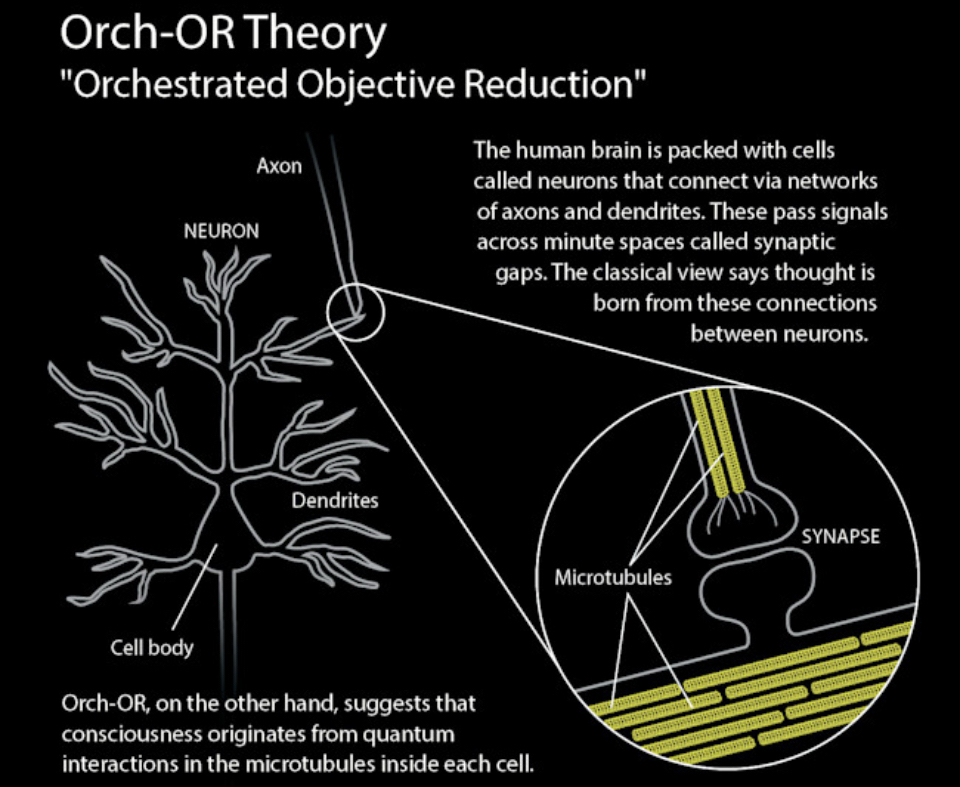
This theory proposes a connection between thoughts and quantum phenomena, claiming that consciousness is influenced by intricate brain cell processes.
Orch-OR theory, proposed by physicists, Sir Roger Penrose and Stuart Hameroff, suggests an intriguing link between consciousness and quantum mechanics.
THIS THEORY POSITS THAT:
Consciousness arises from quantum processes occurring within neuronal microtubules.
Meanings that the brain operates not just as a traditional information processor, but also experiences quantum effects that affect our conscious experiences.
So if true, these quantum vibrations play a crucial role in the coherence and organization of neural activity in the brain, ultimately giving rise to consciousness.
This geometry relies on the principles of quantum mechanics, which explores how matter and energy behave at the smallest levels.
With the aid of this geometry, we can visually represent the intricate structure of the human will in a manner that is both reflexive and scientifically grounded.
QUANTUM GEOMETRY IS GAINING POPULARITY BECAUSE IT ACCURATELY VISUALIZES THE STRUCTURE OF THE HUMAN WILL USING SCIENTIFIC PRINCIPLES.
The quantum geometry of the human will can be visualized as a complex network of interconnected circles, each representing a distinct aspect of the will.
These circles are connected by lines of varying lengths and widths, illustrating the diverse pathways of conscious perception.
Additionally, the circles are filled with a variety of colors, symbolizing the different energies associated with the will.
At the center of this network lies a single, large circle that represents the core of the human will, where all other circles converge.
Understanding the structure of the human will is essential for comprehending the influence of the quantum field on our decisions and actions.
Understanding the structure of the human will enables us to grasp how the quantum field influences our decisions and actions.
The quantum geometry of the human will also aids in examining the effects of quantum entanglement, which occurs when two particles become interconnected, regardless of the distance between them.
On the quantum "self-teleportation" probability of a human body
