
The word “foreknowledge” is a term used in theology to denote the prescience or foresight of God, that is, His knowledge of the entire course of events which are in the future, at least from the human’s point of view.
DEFINITION:
Foreknowledge is the knowledge of something before it occurs or is known by others.
God did not elect us because He foreknew, but the truth is He foreknew because He elected us. First God chooses, that is, He unconditionally sets His favor on whom He wills, then He destines them for their future role in eternity.
"We love because he first loved us." 1 John 4:19
"You did not choose me, but I chose you and appointed you that you should go and bear fruit." John 15:16

"Before I formed you in the womb I knew you, and before you were born I consecrated you; I appointed you a prophet to the nations.” Jeremiah 1:5
Faith: a gift of God.
God is omniscient
God’s foreknowledge is an essential part of His divine nature, which means that it is an inherent quality of His being that has always been present. It is not something that He has acquired or discovered “in times past,” as it is not something that is outside of Himself. Rather, it is something that is part of His very essence. God’s foreknowledge is a reflection of His omniscience, which is the ability to know all things. God’s foreknowledge is also a reflection of His sovereignty. He is the ultimate authority in the universe and has complete control over all things. He is not limited by time or space, and so His knowledge of the future is not limited by the constraints of time.
In other words, God’s knowledge is not limited by time or causality, but rather is eternal and encompassing. Therefore, it can be argued that God’s foreknowledge is not dependent on His creation, but rather is an inherent aspect of His being.
Is Election Based On Foreknowledge?
Many say that election is based on foreknowledge, that God looks down the broad avenue of the future and sees those who will respond to His gracious offer, and so elects them…
Whom He foreknew, he also predestined to be conformed to the image of his Son, that he might be the firstborn among many brethren. Whom he predestined, he also called; and whom he called, those he also justified; and whom he justified, those he also glorified.
Romans 8:29-30
It is a mistake to read it merely as ‘perceiving beforehand’.
Click Here For My Breakdown Of Romans 8:29:
The Next Verse mentioning foreknowledge:
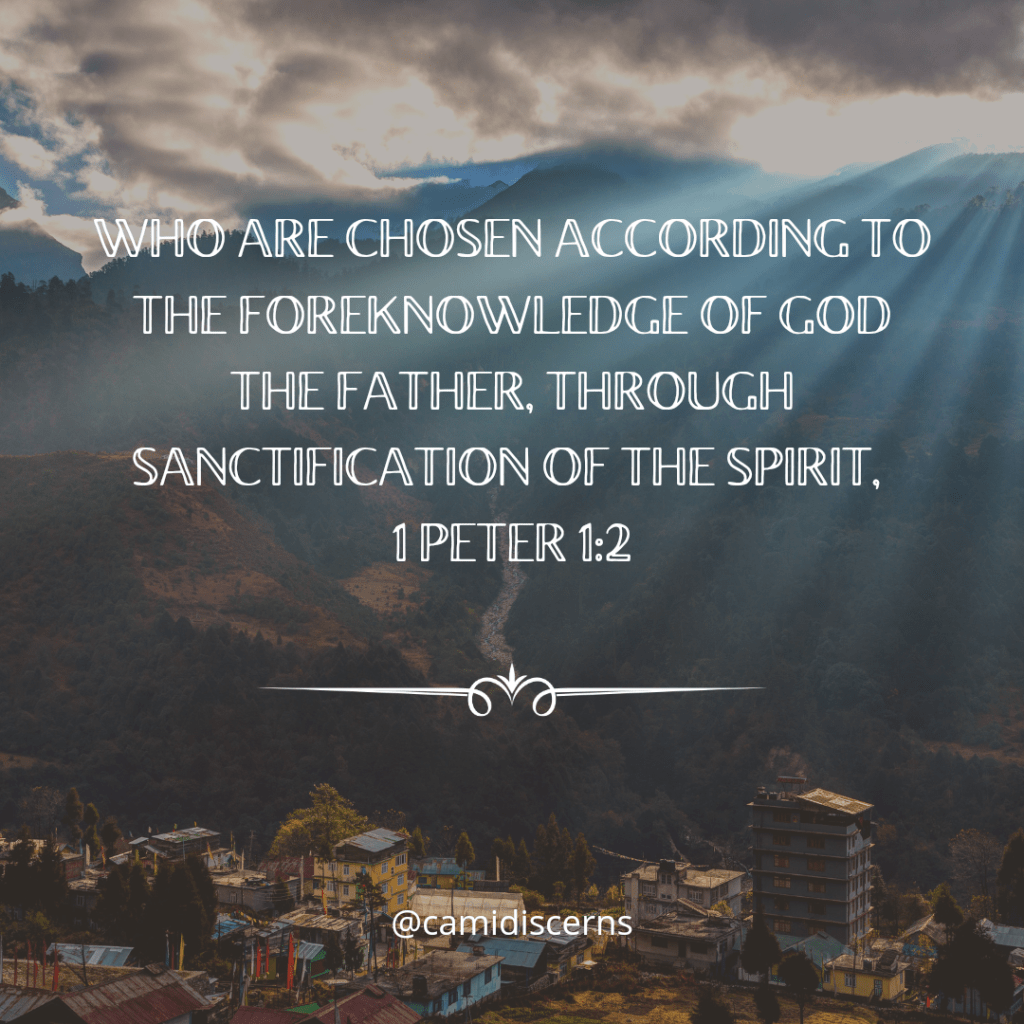
"...who are chosen according to the foreknowledge of God the Father, through sanctification of the Spirit, for obedience and sprinkling by the blood of Jesus Christ: Grace to you, and peace, be multiplied."
1 Peter 1:2
Many things are said in 1 Peter 1:2 about our salvation. The three persons of the Trinity in this verse.
We can see the cause and the origin of it (Cause & Effect) God’s choice.

God’s Will is the primary cause.

The manner and process:

The Spirit’s work.
The purpose and goal:
Obedience to Christ.
The means and basis:
The blood of Christ.
“… God has from the beginning chosen you to salvation through sanctification of the Spirit and belief in the truth.”
2 Thessalonians 2:13
Biblical Definitions
Here are examples of how the Biblical text uses the term which is translated “foreknowledge.”
In the Old Testament the word used is the Hebrew word “yada” which means “know.”
“You only have I known (Hebrew equivalent: chosen) of all the families of the earth…” Amos 3:2 KJV
This is the way God speaks of foreknowing in the sense that he set His special saving love upon us from before the foundation of the world.l
“Before I formed you in the womb, I knew [meaning “chose”] you, and before you were born I consecrated you; I appointed you a prophet to the nations.” Jer 1:5
Thus God foreknew
God predestined
God called
God justified, and
God glorified

They aren't separated.
Rom 8:30 puts it in the past tense, since what God set out to do is as good as done! This is precisely the point of the passage.
Let us take a look at the view of foreknowledge that says that God simply knew beforehand who would believe and therefore called them to be His children.
As noted above, the false belief that ” God does not preordain any individual to anything; but the individual actually ordains himself. God in effect complies with the individual’s choice.”
What does Scripture tell us of man's condition?

- It tells us that man is "dead in transgressions and sins" Eph 2:1.
- It says, "there is no one...who seeks God" Rom 3:10-11.
- Jesus declared, "No one can come to me unless the Father who sent me draws him" John 6:44.

In view of what Scripture teaches, what did (or would) God see beforehand looking down the corridors of time?

- He saw people "dead" spiritually, who rejected him (Rom 1:18-23)

People who, if left to themselves would never choose to come to Him.

A dead person cannot come up with a response of any kind.
A spiritually dead person, similarly, cannot generate faith so as to believe.

No, in eternity past, before the creation, the Fall, the covenants, or the Law, we were sovereignly predestined by God to be His.

God's purpose?
That we might be holy & blameless.

His motivation? Love.
"In love He predestined us to adoption as sons."

His goal & reason?
"to the praise of the glory of His grace."
“Before I formed you in the womb, I knew you, and before you were born I sanctified you, and I ordained you a prophet to the nations”. Jeremiah 1:5
Note: The same Hebrew word translated “knew” in this verse is translated “chosen” in Gen 18:19 and Amos 3:2
Jesus Foreordained Before The Foundation Of Earth
He was indeed foreordained before the foundation of the world, but was revealed in these last times for you.
1 Peter 1:20
Before He created the world, before mankind fell into sin God had a plan for the salvation of man, and Christ was at the heart of that plan. Eph 1:4; Acts 2:23.
God has not cast away his people whom he foreknew.
Do you not know what the Scripture says about Elijah? This is how he pleads with God against Israel and says,
"Lord, they have killed your prophets and torn down your altars, and I alone am left, and they seek my life."

But what does the answer of God say to him?
"I have reserved for myself
seven thousand men who have
not bowed the knee to Baal."

Paul goes on:
So also at this present time there is a remnant according to the choice of grace.
And if by grace, then it is no longer by works.
Otherwise grace would no longer be grace. But if it is by works, then it is no longer by grace. Otherwise work would no longer be work.
What then? Israel did not obtain what it sought,
but the chosen ones obtained it. And the rest were blinded.
Romans 11:2-7
…even as he has chosen us in him before the foundation of the world, that we should be holy and blameless before him. In love he predestined us to the adoption as children to himself, by Jesus Christ, in accordance with the good pleasure of his will, to the praise of the glory of his grace, by which he has made us accepted in the Beloved.
Ephesians 1:4-6
