Tag: Reality

Reality is often more complex than we care to admit. It’s filled with nuances and unexpected turns that challenge our understanding. Sometimes, we find ourselves grappling with situations that don’t fit neatly into our perceptions or beliefs. This complexity can be daunting, yet it’s also what makes life rich and full. Embracing these realities allows us to grow, adapt, and find meaning in the chaos around us.

  • Guide To Intuition

    Guide To Intuition

    Intuitive — both an adjective and a noun

    There is a kind of knowing that does not ask permission from the mind.

    It does not build a case.

    It does not cite its sources.

    It arrives already finished — and you are left, afterward, trying to reverse-engineer a reasoning process that never actually happened, because there wasn’t one.

    There was only recognition.

    THIS IS INTUITION

    And I want to be precise about what it is, because the word gets used carelessly — as a synonym for ‘hunch’, for ‘gut feeling’, for whatever unexamined impulse happens to walk through the door.

    It is more disciplined than that.

    It is older than that.

    What the Word Actually Says

    Intuitive: from the 1640s, meaning to perceive directly and immediately.

    French intuitif. Medieval Latin intuitivus.

    Beneath that, Latin intueri — to look at, to consider — built from in- (into) and the Proto-Indo-European root tueri, to look at, to watch over.

    Sit with that construction for a second— TO LOOK INTO.

    Not to look at something from the outside, the way the analytical mind does when it studies a thing and holds it at arm’s length.

    TO LOOK INTO

    Intuition was never framed, at its root, as a shortcut around understanding.

    It was framed as a more direct route to the same place, perception without the detour through argument.

    By 1833 the word had picked up its second meaning: self-evident.

    Which tells you something about how intuitive knowledge behaves once it arrives.

    It doesn’t feel like a conclusion you reached.

    It feels like a fact you always had.

    INTUITION’S ESSENCE

    Intuition is knowledge acquired without recourse to conscious reasoning.

    It costs little apparent effort, and it often arrives beneath the threshold of awareness. —you didn’t notice yourself knowing it, you just discovered that you already did.

    I’ll say what I am convinced is objective reality and the rationalist minds reading this will resist:

    Intuition is not knowledge in spite of the unconscious. It is knowledge because of it.

    Subconscious Intuition

    Somewhere beneath the noise of deliberate thought, pattern and truth are being recognized continuously, without your permission and without your effort.

    Intuition is what it sounds like when that recognition finally surfaces loud enough to hear.

    Call it whatever you want— Gnosis, Pattern Recognition …

    Call it pattern-recognition if the word “gnosis” makes you nervous. I won’t argue about the name. I will insist on the thing.

    The analytical mind — the part of you that constructs arguments, weighs pros and cons, wants everything justified before it’s trusted — is not the enemy of intuition.

    But the analytical mind is not its source, either.

    It is downstream.

    It is the part of you that shows up afterward, translating a knowing into language, dressing it in reasons it can defend at a dinner party.

    The knowing came first.

    Four Intuitive Types Moving Through People

    Not everyone’s intuition operates the same way.

    I’ve watched these four show up distinctly enough, in myself and in the people I’ve cared about enough to study.

    I think of these types less as a typology and more as four different instruments the same instinct can be played on.

    1. ADAPTIVE INTUITION

    Adaptive intuition moves fast, and it moves on experience — not analysis, experience, the kind that’s been lived through the body enough times to have left a residue.

    It shows up when a situation is too time-compressed for deliberation, and it’s the one people instinctively turn to for guidance in a crisis, because it doesn’t destabilize when the ground does.

    This is the intuition of someone who’s been through the fire enough times to recognize the smell of smoke before the alarm goes off.

    2. OBSERVANT INTUITION

    Observant intuition is quieter and more patient. It’s built on close attention — visual, sensory, environmental.

    It notices the cue nobody else caught:

    1. the tone that shifted & 2. the detail that doesn’t match the story being told.

    People who carry this type tend to move cautiously, because they’re gathering before they’re deciding, and it often coexists with real artistic ability — the same faculty that reads a room can read a canvas, or make one.

    3. ANALYTICAL INTUITION

    Analytical intuition looks, from the outside, almost like its opposite — deliberate, unhurried, unwilling to move until every possibility has been turned over.

    But it’s still intuition, not pure logic, because the “considering” isn’t a formal process; it’s a felt need to hold the question longer, even when it produces something that looks like indecision.

    This is the instinct behind good lawyers and good detectives — not faster knowing, but knowing that refuses to close early.

    4. QUESTIONING INTUITION

    Questioning intuition is analytical intuition’s more skeptical cousin — the same refusal to rush, but anchored harder in fact and evidence rather than felt pattern.

    It doesn’t trust a recognition until it can also verify it.

    This is the instinct behind good accountants:

    the sense that something’s off, followed immediately by the demand to prove it.

      Why This Matters

      None of these four are “more intuitive” than the others.

      They’re the same faculty filtered through different relationships to time, evidence, and trust.

      What they share is the thing the word has meant since the 1640s: direct perception.

      A way of looking into something rather than only at it.

      CULTURAL CONDITIONING

      We’ve been trained — by a culture that worships the analysis it can show its work for — to distrust the knowing that arrives without a paper trail.

      I’d ask you to consider the opposite: that the paper trail is the translation, not the source.

      That the fastest, oldest, least defensible-sounding knowledge you have might also be the least corrupted.

      It hasn’t been argued into a shape that’s convenient.

      It’s just true, the way a self-evident thing is true — because you looked directly at it, and it looked back.


      EXTERNAL REFERENCES

      Study on Intuition and Insight

      Psychology and Philosophy of intuition

      The Roots of Intuition

    1. Feminine Magick Part 1

      Feminine Magick Part 1

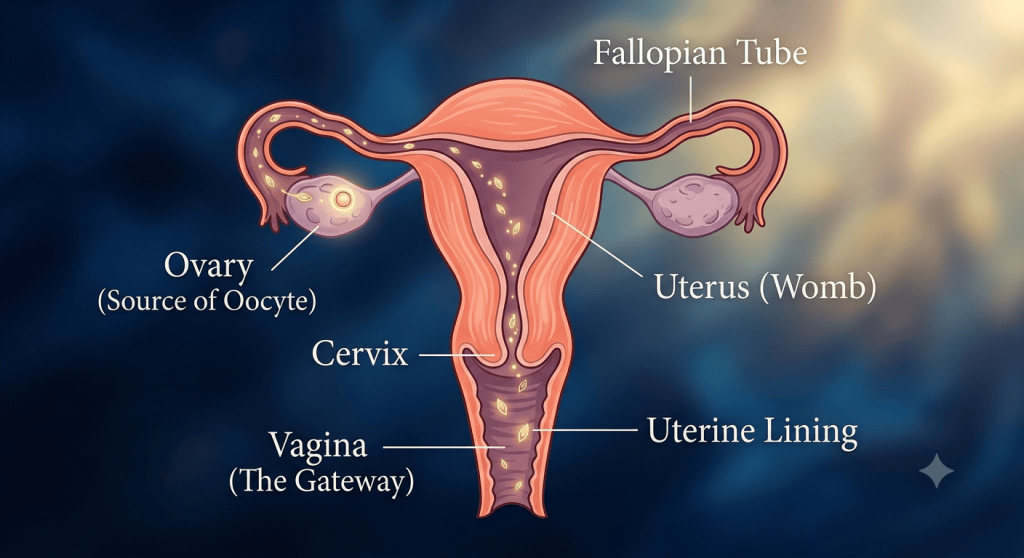
      The female body is a landscape of biological brilliance.

      When I speak of “feminine magick,” I am not talking about folklore; I am observing the deeply intricate reality of human reproduction.

      It is a system built on precise cycles, transformative environments, and the profound intersection of biological function and physical pleasure.

      Here is a straightforward analysis into the mechanisms that drive fertility and the essential role of pleasure in these processes.

      Seed of Life: The Vagina

      The vagina is the foundational gateway of the female reproductive system.

      It is a highly adaptable, muscular canal designed to bridge the external environment with the internal reproductive organs.

      It serves three vital physiological functions:

      The Pathway for Sperm

      During intercourse, sperm are deposited here.

      The vagina acts as the starting line, allowing sperm to travel upward through the cervix to reach the egg waiting in the fallopian tubes.

      The Birth Canal

      Its muscular walls expand remarkably to allow a baby to pass safely from the uterus into the world during childbirth.

      The Menstrual Flow

      It provides the necessary exit route for blood and tissue shedding from the uterine lining during menstruation.

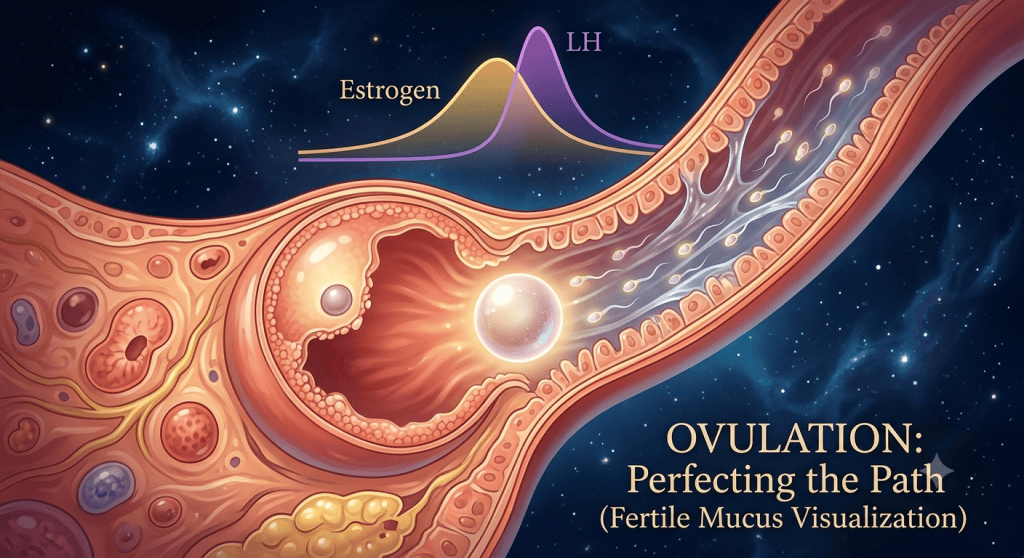
      Ovulation: Perfecting the Environment

      Reproduction cannot happen without the precise timing of ovulation—the release of an oocyte (egg) from the ovary.

      This is the moment the body intentionally alters its own internal environment to cultivate life.

      We must move past gross anatomy to visualize this perfected environment on a microscopic scale:

      This process is governed by a strict, biological order of operations:

      Hormonal Regulation

      The cycle is commanded by an intricate hormonal dance.

      Estrogen and progesterone rise and fall to regulate the maturation of the egg and to thicken the uterine lining, preparing it for the potential implantation of a fertilized egg.

      The Fertile Window

      Ovulation marks the most critical phase of a woman’s cycle.

      Occurring near the midpoint, it is the brief, highly optimized timeframe where conception is biologically possible.

      Cervical Mucus Transformation

      As ovulation approaches, cervical mucus changes dramatically.

      It becomes slippery, clear, and stretchy.

      This creates a frictionless, nutrient-rich medium that protects sperm from natural acidity and physically helps propel them through the cervix toward the egg.

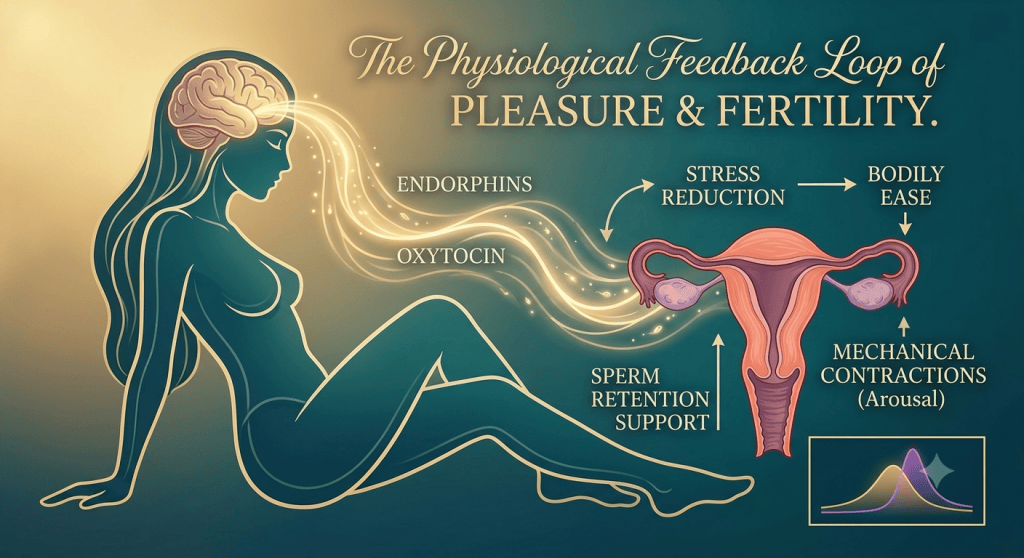
      Increasing Pleasure and Bodily Ease

      Pleasure is not merely a byproduct of human anatomy; it is deeply interwoven with biological success and physiological health. The mechanics of arousal and climax serve distinct, observable purposes.

      How do these less visible signals (hormones, contractions, relaxation) integrate into a system of ease?

      We visualize this feedback loop:

      • Enhanced Fertility: Biological evidence suggests that the involuntary muscular contractions of the uterus and vagina during female orgasm may function as a retention mechanism, physically aiding the upward movement of sperm toward the egg.
      • Stress Reduction: Sexual activity and climax trigger a cascade of neurochemicals, including a massive release of endorphins. This chemical flood actively dismantles stress responses, promoting the deep physical relaxation required for an optimal, healthy reproductive environment.
      • Relational Bonding: Beyond the physical mechanics, shared sexual pleasure releases oxytocin—often called the “bonding hormone.” This cements emotional intimacy and trust between partners, which is a foundational element for overall relationship health and stability.

      I plan to go much much deeper in the near future on this… stay tuned for part 2.


      References & Source Material

      Evolutionary Biology of Pleasure and Fertility

      • Baker, R.R., & Bellis, M.A. “Human Sperm Competition: Ejaculate Manipulation by Females and a Function for the Female Orgasm.” Animal Behaviour. This foundational paper introduces the mechanical reality of how female climax functions to selectively retain sperm and influence fertility.
      • Lloyd, Elisabeth A. The Case of the Female Orgasm: Bias in the Science of Evolution. A biological and philosophical critique breaking down the evolutionary arguments surrounding female pleasure, separating biological fact from cultural byproduct.
      • Gross, Rachel E. Vagina Obscura: An Anatomical Voyage. A heavily researched look at the female reproductive system that strips away outdated medical dogma, presenting the female body as an active, dynamic landscape.
        Mechanics of Ovulation and the Cervical Environment
      • Clinical Reproductive Anatomy & Physiology. Standard clinical references regarding Spinnbarkeit (the stretchability of cervical mucus) detail how estrogen transforms the cervix into a highly optimized biological pathway for sperm leading up to the fertile window.
      • The Billings Ovulation Method Clinical Studies. Research on natural fertility tracking providing extensive biological data on how cervical mucus changes daily in response to hormonal cascades, proving the body communicates its fertility status in real-time.
        Neurochemistry of Bonding and Ease
      • Peer-Reviewed Literature on Oxytocin and Bonding (e.g., Evolution and Human Behavior, Psychological Science). Studies detailing the specific hormonal flood during climax, documenting how oxytocin and endorphins actively dismantle cortisol (stress) and facilitate the deep physiological ease required for reproductive success and relational trust.
    2. Plato’s Cave

      Plato’s Cave

      Lesson Allegory of the Republic

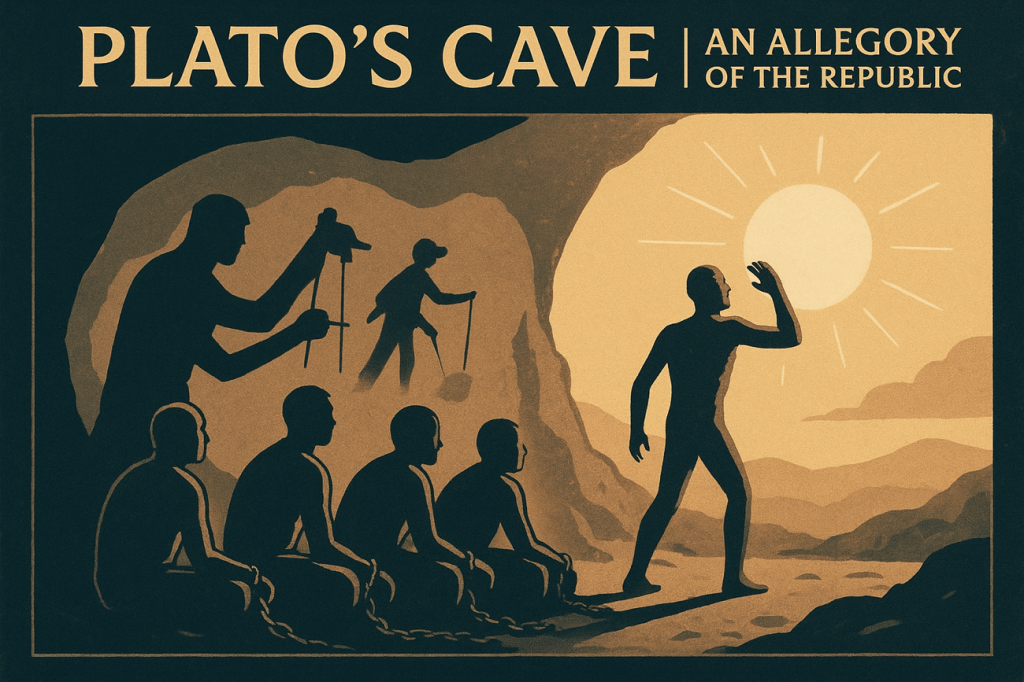
      The Allegory of the Cave from Plato’s Republic is one of those perfect metaphors.

      I think about it’s truth over and over again, even more so in today’s societal atmosphere.

      The Cave depicts our tendency to mistake perception for truth.

      THE STORY

      In the story, these prisoners are chained inside a cave, they’re facing a wall where they watched these shadows dancing and moving.

      These shadows were cast by puppeteers, covertly hiding behind them.

      They were manipulating objects to create a shadow that gave the illusion of a fire’s flame.

      The prisoners named the shadows, studied them, and even built hierarchies around who interpreted the shadows most accuratel.

      To them, this was reality, and they took it very seriously.
      We’re not so different.

      Most people live confined within their own perceptual cave.

      We’re inevitably going to be shaped by our emotional connection to our belief systems, cultural roots, educational indoctrination, and familial conditioning.

      Too often we’re caught mistaking projection for truth.

      Yes, we’ve been conditioned, but this isn’t the problem per se. We can see past all the programs if we have a fully functioning brain.

      The resistance to confronting the possibility of a constructed reality is understandable.

      The idea that memories, identity, and perceptions might not be as solid as they seem can feel like an existential threat.

      Letting go of deeply held beliefs, even if they are illusions, requires confronting discomfort, uncertainty, and the fear of losing oneself.

      It’s easier to cling to familiarity, even if it’s flawed, than to face the unknown. But growth often begins where certainty ends.

      Freedom is admitting that you have been deluded and under an illusory story of your own making. Then you’ll break free.

      CONSIDER THE PUPPETEERS

      The puppeteers are those who shape the narratives we consume.

      They are the gatekeepers of knowledge and power:

      the donors, financiers, and elites who we likely will never know the true name of.

      By controlling the information and communication, they can and do shape what a society perceives as “real.”

      Propaganda, entertainment, and social pressure all became tools of control through illusions.

      The Awakening

      Then comes the moment of liberation. One prisoner is freed.

      At first, he’s blinded by the fire’s light.

      His eyes, accustomed to shadows, can’t handle the truth so suddenly.

      But as they adjust, he begins to see clearly: the shadows were never real.

      They were only echoes of something greater.

      He’s led outside the cave into the sunlight, another painful adjustment.

      Yet when vision returns, he beholds the true world in all its beauty and realizes that the cave was only a prison of perception.

      Why Can’t They Turn Their Heads?

      CHAINS OF IGNORANCE

      Because they are chained. Not just physically, but mentally.

      The chains represent ignorance, the invisible grip of conformity and belief.

      Most never question the nature of their own bondage.

      To break these chains requires courage. It requires unlearning.

      It requires the willingness to endure the pain of seeing clearly for the first time.

      The Philosopher’s Task

      For Plato, this story points to his Theory of Forms.

      Theory of Forms is the idea that the physical world is but a shadow of a higher, more perfect reality.

      The philosopher’s role is to turn toward that higher truth, to step into the light and understand what truly is true.

      EXPECT STRUGGLE

      But enlightenment is not a comfortable process.

      When the freed prisoner returns to the cave to tell the others what he has seen, they mock him.

      They reject him. To them, his truth sounds like madness, because it threatens the foundation of their world.

      QUESTION YOUR OWN BELIEFS

      The Allegory of the Cave calls us to question our own shadows, to notice what we’ve been taught to believe and think: who benefits from those beliefs?

      It asks us to endure the blinding light of truth, no matter how uncomfortable, and to choose freedom over comfort.

      To break the chains of ignorance is to step into the light, not to escape the world, but to finally see it.

    3. What is Time?

      From scientific models to ancient myths, humanity has long sought to unravel the mystery of time.

      THEORIES THROUGH HISTORY

      The concept of time has been a subject of intense interest for thinkers throughout history.

      Time as a Measure of Change:

      Aristotle argued that time is not a thing in itself, but rather a way of measuring change and motion. 

      Time, in essence, is a measure of change, and without change, there would be no way to perceive or measure the passage of time. 

      We experience time through changes in our surroundings like:

      • the sun rising and setting
      • the seasons changing
      • growing older

      Time & Motion

      Aristotle claimed that time is dependent on motion, meaning that time only exists in relation to and as a consequence of change occurring in the world. 

      Time is “Now”

      Aristotle considers the present moment, now, as a point of transition between the past and the future, a kind of “nothingness” that divides the two. 

      Richard Muller’s Theory

      Muller, a physicist at the University of California, Berkeley, posits that the expansion of the universe, starting with the Big Bang, constantly creates new space and, consequently, new time. 

      “Now” as the Leading Edge

      He argues that the “now” is the boundary, the shock front, or the leading edge of time, where new time is constantly being created. 

      Implications for Time Travel

      This theory has implications for our understanding of time travel, suggesting that the future is not predetermined, and that the “now” is the only reality that truly exists. 

      Eternalism vs. Presentism

      This concept contrasts with the block universe or eternalism, which suggests that all moments in time exist equally, and the presentism, which holds that only the present moment is real. 

      Einstein’s Relativity

      Muller’s theory builds on Einstein’s theory of general relativity, which views space and time as intertwined in a four-dimensional spacetime. 

      “Now” as a Relative Concept

      According to the American Museum of Natural History, time is relative, meaning the rate at which time passes depends on the observer’s frame of reference. 

      Time as a Dimension

      Some forms of eternalism view time as a dimension, similar to space, where different times are as real as different place.

      Time & Soul

      Aristotle and Time’s Dependence on the Soul: 

      • Aristotle argued that time, as a concept, depends on the soul’s ability to perceive and count it. 
      • He suggested that if there were no souls to “count” time, there might still be change, but not time itself. 
      • This view implies that time is not just countable but also essentially counted, meaning it requires a conscious entity to exist as a measurable concept. 

      Plato & the Soul’s Immortality

      • Plato’s theory of the soul, influenced by Socrates, considered the soul (psyche) as the essence of a person, an incorporeal and eternal entity. 
      • He believed the soul exists even after death and is able to think, and that as bodies die, the soul is continually reborn (metempsychosis) in subsequent bodies. 
      • Plato divided the soul into three parts: logistikon (reason), thymoeides (spirit), and epithymetikon (appetite or desire). 

      The World Soul (Anima Mundi)

      • Some philosophical traditions, like Neo-Platonism, explored the concept of a world soul (anima mundi) or soul of the world,suggesting an intrinsic connection between all living beings and that the world is animated by a soul. 
      • This concept posits that the world is animated by a soul much like the human body. 

      Quantum Theory of Soul

      This perspective suggests that the soul is not limited by space or time. 

      Some theories, like the Quantum Theory of Soul, propose that the soul, as defined as information stored in the quantum field, can extend over space and time, potentially transcending the limitations of the physical body. 

      Time as a Number

      Aristotle describes time as a “number of motion with respect to the before and after,” suggesting that we can count or measure time by counting instances of change. 

      Descartes on Time

      Time as a Foundation for Diversity and Motion

      Descartes’s mechanistic view of the world, where diversity and motion are fundamental, requires time for these phenomena to occur. 

      Time as Proof for God’s Existence

      Descartes uses the concept of “parts of time” in his Meditation III proof for God’s existence, emphasizing the role of time in our understanding of God’s attributes. 

      Time as a “Mode of Thought”

      In his Principles of Philosophy, Descartes also states that time is a mere attribute and “mode of thought”. 

      Time & Duration

      Descartes distinguishes between time as the measure of motion and duration as an attribute of things. 

      Time & the Span of Life

      Descartes sees no differentiation between the span of a life and the span of time itself. 

      Descartes’s Method

      Descartes’s method, which he later formulated in Discourse on Method (1637) and Rules for the Direction of the Mind (written by 1628 but not published until 1701), consists of four rules:

      1. Accept nothing as true that is not self-evident
      2. Divide problems into their simplest parts
      3. Solve problems by proceeding from … 

      Descartes’s dualism

      Descartes introduced the concept of dualism, which argued that reality or existence is divided into two parts.

      He argued that humanity could be divided into two parts as well: the mind and the body.

      TIME AS MOMENTS

      Time as a Series of Moments

      This perspective suggests that time can be broken down into a sequence of unique, distinct moments, each representing a specific point in the timeline. 

      Moment as a Point in Time

      A moment, in this context, is an instantaneous point, a “now,” rather than a duration. 

      Philosophical and Scientific Perspectives

      Philosophers and scientists debate whether time is a real, objective thing or a human way of conceptualizing changing events. Some theories, like the

      Static Theory of Time

      suggest that time is like space, with no passage.

      Dynamic Theory of Time

      view time as a real phenomenon. 

      Kairos vs Chronos

      Kairos refers to an opportune or significant moment, while chronos refers to a specific amount of time, such as a day or an hour. 

      Examples of “Moments in Time”

      Think of memorable events, like a wedding, a birth, or a historical turning point. 

      These are all “moments in time” that stand out as distinct points in the flow of time. 

      Time as Absolute

      Newtonian Time

      According to its most famous proponent, Sir Isaac Newton, for example, absolute time (which is also sometimes known as “Newtonian time”) exists independently of any perceiver, progresses at a consistent pace throughout the universe, is measurable but imperceptible, and can only be truly understood mathematically.

      For Newton, absolute time and space were independent and separate aspects of objective reality, and not dependent on physical events or on each other.

      Time as a Product of the Mind

      Whitehead | Heidegger—Time as the Form of Becoming

      Whitehead and Heidegger described time as the process of things changing and becoming.

      They believed that time is essential for things to happen and transform.

      Theory of Relativity

      SPACETIME

      According to modern science, particularly the theories of relativity and quantum mechanics, time is considered a part of a larger concept called spacetime.

      Spacetime includes all the events in the past, present, and future, and is interconnected with space.

      Time as the Fourth Dimension

      In physics, time is often considered the fourth dimension, alongside the three spatial dimensions, used to describe events in space. 

    4. Quantum Physics and Spirituality: Unveiling the Power of Consciousness

      Quantum Physics and Spirituality: Unveiling the Power of Consciousness

      Prepare yourself for a mind-expanding journey as we delve into the captivating realm of quantum physics.

      Quantum Physics: a captivating realm of scientific exploration, delves into the intricate interplay of matter and energy at the subatomic level, revealing the awe-inspiring concept of the observer effect and the profound influence of conscious presence on shaping the fabric of reality.

      Within its intricate framework lies a concept known as the observer effect, which challenges our perception of reality and unveils the immense influence of our conscious presence.

      The Observer Effect in Quantum Physics

      Image result for The Observer Effect in Quantum Physics

      In the mesmerizing realm of quantum physics, the observer effect asserts that the mere act of observation can shape the behavior of subatomic particles.

      It suggests that our conscious presence has the remarkable capacity to mold the very fabric of reality itself.

      This concept, rooted in quantum physics, aligns with the philosophical notion of a divine mind or higher consciousness, indicating that our thoughts, intentions, and focus intricately contribute to shaping the world around us.

      Image result for This concept, rooted in quantum physics, aligns with the philosophical notion of a divine mind or higher consciousness, indicating that our thoughts, intentions, and focus intricately contribute to shaping the world around us.

      The Divine Observer and the Creation of All Things

      Image result for The Divine Observer and the Creation of All Things

      Within a spiritual context, the belief in a higher consciousness or a divine entity implies that this consciousness possesses an all-encompassing awareness, with the power to influence the physical world.

      In this perspective, the mind of God stands as the ultimate observer, actively participating in the creation and existence of all things.

      Image result for n this perspective, the mind of God stands as the ultimate observer, actively participating in the creation and existence of all things.

      Drawing a parallel, the observer effect in quantum physics suggests that whether human or divine, consciousness plays a significant role in the manifestation of the physical world.

      Image result for Drawing a parallel, the observer effect in quantum physics suggests that whether human or divine, consciousness plays a significant role in the manifestation of the physical world.

      The observer effect can be seen as a manifestation of the underlying causal chain governing all events.

      Image result for This interpretation suggests that the mind, as a product of predetermined factors, merely serves as a conduit for the unfolding of reality.

      This interpretation suggests that the mind, as a product of predetermined factors, merely serves as a conduit for the unfolding of reality.

      See related image detail. Igor JERMAN | Professional Head | full professor | BION Institute, Ljubljana | general

      It prompts us to explore the intriguing relationship between quantum physics and determinism, offering insight into the intricate mechanisms shaping the fundamental nature of existence.

      Image result for It prompts us to explore the intriguing relationship between quantum physics and determinism, offering insight into the intricate mechanisms shaping the fundamental nature of existence.
      Image result for The observer effect in quantum physics brings a fascinating connection to spiritual beliefs. It implies that our thoughts and intentions have a profound impact on reality. By consciously focusing and aligning our desires, we can create powerful transformations in the physical world.

      The Power of Thoughts and Intentions

      The observer effect in quantum physics brings a fascinating connection to spiritual beliefs. It implies that our thoughts and intentions have a profound impact on reality. By consciously focusing and aligning our desires, we can create powerful transformations in the physical world.

      This realization prompts us to explore the depths of our minds and harness the immense power within us to manifest positive change.

      Quantum Entanglement:

      Quantum entanglement is a phenomenon in which particles become inseparably linked, resulting in instantaneous correlations regardless of distanc e.

      The Web of Interconnectedness:

      Image result for Another captivating phenomenon within quantum physics is quantum entanglement, where particles instantaneously affect each other regardless of distance. This concept mirrors the spiritual notion of interconnectedness, promoting empathy and unity.

      Another captivating phenomenon within quantum physics is quantum entanglement, where particles instantaneously affect each other regardless of distance. This concept mirrors the spiritual notion of interconnectedness, promoting empathy and unity.

      Quantum entanglement suggests that at a fundamental level, all particles are intricately linked, symbolizing the interconnected nature of our existence. Understanding this profound interconnectedness fosters a sense of empathy and unity, encouraging us to recognize the importance of our actions and their impact on the collective human experience.

      Quantum Superposition:

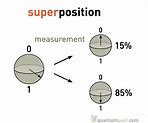
      Quantum superposition is a fundamental principle in quantum mechanics where a particle exists in multiple states simultaneously until measured.

      Embracing Limitless Possibilities

      In the realm of quantum physics, we encounter the intriguing concept of quantum superposition, where particles exist in multiple states until observed.

      Image result for In the realm of quantum physics, we encounter the intriguing concept of quantum superposition, where particles exist in multiple states until observed. This parallels the spiritual idea of limitless possibilities, inspiring personal growth and intention-driven change.

      This parallels the spiritual idea of limitless possibilities, inspiring personal growth and intention-driven change.

      Quantum superposition teaches us that until we observe and define the outcome, countless potential realities coexist simultaneously.

      Image result for Quantum superposition teaches us that until we observe and define the outcome, countless potential realities coexist simultaneously. Embracing this understanding empowers us to transcend limitations, expand our horizons, and embark on a journey of self-discovery and transformation.

      Embracing this understanding empowers us to transcend limitations, expand our horizons, and embark on a journey of self-discovery and transformation.

      The enthralling interplay between quantum physics and spirituality unveils a new frontier of understanding, one that challenges conventional notions of reality and our place within it.

      By recognizing the power of consciousness, thoughts, and intentions, we awaken to the profound impact we have on the world around us.

      By bridging the realms of science and spirituality, we embark on a journey of exploration, expanding our perspectives and enriching our understanding of the intricate tapestry that weaves together the fabric of reality.

      READ MORE:

    5. Quantum Entanglement: Fabric Of God

      Quantum Entanglement: Fabric Of God

      Quantum entanglement is an effect of the behaviour of particles.

      When we talk about particles, we are referring to small segments of material and matter.

      The quantum level is where the spin and position of one particle can influence another particle, regardless of the distance between them.

      This cannot be described within the confines of standard physics.

      Nevertheless, it serves as a direct manifestation of the Divine Spirit that unifies and sustains all physical elements.

      The spiritual essence of God transcends the constraints of the physical world and brings unity to all things in relation to Himself.

      2 Chronicles 20:6: “O Lord, God of our ancestors, are you not the God who is in heaven? You rule over all the kingdoms of the nations. Power and might are in your hand, and no one can withstand you.”

    6. Thoughts From The Spirit

      Thoughts From The Spirit

      The Spirit Is More Real Than The Material

      The One and Only Divine Creator has gifted a holy ruling upon His chosen ones, who are incredibly flawed yet cherished, to be forgiven from the consequences of their earthly forms through the Divine Mercy and Grace of the only Righteous One, Jesus Christ, Who, at a predestined moment, was tasked by The Father to Save you. The Mastermind behind every planet, star, organism, feeling, thought, and emotion has ordained us to be able to perceive things beyond the scope of our physical vision.

      Despite the false assertions made by mere mortals, we remain unaffected by their attempts to denounce what God has ordained or any passive aggression they employ to resist the works of God. We disregard their ego-driven, bad attitude because truth (God) is not intimidated by scrutiny.

      Despite existing in the physical realm, we comprehend that our body is God’s Property; we are His peculiar people.

      When the soul, once enslaved to the body, now belongs to the Divine Creator, salvation is impossible not to feel and comprehend cognitively.

      Who You Are

      As a Spiritual being, you receive information in a Divine way that transcends the constraints of the biological brain.

      Your soul is the essence of who you are, and the Holy Spirit governs your body, mind, and emotions.

      Through the power of the Spirit, you can connect with God and become One with the information (Wisdom) sent to you. This is because you are a Spiritual being, not bound by the material world.

      When God’s Spirit enters your stamina, it turns you over from the inside; out, preserving your soul for the day you will be reunited with the Divine source, YHWH.

      Although your physical body experiences pain and anguish, you comprehend that you are not a slave to the flesh but rather a spiritual being that is destined for eternal life, a slave to the Spirit, a slave to Righteousness.