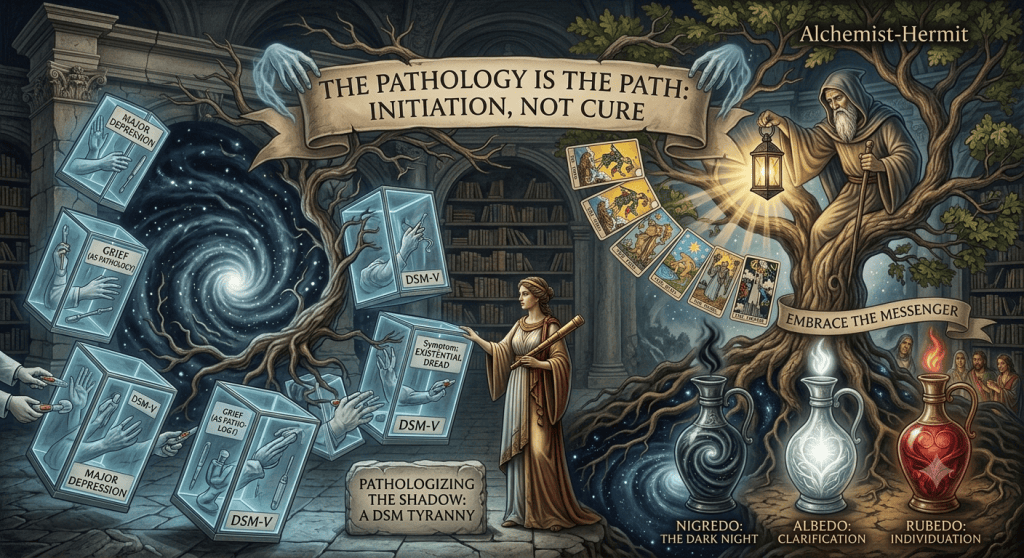
The Diagnostic and Statistical Manual of Mental Disorders (DSM) is routinely hailed as the bible of modern psychiatry. DSM labels are actually detrimental pigeon-holes.
It provides professionals with a standardized, clinical framework for classifying psychological conditions.
However, as a map of human suffering, it is profoundly bankrupt.
The DSM catalogues the surface of mental distress while entirely ignoring the depths of the psyche.
It is an oversimplified, shallow inventory that fundamentally fails to understand the architecture of the soul.
The Categorical Illusion
One of the DSM’s most glaring failures is its reliance on a rigid, categorical approach to the mind.
The manual chops the fluid, dynamic human experience into sterile boxes.
If an individual experiences both anxiety and depression, they are diagnosed with two distinct dysfunctions based on a checklist.
This one-size-fits-all taxonomy ignores reality.
In depth psychology, these overlapping states are rarely separate mechanical errors; they are often intertwined symptoms of a psyche in the midst of the nigredo… the dark, chaotic first stage of psychological alchemy.
By compartmentalizing the mind, the DSM treats the individual as a collection of broken parts rather than a whole entity undergoing a complex process of individuation.
Silencing the Unconscious
Furthermore, psychiatry’s obsession with symptom-based diagnosis is its greatest blind spot.
The DSM views a symptom exclusively as a malfunction to be eradicated. It fails to consider the complex interplay of biological, psychological, and archetypal forces at work.
A Jungian approach recognizes the symptom for what it is: the unconscious attempting to communicate.
Depression, neurosis, and anxiety are often the Shadow demanding integration.
When the DSM focuses solely on observable behaviors, it silences the messenger.
It attempts to clear the smoke while ignoring the fire of the unconscious, leaving the underlying spiritual or psychological rupture completely unaddressed.
Thoughts From Carl Jung
Jung offers a fundamentally different account of psychological distress than the one implied by strictly diagnostic models.
Rather than treating symptoms as meaningless defects to be eliminated, he understood them as symbolic communications from the unconscious, often arising when consciousness has become one-sided or psychologically overidentified with a limited attitude toward life. Source
In this view, neurosis is not merely a pathology to be suppressed but a signal of psychic imbalance, indicating that the individual is being compelled toward greater integration, self-recognition, and transformation. Source
Jung’s concept of individuation indicates that suffering can have developmental value, insofar as it initiates confrontation with the Shadow and with disowned dimensions of the self.
From this perspective, psychological symptoms may function less as evidence of a broken mind than as expressions of the psyche’s attempt to restore wholeness.
You can support this with Jung’s broader writings on symbols and the unconscious, such as Man and His Symbols, The Archetypes and the Collective Unconscious, and Two Essays on Analytical Psychology.
Pathologizing the Shadow
Perhaps the most dangerous aspect of the DSM is its pathologizing of normal, necessary human suffering. Source
The manual’s ever-expanding criteria inevitably lead to the medicalization of the human experience.
Grief, existential dread, and the shattering of the ego are not inherent pathologies… they are initiatory rites of passage.
By slapping a medical label on the dark night of the soul, the DSM turns the agonizing work of becoming whole into a disease.
This overreliance on diagnostic labels stigmatizes the natural descent into the unconscious, teaching individuals to fear and medicate their own depths rather than explore them.
Blind Leading The Blind
The DSM is an inventory of human suffering written by observers who refuse to look into the dark.
Its categorical and symptom-based approach robs the individual of meaning, reducing the profound mystery of the psyche to a clinical checklist.
Until modern psychiatry recognizes that mental distress is often the messy, painful birth of consciousness rather than a mere chemical error, the DSM will remain exactly what it is: a colossal failure to understand the human mind.
Professional References & Supporting Frameworks
Several leading voices across psychiatry, psychology, and depth analysis have publicly condemned the DSM’s methodology:
Dr. Allen Frances (Chair of the DSM-IV Task Force) 🔗
In his book Saving Normal, Dr. Frances became one of the DSM’s most vocal critics from the inside. He explicitly condemns the DSM-5 for pathologizing everyday human experiences—such as classifying normal bereavement as Major Depressive Disorder—warning that modern psychiatry is dangerously medicalizing the natural human condition.
Dr. Thomas Insel (Former Director of the National Institute of Mental Health)🔗
In 2013, Dr. Insel famously announced that the NIMH would pivot its research funding away from the DSM categories.
He stated the manual lacks scientific validity because its diagnoses are based strictly on superficial symptom clusters (the “categorical illusion”) rather than underlying biological or psychological realities.
The British Psychological Society (Division of Clinical Psychology)
The BPS challenged the fundamental premise of the DSM with their Power Threat Meaning Framework.
They formally argue against the “disease model” of mental health, proposing instead that psychological distress is not a malfunction, but a deeply meaningful, understandable response to adversity, trauma, and environment.
Dr. James Hillman (Post-Jungian Analyst and Author)
In Re-Visioning Psychology, Hillman dismantled the clinical urge to “cure” the patient of their darkness.
He argued that the soul speaks explicitly through its pathologies, and that by rushing to eradicate symptoms, modern psychiatry silences the psyche’s attempt to communicate.
Carl Jung (Founder of Analytical Psychology)
Laying the groundwork for depth psychology’s opposition to rigid clinical diagnosis, Jung observed that “neurosis is always a substitute for legitimate suffering.” He viewed psychiatric symptoms not as arbitrary defects, but as purposeful attempts by the unconscious mind to force a necessary psychological transformation.
PEP | Read – Jung’s Typology and Dsm-III Personality Disorders
Compares Jungian typology with DSM-III personality disorders, distinguishing symptomatology from personality structures and exploring potential connections, though it focuses on an outdated DSM version.