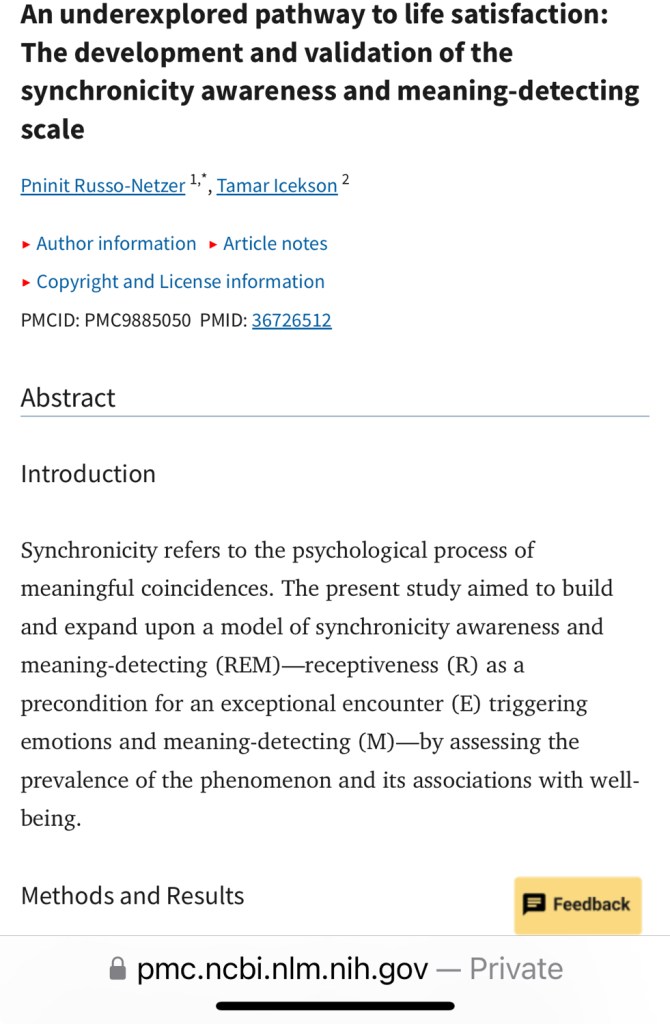
“acausal connecting (togetherness) principle,” “meaningful coincidence”, “acausal parallelism” or “meaningful coincidence of two or more events where something other than the probability of chance is involved.”
–Carl G. Jung (1960), Synchronicity: An Acausal Connecting Principle, Princeton University Press, 2012, p. 44.
Synchronicity, the term coined by psychologist Carl Jung, refers to these deeply meaningful coincidences that mysteriously occur in your life.
These events are often seen as symbols or transmissions meant to guide you towards alignment and self-discovery.
Have you every thought of a long-lost friend and then receive a call from them minutes later?
Or have you seen a specific symbol repeatedly in different contexts, which then leads to having a significant realization or profound event occur?
Those are both instances on synchronicity.
“Synchronicity is no more baffling or mysterious than the discontinuities of physics. It is only the ingrained belief in the sovereign power of causality that creates intellectual difficulties and makes it appear unthinkable that causeless events exist or could ever exist. But if they do, then we must regard them as creative acts, as the continuous creation of a pattern that exists from all eternity, repeats itself sporadically, and is not derivable from any known antecedents.”
–Carl Jung
They challenge the conventional view that consciousness is solely a product of ‘brain activity’ suggesting that there are more than likely, non-physical aspects to consciousness that we have yet to entirely explore.
This aligns with consciousness as being a fundamental aspect of the universe, similar to matter and energy.
A PATHWAY
Synchronistic experiences are a pathway to understanding the collective unconscious, a concept introduced by Jung.
The collective unconscious is thought to be a reservoir of human experiences and archetypes that influence our thoughts and behaviors on a subconscious level and visa versa; our thoughts and behaviors on an individual level influence the collective.
These experiences might be driven by this collective unconscious, suggesting that our individual consciousnesses are interconnected in ways we are only beginning to comprehend.
In addition to their psychological implications, synchronistic experiences also have social and personal growth implications.
They can affirm one’s life direction and provide a sense of purpose and meaning.
For many, these experiences are not just random occurrences but are deeply significant and can lead to profound personal insights and transformations.
These experiences point towards a deeper interconnectedness in the universe and challenge our current understanding of consciousness.
They also highlight the potential for personal growth and transformation through these meaningful coincidences.
F David Peat — With fascinating historical anecdotes and incisive scientific analysis, this important work combines ancient thought with modern theory to reveal a new way of viewing our universe that can expand our awareness, our lives, and may well point the way to a new science for the twenty-first century.
Carl Jung, the renowned Swiss psychiatrist and psychoanalyst, made significant contributions to the understanding of art and its psychological dimensions.
Key aspects of his work related to art & the psyche:
Collective Unconscious + Visual Art:
Jung proposed the concept of the collective unconscious, which suggests that certain universal symbols and archetypes are shared across cultures and generations.
Visual art often taps into these archetypal images, providing a means for individuals to express and explore their inner worlds.
Jung believed that art could reveal latent memories from our ancient past and help us understand our responses to the environment.
Jung believed that art itself had no inherent meaning; instead, it was the artistic process that mattered.
Artists grappled with an “artistic impulse,” akin to a kind of madness—an irresistible force that drove them to create.
Through this process, artists found temporary relief and a way to express their psychological condition.
Jung’s own experiences as both a psychologist and an artist informed his understanding of this delicate balance between completion and incompleteness in artistic expression.
His approach to art was deeply rooted in his theories of the unconscious mind and symbolism.
Jung believed that art was a powerful medium for expressing the unconscious, serving as a bridge between the conscious and unconscious realms.
He saw artistic creation as a process that tapped into universal symbols and archetypes, which he termed the collective unconscious.
This perspective allowed for a unique interpretation of visual art, providing insights into both the artist’s psyche and broader cultural meanings.
Jung’s own artistic endeavors, such as his Alchemical Tower at Bollingen, exemplified his belief in the transformative power of creative expression. This personal project was a physical manifestation of his inner psychological journey.
In analyzing artworks, Jung developed a method of symbolic interpretation that became a tool for understanding an individual’s mental functioning and social behavior.
His approach to symbolism in art emphasized the importance of psychic content and its vital role in human life and culture.
Jung’s ideas have influenced various fields, including music composition. His cognitive functions system has been used to understand different composers’ psychological tendencies and creative processes.
This application of Jungian theory demonstrates the enduring relevance of his ideas in interpreting artistic creation across various mediums.
Liber Novus
The Red Book
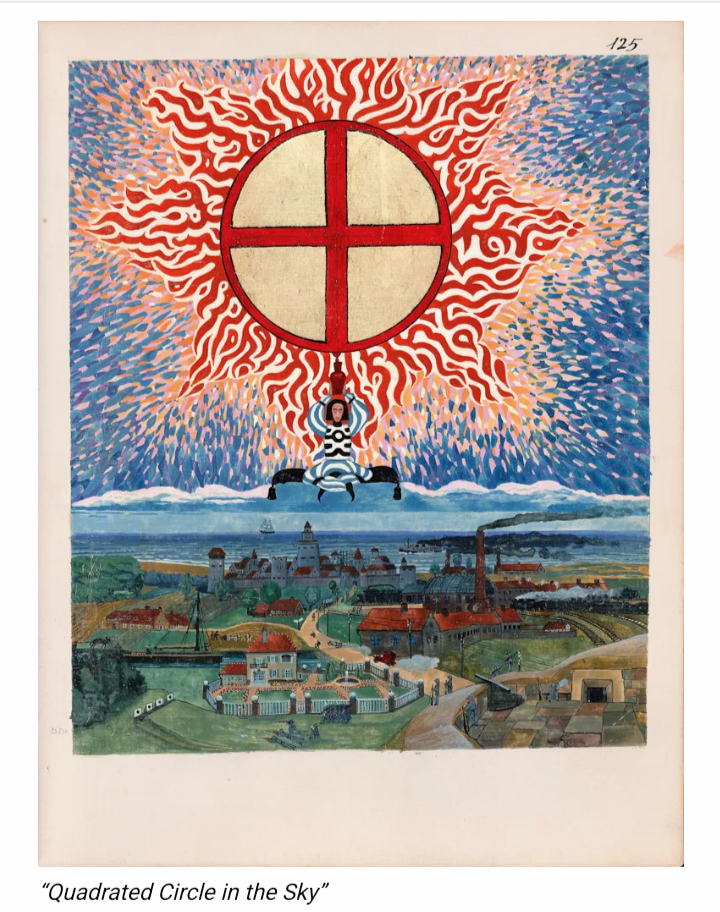
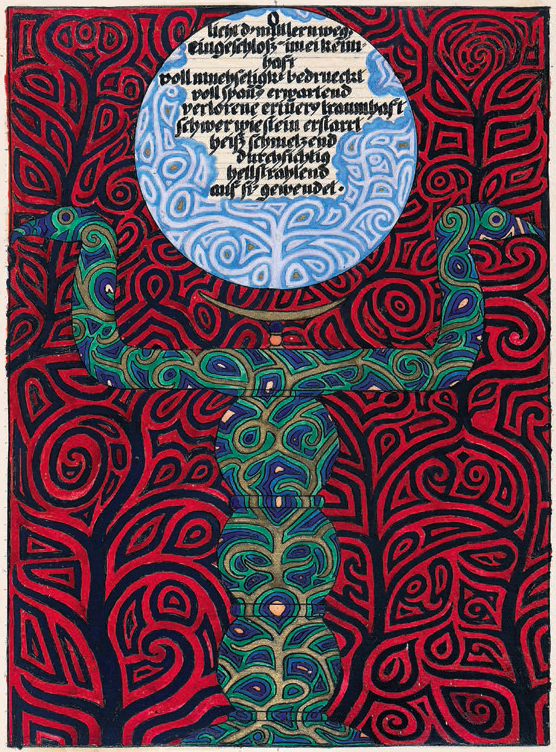
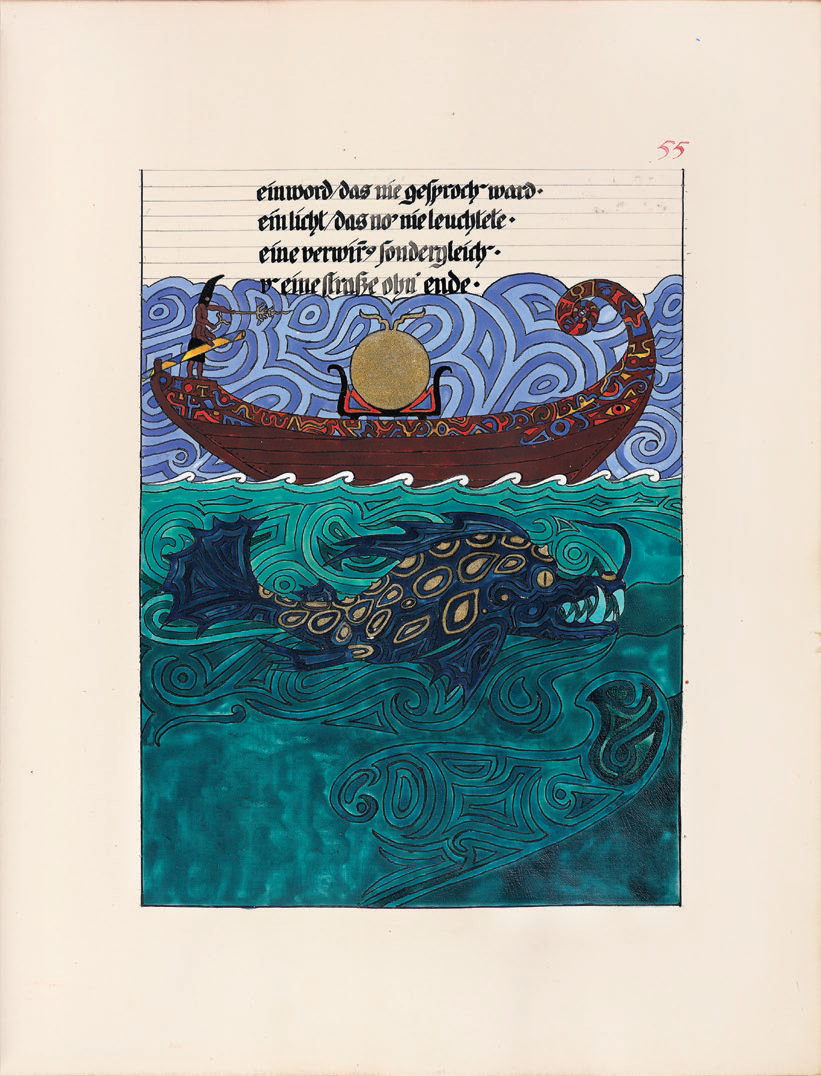
Carl Jung’s Liber Novus, also known as The Red Book, was recently unveiled in a complete English translation by Norton. This translation was first published in a facsimile edition in 2009, followed by a smaller “reader’s edition” in 2012. Since then, there have been several exhibitions showcasing the book.
Art critic Peter Frank describes it as resembling a Bible crafted by a medieval monk, particularly noting the intricate Gothic script that Jung meticulously used for his writings.
Despite Carl Jung’s reluctance to consider himself an “artist,” it is noteworthy that his Liber Novus has been displayed in museums and served as the core of the ‘Encyclopedic Palace,’ a survey of visionary art featured at the 2013 Venice Biennale. Jung’s intricate paintings depict him as every inch an artist, akin to medieval monks or Persian courtiers. His artistry was devoted not to divine or royal glorification, but rather to celebrating the potential and significance of humanity.
One could more accurately say that Jung’s book was dedicated to the mystical unconscious, a much more nebulous and oceanic category. The “oceanic feeling”—a phrase coined in 1927 by French playwright Romain Rolland to describe mystical oneness—so annoyed Sigmund Freud that he dismissed it as infantile regression.
Freud’s antipathy to mysticism, as we know, did not dissuade Jung, his onetime student and admirer, from diving in and swimming to the deepest depths.
The voyage began long before he met his famous mentor.
At age 11, Jung later wrote in 1959, “I found that I had been in a mist, not knowing how to differentiate myself from things; I was just one among many things.”
Jung considered his elaborate dream/vision journal—kept from 1913 to 1930, then added to sporadically until 1961—“the central work in his oeuvre,” says Jung scholar Sonu Shamdasani in the Rubin Museum introduction above. “It is literally his most important work.”
And yet it took Dr. Shamdasani “three years to convince Jung’s family to bring the book out of hiding,” notes NPR. “It took another 13 years to translate it.”
Part of the reason his heirs left the book hidden in a Swiss vault for half a century may be evident in the only portion of the Red Book to appear in Jung’s lifetime.
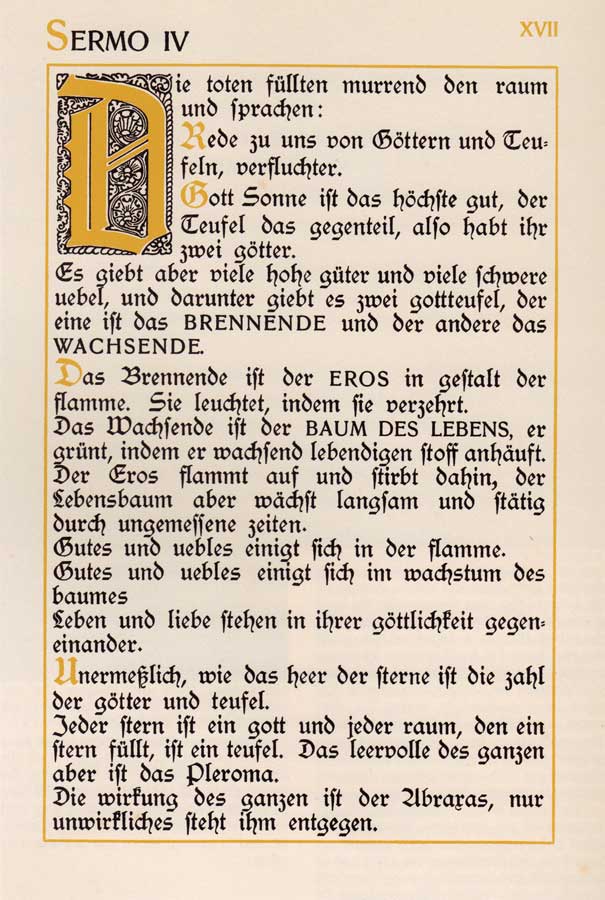
Jung had this text privately printed in 1916 and gave copies to select friends and family members. He composed it in 1913 in a period of Gnostic studies, during which he entered into visionary trance states, transcribing his visions in notebooks called the “Black Books,” which would later be rewritten in The Red Book.
You can see a page of Jung’s meticulously hand-lettered manuscript above. The “Sermons,” he wrote in a later interpretation, came to him during an actual haunting:
The atmosphere was thick, believe me! Then I knew that something had to happen. The whole house was filled as if there were a crowd present, crammed full of spirits. They were packed deep right up to the door, and the air was so thick it was scarcely possible to breathe. As for myself, I was all a‑quiver with the question: “For God’s sake, what in the world is this?” Then they cried out in chorus, “We have come back from Jerusalem where we found not what we sought/’ That is the beginning of the Septem Sermones.
The strange, short “sermons” are difficult to categorize. They are awash in Gnostic theology and occult terms like “pleroma.”
The great mystical oneness of oceanic feeling also took on a very sinister aspect in the demigod Abraxas, who “begetteth truth and lying, good and evil, light and darkness, in the same word and in the same act. Wherefore is Abraxas terrible.”
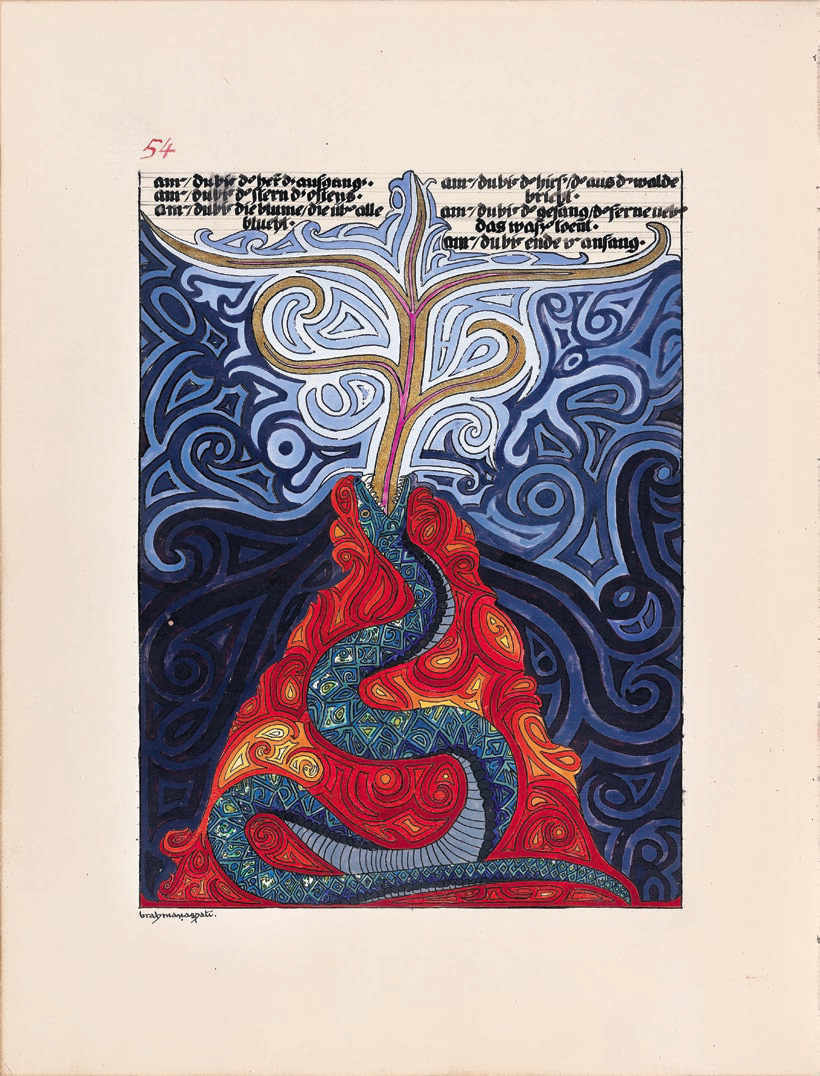
There are tedious, didactic passages, for converts only, but much of Jung’s writing in the “Seven Sermons,” and throughout The Red Book, is filled with strange obscure poetry, complemented by his intense illustrations. Jung “took on the similarly stylized and beautiful manners of non-western word-image conflation,” writes Frank, “including Persian miniature painting and east Asian calligraphy.”
If The Red Bookis, as Shamdasani claims, Jung’s most important work—and Jung himself, though he kept it quiet, seemed to think it was—then we may in time come to think of him as not only as an inspirer of eccentric artists, but as an eccentric artist himself, on par with the great illuminators and visionary mystic poet/painters.
Modern man has lost all the metaphysical certainties of his medieval brother, and set up in their place the ideals of material security, general welfare and humanitarianism.
““How totally different did the world appear to medieval man!
For him the earth was eternally fixed and at rest in the centre of the universe…
Men were all children of God under the loving care of the Most High, who prepared them for eternal blessedness; and all knew exactly what they should do and how they should conduct themselves in order to rise from a corruptible world to an incorruptible and joyous existence.
Such a life no longer seems real to us, even in our dreams.”
– Carl Jung The Spiritual Problem of Modern ManPDF
The Shift in Worldviews
In the annals of human civilization, few shifts have been as profound as the transition from the medieval worldview to our contemporary perception of reality.
Carl Jung, the renowned Swiss psychiatrist and psychoanalyst, shed light on this remarkable transformation, illuminating the profound implications it has had on our collective psyche.
During the Middle Ages, society was firmly rooted in a shared belief system that embraced a universal order and divine providence.
This collective mindset dictated that each individual had a predetermined purpose in life, guided by religious teachings and societal norms.
The promise of eternal happiness in the afterlife served as a powerful incentive for living a morally upright existence, as defined by the prevailing religious and cultural frameworks.
However, the modern era has witnessed a departure from these collective moral frameworks, ushering in an era of personal belief and moral ambiguity.
Contemporary individuals are increasingly seeking their own moral compass and sense of purpose, liberated from the constraints of a singular, authoritative belief system.
Jung’s insights into the collective unconscious and the power of shared beliefs and values underscore the significance of this shift.
In medieval times, the collective unconscious was deeply intertwined with religious and societal narratives, shaping a shared understanding of reality and one’s place within it. This provided a sense of stability and purpose, even if it came at the cost of individual autonomy.
In contrast, the absence of a universal moral system in modern times has led to feelings of uncertainty and disconnection from the spiritual guidance that once provided a reliable anchor. While this newfound freedom to choose one’s beliefs is empowering, it also necessitates a heightened sense of personal responsibility in defining one’s path towards meaning and purpose.
As we navigate this landscape of personal belief and moral autonomy, it becomes crucial to recognize the profound influence that shared values and belief systems have on our perception of the world and our role within it. Even as we embrace the freedom to forge our own paths, we must acknowledge the inherent human need for a sense of belonging and collective meaning.
The challenge lies in striking a balance between individual autonomy and the recognition that our beliefs, values, and worldviews are shaped, to a significant extent, by the collective narratives that permeate our societies. By understanding the historical context and psychological underpinnings of this shift, we can better navigate the complexities of forging our own moral compasses while remaining cognizant of the power of shared beliefs in shaping our understanding of reality.