A category encompassing a diverse range of religious traditions that are typically included together because of their shared cultural marginality or their focus on imparting teachings to a select group. The concept emerged largely in 19th-century western Europe as a means of categorizing various traditions with a much longer history in European societies, including Hermetism, Kabbala, Rosicrucianism, ceremonial magic, alchemy, and astrology, although it has since also come to encompass more-modern traditions, such as Spiritualism, Theosophy, Wicca, and the New Agemilieu.
Greek Root esōterikos | “inner” or “belonging to an inner circle”
Esoteric subjects often deal with the hidden, mystical, or inner dimensions of reality, contrasting with exoteric teachings, which are openly accessible and geared toward a general audience.
Esoteric knowledge frequently encompasses spiritual, philosophical, or metaphysical systems designed to unveil the underlying principles.
Examples include hermeticism, alchemy, Gnosticism, Kabbalah, and various mystical traditions.
Esoteric Systems:
Symbolism: a reliance on metaphors, archetypes, and symbols to communicate complex or ineffable truths.
Initiation
A process of awakening or training that deepens one’s understanding and experiential wisdom.
Inner transformation
A focus on self-realization, inner alchemy, or personal enlightenment as the goal of the knowledge or practice.
The Essence of Esoteric…
the hidden essence beneath the surface of phenomena requires not only intellect but also intuition demands experiential insight to comprehend…
Esoteric teachings are profound yet hidden from the public, accessible only to a few.
Purpose
to transcend the mundane and reach higher consciousness, and connect with deeper truths, to cut through boundaries of religion, science, art, & philosophy.
SIMILAR WORDS:
Abstruse
Difficult to understand; obscure.
Arcane
Known or understood by only a few; mysterious.
Recondite
Dealing with very profound, difficult, or abstruse subject matter.
Obscure
Not clearly expressed or easily understood.
Cryptic
Having a meaning that is mysterious or obscure.
exclusive – obscure – arcane – cryptic
Esoteric Fields of Work & Study
Esotericism encompasses an array of ideologies, movements, and traditions, each with unique characteristics yet united by a common thread of seeking gnosis; hidden or deeper knowledge.
Esoteric Traditions have usually been exclusively for academic intellectuals seeking for more exploration into hidden and mystical wisdom.
The focus is usually for personal transformation, gaining spiritual insight, and attaining deeper truths that are beyond empirical evidence and surpassing experiential.
These insights and deeper ideas emerge through the portals of symbolism, intuition, and inner experiences.
ESOTERICISM IS A VAST REALM
Esotericism hits the core… the study of the hidden, the unseen forces, unspoken truths, and ineffable dimensions of existence that lie just beyond the reach of ordinary perception.
Esotericism thrives on multiplicity
…every symbol, every ritual, every text can be read on multiple levels: literal, allegorical, anagogical.
Fusion of Traditions
Esotericism is not bound by geography or era. It is a crossroads…
Belief Systems and ideologies
Gnosticism, Hermetism, Neoplatonism, theurgy, astrology, alchemy, natural magic, Christian Kabbalah, Rosicrucianism, Christian Theosophy and Illuminism, modern Occultism, Spiritualism, Traditionalism, New Age movement, Neopaganism, ritual magick clubs, and the list goes on.
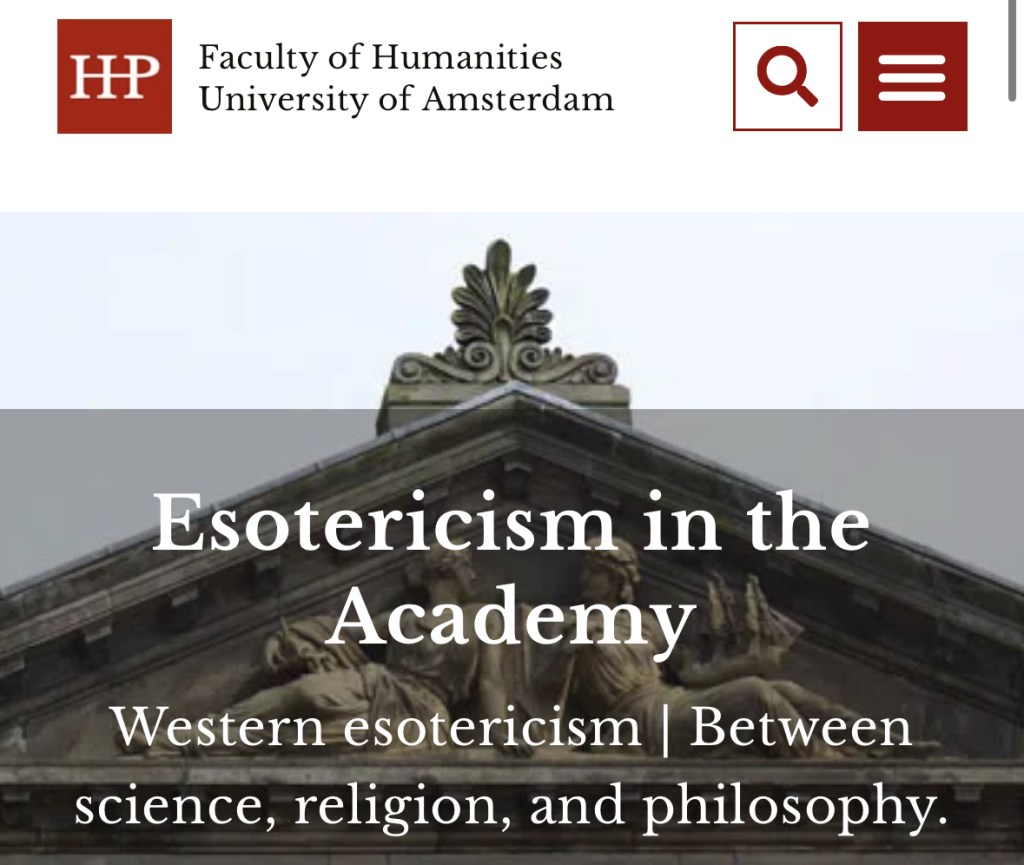
Centre for the History of Hermetic Philosophy and Related Currents (HHP)
Distinct Esoteric Traditions:
Gnosticism:
An ancient belief system emphasizing esoteric knowledge (gnosis) as the path to spiritual enlightenment, often viewing the material world as a creation of a lesser divinity.
Hermeticism:
Rooted in the writings attributed to Hermes Trismegistus, this tradition blends elements of Greek and Egyptian thought, focusing on the pursuit of hidden wisdom and the understanding of the natural world through mystical means.
Kabbalah
form of Jewish mysticism exploring the nature of God, the universe, and the soul, offering esoteric interpretations of the Hebrew Bible and Jewish teachings.
Esoteric Works
The Three Books of Occult Philosophy
by Heinrich Cornelius Agrippa This work is a comprehensive treatise on magic, astrology, and alchemy.
It delves into the Hermetic tradition and the teachings of the ancient Egyptian god Hermes Trismegistus. Agrippa’s work was highly influential and widely read among scholars and occultists of the time.
The Monas Hieroglyphica
by John De John Dee, a prominent English mathematician, astronomer, and occultist, wrote this esoteric work that combines mystical symbols and mathematical principles.
The Monas Hieroglyphica is a complex text that requires deep knowledge of various esoteric traditions to decipher.
The Great Cipher of Louis XIV
Created by Antoine and Bonaventure Rossignol, this cipher was used by Louis XIV to transmit sensitive political messages.
It remained unbroken for 200 years and was eventually deciphered by cryptanalyst Étienne Bazeries. The cipher used 587 numbers to represent French syllables instead of single letters, making it highly complex.
Methods to Decipher Esoteric Texts
Symbolism and Allegory
Many Renaissance esoteric texts used symbols and allegories to convey hidden meanings.
For example, Agrippa’s “Three Books of Occult Philosophy” employs a variety of symbols that require a deep understanding of Hermeticism and other mystical traditions to interpret correctly.
Ciphers and Codes
Esoteric writers often used ciphers to encode their messages.
For instance, the Great Cipher of Louis XIV used a complex system of numbers to represent syllables, making it difficult to decode without the key.
Similarly, John Dee’s Monas Hieroglyphica uses a combination of symbols and mathematical principles that require specialized knowledge to understand.
Hermetic and Neoplatonic Traditions
Many Renaissance esoteric texts draw heavily from the Hermetic tradition and Neoplatonic philosophy.
Understanding these traditions is crucial for deciphering the texts.
For example, Agrippa’s work is deeply rooted in Hermeticism, requiring knowledge of ancient Egyptian mysticism and Greek philosophy to fully grasp its meanings.
Secret Societies and Initiation
Some esoteric writings were intended for members of secret societies or initiates who had undergone specific rituals or training.
These texts often contained hidden knowledge that was only accessible to those who had been initiated into the society’s mysteries.
For example, the Freemasons used the Pigpen Cipher to encrypt their messages, which required knowledge of the cipher’s structure to decode.
Scholarly Analysis and Commentary
Over time, scholars have analyzed and commented on these esoteric texts, providing insights and interpretations that help modern readers understand their meanings.
For instance, the works of Heinrich Cornelius Agrippa have been studied extensively by historians and occultists, leading to various commentaries that shed light on their complex symbolism and hidden meanings.
Only Revealed To Seekers
Esoteric knowledge, by its very nature is only revealed by those who seek it with dedication and a thirst for deeper understanding. It’s the kind of wisdom that can’t be Googled or downloaded in an instant.
Esoteric Wisdom requires an investment – of time, of effort, of the self.
The dusty pages of ancient texts, intense personal experiences, and trials.
The path of Esoteric Knowledge is not for the faint of heart, but but is for those who yearn for something more, something beyond the surface level of everyday reality.
Specialized Language
Esoteric domains often employ jargon, symbolism, or technical vocabulary inaccessible to the uninitiated.
Esoteric jargon, symbolism, and technical vocabulary from the Renaissance period are rich and complex, often requiring specialized knowledge to interpret.
Here are some key terms, symbols, and concepts that were prevalent during this time:
Esoteric Jargon
Hermeticism: A philosophical and religious tradition based on the writings attributed to Hermes Trismegistus, which combines elements of Greek, Egyptian, and Jewish thought. It emphasizes the unity of all things and the pursuit of spiritual wisdom.
Alchemy: A protoscience that sought to transform base metals into gold and discover the elixir of life. It was also a metaphor for spiritual transformation and the quest for divine knowledge.
Kabbalah: A mystical tradition within Judaism that seeks to understand the nature of God and the universe through esoteric interpretations of the Torah.
Neoplatonism: A philosophical system developed by Plotinus, which combines elements of Plato’s philosophy with mystical and religious ideas. It emphasizes the existence of a single, transcendent source of all reality.
Theurgy: The practice of rituals intended to invoke divine power or presence, often associated with Neoplatonism and Hermeticism.
Esoteric Symbolism
The Philosopher’s Stone: A legendary substance in alchemy believed to be capable of turning base metals into gold and granting immortality. It symbolizes the ultimate goal of spiritual and material transformation.
The Tree of Life: A diagram used in Kabbalah to represent the structure of the universe and the paths to spiritual enlightenment. It consists of ten sefirot (emanations) connected by 22 paths.
Mandala: A geometric configuration of symbols used in various spiritual traditions, including Hinduism and Buddhism, to represent the universe and aid in meditation.
The Sun: Often symbolizes life-giving energy, divine presence, and enlightenment in esoteric art and literature.
The Serpent: In Christian symbolism, the serpent represents temptation and the fall of mankind, as depicted in the story of Adam and Eve.
Hermetic Seal: A symbol used in alchemy to signify the sealing of a vessel containing substances undergoing transformation, symbolizing the containment and protection of spiritual or alchemical processes.
Esoteric Technical Vocabulary
Occult Properties: In Renaissance natural philosophy, these were properties that produced effects beyond normal sensory perception and empirical understanding, such as magnetism and heliotropism.
Elixir of Life
A mythical potion believed to grant eternal life and youth, often sought after in alchemical practices.
Athanor
An alchemical furnace used for heating substances over a long period, symbolizing the slow and steady process of spiritual transformation.
Interpretation of Symbols
Interpreting esoteric symbols often requires a deep understanding of the underlying philosophical or mystical traditions.
Mandala: Represents the universe and is used as a tool for meditation and spiritual insight. Tree of Life: Symbolizes the structure of the universe and the paths to spiritual enlightenment in Kabbalistic thought. Philosopher’s Stone: Represents the ultimate goal of spiritual and material transformation in alchemy.
These terms, symbols, and concepts are integral to the esoteric traditions of the Renaissance, reflecting a blend of mystical, philosophical, and scientific ideas that sought to uncover hidden truths about the universe and human existence.
Obscurity: Esoteric subjects may seem impenetrable to the general public due to their complexity, abstract nature, or intentional secrecy.
Context-Dependence: What is considered esoteric can vary across cultures, historical periods, and disciplines.
Esoteric Doctrines:
Kabbalah in Jewish Mysticism
Kabbalah explores the nature of the divine, the structure of the universe, and the path to spiritual enlightenment. It involves intricate symbolisms and interpretations of the Hebrew scriptures, offering profound insights into the spiritual dimensions of existence.
Kabbalah’s roots can be traced back to Merkava mysticism, which emerged in Palestine during the 1st century CE.
This early form of Jewish mysticism focused on ecstatic and mystical contemplation of the divine throne, or “chariot” (merkava), as described in the visions of the prophet Ezekiel.
The earliest known Jewish text on magic and cosmology, Sefer Yetzira (“Book of Creation”), appeared between the 3rd and 6th centuries and laid the groundwork for Kabbalistic thought by explaining creation through the 10 divine numbers (sefirot) and the 22 letters of the Hebrew alphabet.
The Hermetic Teachings in Western Esotericism
Hermeticism is an ancient esoteric tradition rooted in the writings attributed to Hermes Trismegistus, a legendary figure who is a fusion of the Greek god Hermes and the Egyptian god Thoth.
This tradition encompasses a variety of spiritual, philosophical, and magical practices, emphasizing the interconnectedness of all things, the power of human consciousness, and the pursuit of spiritual wisdom.
Seven Core Principles of Hermeticism
Hermeticism is built upon seven fundamental principles, often referred to as the Seven Hermetic Principles. These principles are outlined in “The Kybalion,” a book published in 1908 that aims to convey the essence of Hermetic philosophy and its application in daily life.
The Principle of Mentalism
This principle posits that everything in the universe is a mental creation. It suggests that our thoughts and beliefs shape our reality, and that the universe itself is a mental construct. This principle is closely related to the concept of the Law of Attraction, which states that our thoughts can influence our physical environment.
The Principle of Correspondence: Known by the phrase “As above, so below; as below, so above,” this principle highlights the interconnectedness of all things. It suggests that patterns and laws that exist in the macrocosm (the universe) also exist in the microcosm (the individual). This principle encourages individuals to understand that their inner world reflects their outer world and vice versa.
The Principle of Vibration: This principle states that everything in the universe is in constant motion and vibration. It emphasizes that nothing rests and that everything vibrates at different frequencies. Understanding this principle can help individuals recognize the dynamic nature of reality and the importance of maintaining high vibrational states to attract positive experiences.
The Principle of Polarity: This principle teaches that everything has its opposite and that these opposites are two extremes of the same thing. For example, hot and cold are different degrees of temperature. This principle encourages individuals to understand and balance these opposites to achieve harmony and wholeness.
The Principle of Rhythm: This principle states that everything flows in cycles and patterns. It suggests that life is full of ups and downs, and understanding these rhythms can help individuals navigate their experiences with grace and ease. This principle is similar to Newton’s Third Law of Motion, which states that for every action, there is an equal and opposite reaction.
The Principle of Cause and Effect: This principle asserts that every action has a reaction and that nothing happens by chance. It emphasizes the importance of taking responsibility for one’s actions and understanding the consequences of one’s choices. This principle encourages individuals to be mindful of their actions and their impact on their lives and the world around them.
The Principle of Gender: This principle acknowledges that everything has masculine and feminine aspects, which are necessary for creation and balance. It suggests that these energies exist on all planes of existence and are essential for understanding the dynamics of life and the universe.
Practices in Hermeticism
Hermetic practices often involve a combination of meditation, contemplation, rituals, and the study of esoteric texts.
Rituals and Ceremonies: Hermetic rituals often include invoking divine energies, casting circles, and performing ceremonies to honor the elements or deities.
Study of Esoteric Texts: The study of Hermetic texts, such as the Corpus Hermeticum and “The Kybalion,” is essential for understanding Hermetic philosophy and its principles.
Hermeticisms
Historical Context
Hermeticism flourished during the Hellenistic period in Greece and later influenced Renaissance thinkers, alchemists, astrologers, and mystics.
The tradition’s emphasis on the unity of all things and the power of human consciousness has resonated with many seekers of wisdom throughout history.
In modern times, Hermetic principles continue to inspire individuals interested in spirituality, psychology, and personal development. The interconnectedness of all things, the power of thought, and the pursuit of inner wisdom remain relevant themes in contemporary discussions about consciousness and reality.
Akashic Records
“Akashic” originates from the Sanskrit word “Akasha,” which means “ether” or “space.” This concept suggests that the Akashic Records are not physical but exist in a non-physical plane, often described as an ethereal or energetic field. This field is thought to hold the collective memory of all events, actions, thoughts, and feelings that have ever occurred in the universe.
Historical Records of Akashic Records
Hinduism: In Hinduism, the term “Akasha” refers to the fifth element or essence, which is associated with space or ether. The Akashic Records are believed to be a cosmic library that stores all events, actions, thoughts, and feelings that have ever occurred. Theosophy: Helena Blavatsky, a prominent figure in the Theosophical Society, introduced the term “Akashic Records” to the Western world. She described it as a compendium of all universal events, thoughts, words, emotions, and intent ever to have occurred in the past, present, or future.
Anthroposophy: Rudolf Steiner, the founder of Anthroposophy, also referenced the Akashic Records. He believed that these records could be accessed through spiritual practices and that they contained the history of the cosmos and human evolution.
Ancient Spiritual Traditions: Various ancient spiritual traditions, including those in Asia, have concepts similar to the Akashic Records. These traditions often refer to a universal field or ether that stores information about past events and experiences. Upanishads and Vedas: In Indian scriptures like the Upanishads and Vedas, there are references to a cosmic memory or universal record that stores all knowledge and experiences. This is akin to the concept of the Akashic Records.
Esoteric Doctrine Characteristics
Esoteric teachings propose that there are hidden truths and realities beyond the surface level of our everyday existence.
By delving into these hidden realms, practitioners can gain a deeper understanding of themselves and the world around them.
Interconnectedness
A central theme in many esoteric traditions is the interconnectedness of all things. This perspective emphasizes that all aspects of reality are interwoven and that understanding these connections can lead to spiritual growth.
Mind and Reality
Esoteric teachings often focus on the power of the mind to shape reality. They explore how thoughts, intentions, and consciousness can influence the material world, advocating for the cultivation of a disciplined and focused mind.
Spiritual Growth and Self-Discovery
Esoteric paths emphasize the importance of spiritual growth and self-discovery. They offer practices and teachings designed to help individuals achieve greater self-awareness, inner peace, and enlightenment.
Transmission of Esoteric Knowledge:
Esoteric teachings are often passed down through secret societies, mystery schools, and spiritual traditions that have been carefully preserved over the centuries. These teachings are not meant for everyone, as they require a certain level of spiritual maturity and readiness to receive the knowledge that they impart.
Embracing Esotericism:
To fully grasp the teachings of esotericism, one must be open to new ideas, willing to question their own beliefs, and ready to embark on a journey of self-discovery. It is a path that requires courage, curiosity, and a willingness to embrace the unknown. By engaging with esoteric doctrines, practitioners can experience transformative insights and a deeper connection to the mysteries of existence.
Characteristics of Esoteric Traditions:
Secret Knowledge
Esoteric traditions often claim to possess hidden or higher knowledge that is not readily accessible to everyone.
Initiation
Many esoteric groups have formal processes of initiation for new members.
Symbolism
Esoteric teachings frequently use complex symbolism and allegory.
Mystical or Spiritual Focus
These traditions often emphasize personal spiritual development or mystical experiences.
Traditions
The concept of esotericism as a distinct category emerged in 19th-century Western Europe, primarily as a scholarly effort to classify and study a diverse range of spiritual and mystical traditions that have deep historical roots.
These traditions include Hermetism, Kabbalah, Rosicrucianism, ceremonial magic, alchemy, and astrology.
Each of these esoteric systems has its origins in ancient civilizations and has evolved over centuries, often intertwining with philosophical, religious, and scientific currents of their times.
Historical Context:
Hermeticism
Rooted in the writings attributed to Hermes Trismegistus, Hermetism blends elements of Greek, Egyptian, and Hellenistic thought.
It emphasizes the unity of the divine and the material worlds, the power of human consciousness, and the pursuit of spiritual enlightenment.
Kabbalah
Originating within Jewish mysticism, Kabbalah offers a complex system of symbolic interpretations of the Hebrew scriptures.
It explores the nature of the divine, the structure of the cosmos, and the path to spiritual ascension, dating back to medieval times and possibly earlier.
Rosicrucianism
Emerging in early 17th-century Europe, Rosicrucianism presents itself as a secretive, mystical order with a focus on esoteric knowledge and spiritual transformation. Its foundational texts, such as the Fama Fraternitatis, blend elements of alchemy, mysticism, and proto-science.
Ceremonial Magic
This tradition encompasses various ritualistic practices aimed at invoking and manipulating spiritual forces. Its roots can be traced to ancient Egypt and Greece, with significant developments during the Renaissance and later periods, including influences from Kabbalistic and Hermetic traditions.
Alchemy
Known for its pursuit of transmutation and the philosopher’s stone, alchemy is both a proto-scientific and spiritual discipline. It seeks the transformation of both matter and the self, symbolizing a deeper quest for perfection and enlightenment.
Astrology
With origins in Babylonian, Greek, and Roman practices, astrology involves the study of celestial bodies to understand human affairs and terrestrial events. It has played a significant role in various esoteric traditions as a tool for divination and spiritual insight.
Over time, the scope of esotericism has expanded to include more modern traditions such as Spiritualism, Theosophy, Wicca, and New Age practices:
Spiritualism
Arising in the mid-19th century, Spiritualism focuses on communication with the spirits of the dead through mediums. It gained significant popularity in both Europe and America, influencing later esoteric and New Age movements.
Theosophy
Founded by Helena Blavatsky in the late 19th century, Theosophy blends Eastern and Western religious philosophies with esoteric teachings. It aims to explore the hidden dimensions of reality and promote universal brotherhood.
Wicca
A modern pagan religious movement that emerged in the mid-20th century, Wicca incorporates elements of ancient pagan practices, witchcraft, and ceremonial magic. It emphasizes nature worship, ritual practices, and the reverence of a goddess and god.
New Age Practices
Emerging in the late 20th century, New Age spirituality encompasses a wide range of beliefs and practices focused on personal spiritual growth, healing, and the exploration of metaphysical realities. It often draws from older esoteric traditions, as well as contemporary psychological and scientific insights.
These diverse traditions, both ancient and modern, collectively form the rich tapestry of esotericism, reflecting humanity’s enduring quest for hidden knowledge, spiritual wisdom, and a deeper understanding of the universe.
Academic Study
The academic study of Western esotericism as a distinct field of research emerged in the 1990s and 2000s, gaining recognition and legitimacy within the broader academic community. This development was marked by the establishment of dedicated research centers, scholarly journals, and university programs focusing specifically on esoteric traditions and their historical, cultural, and philosophical contexts.
Historical Context of the Academic Study:
Emergence and Recognition
The formal academic study of esotericism began to take shape with the pioneering work of scholars like Antoine Faivre, who is often credited with defining the field’s foundational parameters. Faivre’s approach emphasized the identification of specific characteristics shared by various esoteric traditions, such as the emphasis on correspondences, living nature, imagination and mediations, transmutation, and the experience of spiritual gnosis.
Institutional Support
The establishment of research centers, such as the Center for History of Hermetic Philosophy and Related Currents at the University of Amsterdam, played a crucial role in legitimizing the study of esotericism. Academic journals, including Esoterica and Aries, provided platforms for scholarly discourse and dissemination of research findings.
Debates and Definitions:
Scholars have engaged in extensive debates regarding the definition and scope of esotericism.
Two primary perspectives have emerged:
Western Phenomenon
Some scholars, following Faivre’s model, argue that esotericism is fundamentally a Western cultural and historical phenomenon.
This perspective focuses on the specific historical development of esoteric traditions in Europe and their influences on Western thought, from the Renaissance through the Enlightenment and into modern times. Key elements include Hermeticism, alchemy, Kabbalah, and various secret societies like the Rosicrucians and Freemasons.
Global Application
Other scholars advocate for a broader application of the concept of esotericism, suggesting that similar currents can be found in non-Western traditions.
This comparative approach examines esoteric elements in diverse cultures, including Islamic mysticism (Sufism), Hindu and Buddhist tantra, Daoist alchemy, and indigenous spiritual practices.
Approaches to Esoteric Study:
Historical Analysis
Investigating the historical development of esoteric traditions, their texts, key figures, and their socio-cultural contexts. This approach often involves archival research and the critical examination of primary sources.
Philosophical & Theological Inquiry
Exploring the philosophical underpinnings and theological dimensions of esoteric doctrines. This includes examining concepts like the nature of the divine, cosmology, the soul, and the relationship between the material and spiritual worlds.