“Dead”– no one separated from Christ has true spiritual life. Because everyone has sinned (Rom 3:23) every person is spiritually dead until Christ gives him new life. This death means separation from God’s life and fellowship – 4:18; Isa 59:1-2. See Gen 2:17; John 5:24; Rom 7:5; 8:6; Col 2:13; 1 Tim 5:6; Jam 1:15; 1 John 3:14. This is the reason the new birth is essential for salvation. See John 1:12-13; 3:3-8
Blog
-
Prescience Defined
Prescience is a concept that has been revered and debated for centuries. It is defined as the ability to know the future or to have knowledge of things before they occur. In the Bible, prescience is attributed to God and is part of His omniscience, which is His perfect knowledge of all things. This ability to know the future is not based on speculation or guesswork, but on His perfect and infallible wisdom.The idea of God’s prescience is deeply rooted in the biblical text. Throughout the Old Testament, we see numerous examples of God’s prescience through His prophecies. For instance, in the book of Isaiah, God prophesies that a virgin will give birth to a son and that he will be called Immanuel (Isaiah 7:14). This prophecy was fulfilled hundreds of years later when Jesus Christ was born of a virgin in Bethlehem.Another example of God’s prescience can be found in the book of Daniel. In this book, God gives Daniel a vision of the rise and fall of various empires. This vision includes the rise of the Babylonian Empire, the Medo-Persian Empire, the Greek Empire, and the Roman Empire. Each of these empires rose and fell exactly as God had prophesied through Daniel.The New Testament also contains many examples of God’s prescience. For instance, Jesus prophesied that he would be betrayed by one of his disciples, that he would be crucified and resurrected on the third day. All of these events came to pass exactly as he had predicted.It is important to note that God’s prescience is not limited to the events described in the Bible. Rather, God’s knowledge of the future extends to all of creation. God knows the outcome of every decision we make and every event that occurs in the world. This means that nothing happens outside of God’s will or His knowledge.In conclusion, the concept of prescience is an essential aspect of the Christian faith. It reminds us that God is in control of all things and that nothing happens outside of His will or His knowledge. As we reflect on God’s prescience, we are reminded of His -
Anthropomorphic forms
Anthropomorphic forms are physical objects or designs that take on
human-like characteristics or qualities. This can refer to objects that
physically resemble human forms, such as anthropomorphic robots or
figurines, but it can also refer to the use of human-like movements,
gestures, or expressions in products or designs.
Anthropomorphism has
been used in design and art throughout history, with examples ranging
from ancient Greek statues to contemporary product designs.The appeal
of anthropomorphic forms may stem from a natural human tendency to find
forms that appear humanoid or exhibit human-like characteristics
appealing [1],
as described by the universal principle of design known as
Anthropomorphic Form. Overall, anthropomorphic forms can serve
functional and cultural purposes in artifacts and can also express
deeper cultural or psychological meanings. -
Determinism
God’s foreknowledge of Christ’s sacrifice on the cross was not just a passive awareness, but an active plan to redeem humanity from the grip of sin and death. Through Christ’s death and resurrection, God’s sovereign plan of salvation was fulfilled, and those who believe in him are saved from eternal separation from God.God’s foreknowledge is not limited to the grand scheme of salvation history, but extends to the intimate details of our lives. He knows our past, present, and future, and his plans for us are good and perfect ( Jer 29:11 ). Even when we face trials and hardships, we can trust that God is working all things for our good ( Rom 8:28 ).In light of God’s foreknowledge, we can have confidence in his sovereignty and trust that his plans will ultimately prevail. We can rest in the assurance that nothing can separate us from his love ( Rom 8:38-39 ), and that he will guide us through every step of our journey. May we seek to align our will with his, trusting in his perfect knowledge and wisdom.DeterminismDeterminism, the philosophical concept that all events and actions are predetermined by a higher power, is deeply rooted in the biblical teachings of divine sovereignty and providence.The scriptures speak of God’s absolute control over the universe and His ability to orchestrate events according to His will.From the creation of the world to the redemption of humanity, every aspect of existence is subject to God’s sovereign plan.This profound truth invites us to trust in the wisdom and goodness of God, even in the midst of trials and uncertainties.We find comfort in the knowledge that our lives are not aimless or random, but rather part of a grand design that leads to our ultimate purpose and destiny.De-villianize DeterminismDeterminism is a philosophical concept that suggests that all events, including human actions, are determined by prior causes and cannot be altered by free will. This idea can be seen as a challenge to the traditional religious belief in free will, which is often seen as a cornerstone of spiritual life. However, I believe that determinism can be de-villainized and even spiritualized when viewed through a scriptural lens.One way to approach determinism from a scriptural perspective is to look at the concept of predestination. In many religious traditions, predestination is the idea that God has already determined the fate of each individual, including their salvation or damnation. This concept can be seen as a form of determinism, as it suggests that our ultimate destiny is predetermined and cannot be altered by our own actions.However, predestination can also be seen as a source of comfort and assurance for believers. Knowing that God has already determined our fate can provide a sense of security and peace, as we trust in God’s plan for our lives. This can be seen in the Christian concept of election, which suggests that God has chosen certain individuals for salvation before the foundation of the world.Another way to spiritualize determinism is to view it as a reminder of our interconnectedness with all of creation. If all events are determined by prior causes, then our actions are not isolated events, but rather part of a larger web of causality. This can be seen as a reflection of the Buddhist concept of dependent origination, which suggests that all phenomenaDeterministicThe book of Romans delves into the profound struggle between the deterministic forces of the flesh and the spirit. It highlights the transformative power of the deterministic Holy Spirit, which determines our salvation and transformation through our unwavering faith in Jesus Christ. Our own efforts and works are futile in comparison to the deterministic sacrifice of Christ on the cross.Paul emphasizes the deterministic importance of living a life of obedience to God, guided by the deterministic Holy Spirit. We must not allow deterministic sin to reign in our mortal bodies, but rather offer ourselves as deterministic instruments of righteousness to God.As deterministic beings, we are called to focus our minds on the things of the Spirit and live a life of deterministic faith and obedience to God. The book of Romans reminds us that our salvation and transformation are determined by our faith in Jesus Christ and the deterministic power of the Holy Spirit. -
The Predestination Of Jesus’ Betrayal and Death
God Predetermined (destined) Jesus ‘ Death
While some may find it difficult to accept, the Scriptures make it clear that Jesus’ life, work and death had been preordained by God from before the beginning of time.
The Gospel of Mark provides an example in which we can see this truth being expressed:“For even the Son of Man did not come to be served, but to serve, and give his life as a ransom for many” Mark 10:45
This verse reveals that Jesus was destined from eternity past to serve mankind through His sacrificial death on our behalf.
In addition, there are numerous other passages throughout Scripture which point towards God’s predestined plan for Christ’s coming into this world.
IT PLEASED THE LORD TO BRUISE HIS SON
Isaiah 53 is filled with prophecies about what would happen when He came—His suffering and death—all written hundreds years prior!
Yet it pleased the LORD to bruise him. He put him to grief. When you make his soul an offering for sin, He will see his offspring, He will prolong his days, and the pleasure of the LORD will prosper in his hand. Isaiah 53:10
Those who afflicted and killed the Lord Jesus were instruments in God’s hands.
Those who made Christ suffer: God was behind them, working out His will through their transgressions.
He was delivered up by the determined purpose and foreknowledge of God, and you took him and by wicked hands crucified and killed him. Acts 2:23
God was works through the actions of wicked men in order to make fulfill His Will; Christ was a guilt offering for the sins of men.
“MY GOD, MY GOD, WHY HAVE YOU FORSAKEN ME?”
In Psalm 22 David speaks prophetically about how Jesus would suffer at Calvary long before it ever happened.
My God, my God, why have you forsaken me? Why are you so far from helping me, and from the words of my groaning? Psalms 22:1
And about three Jesus cried out with a loud voice, saying, “Eli, Eli, lama sabachthani?” That is to say, “My God, my God, why have you forsaken me?” Matthew 27:46
RULER OF ISRAEL FROM ANCIENT OF DAYS
Then there is Micah 5:2 where we read details concerning Bethlehem being His birthplace hundreds of years beforehand!
Therefore he will give them up, until the time that she who travails has given birth. Then the remnant of his brethren will return to the children of Israel. And he will stand and shepherd his flock in the strength of the LORD, in the majesty of the name of the LORD his God; and they will remain, for now he will be great to the ends of the earth. Micah 5:3-4
It Was The Father’s Will
And he went a little farther, and prostrated himself and prayed, saying, “My Father, if it is possible, let this cup pass from me. Nevertheless not as I will, but as you will”. Matthew 26:39
The act of bowing down showed immense restlessness, a feeling of upheaval, and a desperate yearning for assistance.
Jesus, during the days of his earthly life in the body, when he had offered up prayers and requests with strong crying and tears to him who was able to save him from death, was heard because of his reverence. Hebrews 5:7 He who did not spare his own Son but gave him up for us all, how will he not also with him graciously give us all things? Romans 8:32
-
Introduction To Biblical Foreknowledge
The word “foreknowledge” is a term used in theology to denote the prescience or foresight of God, that is, His knowledge of the entire course of events which are in the future, at least from the human’s point of view.
DEFINITION:
Foreknowledge is the knowledge of something before it occurs or is known by others.
God did not elect us because He foreknew, but the truth is He foreknew because He elected us. First God chooses, that is, He unconditionally sets His favor on whom He wills, then He destines them for their future role in eternity.
"We love because he first loved us." 1 John 4:19
"You did not choose me, but I chose you and appointed you that you should go and bear fruit." John 15:16

"Before I formed you in the womb I knew you, and before you were born I consecrated you; I appointed you a prophet to the nations.” Jeremiah 1:5
Faith: a gift of God.
God is omniscient
God’s foreknowledge is an essential part of His divine nature, which means that it is an inherent quality of His being that has always been present. It is not something that He has acquired or discovered “in times past,” as it is not something that is outside of Himself. Rather, it is something that is part of His very essence. God’s foreknowledge is a reflection of His omniscience, which is the ability to know all things. God’s foreknowledge is also a reflection of His sovereignty. He is the ultimate authority in the universe and has complete control over all things. He is not limited by time or space, and so His knowledge of the future is not limited by the constraints of time.
In other words, God’s knowledge is not limited by time or causality, but rather is eternal and encompassing. Therefore, it can be argued that God’s foreknowledge is not dependent on His creation, but rather is an inherent aspect of His being.
Is Election Based On Foreknowledge?
Many say that election is based on foreknowledge, that God looks down the broad avenue of the future and sees those who will respond to His gracious offer, and so elects them…
Whom He foreknew, he also predestined to be conformed to the image of his Son, that he might be the firstborn among many brethren. Whom he predestined, he also called; and whom he called, those he also justified; and whom he justified, those he also glorified.
Romans 8:29-30
It is a mistake to read it merely as ‘perceiving beforehand’.
Click Here For My Breakdown Of Romans 8:29:
The Next Verse mentioning foreknowledge:
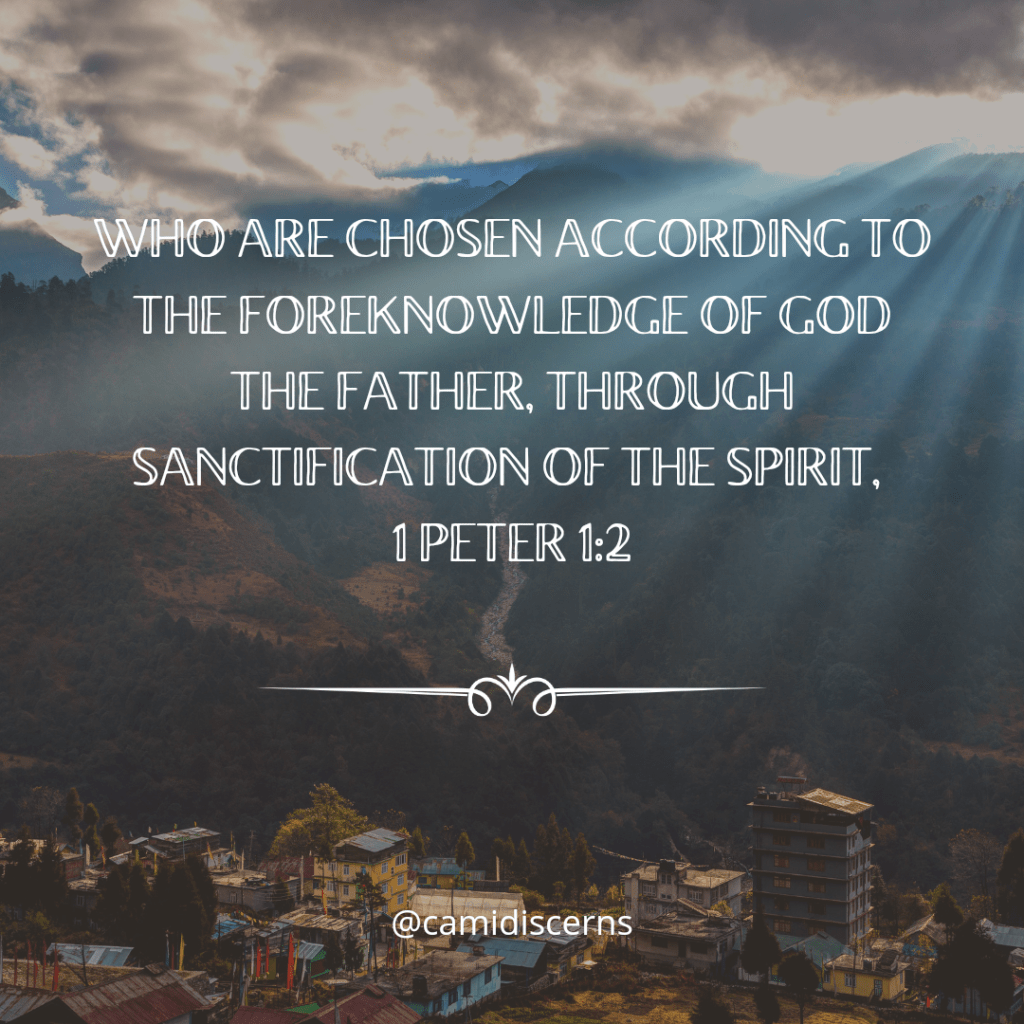
"...who are chosen according to the foreknowledge of God the Father, through sanctification of the Spirit, for obedience and sprinkling by the blood of Jesus Christ: Grace to you, and peace, be multiplied."
1 Peter 1:2
Many things are said in 1 Peter 1:2 about our salvation. The three persons of the Trinity in this verse.
We can see the cause and the origin of it (Cause & Effect) God’s choice.

God’s Will is the primary cause.

The manner and process:

The Spirit’s work.
The purpose and goal:
Obedience to Christ.
The means and basis:
The blood of Christ.
“… God has from the beginning chosen you to salvation through sanctification of the Spirit and belief in the truth.”
2 Thessalonians 2:13Biblical Definitions
Here are examples of how the Biblical text uses the term which is translated “foreknowledge.”
In the Old Testament the word used is the Hebrew word “yada” which means “know.”
“You only have I known (Hebrew equivalent: chosen) of all the families of the earth…” Amos 3:2 KJVThis is the way God speaks of foreknowing in the sense that he set His special saving love upon us from before the foundation of the world.l
“Before I formed you in the womb, I knew [meaning “chose”] you, and before you were born I consecrated you; I appointed you a prophet to the nations.” Jer 1:5
Thus God foreknew
God predestined
God called
God justified, and
God glorified

They aren't separated.
Rom 8:30 puts it in the past tense, since what God set out to do is as good as done! This is precisely the point of the passage.
Let us take a look at the view of foreknowledge that says that God simply knew beforehand who would believe and therefore called them to be His children.As noted above, the false belief that ” God does not preordain any individual to anything; but the individual actually ordains himself. God in effect complies with the individual’s choice.”
What does Scripture tell us of man's condition?

- It tells us that man is "dead in transgressions and sins" Eph 2:1.
- It says, "there is no one...who seeks God" Rom 3:10-11.
- Jesus declared, "No one can come to me unless the Father who sent me draws him" John 6:44.

In view of what Scripture teaches, what did (or would) God see beforehand looking down the corridors of time?

- He saw people "dead" spiritually, who rejected him (Rom 1:18-23)

People who, if left to themselves would never choose to come to Him.

A dead person cannot come up with a response of any kind.
A spiritually dead person, similarly, cannot generate faith so as to believe.

No, in eternity past, before the creation, the Fall, the covenants, or the Law, we were sovereignly predestined by God to be His.

God's purpose?
That we might be holy & blameless.

His motivation? Love.
"In love He predestined us to adoption as sons."

His goal & reason?
"to the praise of the glory of His grace."
“Before I formed you in the womb, I knew you, and before you were born I sanctified you, and I ordained you a prophet to the nations”. Jeremiah 1:5
Note: The same Hebrew word translated “knew” in this verse is translated “chosen” in Gen 18:19 and Amos 3:2
Jesus Foreordained Before The Foundation Of Earth
He was indeed foreordained before the foundation of the world, but was revealed in these last times for you.
1 Peter 1:20
Before He created the world, before mankind fell into sin God had a plan for the salvation of man, and Christ was at the heart of that plan. Eph 1:4; Acts 2:23.
God has not cast away his people whom he foreknew.
Do you not know what the Scripture says about Elijah? This is how he pleads with God against Israel and says,
"Lord, they have killed your prophets and torn down your altars, and I alone am left, and they seek my life."

But what does the answer of God say to him?
"I have reserved for myself
seven thousand men who have
not bowed the knee to Baal."

Paul goes on:
So also at this present time there is a remnant according to the choice of grace.
And if by grace, then it is no longer by works.
Otherwise grace would no longer be grace. But if it is by works, then it is no longer by grace. Otherwise work would no longer be work.
What then? Israel did not obtain what it sought,
but the chosen ones obtained it. And the rest were blinded.
Romans 11:2-7
…even as he has chosen us in him before the foundation of the world, that we should be holy and blameless before him. In love he predestined us to the adoption as children to himself, by Jesus Christ, in accordance with the good pleasure of his will, to the praise of the glory of his grace, by which he has made us accepted in the Beloved.
Ephesians 1:4-6 -
Philosophical arguments that support the concept of an absolute truth:
The correspondence theory of truth:
According to this theory, truth is a matter of accurately representing reality.
In other words, a statement or belief is true if it corresponds with the facts.This view implies that truth is objective and independent of individual perspectives or cultures.The coherence theory of truth:
This theory asserts that truth is a matter of logical consistency within a set of beliefs or propositions.
For example, if someone claims to value honesty but lies consistently, their statements are not coherent with their supposed values.This view suggests that there are certain logical principles that apply universally and are not relative to specific individuals or cultures.The pragmatic theory of truth:
This theory defines truth in terms of its practical consequences.
For instance, if a scientific theory is widely accepted and provides practical benefits, it is considered as true.This view emphasizes the importance of empirical evidence and objective criteria in assessing truth claims.Truth is not a matter of opinion, but rather is based on certain objective principles that are applicable everywhere. -
Pre-tribulation Deception
Do you believe in the pre-tribulation rapture? Are you one of those who want to be taken away? It’s time to rethink this doctrine and examine it in the light of the Word of God. Matthew 24:40 is often quoted to support the idea of a secret rapture, but if we read the preceding verses, we find a different picture.As in the days of Noah, people were caught up in their own affairs and did not heed the warning of the coming flood. They were taken away, not Noah, who was prepared and ready. This pattern repeats itself in the end times, where another flood of lies will be widespread. False teachers, who preach the rapture doctrine, mislead people and prevent them from delving deeper into the Word of God to understand end-time events.Luke 17 further strengthens the understanding that the one taken is not the blessed one. Vultures or scavengers prey on the spiritually dead, and Satan and his agents use this deception to take advantage of the spiritually unprepared. Christ is coming like a thief in the night, but we have been given signs to watch for His coming.The emphasis here is not on escaping, but on being ready, vigilant, and engaged in God’s work. We are called to be faithful and wise servants in carrying out the mission of spreading the gospel. God did not rapture Noah or Moses, but provided them with a way to endure the tribulation of their times. He will do the same for us as well.Therefore, the idea of a pre-tribulation rapture is a false doctrine created by man, an attempt to escape tribulation, and deceive believers into not understanding and preparing for the end times. As believers, we must be ready to endure and fight the good fight, knowing that Christ is with us every step of the way. -

God Does What He Pleases ~ Psalms 115 & 135
The divine presence of the Almighty rests in the celestial realm, where He rightfully reigns over the vast expanse of the universe. His grand design is impervious to failure, for no force can thwart His majestic intentions.
In the abode of heaven, our God dwells, transcending mortal confines. His actions are guided solely by His own will, unrestricted by any external influence. As expressed in Psalm 115:3, He exercises His sovereignty with absolute freedom and autonomy.
But our God is
Psalms 115:3
in heaven.
He does whatever he pleases.Psalm 135:5-6 further emphasizes the greatness of the LORD, acknowledging that He surpasses all other deities.
For I know that the LORD
Psalms 135:5-6
is great,
and that our Lord
is above all gods.
Whatever the LORD pleased,
that he did in heaven
and on earth,
in the seas and all deep places.His dominion extends beyond the heavens, encompassing the earth, the depths of the seas, and all hidden realms. The LORD executes His desires, shaping the course of events both in the celestial and terrestrial spheres.
Through these verses we grasp the profound understanding of the Almighty’s supreme authority and unrivaled power. His divine plan unfolds according to His sovereign will, unassailable and unyielding.
No entity, mortal or divine, can thwart the omniscient purpose of our heavenly God.
-

The Truth: What Is It?
Truth is objective because it is based on facts and evidence that can be verified rather than on opinion or personal beliefs.
Truth is not subject to interpretation or opinion, and it is not affected by personal bias or preferences.
Truth is based on facts that are verifiable and can be proven to be true. It is not relative or subjective, and it does not change based on a person’s feelings or beliefs.
The Scriptures Agree
As it is written in John 8:32, “Then you will know the truth, and the truth will set you free.”
The truth spoken of here is not a subjective or relative truth but rather an objective truth based on facts and evidence.
In 2 Timothy 3:16-17, it is written that: “All Scripture is God-breathed and is useful for teaching, rebuking, correcting and training in righteousness, so that the servant of God may be thoroughly equipped for every good work.”
This shows that the truth found in Scripture is not based on personal opinion or bias but rather on the divine inspiration of God.
In Psalm 119:160, it is written that “The sum of your Word is truth, and every one of your righteous rules endures forever.”
This further emphasizes the objective nature of truth found in Scripture, which is not subject to personal interpretation or bias.
“Jesus answered, “My kingdom is not of this world. If it were, my servants would fight to prevent my arrest by the Jewish leaders. But now my kingdom is from another place.””
John 18:36Pursuing truth is essential to humans, but it is not always easy. Truth is objective, and we cannot create it based on our preferences. We must approach the world with an open mind and seek out evidence to understand it better. Being aligned with truth requires us to accept what is objectively true, even if it conflicts with our beliefs. Pursuing truth is a lifelong journey that requires us to be humble, curious, and open-minded, leading to a greater sense of clarity and purpose in our lives and contributing to a more just and equitable society.
Jesus said to him, “I am the way, and the truth, and the life. No one comes to the Father except through me.” –
John 14:6Living in a state of truth is a spiritual journey that requires a deep relationship with God, the self, and the world. It involves aligning oneself with the divine reality and accepting the fundamental nature of existence. This state of harmony is essential for living a purposeful life and requires a commitment to following the principles of truth. Through this transformative process, we can gain a profound understanding of the objective reality of God, the subjective reality of self, and the observed reality of the world. Ultimately, living in a state of truth is a spiritual awakening that leads to a deeper connection with God and a more meaningful existence.
Truth Is The Nature Of God
God is the source of all truth; He is perfect, holy, and unchanging. This is found throughout the Bible and is seen in passages such as Psalm 31:5, which states, “Your word is truth.” This means that whatever God says is valid and can be trusted. God is also light, which symbolizes truth. In John 8:12, Jesus says, “I am the light of the world. Whoever follows me will never walk in darkness but have the light of life.”
God Is The Source Of All Truth
So it is only through a relationship with Him we can genuinely understand and access the fullness of truth.
By praying, studying the Bible, and listening to God’s guidance, we can better understand the truth and how it applies to our lives. As we grow closer to God, our knowledge of His truth deepens, allowing us to live in alignment with His will. This spiritual journey leads to a more profound understanding of reality and a more meaningful existence.
My Philosophy on objective truth.