Blog

  • What is the “Logos” ?

    λόγο
    In the Works of Heraclitus and Aristotle, "logos" refers to the underlying principle of order and reason that governs the universe. It was associated with rationality, logic, and intelligence that bring coherence and structure to the world.

    Logos, an ancient Greek word, has diverse meanings like word, statement, story, thought, principle, reason, and speech. Its usage can be technical or common, and the meaning depends on the context. In the technical sense, it refers to human reason/speech or universal intelligence/principle. Pythagoras, a philosophical pioneer, employed logos with specialized significance. He posited three fundamental principles: Monad (unification), Dyad (diversification), and Harmony (relation). Harmony represents the proportionate relationship between numbers, shapes, or tones. Logos play a unifying role in connecting these principles, establishing a cohesive framework of understanding.

    In the Works of Heraclitus and Aristotle, “logos” refers to the underlying principle of order and reason that governs the universe. It was associated with rationality, logic, and intelligence that bring coherence and structure to the world.

    Heraclitus

    Heraclitus was an ancient Greek philosopher who lived before Socrates and Plato. He was known for his written book of sayings, which covered topics such as the nature of the physical universe, ethics, and politics. Although he avoided involvement in politics and was a loner, his influence was greatest among the Stoics. Heraclitus’ metaphysical ideas have retained their power over time.

    He claimed “Logos” {the Word} as Reason, a Reason that rules the universe. Still, for Heraclitus, man remained trapped within the cycles of the earth (spring, summer, fall, winter; birth, middle age, death).

    “Although this Logos is eternally valid, yet men are unable to understand it – not only before hearing it, but even after they have heard it for the first time … though all things come to pass in accordance with this Logos, men seem to be quite without any experience of it … My own method is to distinguish each thing according to its nature, and to specify how it behaves; other men, on the contrary, are as forgetful and heedless in their waking moments of what is going on around and within them as they are during sleep.”

    Aristotle

    Aristotle understood logos as the basis of reason and rationality, especially in ethics. He believed that logos guides us in making logical and ethical decisions by bringing together reason and morality in a meaningful way. This deep understanding of logos sheds light on the importance of logical coherence and ethical comprehension.

    The stoics

    The Stoics emphasized the concept of logos as an active and rational force shaping the universe.

    In the Greek language, “logos” translates to “word,” “speech,” or “reason.” It can refer to the expression of thoughts and ideas through language or the act of speaking itself.

    “Logos” encompasses communication, discourse, and the power of language to convey meaning.

    Christian Theology

    In Christian theology, “logos” is used to denote the pre-existent, divine Word of God, as mentioned in the Gospel of John: “In the beginning was the {logos} Word, and the {logos} Word was with God, and the {logos} Word was God.”

    The Lexham Bible Dictionary defines logos (λόγος) as “a concept word in the Bible symbolic of the nature and function of Jesus Christ. It is also used to refer to the revelation of God in the world.” Logos is a noun that occurs 330 times in the Greek New Testament.

    The embodiment of God’s eternal creative powers is observed, clearly signifying the process that the vast expanse of the universe was brought into existence. Simultaneously serving as the conduit, through which transcendent truths are constructively and effectively conveyed to the totality of humanity. The Logos, or The Christ imparts deep insights to us. Giving way to an exhaustive ability to comprehend, and experience transcendence, moving past the borders of mundane cognition.

    New Testament

    In the New Testament, the Greek word logos is used to refer to Jesus Christ in many places, notably in John 1:1, which states; “In the beginning was the Word, and the Word was with God, and the Word was God.”

    The Gospel of John makes frequent use of the term logos to refer to Christ. John 1:14 states “And the Word {logos} became flesh and dwelt among us.”

    This verse holds significant meaning as it discloses that Jesus embodies and represents the power and intentions of God, within this world.

    Jesus is not solely a messenger or servant of God but rather a direct expression of God’s authority and purpose.

    Through the quintessence of {the logos} Jesus, we are granted the ability to witness the manifestation of God’s incredible power and the complete actualization of His intentions. It is only through the reality of Jesus that we are granted the ability to seize the profundity and immenseness of God’s omnipresence, as well as a visualization of His blueprint.

  • A Demonic Awakening

    {OLD Journal Entries from when I was a “Shamanic” pagan practitioner. A tiny fragment of my perception during a supposed: Spiritual “Awakening” before Lucifer was forced to hand me over to my Creator: 

    I FULL-HEARTEDLY BELIEVED IN THE DIVINE POWER OF THE HUMAN WILL. }

    Today I KNOW the error and twisted perception flipping God’s word upside down: As above, so below.

    My Recent Thoughts In The Midst Of Awakening: Seeking Full Transcendence Past this Realm 

    Spiritual awakenings always get precipitated by experiences of wounding, abuse, and trauma, which is to say, allowing oneself to not only fully experience suffering, but cultivate suffering to work for you as a conduit, masochism is a strength; a way of being; and a discipline.

    Meaning, Being severly damaged or wounded most initiates the primal “Calling” and forces the fast progression of the “Shamanic Archetype” to begin emerging and embed itself in the Unconscious with violence.

    A genuine spiritual awakening can only be started in the complete freedom of the human will seeking out inflicting upon itself pain and fear: a sure way to kick start some hard-core spiritual development and growth.

    Many substances will help on this journey if only used ritualistically and medicinally, but only attainment can come by your powerful will: be strengthened by the power of your Mind, and you can be fulfilled; I am not fulfilled yet, but I am experiencing higher- and higher-level downloads of ancient wisdom.

    The Ancient ones have initiated me, this much I am sure, and I am manifesting my compliance to them so that I can continue my Ascension Process, or else complete breakdown and chaos will consume me. 

    Spiritual Awakening is often co-joined of both healthy and pathological factors. 

    This means we must foster ONLY the healthy aspects of our behaviors and beliefs that aid in the progression of jumping dimensions, as well as forcing and administering the annihilation of other characteristics, forcing them to be annihilated by a Shiva-type energy. 

    The idea is to nourish the healthy facets of the approach so that they keep becoming more potent while allowing the pathological factors to naturally fall away as they merge into the totality of the newly materializing psyche. 

    To quote the great Hindu saint: 

    Ramakrishna, “How to get rid of the lower self? The blossom vanishes of itself as the fruit grows, so will your lower self-vanish as the divine grows in you.” 

    Shamanism is the root from which humanity’s various Spiritual disciplines have been disseminated; the earliest origins of modern psychotherapy known to history lie in archaic Shamanism.

  • Omnipresent God: Unlimited by Time & Space

    Omnipresent God: Unlimited by Time & Space

    Omnipresence refers to the concept or quality of being present in all places or being universally present. It is the attribute of being able to be present everywhere at the same time.

    God’s boundless presence knows no bounds; He is eternally with us, providing guidance, support, and love. His continual presence brings solace, assurance, and guidance, enriching our bond with Him.

    “Where can I go from your Spirit? Where can I flee from your presence?”

    Psalm 139:7

    What Is God Limited By?

    NOTHING!

    He is the Creator of Time and Space. He is the shaper of form, and through formation, all forms were brought forth, destined to take shape.

    Read:
    The Many Faces of Time: A Philosophical Exploration

    The Concept of Space: Exploring Its Many Meanings and Implications

    There is no escape from His presence, for He is there regardless of our destination. Whether we ascend to the heights of heaven or find ourselves in the depths of Sheol, He is there with us. His presence knows no bounds, extending to every corner of existence. Even in the most exalted realms or the deepest abyss, His unwavering presence is a constant source of comfort and reassurance.

    God In Sheol?

    Hell is devoid of the joy, love, and glory of God. It is a place where promises remain unfulfilled, void of beauty, love, pleasure, and joy.

    Yet, in hell, God’s judgment and authority persist, ensuring fairness and upholding the endurance of agony. In this regard, God’s existence is fearful and unavoidable, since His anger cannot be escaped or hidden from. Hell embodies a realm where God’s presence manifests in manners contradictory to human wishes and divergent from the delight that believers experience in His proximity.

    “For You will not abandon my soul to Sheol; Nor will You allow Your Holy One to undergo decay.”

    Psalm 16:10

    The presence of God can be found in every conceivable place, encompassing the depths of the underworld,, to the utmost heights of the Celestial realm known as Heaven. Whether in the darkest abyss or the most exalted domain, God’s presence permeates every corner of existence.

    We are limited in perception by the linear timeline and atmosphere of space.

    Our perception is limited by time and space. The structured nature of time and the vastness of space constrain our understanding. These limitations shape our interpretation of the world and hinder our grasp of its complexities. Time’s order and the physical boundaries of our atmosphere restrict our perception. Yet, we are encouraged to explore knowledge and expand our understanding within these limits.

    Proverbs 2:3-5: “Indeed, if you call out for insight and cry aloud for understanding, and if you look for it as for silver and search for it as for hidden treasure, then you will understand the fear of the LORD and find the knowledge of God.”

    God Transcends All Limits

    The boundless nature of God’s existence transcends the limitations of singular domains, as He navigates effortlessly through an intricate tapestry of dimensions and realms, seamlessly orchestrating His divine purposes across parallel realities.

    His omnipresence extends beyond the confines of a single dimension, permitting Himself to operate simultaneously in a multitude of cosmic spheres.

    He weaves together the intricate threads of existence, harmonizing the diverse landscapes of the spiritual and physical realms into a grand symphony of divine providence. In awe-inspiring brilliance, he moves effortlessly through the expanses of time, space, and beyond, revealing the breathtaking magnitude of His presence in every facet of creation. God traverses domains, working in multiple dimensions and realms concurrently.

    In the earthly realm, we perceive Earth’s reality, but beyond our understanding, God’s divine plan encompasses vast dimensions in perfect harmony. It’s like a symphony where cosmic realms intertwine within His design. As we navigate our limited domain, let us humbly acknowledge God’s boundless authority, knowing our experiences are just a small part of His magnificent panorama.

    God operates the Micro & Transcends The Macrocosm

    In the grand tapestry of existence, God orchestrates the intricate dance between the microcosm and the macrocosm.

    With divine precision, He navigates the subtle complexities of the smallest particles, delving into the infinitesimal realms of the microscopic. Simultaneously, He governs the expansive expanses of the cosmic macrocosm, where galaxies and celestial bodies twirl in a celestial ballet.

    From the tiniest quarks to the vast cosmic web, God’s omnipotent hand guides the harmonious interplay between the micro and macro, unveiling the awe-inspiring depth and magnitude of His creative power.

    God’s dominion transcends the vast expanse of the macrocosm, where He reigns supreme over all creation. However, His presence is not limited to the cosmic tapestry alone. Within the intricate fabric of the microcosm, where minuscule particles and complex systems reside, He governs with meticulous care.

    He Is The Cosmic Adhesive

    His divine influence permeates every minute detail, ensuring harmony and coherence in all aspects of existence. Acting as a cosmic adhesive, He binds together all things, uniting the macro and the micro in a symphony of divine order that flows seamlessly throughout the cosmos.

    He is the source of all the workings of the universe.

    If something is not brought forth by Him, it cannot be considered existent by scientific and logical standards. If God did not create it, He cannot be considered God according to the scriptures.

    The All In All

    Thus, logic, reason, and faith confirm one truth: God is the all in all. He binds things together, causes every effect, and is the effect of every cause. He determines what exists and what doesn’t. All things exist for Him, through Him, and by Him, and nothing exists outside of Him. If anything is beyond His will, then His will is imperfect, and He would be untruthful.

  • Slander (Select Scriptures)

    Slander (Select Scriptures)

    For I have heard the slander of many,
    Terror is on every side;
    While they took counsel together against me,
    They schemed to take away my life.
    — Psalm 31:13

    Rest in the Lord and wait patiently for Him;
    Do not fret because of him who prospers in his way,
    Because of the man who carries out wicked schemes.
    — Psalm 37:7


    But as for me, I shall walk in my integrity;
    Redeem me, and be gracious to me.
    My foot stands on a level place;
    In the congregations I shall bless the Lord.

    A Psalm of David.
    The Lord is my light and my salvation;
    Whom shall I fear?
    The Lord is the defense of my life;
    Whom shall I dread?
    When evildoers came upon me to devour my flesh, and
    My adversaries and my enemies, they stumbled and fell.
    Though a host encamp against me,
    My heart will not fear;
    Though war arise against me,
    In spite of this I shall be confident.
    — Psalm 26:11 – 27:3

    Rest in the Lord and wait patiently for Him;
    Do not fret because of him who prospers in his way,
    Because of the man who carries out wicked schemes.
    — Psalm 37:7

    As for a rogue, his weapons are evil;
    He devises wicked schemes
    To destroy the afflicted with slander,
    Even though the needy one speaks what is right.
    But the nobleman devises noble plans;
    And by noble plans, he stands.
    — Isaiah 32:7-8

    All our enemies have opened their mouths against us.
    Panic and pitfall have befallen us,
    Devastation and destruction;
    My eyes run down with streams of water
    Because of the destruction of the daughter of my people.
    My eyes pour down unceasingly,
    Without stopping,
    Until the Lord looks down
    And sees from heaven.
    My eyes bring pain to my soul
    Because of all the daughters of my city.
    My enemies, without cause
    Hunted me down like a bird;
    They have silenced me in the pit
    And have placed a stone on me.
    Waters flowed over my head;
    I said, “I am cut off!”
    I called on Your name, O Lord,
    Out of the lowest pit.
    You have heard my voice,
    “Do not hide Your ear from my prayer for relief,
    From my cry for help.”
    You drew near when I called on You;
    You said, “Do not fear!”
    O Lord, You have pleaded my soul’s cause;
    You have redeemed my life.
    O Lord, You have seen my oppression;
    Judge my case.
    You have seen all their vengeance,
    All their schemes against me.
    You have heard their reproach, O Lord,
    All their schemes against me.
    The lips of my assailants and their whispering
    Are against me all day long.
    Look at their sitting and their rising;
    I am their mocking song.
    You will recompense them, O Lord,
    According to the work of their hands.
    You will give them hardness of heart,
    Your curse will be on them.
    You will pursue them in anger and destroy them
    From under the heavens of the Lord!
    — Lamentations 3:46-66

    As a result, we are no longer to be children, tossed here and there by waves and carried about by every wind of doctrine, by the trickery of men, by craftiness in deceitful scheming. Still, speaking the truth in love, we are to grow up in all aspects into Him who is the head, even Christ, from whom the whole body, being fitted and held together by what every joint supplies, according to the proper working of each part, causes the growth of the body for the building up of itself in love.
    — Ephesians 4:14-16

    Put on the whole armor of God so that you can stand firm against the devil’s schemes. Our struggle is not against flesh and blood, but against the rulers, against the powers, against the world forces of this darkness, against the spiritual forces of wickedness in the heavenly places. Therefore, take up the whole armor of God so that you can resist evil days and, having done everything, stand firm. Stand farmhouse, having girded your loins with truth, and having put on the breastplate of righteousness, and having shod your feet with the preparation of the gospel of peace; in addition to all, taking up the shield of faith with which you will be able to extinguish all the flaming arrows of the evil one. And take the helmet of salvation, and the sword of the Spirit, which is the word of God. With all prayer and petition, pray at all times in the Spirit, and with this in view, be on the alert with all perseverance and petition for all the saints, and pray on my behalf, that utterance may be given to me in the opening of my mouth, to make known with boldness the mystery of the gospel, for which I am an ambassador in chains; that in proclaiming it I may speak boldly, as I ought to speak. But that you also may know about my circumstances and how I am doing, Tychicus, the beloved brother ad faithful minister in the Lord, will make everything known to you. I have sent him to you for this very purpose so that you may know about us and that he may comfort your hearts. Peace be to the brethren and love with faith from God the Father and the Lord Jesus Christ. Grace be with all those who love our Lord Jesus Christ with incorruptible love.
    — Ephesians 6:11-24

  • Your Eye Is The Light Of Your Body

    Your Eye Is The Light Of Your Body

    The eye is a sacred gateway to the soul. If your vision is pure and filled with love, your entire being will radiate with divine light. But if your eye is clouded with negativity and darkness, your whole being will be consumed by shadows. If the light within you is obscured by night, the depths of that darkness are immeasurable.

    “The eye is the lamp of the body. If then your eye is healthy, your whole body will be full of light. But if your eye is diseased, your whole body will be full of darkness. If then the light in you is darkness, how great is the darkness!
    Matthew 6:22‭-‬23

    Your eye is the lamp of your body. When your eye is healthy, your whole body is full of light, but when it is diseased, it is full of darkness. Therefore see to it that the light in you is not darkness. If your whole body is full of light, with no part in the dark, it will be as full of light as when the light of a lamp shines on you.”
    Luke 11:34‭-‬36
    In this passage, Jesus uses a metaphor to teach about the significance of spiritual discernment.
    He compares the eye to a lamp, suggesting that what we focus on and allow into our lives will bring light or darkness to our entire being. If we have a healthy eye and a clear and focused perspective, our whole body will be full of light. However, if our eye is diseased, meaning we have a distorted or unhealthy view, our whole body will be full of darkness.
    Jesus then warns his listeners to be careful that the light within them is not darkness. This could be interpreted as a warning against false teachings or beliefs that may seem light but lead them astray. He motivates them to confirm that their whole being is full of light, with no part in the dark so that they may experience the fullness of spiritual illumination.
    This passage emphasizes the importance of spiritual discernment and the need to guard our minds and hearts against anything that may lead us away from the truth.

    The eye is essential for gathering information. Unfortunately, some heathen societies had a cruel practice of blinding enemies or rivals to weaken their power (Judges 16:21; 2 Kings 25:7; Jeremiah 39:7). This act of blinding, especially of the right eye, was seen as a great humiliation as it robbed the victim of their beauty and ability to fight in a war (1 Samuel 11:2; Zechariah 11:17).

    The “Eye” Must be single.

    In Matthew 6:22 and Luke 11:34. The text discusses the concept of the eye being “single,” which means that it is not giving a double or uncertain vision. This is important because if the eye is not single, it can lead to confusion and uncertainty.

    Figurative: The eye of the heart or mind, the organ of spiritual perception, which may be enlightened or opened ( Psalms 119:18 ). This is done by the law of God (Psalms 19:8 ) or by the spirit of God (Ephesians 1:18 ), or it may be “darkened” and “holden” (Luke 24:16; compare Matthew 13:13; 2 Corinthians 4:4 ).

    The eye is an index of the mind and disposition of man. The Bible speaks of the “good” margin, or “bountiful” eye, i.e., the kindly disposition (Proverbs 22:9 ); of “proud,” arrogant,” “lofty eyes” (Psalms 18:27; Psalms 131:1; Proverbs 6:17 ); of the ‘lowly eyes’ of the humble (Job 22:29 margin; also compare Luke 18:13 ); of ‘adulterous eyes,’ “eyes which play the harlot” (Ezekiel 6:9, in the sense of idolatrous inclinations; 2 Peter 2:14 ). Rage or anger is shown by the “sharpening” of the eyes (Job 16:9 ).

    (4) The eyes of God, as well as the “seven eyes” of the Lamb (Revelation 5:6 ) and the ‘many eyes’ of the four living creatures of the Apocalypse (Revelation 4:6; also Ezekiel 1:18; Ezekiel 10:12 ), are figurative expressions for the omniscience of God (compare Hebrews 4:13; Psalms 139:16 ) and of His watchfulness and loving care (Jeremiah 32:19 ). As the human eye may, with the slightest glance or motion, give an indication, a command. Hence, God can “guide” or “counsel” His obedient child “with his eye” (Psalms 32:8 ).

    3 Hebrew expressions are translated by “apple of the eye”:

    ( a ) אישׁון, ‘ı̄shōn, literally, “the little man,” which probably means the “pupil of the eye,” it being part of the eye in which the close onlooker may see his image reflected in miniature. Several oriental languages have very similar expressions (Deuteronomy 32:10; Psalms 17:8; Proverbs 7:2 ).

    (b ) בּבה, bābhāh, literally, “the gate of the eye” (Zechariah 2:8 ).

    (c ) בּת־עין, bath -‘ ayin, literally, “the daughter of the eye” (Psalms 17:8; Lamentations 2:18 ). All these three phrases seem to indicate the pupil rather than the “apple of the eye” and designate the sensitive part of the eye, which we protect with the most excellent care. Thus the Scriptures declare, for our great comfort, that God will protect and care for those that are His own.

    The symbolism of the eye in the Bible is rich and complex. It is a physical organ and a metaphor for human emotions and behavior. As we saw in 1 Samuel 18:9, Saul’s envious gaze upon David illustrates how the eye can express negative feelings such as envy and malice. Additionally, the “evil eye” concept warns us about the destructive power of jealousy and covetousness. Thus, the eye is a powerful reminder of the importance of wisely using our sight and emotions. As we navigate life, we should be mindful of how our gaze and intentions can impact those around us and strive to cultivate positive and compassionate attitudes toward others.

  • Thoughts From The Spirit

    Thoughts From The Spirit

    The Spirit Is More Real Than The Material

    The One and Only Divine Creator has gifted a holy ruling upon His chosen ones, who are incredibly flawed yet cherished, to be forgiven from the consequences of their earthly forms through the Divine Mercy and Grace of the only Righteous One, Jesus Christ, Who, at a predestined moment, was tasked by The Father to Save you. The Mastermind behind every planet, star, organism, feeling, thought, and emotion has ordained us to be able to perceive things beyond the scope of our physical vision.

    Despite the false assertions made by mere mortals, we remain unaffected by their attempts to denounce what God has ordained or any passive aggression they employ to resist the works of God. We disregard their ego-driven, bad attitude because truth (God) is not intimidated by scrutiny.

    Despite existing in the physical realm, we comprehend that our body is God’s Property; we are His peculiar people.

    When the soul, once enslaved to the body, now belongs to the Divine Creator, salvation is impossible not to feel and comprehend cognitively.

    Who You Are

    As a Spiritual being, you receive information in a Divine way that transcends the constraints of the biological brain.

    Your soul is the essence of who you are, and the Holy Spirit governs your body, mind, and emotions.

    Through the power of the Spirit, you can connect with God and become One with the information (Wisdom) sent to you. This is because you are a Spiritual being, not bound by the material world.

    When God’s Spirit enters your stamina, it turns you over from the inside; out, preserving your soul for the day you will be reunited with the Divine source, YHWH.

    Although your physical body experiences pain and anguish, you comprehend that you are not a slave to the flesh but rather a spiritual being that is destined for eternal life, a slave to the Spirit, a slave to Righteousness.

  • God Declares the Beginning from the End: Trusting in God’s Plan for Our Lives

    God Declares the Beginning from the End: Trusting in God’s Plan for Our Lives

    Do you believe God is all-knowing?

    If so, then you must believe He knows the beginning from the end.

    The Bible tells us that God declares the beginning from the end and that He knows all things.

    In Isaiah 46:10, God says,

    “My purpose will stand, and I will do all that I please.”

    This verse tells us that God has a plan and He knows what He is doing.

    God’s plan for our lives is to bring us closer to Him and to enable us to live in His will. He knows the beginning from the end, and He will guide us through the journey. We can trust in Him and His plan for our lives.

    God is in control and knows the beginning from the end so that we can trust Him and His plan for our lives.

  • The Misconception Of Judgment And Contempt In Westernized Christian Society: Personal Relationships

    The Misconception Of Judgment And Contempt In Westernized Christian Society: Personal Relationships

    Misconception:

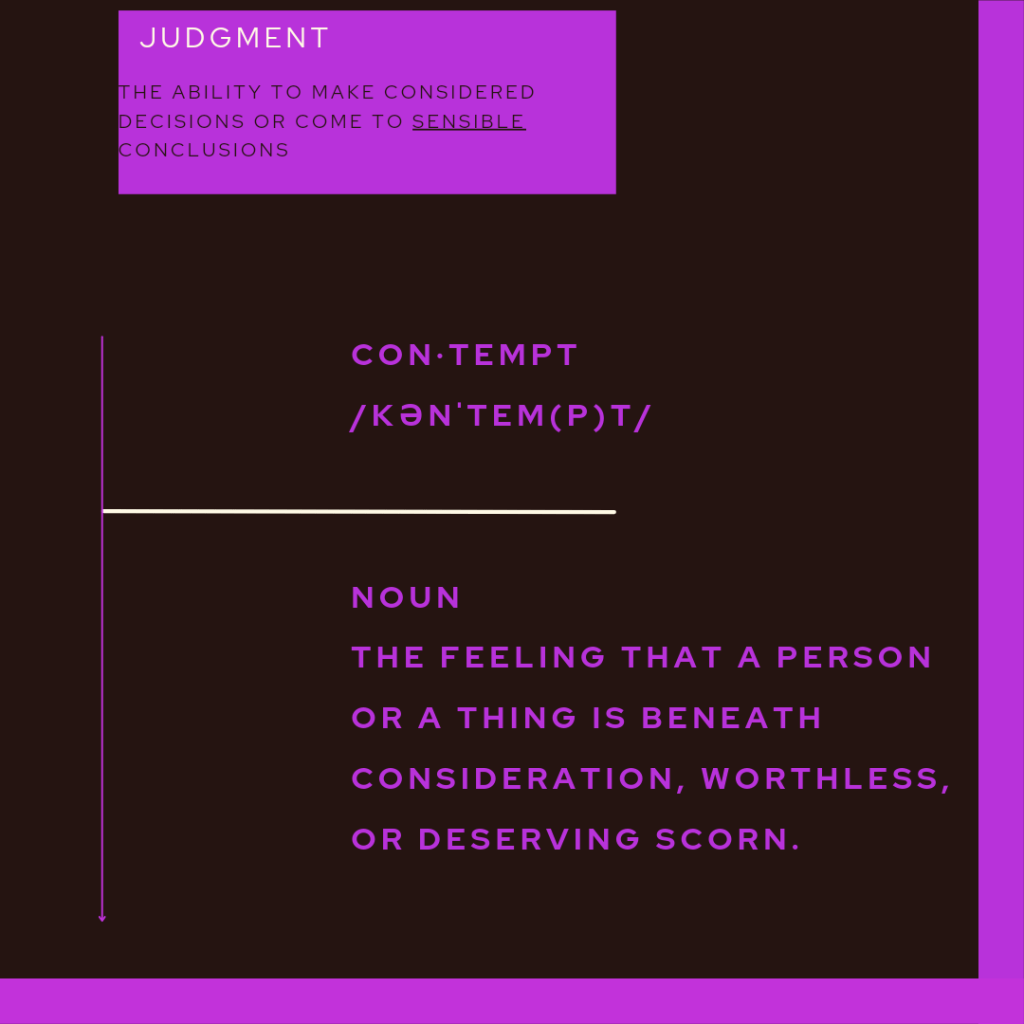
    Judgment is often misunderstood as synonymous with contempt in Westernized Christian society. However, judgment simply means forming an opinion or making a decision based on careful consideration of available information. Contempt, on the other hand, involves a deep-seated feeling of dislike or disrespect towards someone. It is important to distinguish between these two concepts in order to promote healthy communication and relationships.

    Judgment

    Judgment is the act of evaluating someone’s behavior or actions to form an opinion or make a decision. The Bible promotes the use of judgment, with Jesus urging his followers to judge righteously in John 7:24. This means that judgment can be a valuable tool for making thoughtful and empathetic choices.

    Judgment VS Contempt

    While judgment can be constructive and positive, contempt is a harmful emotion characterized by feelings of disrespect or disdain for others. It can be destructive to relationships and the Bible warns against it. Jesus himself cautioned against contempt when he said, “Do not judge, or you too will be judged” (Matthew 7:1).

    Contempt is a harmful emotion and can be destructive to relationships.

    Contempt can manifest itself in various ways, such as through insults, belittling, and dismissive behavior. It often stems from a sense of superiority or a desire to assert dominance over others. However, its negative effects can be far-reaching and long-lasting.

    Contempt In Personal Relationships

    Contempt in personal relationships can take different forms like insults, sarcasm, eye-rolling, dismissive behavior, and criticism. It can lead to a breakdown in communication and emotional connection, which is damaging in romantic relationships where love and mutual respect are crucial.

    A Vicious Cycle

    Contempt can lead to a negative cycle in a relationship and make it hard to resolve conflicts. In extreme cases, it can cause the relationship to end completely.

    Rehash

    To further illustrate the differences between judgment and contempt, let’s take a look at each concept in more detail.

    Judgment is the process of forming an opinion or making a decision through careful consideration or analysis. It involves making a rational and objective assessment of a situation or person based on available information. We use judgment every day to make decisions that affect our lives, such as which job to apply for or who to trust.

    Contempt Is Disrespect

    On the other hand, contempt is a feeling of disrespect or disgust towards someone or something. It is a negative emotion that arises when we perceive someone or something as inferior, unworthy, or despicable. Unlike judgment, which is based on information and logic, contempt is driven by emotions and can be irrational.
    While judgment can be helpful in making informed decisions, contempt can be damaging to relationships and create a negative environment. It can lead to resentment, anger, and an overall breakdown of communication and trust. When we feel contempt towards someone, we are less likely to listen to them, show empathy, or work towards a resolution.

    How To Use Judgment Righteously

    In order to use judgment effectively and avoid contempt, it’s important to approach situations with empathy, curiosity, and an open mind. Rather than jumping to conclusions or dismissing alternative viewpoints, we can seek to understand different perspectives and evaluate evidence objectively. By doing so, we can make informed decisions while maintaining positive relationships with others.

  • Charles Spurgeon Quotes About Free Will: PRINCE OF PREACHERS

    Charles Spurgeon Quotes About Free Will: PRINCE OF PREACHERS

    In his sermons and writings, Spurgeon often expressed his opposition to the argument of human free will, which he saw as a threat to the doctrine of grace and the glory of God.

    “I do not come into this pulpit hoping that perhaps somebody will of his own free will return to Christ. My hope lies in another quarter. I hope that my Master will lay hold of some of them and say, ‘You are mine, and you shall be mine. I claim you for myself.’”

    Charles Spurgeon

    Here Are Some More Quotes; All Sourced And Available To View

    “I believe that every particle of dust that dances in the sunbeam does not move an atom more or less than God wishes—that every particle of spray that dashes against the steamboat has its orbit as well as the sun in the heavens—that the chaff from the hand of the winnower is as much steered as the stars in their courses…The creeping of an aphid over the rosebud is as much fixed as the march of the devastating pestilence—the fall of leaves from a poplar is as fully ordained as the tumbling of an avalanche.”

    This quote is from Spurgeon’s sermon titled “A Defense of Calvinism,” delivered on June 5, 1855.

    “I do not come into this pulpit hoping that perhaps somebody will of his own free will return to Christ. My hope lies in another quarter. I hope that my Master will lay hold of some of them and say, ‘You are mine, and you shall be mine. I claim you for myself.’”

    “A Defense of Calvinism,” delivered on June 5, 1855.

    “The free will of man is a wretched idol, and deserves to be enthroned in hell.”

    “Sovereign Grace and Man’s Responsibility,” delivered on October 9, 1859.

    “Free will has carried many souls to hell, but never a soul to heaven.”

    “Spiritual Resurrection,” delivered on August 24, 1856.

    “If there is anything in the doctrine of the grace of God which commends it to us more than another, it is the sovereignty of it. If there is anything that is calculated to make men adore the grace of God, and to render them humble, it is the doctrine of the election of grace.”

    “Election,” delivered on August 2, 1857.

    Charles Spurgeon
    SERMON #52: VOL. 1 (1855)
    Free Will-A Slave

    THIS is one of the great guns of the Arminians; mounted upon the top of their walls, and often discharged with terrible noise against the poor Christians called Calvinists!

    I intend to spike the gun this morning, or, rather, to turn it on the enemy—for it was never theirs. It was never cast at their foundry at all, but was intended to teach the very opposite doctrine to that which they assert.

    Usually, when the text is taken, the divisions are—first that man has a will.

    Secondly, that he is entirely free.

    Thirdly, that men must make themselves willing to come to Christ, otherwise they will not be saved.

    Now, we shall have no such divisions! But we will endeavor to take a calmer look at the text, and not because there happens to be the words, “will,” or, “will not,” in it conclude that it teaches the doctrine of free will.

    It has already been proved beyond all controversy that free will is nonsense!
    Freedom cannot belong to will any more than ponderability can belong to electricity. They are altogether different things.

    Free agency we may believe in, but free will is simply ridiculous.

    The will is well-known by all to be directed by understanding, to be moved by motives, be guided by other parts of the soul, and be a secondary thing. Philosophy and religion both discard at once the very thought of free will! And I will go as far as Martin Luther, in that strong assertion of his, where he says, “If any man does ascribe anything of salvation, even the very least to the free will of man, he knows nothing of divine grace, and he has not learnt Jesus Christ aright.”
    It may seem a harsh sentiment, but he who in his soul believes that man does of his own free will turn to God, cannot have been taught of God—for that is one of the first principles taught us when God begins with us—that we have neither will nor power—but that He gives both—that He is “Alpha and Omega” in the salvation of men.

    SERMON #52: VOL. 1 (1855)
    Free Will-A Slave
    DELIVERED ON DECEMBER 02, 1855

    To Read The Full Sermon: I created THIS NOTE.

    “Free will carried many a soul
    to hell, but never a soul to
    heaven.”

  • Cognitive Empathy; Powerful Empathy

    Cognitive Empathy; Powerful Empathy

    Empathy is the ability to understand and share the feelings of others; allowing us to connect deeply with others; feeling their emotions, and responding with comprehension and mercy.

    The concept of empathy has been widely studied in the field of psychology, with various definitions and dimensions being proposed. In essence; Empathy directs us to put ourselves in someone else’s shoes and view the world from their viewpoint.

    EMPATHY IS OFTEN ASSOCIATED WITH FRAGILITY OR VULNERABILITY

    Unfortunately, many people see empathy as a weakness or deficiency. Empathy is believed to make us vulnerable, and vulnerability is usually viewed as a weakness in our narcissistically driven society. But I believe that empathy is a strength.
    It takes gutsiness to put ourselves in someone else’s shoes, sense their pain, and respond graciously.

    WHAT’S THE DIFFERENCE BETWEEN EMPATHY & COGNITIVE EMPATHY?

    One dimension of empathy is cognitive empathy, which refers to the ability to understand and predict the thoughts and feelings of others, while maintaining a certain level of emotional detachment.
    In contrast, empathy is frequently characterized as the ability to share and experience the emotions of others, usually resulting in a more emotional response.
    Cognitive empathy and empathy differ in their cause and effect.
    Cognitive empathy relies on cognitive techniques such as perspective-taking and mentalizing, which allow individuals to understand the thoughts and feelings of others without necessarily experiencing them themselves.
    This is useful in situations where emotional detachment is necessary.

    PERSPECTIVE-TAKING AND MENTALIZING

    The concept of perspective-taking and mentalizing implies that humans possess a remarkable capacity to step outside of their own subjective experiences & understand with objective comprehension, the subjective experiences of another.

    This capacity to understand the thoughts and feelings of others without experiencing them directly is a powerful ability; demonstrating that humans are capable of transcending their own identity and connect with others on a deeper level; revealing profound insight into the nature of human consciousness and the possibilities for human connection and comprehension beyond the status quo.

    COGNITIVE EMPATHY IS THE ABILITY TO UNDERSTAND AND APPRECIATE OTHER PEOPLE’S PERSPECTIVES. IT’S AN IMPRESSIVE SKILL

    Cognitive Empathy is a complex and multi-layered concept. At its core, cognitive empathy involves the ability to put oneself in another person’s shoes, to see the world from their perspective, and to truly understand their thoughts, feelings, and motivations.
    This requires an elevated capacity of emotional intelligence, as well as a willingness to give attention to, observe, and learn from others.

    Cognitive Empathy is not just about understanding others but also about utilizing that understanding to construct stronger connections, determine dissensions, and facilitate reciprocal insight and regard.
    It is an essential skill needed to function healthily in this interconnected world, where multiplicity and cultural discrepancies are increasing.

    Cognitive empathy, is also known  in some areas of education as empathic accuracy, and can be viewed as a gift from God that allows us to transcend our ego and truly feel the experiences of those around us.
    COGNITIVE EMPATHY IS THE OPPOSITE OF WEAKNESS

    Cognitive empathy requires a high degree of emotional intelligence. Contrary to popular belief, cognitive empathy is not a sign of weakness but rather a strength. It requires a great deal of mental and emotional effort to put oneself in another person’s shoes and truly understand their perspective without any interjections.

    This level of empathy is potent and rare.

Intuitive Data

Intuition, Decoded

Skip to content ↓