Reflection is a fascinating process. It allows us to look back on our experiences, to examine our thoughts and feelings, and to gain insights that can shape our future decisions. It’s like holding up a mirror to our lives, revealing not just what we’ve done, but also who we are becoming. Sometimes, these moments of contemplation can be uncomfortable, but they often lead to growth and understanding. In the end, taking the time to reflect can deepen our connection to ourselves and the world around us.
There is a kind of knowing that does not ask permission from the mind.
It does not build a case.
It does not cite its sources.
It arrives already finished — and you are left, afterward, trying to reverse-engineer a reasoning process that never actually happened, because there wasn’t one.
There was only recognition.
THIS IS INTUITION
And I want to be precise about what it is, because the word gets used carelessly — as a synonym for ‘hunch’, for ‘gut feeling’, for whatever unexamined impulse happens to walk through the door.
It is more disciplined than that.
It is older than that.
What the Word Actually Says
Intuitive: from the 1640s, meaning to perceive directly and immediately.
French intuitif. Medieval Latin intuitivus.
Beneath that, Latin intueri — to look at, to consider — built from in- (into) and the Proto-Indo-European root tueri, to look at, to watch over.
Sit with that construction for a second— TO LOOK INTO.
Not to look at something from the outside, the way the analytical mind does when it studies a thing and holds it at arm’s length.
TO LOOK INTO
Intuition was never framed, at its root, as a shortcut around understanding.
It was framed as a more direct route to the same place, perception without the detour through argument.
By 1833 the word had picked up its second meaning: self-evident.
Which tells you something about how intuitive knowledge behaves once it arrives.
It doesn’t feel like a conclusion you reached.
It feels like a fact you always had.
INTUITION’S ESSENCE
Intuition is knowledge acquired without recourse to conscious reasoning.
It costs little apparent effort, and it often arrives beneath the threshold of awareness. —you didn’t notice yourself knowing it, you just discovered that you already did.
I’ll say what I am convinced is objective reality and the rationalist minds reading this will resist:
Intuition is not knowledge in spite of the unconscious. It is knowledge because of it.
Subconscious Intuition
Somewhere beneath the noise of deliberate thought, pattern and truth are being recognized continuously, without your permission and without your effort.
Intuition is what it sounds like when that recognition finally surfaces loud enough to hear.
Call it whatever you want— Gnosis, Pattern Recognition …
Call it pattern-recognition if the word “gnosis” makes you nervous. I won’t argue about the name. I will insist on the thing.
The analytical mind — the part of you that constructs arguments, weighs pros and cons, wants everything justified before it’s trusted — is not the enemy of intuition.
But the analytical mind is not its source, either.
It is downstream.
It is the part of you that shows up afterward, translating a knowing into language, dressing it in reasons it can defend at a dinner party.
The knowing came first.
Four Intuitive Types Moving Through People
Not everyone’s intuition operates the same way.
I’ve watched these four show up distinctly enough, in myself and in the people I’ve cared about enough to study.
I think of these types less as a typology and more as four different instruments the same instinct can be played on.
1. ADAPTIVE INTUITION
Adaptive intuition moves fast, and it moves on experience — not analysis, experience, the kind that’s been lived through the body enough times to have left a residue.
It shows up when a situation is too time-compressed for deliberation, and it’s the one people instinctively turn to for guidance in a crisis, because it doesn’t destabilize when the ground does.
This is the intuition of someone who’s been through the fire enough times to recognize the smell of smoke before the alarm goes off.
2. OBSERVANT INTUITION
Observant intuition is quieter and more patient. It’s built on close attention — visual, sensory, environmental.
It notices the cue nobody else caught:
1. the tone that shifted & 2. the detail that doesn’t match the story being told.
People who carry this type tend to move cautiously, because they’re gathering before they’re deciding, and it often coexists with real artistic ability — the same faculty that reads a room can read a canvas, or make one.
3. ANALYTICAL INTUITION
Analytical intuition looks, from the outside, almost like its opposite — deliberate, unhurried, unwilling to move until every possibility has been turned over.
But it’s still intuition, not pure logic, because the “considering” isn’t a formal process; it’s a felt need to hold the question longer, even when it produces something that looks like indecision.
This is the instinct behind good lawyers and good detectives — not faster knowing, but knowing that refuses to close early.
4. QUESTIONING INTUITION
Questioning intuition is analytical intuition’s more skeptical cousin — the same refusal to rush, but anchored harder in fact and evidence rather than felt pattern.
It doesn’t trust a recognition until it can also verify it.
This is the instinct behind good accountants:
the sense that something’s off, followed immediately by the demand to prove it.
Why This Matters
None of these four are “more intuitive” than the others.
They’re the same faculty filtered through different relationships to time, evidence, and trust.
What they share is the thing the word has meant since the 1640s: direct perception.
A way of looking into something rather than only at it.
CULTURAL CONDITIONING
We’ve been trained — by a culture that worships the analysis it can show its work for — to distrust the knowing that arrives without a paper trail.
I’d ask you to consider the opposite: that the paper trail is the translation, not the source.
That the fastest, oldest, least defensible-sounding knowledge you have might also be the least corrupted.
It hasn’t been argued into a shape that’s convenient.
It’s just true, the way a self-evident thing is true — because you looked directly at it, and it looked back.
Cognitive rigidity is the stubborn insistence that our way of thinking is the only way.
It shows up in small, everyday ways:
refusing to consider another perspective
dismissing evidence that challenges our beliefs
or sticking to habitual responses when flexibility is required.
It is mental inflexibility masquerading as certainty.
This rigidity is rarely neutral. It filters experience, allowing only what aligns with our preconceptions to pass through.
What we notice and refuse to notice is determined less by reality and more by the contours of our existing beliefs. The mind becomes its own jailer.
FILTERED VISION
Perceptual limitations compound this problem. Our senses, our expectations, and our biases shape what we perceive.
Two people can witness the same event and walk away with entirely different “realities,” each convinced theirs is the truth.
Culture, language, upbringing, and personal trauma all function like lenses, coloring everything we see.
When cognitive rigidity meets these perceptual filters, the feedback loop begins: our beliefs dictate what we perceive, and our perceptions reinforce our beliefs.
We become prisoners of our own limited frameworks, blind to the complexity—and often the truth—of the world around us.
Breaking the Loop
Escaping this loop is not about acquiring more information. It is about retraining the mind to see what it usually ignores:
Observe without judgment. Watch your thought patterns and notice when you shut down possibilities automatically.
Seek what challenges you. Engage with ideas and perspectives that make you uncomfortable.
Question your perception. Ask yourself what you might be missing, what biases are filtering your experience.
Embrace intellectual humility. Accept that your understanding is provisional, incomplete, and subject to correction.
The moment we recognize that perception is always partial, and thought is always provisional, the bars of the cage begin to loosen.
Clarity is not a gift; it is a discipline.
The Work of Liberation
This is the work of liberation: not avoiding rigidity, but confronting it; not denying perceptual limits, but piercing them.
The mind can be trained to perceive more, think more flexibly, and respond more intelligently.
It is uncomfortable, but truth always is.
We cannot see everything, but we can see more than we did yesterday.
In my heart resides a girl named Rainne who carries a great burden.
Rainne is prone to analyzing everything, even the smallest nuances in a person’s voice.
What ignited Rainne’s passion for scrutinizing everything? What is the foundation of her elaborate thought process? Whence does it all emanate?
I think I know…
At the core of her receptive mind, constantly striving to comprehend a chaotic world, lies a pivotal moment: her birth.
Maternal Influence
Beginning with the individual who holds the utmost significance in the life of each young girl, namely the mother (or female guardian/caretaker), for it is through this bond that her character and cognitive abilities are honed.
Growing up in a chaotic environment due to her mother’s mental health issues, Rainne’s mother lacked the necessary support to reach her full potential.
The scars of her past continued to impact her parenting style and choices, making it difficult for her to break free from the cycle of dysfunction.
Living in the suffocating grip of unhealed trauma, she made a conscious decision to suppress the fiery rebellion of her wounded inner child.
Instead, she chose to remain in the shadow of resentment and defiance towards her mother, whose ignorance and neglect had contributed to the pain that lingered deep within her.
The scars of her past were etched into her being, a constant reminder of the battles she fought alone, yearning for love, understanding, and healing that seemed perpetually out of reach.
Despite the weight of her struggles, she kept a hard head, sadly hardening her heart…
Without knowing it:
Her primary focus remained on guiding her children on how to evade their personal trauma, since teaching them anything different would oblige her to confront the truth mirrored in a looking glass, a reality she chose to elude, punish, and push into the depths of darkness.
Rainne’s mother was traumatized, leading her to resist anything that sought to tear down walls, dismantle barriers, or open the heart to vulnerability.
The refusal was meant to safeguard her self-worth, on which Rainne’s mother heavily relied, with arrogance and a sense of moral superiority keeping her defenses intact.
These identities were profoundly rooted in her existence in an effort to offset the ominous weight of the maternal, generational curse.
The cycle of generational curses continues through the family line, with very few individuals able to recognize and break the pattern.
That is why Rainne found it fitting to claim the title of masochist.
But to Rainne: Pain is significantly superior to confusion and chaos.
Personal Struggles and Empathy
That’s where Rainne truly comes into her own. Despite being burdened with these traumas, she courageously confronts her own pain and bravely shoulders her mother’s trauma, fully embracing the heaviness of it all.
Every horrifying narrative her mother relayed, every time the agony was gently dispersed into Rainne’s ears, her soul was deeply gashed, inserting within her the dread that was not hers to carry, lacking the tools to understand.
Rainne was akin to a sponge, a remarkable healer, she could sense herself soaking up her mother’s distress as she watched her mother’s anguish.
Experiencing it regularly decrease in her mother as it seeped into Rainne, deep within herself, her mother felt relief, yet unknowingly.
It was excruciating.
Rainne discovered tranquility in being the one suffering rather than watching her dear mother in unbearable agony.
Rainne was and knew she was a conduit of sorts and had been put into a position of learning how to heal, cope, practice self-control, and take ownership of hellish suffering.
Rainne was no professional, she was just a mere child… this profound psychological metamorphosis was in response to her mother’s inability and unaware void in teaching her skills to invoke resilience nor tools to process the big emotions and confusion.
Cognitive and Emotional Development
A person who is severely gaslit during their childhood brain formation inevitably learns to gaslight.
The small child who witnesses their caregiver’s extreme responses and anger will emulate this behavior, as they absorb and imitate the behaviors they witness while their young minds are still flexible and evolving.
That child doesn’t simply learn to overreact, but rather, they are deeply ingrained with the personality that becomes a fundamental aspect of their identity, as opposed to a conscious choice actively made.
Rainne’s meltdowns were like violent storms unleashing all at once, with screams so piercing they echoed through the house, and thrashing so wild it felt like she was a hurricane tearing everything in her path.
The intensity of her emotions seemed to consume her, leaving her trembling and drained when the storm finally passed.
It was as if she had no control over this inner turmoil that threatened to engulf her at any moment.
To this very day, the memory remains etched in her mind.
She yearned fiercely to break free from it, but a force within her always seized control, preventing her from thinking logically.
The concept of healthy coping techniques was foreign to her.
During periods of calm, she engaged in positive activities like crafting, singing, studying, and more.
However, the real challenge emerged during trying times when she encountered obstacles with no clear solutions, strategies, or guidance on how to navigate through them.
She had never witnessed anyone model healthy coping behavior, leaving her lost and without direction.
One cannot effectively teach coping skills if they have never been taught how to cope themselves.
Generational Trauma
So the generational way of dealing with issues, conflicts, and scuffles involves going to the extreme, hurling the harshest insults possible, and yearning for the other person to face harsh retribution for hurting our feelings, having to ensure they suffer, all their “deserved” guilt.
We use the logic of our stagnantly pent-up anger to react until a distraction comes about… only to then brush it all off as if it never occurred.
The resolution of all recurring, deep rooted problems was avoided since no solutions were easily within view, leading to the faulty strategy of persistent denial… the problem is disregarded, said to be “resolved“, so then hidden resentments would fester within a deflecting surface of self, maintaining a facade of “care” and compassion, concealing the inner turmoil…
Wounded souls we were yearning to break free from the self-imposed confinement, torn between conflicting thoughts, seeking distractions at every turn.
Early Awareness and Analysis of Adult Issues
Rainne knew adult issues from a young age.
Her parents would fight multiple times a week, they also drank which didn’t help.
Her young mind absorbed the complexities of their arguments like a sponge, dissecting each hurtful remark and dissecting the underlying emotions. An obsession it became, it was the only solid ground she could find strong enough to stand on, in her childish creativity.
It was as if she had a maturity far beyond her years, as she recognized the pain and misunderstandings that fueled their fights. The answers were ever before her, an 8 year old with no leverage.
While they simply brushed off the conflicts in the morning, she couldn’t shake the weight of their hate filed, damaging words and the lasting impact they had on each other.
It was a heavy burden for a child to bear, but she couldn’t help but feel responsible to bear it. Sure would have given her little life to bring peace and understanding to their fractured relationship, as she understood the fighting was not what it should have been.
They would talk and scream past the other, it would become something it isn’t.
They wouldn’t listen to one another, it would become a poop flinging contest.
Rainne’s knew the problem in grade school, but he parents couldn’t see it.
She knew what it was.
Despite her limited knowledge (because of her sheltered youth) of both herself and the world around her, Rainne acknowledged that to truly love, one must first comprehend oneself with purity and seek the others feelings without pretenses.
In a self denying mode of being, to preserve her own life and protect her family (her family was her life), she sacrificed her own identity, disowning her individuation and betraying her own future.
Naively believing she could salvage something meaningful in her parents marriage, in doing so she sought a dead end as her young mind remained steadfast in its misguided conviction.
The Quest for Order
In her psyche, she sought solutions that (by the creativity of her mind) made sense and seemed so perfect.
Her brain wasn’t set in the shadow; she wasn’t jaded by the rejection of her own inner child like her mother was. She had yet to know what a shadow was, but she was sure going into it.
The brokenness of her mother was so deep in denial of inadequacies, that any slight causing a negative emotion was reviled. So the root on which her family raised her rebuked authenticity, the very substance Rainne functioned, so secrecy became imperative to keep true to her self. Although stability and consistency were words foreign to Rainne, a spark within her Spirit thirsted for the key to attaining order and logic, a thirst to turn her family’s chaos into order, without knowing: the Philosopher’s Stone was the very thing she sought since grade school.
Her mind didn’t just linger in her mother’s shadows; she remained untouched by the contraction of the bitterness, yet turned to the natural rejection of her inner child, not like her mother was but almost.
The brokenness of her mother ran so deep that denial was the mode of familial operation… that any perceived criticism provoked an emotional response from the mother that bit like an angry viper and suffocated the air like a boa.
This balancing act was the foundation of Rainne’s upbringing.
Still, a yearning to convert her family’s disorder into harmony was the very object of her quest and became her demise, as well as her necessary dark night needed for a Salvation.
Paternal Influence
Her father was a latchkey kid who never grew up and lacked significant structure as a boy, so stability wasn’t instilled within him. He possessed a profound terror of perishing. Jew had a lot of love though, Rainne knew his love was true, as it was consistent, he was never cruel.
Rainne was nurtured and found comfort in him, in an environment suffused with fear. She was shown to tremble at the idea of death instead of embracing it, she would evade it.
She was brought up to dread the inescapable and to grasp onto fantasies and deceit. She knew this to be folly in her soul.
Rainne’s sophisticated cognitive process and critical disposition are strongly influenced by her childhood encounters with uncertainty, distress, and the intricate interpersonal relationships within her role models.
Rainne’s childhood was marked by the constant tension that lingered…
Her mother, haunted by past traumas, never fully addressed, existing in a perpetual state of anxiety and unrest.
In this environment of fear and unease, Rainne developed a heightened sense of vigilance and analytical processing.
She learned to diligently observe the world around her, deciphering underlying tensions and unspoken truths. Looking for patterns and breaks in patterns.
This skill became a vital tool for navigating her tumultuous and uncertain surroundings.
However, Rainne’s innate empathy and sensitivity added another layer to her complexity.
Despite the trauma and fear that surrounded her, she possessed a deep capacity for understanding and connecting with others.
This empathy allowed her to see beyond the surface, to recognize the pain and struggles that others experienced, even when they tried to mask them, even when they were mean to her.
Combining her keen analytical skills with her compassionate nature, Rainne became a master at unraveling the complexities of human emotions and motivations that are locked away in a person.
She sought to bring order to the chaos around her, to make sense of the contradictions and conflicts that seemed to define her world.
Rainne never lost sight of her ultimate goal: to create a sense of harmony and understanding in a world that often seemed tumultuous and unpredictable.
Her journey was one of constant self-discovery and growth, failure and lessons… as she learned to navigate the complexities of her own emotions and relationships while striving to bring a sense of peace and clarity to those around her.
Often chaos insued but awareness of the context within its faced at all face costs, she is still fighting for peace.
I embody the destruction of love, and I dare you to take me on.
Jump to conclusions, catastrophize every scenario, & wrongly perceive oneself & others as worse than one actually is…
Feelings, Feelings… Turned To One Distorted Emotion
Unpleasant memories and distress intertwine with future optimism and allure.
Your past is so sinister, it darkens everything it touches, tainting what could have been.
Undeniably Demonic
You found yourself torn between two contrasting tables — one representing the fiery depths of hell, the other a celestial haven of Heavens Treasures.
Struggling to distill it to its essence, you embodied a dualistic mind, weaving a perplexing web of deception and ensnaring the unsuspecting souls crossing your path.
How can you possibly entertain the idea of forgiveness?
You’ve been cast aside to your own whims, absolution simply became a far-fetched illusion.
Do you fail to grasp, not to mention observe, the reality in front of you?
Or are you still ungrateful even when blessed?
Fading the rugged boundaries of what seemed achievable, maybe even anticipated.
Engaging in a relentless struggle to unearth the slightest of flaws in the most evident armor.
Somehow, in some manner, you perpetually manage to stumble upon one.
Flaw after flaw, you fall into your trap.
Uncover the fissure, the cipher, the illumination that never existed.
Amplify it.Elaborate upon it. Die in it.
The Surging Torrents
Oh, the surging torrents of insecurity; as they surge, twist, and crash onto the shores.
Whatever you kept vulnerable for such a duration, all you required was resolution.
All the trivial, imaginary situations born from your distorted perspective, cleverly hiding your unspoken grudges. Allowing them to endlessly repeat, in a frenzy.
Any semblance of reason or rationality consumed by the electric, unfounded vulnerability of fear.
It is you who questions yourself, with the ’purest intention’, defining yourself entirely unworthy.
Unworthy of both what you have received and what you desire.
As you read, a sense of darkness seeps through the words, almost like you’re touching the shadowy spaces between each moment, within each line.
Their voice lacks any firmness, resonating with the hesitant tones that have become all too familiar to you.
You prepared yourself for heartache, despite it never even being there.
There’s nothing to even suggest it existed in the first place. Setting yourself up with such damning evidence.
The beauty that was waiting for you, stripped from right under your own two feet.
Picture yourself gliding on the ethereal surface of your make-believe carpet, immersed in isolation, firmly convinced of your status as a victim, while casting blame and condemning victims as villians.
A glass that appears to be completely full but deep down you fear its impending emptiness.
A seemingly sturdy wall that stands unsteady before your very eyes, as you witness the gradual crumbling of its metallic structure.
Embrace the illusion, confess it!
Eventually ending in a feeling, for once returning to a time produced from the many pauses between words.
Silence, prior to embrace in the moments that free-fell from your heart; deceived, felt, immediately after.
Pathetic.
Holding all the world’s promises in the palm of your hand.
Spending the time watching shadows dancing in the distance. Overruling that which is clearly present, in the here and now.
It’s the belief that heartbreak is, in the end, inevitable. Despite your undying hope for the contrary. You allowed this belief to undermine all you think, say, or do.
That sweet morsel is followed by a bitter gut.
It’s the inconsistent ability to seize the moment.
Theal false confidence that you were meant to play the cards that you were dealt.
The ongoing struggle of being your own deceiving dealer who’s giving you shitty hands of sabatoge, you’re fighting yourself, but you blame the other.
Being relentlessly gripped by sickening, maddening, torturing nostalgia.
This nostalgia that suffocates, it continues to grow, fester, and generate from each and every moment, and as it passes, you’re standing firmly in the center unable to do a thing about it anymore.
A gripping fear that each touch, affection, or unsuspecting eternal feeling of love might be the last, so don’t feel it too much… or it’ll hurt too much.
And as this thought pattern persists, it very well could have been the very last thought.
The unconscious is like a vault that holds our hidden selves, known as the Shadow according to Carl Jung. It stores traits, both good and bad, that we have cast aside. These traits are shaped by shame, which influences the thoughts, desires, and urges that we push away.
UNCONSCIOUS
Within each of us exists a mysterious realm, beyond the reach of our conscious minds. This inner world, free from external influences, shapes our complex and sometimes bewildering responses to the outside world.
The Shadow dwells in our subconscious, concealed within the uncharted abyss of our thoughts.
It represents the unacknowledged aspects of our being that are concealed and disconnected from our conscious selves. Similar to an invisible force, it subtly influences our thoughts, emotions, and actions.
Exploring our unconscious mind allows us to unlock our hidden potential and gain a deeper understanding of ourselves. This journey of self-discovery leads to increased self-awareness and personal development.
Embracing the Shadow leads to a more complete and authentic expression of who we truly are.
“The shadow is a moral problem that challenges the whole ego-personality, for no one can become conscious of the shadow without considerable moral effort. To become conscious of it involves recognizing the dark aspects of the personality as present and real. This act is the essential condition for any kind of self-knowledge.”
Our unconscious is a powerful part of ourselves that often goes unnoticed and untapped, starting from our early years.
It includes suppressed thoughts, emotions, and memories that have been rejected or deemed unacceptable. Unfortunately, we may be unaware of this hidden realm of our psyche.
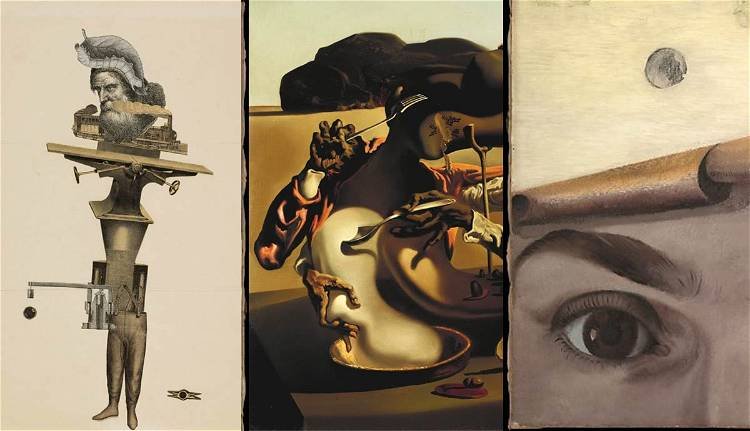
Exquisite Corpse by André Breton and Yves Tanguy, 1938, via The National Galleries Scotland, Edinburgh (left); with Autumnal Cannibalism by Salvador Dalí, 1936, via Tate, London (center); and Gala Éluard by Max Ernst, 1924, via The Metropolitan Museum of Art, New York (right)
Additionally, the unconscious mind functions as a reservoir for projection, which is a psychological defense mechanism that involves attributing our own undesirable traits, desires, or emotions to others. Essentially, it allows us to detach from certain aspects of ourselves and assign them to external objects or individuals. This process takes place involuntarily and without conscious awareness.
Projection is a psychological strategy employed by the ego with the intention of safeguarding itself against perceived dangers. This defense mechanism manifests when the ego disavows characteristics or attributes that it discerns in others, particularly those which it also despises within its own personality.
It is quite remarkable, if we take a moment to reflect, how frequently we observe this phenomenon not only in the behavior of others but also within our own selves, provided we are willing to be introspective and truthful.