Unveiling the Mysteries of the 17th Century
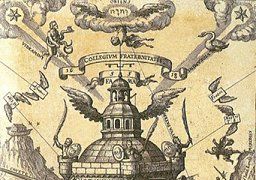
Rosicrucianism emerged into public consciousness during the early 17th century, with the release of its initial manifesto, Fama Fraternitatis, circulated among German occultists around 1610.
The printed editions of Fama Fraternitatis and Confessio Fraternitatis in 1614 and 1615, respectively, ignited widespread interest among alchemists, Qabalists, magicians, and astrologers across Europe.
These manifestos narrate the history of the Order, introduce its enigmatic Founder, and elucidate its principles, sparking intellectual fervor for several years.
In 1616, The Chymical Marriage of Christian Rosenkreutz was published, contributing to the belief that the Order was founded by a figure named Christian Rosenkreutz.
LISTEN TO THE AUDIO (mp3) Version
The Rosicrucian manifestos, initially published in the 17th century, were later translated into English by Thomas Vaughan in 1652. This translation sparked renewed interest in the 19th and 20th centuries.
However, the modern Rosicrucian organizations, such as the Societas Rosicruciana in America (SRIA) and the Ancient Mystical Order Rosae Crucis (AMORC), often obscure the original teachings.
Key Differences
The original manifestos were anonymous and mystical, conveying esoteric knowledge through allegories and legends.
Modern Rosicrucianism, as represented by SRIA and AMORC, has evolved into a more structured and organized system, with specific rituals, initiations, and teachings.
The modern names and symbols may overshadow the original intent and message of the manifestos, potentially altering the understanding and interpretation of the teachings.
Consequences
The original teachings may be lost or distorted due to the modern emphasis on organization and structure.
The mystical and allegorical nature of the manifestos may be overlooked or misunderstood in favor of more literal and dogmatic interpretations.
The historical context and cultural influences that shaped the original manifestos may be forgotten or ignored.
Importance of Context
To truly appreciate the Rosicrucian manifestos, it is essential to consider their historical context and the original intentions of their authors. By doing so, we can gain a deeper understanding of the mystical and esoteric teachings that underlie modern Rosicrucianism, and appreciate the evolution of the movement over time.
These texts are historical documents relating to the ‘Brotherhood of the Rosy Cross’, a renaissance German secret society. This group had a huge impact on more recent organizations such as the Golden Dawn, and is often cited by conspiracy theorists for completely different reasons.
Note:
The connection of the original Rosicrucians with the well-known contemporary fraternal organization, the Rosicrucian Society [AMORC] is vague at best. The AMORC, founded in 1915, runs the Egyptian Museum in San Jose, CA, and a mail-order study series.
The Real History of the Rosicrucians
by Arthur Edward Waite
This is Arthur Edward Waite’s study of the elusive Rosicrucians, a secret society of which the first public notice was in early 17th century Germany.
Waite presents complete translations of all of the texts which defined the Rosicrucians, including the Fama Fraternitatis, the Confessio Fraternitatis, and the Chemical Wedding of Christian Rosencreutz.
The longest text, the Chemical Wedding is a thinly veiled alchemical allegory.
Waite also surveys Rosicrucian literature from successive centuries, including extensive quotes from authors who wrote about the Rosicrucians such as Michael Maier, Robert Fludd, Thomas Vaughan and John Heydon.
Heydon wrote Voyage to the Land of the Rosicrucians, reminiscent of Thomas More’s Utopia, about a voyage to an obscure continent inhabited by Rosicrucians, included here in its entirety.
Waite concludes with a look at a 19th century ‘Rosicrucian’ organization: Hargrave Jennings was, notably, a member of this group. Speaking of whom. . .
The Real History stands in stark contrast to Hargrave Jennings’ The Rosicrucians, their Rites and Mysteries, which Waite (justifiably) criticizes throughout.
All in all, this serves both as a survey of the literature about Rosicrucians and an invaluable anthology of that literature.
Waite, although he had a solid background in the occult, is in a firmly rationalist mode in this book.
The Real History will be of use to both academic and general readers.
Start Reading
Fama Fraternitatis
In the Pronaos of the Temple of Wisdom
by Franz Hartmann [1890]
Contents
Start Reading
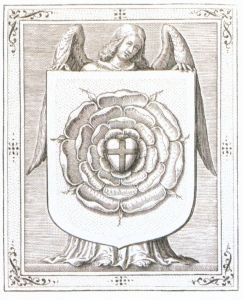
Franz Hartmann, who also wrote the esoteric novella With the Adepts, published this short non-fiction summary of the Rosicrucian question in 1890.
Franz Hartmann, who also wrote the esoteric novella With the Adepts, published this short non-fiction summary of the Rosicrucian question in 1890.
He reviews the well-known history and literature of the Rosicrucians. In the last two chapters Hartmann presents what he believes to be the core doctrines of the ‘true’ Rosicrucians.
The Secret Doctrine of the Rosicrucians
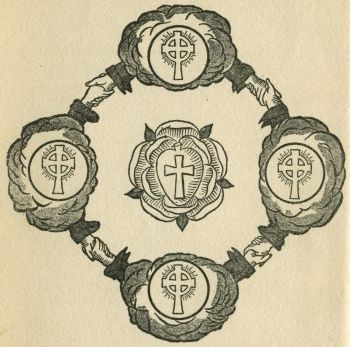
This book, attributed to William Walker Atkinson under the pseudonym “Magus Incognito”, is a comprehensive exploration of the Rosicrucian manifestos from the 1600s.
The text delves into the esoteric teachings and occult doctrines of the Rosicrucians.
It bears strong similarities to The Kybalion, which is also known to have been authored by Atkinson.
Key Concepts in The Secret Doctrine of the Rosicrucians
- The Rosicrucian manifestos and their significance
- The nature of the universe, including the astral plane and the infinite unmanifest
- The human soul and its relationship to the divine
- The pursuit of spiritual enlightenment and the attainment of higher states of consciousness
- The synthesis of Eastern and Western philosophies and spiritual traditions
Fama Fraternitatis
Fama Fraternitatis, attributed to C.R., was first published in 1614 in German and in 1615 in Latin. This anonymous manifesto introduced the concept of a secret brotherhood, the “Fraternity of the Rose Cross,” comprising wise men who had traveled extensively, including Damascus and Fez, to learn from scholars and philosophers.
This document is the key on which the Rosicrucian phenomenon was based.
It was first published in 1614 in German and in 1615 in Latin.
The document discusses the wisdom and power of God, as well as the secrets of nature
The author, Brother C.R., traveled extensively and learned from wise men in Damascus and Fez.
He sought to reform the arts and sciences and impart his knowledge to others.
The document emphasizes the importance of unity and the pursuit of true knowledge.
Brother C.R. Built a fitting dwelling for himself and three other brethren to continue their work in secrecy
About the Fraternity’s Founding
The Fraternity of the Rosy Cross created a Magical Language and writing system, as well as a large Dictionary.
Fraternity Beliefs
The Fraternity believed that their teachings and knowledge should be shared with others, but only to those who were worthy and deserving.
The Fraternity believed in the importance of secrecy and remained hidden for 100 years.
The Fraternity believed in the power of God and the importance of following His commandments.
The Fraternity believed in the reform and purification of the Church and the world.
The Fraternity had a strong belief in the afterlife and the resurrection of the body.
The Fraternity had a strong emphasis on learning and knowledge, and they valued the pursuit of wisdom and understanding.