Tag: gnosis

  • Guide To Intuition

    Guide To Intuition

    Intuitive — both an adjective and a noun

    There is a kind of knowing that does not ask permission from the mind.

    It does not build a case.

    It does not cite its sources.

    It arrives already finished — and you are left, afterward, trying to reverse-engineer a reasoning process that never actually happened, because there wasn’t one.

    There was only recognition.

    THIS IS INTUITION

    And I want to be precise about what it is, because the word gets used carelessly — as a synonym for ‘hunch’, for ‘gut feeling’, for whatever unexamined impulse happens to walk through the door.

    It is more disciplined than that.

    It is older than that.

    What the Word Actually Says

    Intuitive: from the 1640s, meaning to perceive directly and immediately.

    French intuitif. Medieval Latin intuitivus.

    Beneath that, Latin intueri — to look at, to consider — built from in- (into) and the Proto-Indo-European root tueri, to look at, to watch over.

    Sit with that construction for a second— TO LOOK INTO.

    Not to look at something from the outside, the way the analytical mind does when it studies a thing and holds it at arm’s length.

    TO LOOK INTO

    Intuition was never framed, at its root, as a shortcut around understanding.

    It was framed as a more direct route to the same place, perception without the detour through argument.

    By 1833 the word had picked up its second meaning: self-evident.

    Which tells you something about how intuitive knowledge behaves once it arrives.

    It doesn’t feel like a conclusion you reached.

    It feels like a fact you always had.

    INTUITION’S ESSENCE

    Intuition is knowledge acquired without recourse to conscious reasoning.

    It costs little apparent effort, and it often arrives beneath the threshold of awareness. —you didn’t notice yourself knowing it, you just discovered that you already did.

    I’ll say what I am convinced is objective reality and the rationalist minds reading this will resist:

    Intuition is not knowledge in spite of the unconscious. It is knowledge because of it.

    Subconscious Intuition

    Somewhere beneath the noise of deliberate thought, pattern and truth are being recognized continuously, without your permission and without your effort.

    Intuition is what it sounds like when that recognition finally surfaces loud enough to hear.

    Call it whatever you want— Gnosis, Pattern Recognition …

    Call it pattern-recognition if the word “gnosis” makes you nervous. I won’t argue about the name. I will insist on the thing.

    The analytical mind — the part of you that constructs arguments, weighs pros and cons, wants everything justified before it’s trusted — is not the enemy of intuition.

    But the analytical mind is not its source, either.

    It is downstream.

    It is the part of you that shows up afterward, translating a knowing into language, dressing it in reasons it can defend at a dinner party.

    The knowing came first.

    Four Intuitive Types Moving Through People

    Not everyone’s intuition operates the same way.

    I’ve watched these four show up distinctly enough, in myself and in the people I’ve cared about enough to study.

    I think of these types less as a typology and more as four different instruments the same instinct can be played on.

    1. ADAPTIVE INTUITION

    Adaptive intuition moves fast, and it moves on experience — not analysis, experience, the kind that’s been lived through the body enough times to have left a residue.

    It shows up when a situation is too time-compressed for deliberation, and it’s the one people instinctively turn to for guidance in a crisis, because it doesn’t destabilize when the ground does.

    This is the intuition of someone who’s been through the fire enough times to recognize the smell of smoke before the alarm goes off.

    2. OBSERVANT INTUITION

    Observant intuition is quieter and more patient. It’s built on close attention — visual, sensory, environmental.

    It notices the cue nobody else caught:

    1. the tone that shifted & 2. the detail that doesn’t match the story being told.

    People who carry this type tend to move cautiously, because they’re gathering before they’re deciding, and it often coexists with real artistic ability — the same faculty that reads a room can read a canvas, or make one.

    3. ANALYTICAL INTUITION

    Analytical intuition looks, from the outside, almost like its opposite — deliberate, unhurried, unwilling to move until every possibility has been turned over.

    But it’s still intuition, not pure logic, because the “considering” isn’t a formal process; it’s a felt need to hold the question longer, even when it produces something that looks like indecision.

    This is the instinct behind good lawyers and good detectives — not faster knowing, but knowing that refuses to close early.

    4. QUESTIONING INTUITION

    Questioning intuition is analytical intuition’s more skeptical cousin — the same refusal to rush, but anchored harder in fact and evidence rather than felt pattern.

    It doesn’t trust a recognition until it can also verify it.

    This is the instinct behind good accountants:

    the sense that something’s off, followed immediately by the demand to prove it.

      Why This Matters

      None of these four are “more intuitive” than the others.

      They’re the same faculty filtered through different relationships to time, evidence, and trust.

      What they share is the thing the word has meant since the 1640s: direct perception.

      A way of looking into something rather than only at it.

      CULTURAL CONDITIONING

      We’ve been trained — by a culture that worships the analysis it can show its work for — to distrust the knowing that arrives without a paper trail.

      I’d ask you to consider the opposite: that the paper trail is the translation, not the source.

      That the fastest, oldest, least defensible-sounding knowledge you have might also be the least corrupted.

      It hasn’t been argued into a shape that’s convenient.

      It’s just true, the way a self-evident thing is true — because you looked directly at it, and it looked back.


      EXTERNAL REFERENCES

      Study on Intuition and Insight

      Psychology and Philosophy of intuition

      The Roots of Intuition

    1. Recognize Jesus

      Recognize Jesus

      Through history, Jesus’ teachings have been twisted.

      His message has been distorted by worldly authorities, repackaged and sold to the masses in 66 Books, not only branded as Divine, but also proclaimed to be the only divinely inspired text in the world that we could trust.

      False doctrine dressed as truth.

      The true simplicity of His words and depth of His message has been concealed beneath centuries of misinterpretations, some on accident due to error… others with malicious intent.

      HOW JESUS TAUGHT

      Jesus spoke from a place of gnosis.

      GOSPEL OF THOMAS

      Gospel of Thomas (Lambdin Translation) — The Nag Hammadi Library – Gnosis

      The Gospel of Thomas in multiple translations, along with a vast collection of material about the Thomas tradition. This site includes the entire Hammadi Library, as well as a large collection of other primary Gnostic scriptures and documents.


      What is Gnosis?
      Gnosis is knowledge that transcends what society was able to grasp.

      Canonized doctrine has obscured this inner wisdom.

      The true path, He revealed, was not in compliance with man’s laws or constructed hierarchies.

      Gnosis is awakening.

      Awakening to the divine potential already living within, it is intimate exploration, not institutional obedience.

      Know Christ. Be Known by Him.

      Pride.

      Self-righteousness.

      The need to assert control.

      These are the antithesis of Jesus’ way.

      He would have overturned the tables of those clinging to materialistic delusion, worshipping the god of society instead of the truth.

      He taught through stories, parables designed to open hearts, spark insight, and reveal reality to those ready to see.

      The False Jesus of the Mainstream

      Over time, His teachings have been distorted.

      I do not see this as an accident.

      Deception is a natural habit of the human heart.

      Many will come in His name and mislead others, as He warned in Matthew 24:5.

      Lies will be spun. Truth will be hidden. The path to understanding will be obscured. & it has.

      His guidance is simple: stay vigilant. Seek truth. Seek God. Do not lean on man. Lean on the Spirit. Open your heart.

      Discernment is the key. Through connection with the Holy Spirit, the true meaning of His teachings will be revealed.

      In God’s eyes, all souls are equal. Hierarchy, power, wealth—they hold no weight in the light of Heaven.

      We are spiritual beings inhabiting human bodies. Our essence is love.

      Our value is inherent. In His presence, there is no superiority, only unity and grace.

      Open the Bible. See for yourself.

      Jesus’ message aligns with the deeper structures of the human psyche—the archetypes that Carl Jung described.

      LEARN MORE

      The Four Psychological Functions and the Gospel Drama

      Jung had much to say about the gospel drama. His reading was largely literary and symbolic, avoiding what he considered misguided attempts by scholars of his day to extract the human figure of Jesus from what they presumed to be fictional accounts


      Jesus’ purpose was not to educate superficially but to illuminate within our minds and hearts the principles of love, compassion, and divine order.

      He took on the burden of our failures, showing us that we could not ascend alone in our ego.

      He bore the weight of what we could not bear, saying, in essence, “You are weak, but I am here. I carry this for you.”

      He demonstrated what it means to embody the divine because He is the Divine.

      He did not expect us to imitate Him blindly.

      Through understanding Him, we find salvation—not through effort, but through alignment with His mind and heart.

      To truly grasp His teachings, our hearts and minds must be open.

      Wisdom resides within us, waiting.

      When we integrate the external world with our inner essence, when we allow the Spirit to guide us, Jesus’ teachings become alive.

      The divine does not reside in walls, pulpits, or rituals—it resides within. Limiting Christianity to buildings, to man-made constructs, stifles spiritual evolution.

      The shadows of false guidance hide behind piety.

      But if you engage scripture, cultivate the Divine within, and surrender to the Spirit, there are no barriers.

      God’s presence lives in every faithful heart, guiding, illuminating, and giving purpose.

      Know this presence within yourself and others. Your mind will sharpen. Your intuition will deepen. Wisdom will anchor you.

      Chaos dissolves when you align with Him. True freedom is forgetting yourself and finding yourself lost in Him.

      Get lost in Him.

    2. The Soul

      The Soul

      The Soul is the immaterial, spiritual essence of a human being.

      It is the part of us that exists beyond flesh and blood—the spark fashioned by God before creation, known and willed into being with purpose.

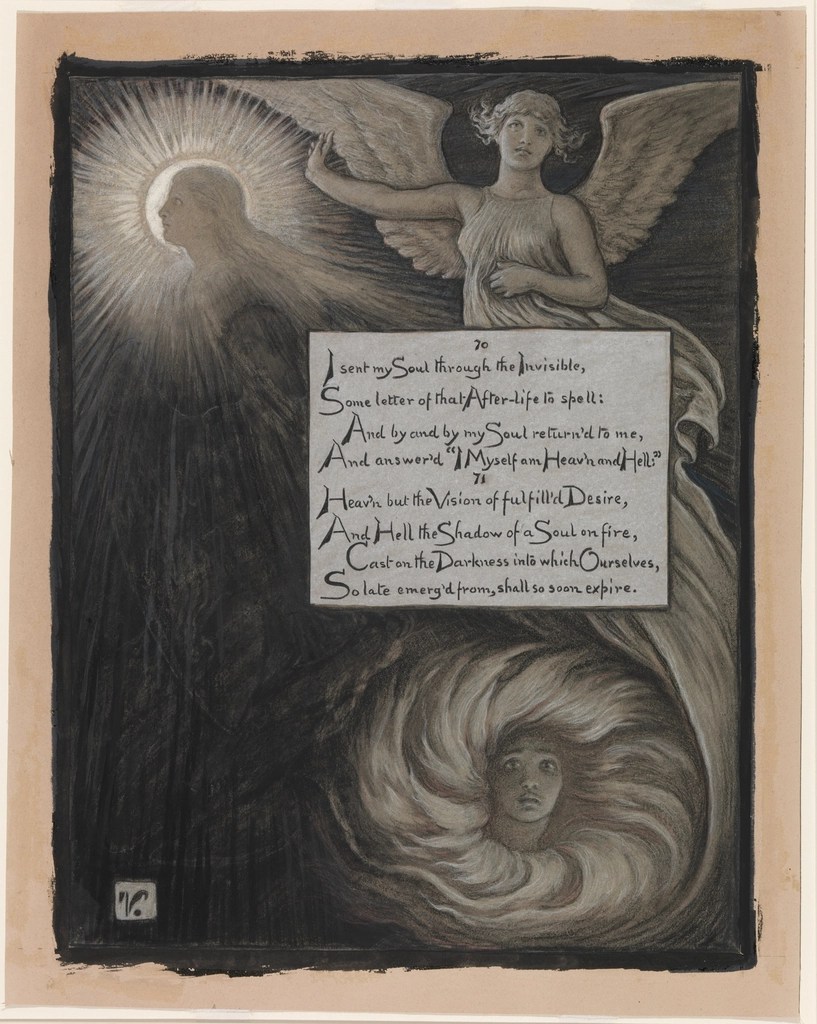
      “(Illustration Rubáiyát Omar Khayyám) Soul’s“/ CC0 1.0

      Etymology

      “Soul” comes from the Old English sawol and the Germanic saiwalo, signifying life itself—the principle that separates the living from the inanimate.

      The Soul as Our Inner Nature

      The soul is the core of human spiritual nature, capable of longing, thirsting, and reaching for truths that transcend the visible world.

      It hungers for God, for understanding, for the “solid food” of deeper wisdom embedded in scripture.

      Soul Hunger and Awakening

      When God opens the eyes of the spirit, the soul awakens. It senses a void that can only be filled by divine truth.

      This hunger is not fleeting desire—it is a gnosis-driven recognition of what the soul was made to receive.

      Growth Through Discernment

      As the soul engages with God’s word, it matures. Discernment sharpens. Understanding deepens.

      The soul is not static—it evolves as it drinks from the well of spiritual nourishment, separating truth from illusion.

      Transformation in the Human Being

      The soul is the locus of change. Surrendering to God’s word, allowing His living message to permeate the inner being, renews and transforms the soul.

      This is the ongoing work of sanctification: a refining fire that shapes the heart and mind, aligning them with divine purpose.

      The soul is more than life—it is the canvas upon which God paints His eternal image.

      To nourish it is to participate in the work of transformation that echoes in eternity.

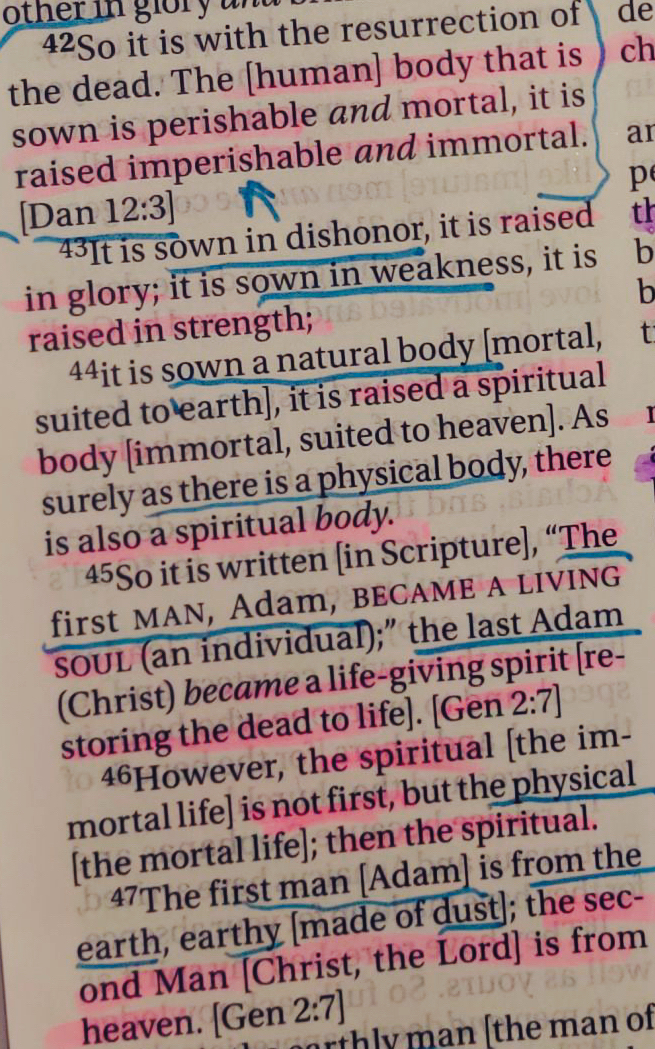
    3. Resurrection Bible Note Highlights

      The human body, as we experience it: flesh, blood, nerve endings, and all, is bound to the material world.

      It decays, ages, and ultimately returns to the dust from which it came.

      What transcends is not the physical body but the Ethereal body.

      the essence — the soul — the spirit— consciousness.

      Resurrection is a transformation into a glorified body– a heavenly body.

      This is not a mere continuation of the one we now inhabit.

      Paul’s writings in 1 Corinthians 15 describe a shift from a perishable, earthly body to an imperishable, spiritual form.

      Whatever survives death is not the frail, tangible flesh we now experience through.

      Heaven exists as a higher state of being, a realm beyond time and physical decay– a body of matter, subject to entropy, has no place there.

      The material body is a vessel, not the traveler.