The term “abuse” has a rich etymological background that reveals its complex nature and historical connotations. The word itself traces its origins back to the Latin term “abusus,” which is derived from the verb “abutere.” This Latin verb can be broken down into two components: “ab,” meaning “away from,” and “uti,” meaning “to use.” Therefore, “abutere” conceptually suggests the idea of using something inappropriately or improperly, straying from its intended purpose.
As it evolved from Latin into Old French, the word took on the form “abuser,” which also retained the essence of misusing or mistreating something. The transition through these languages reflects not just a change in spelling but also an expansion in meaning. By the time it entered Middle English, “abuse” had solidified its association with wrongdoing and maltreatment, signifying not simply the act of poor usage, but a willful distortion of fundamental rights, respect, or dignity.
Over the years, the understanding of “abuse” has further diversified. Today, the term encompasses a range of harmful behaviors and actions that violate the rights of individuals, including physical, emotional, verbal, and sexual abuse. This broad spectrum indicates that “abuse” is not limited to one particular context or situation; rather, it can manifest in various forms within relationships, institutions, and even broader societal structures.
Moreover, the etymology of “abuse” invites a deeper consideration of the moral and ethical implications of the term. It encourages reflection on the power dynamics inherent in abusive situations, where the abuser typically wields a significant degree of control over the victim, often exploiting vulnerabilities for their own gain. This understanding highlights the seriousness of the issue, underscoring the urgent need for societal awareness and intervention to combat abuse in all its forms.
In summary, the etymological journey of the word “abuse” traces a path from Latin to contemporary usage, illustrating a shift from a simple notion of improper use to a complex and multifaceted concept that captures the essence of harm and violation in human interactions. Through this lens, one can appreciate the profound implications of abuse and the continuous need for dialogue, prevention, and healing within both individual lives and society as a whole.
Narcissists are known for their adeptness at emotional manipulation.
This skill allows them to maintain control over others and ensure their desire are met.
One of the most prevalent tactics employed by narcissists is gaslighting.
Gaslighting
Gaslighting is a form of psychological manipulation in which the narcissist distorts the reality of their partner, causing them to doubt their own perceptions and sanity.
Invalidation
Through invalidating their partner’s emotions and experiences, narcissists establish a power imbalance and reinforce their dominance in the relationship.
Projection
Another manipulative tactic employed by narcissists is projection.
When confronted with their own flaws or shortcomings, narcissists deflectblame onto their partners by projecting their own negative traits onto them.
This not only shifts the focus away from their own behavior but also allows them to maintain their self-image as faultless and superior.
Stonewalling
Stonewalling is a behavior commonly exhibited by narcissists when faced with conflict or criticism.
It involves withdrawing emotionally and shutting down communication as a means of maintaining control and avoiding accountability.
When a partner attempts to express their feelings or concerns, the narcissist may dismiss and invalidate them, leaving the partner feeling unheard and invisible.
Stonewalling serves as a powerful weapon in the narcissist’s arsenal, as it not only denies the partner’s emotions but also denies their very existence.
By refusing to engage in meaningful dialogue, the narcissist effectively shuts down any potential for growth or resolution in the relationship.
Coercive Control (Power)–an act or a pattern of acts of psychological assault, threats, humiliation and intimidation or other abuse that is used to harm, punish, or frighten their victim into conforming.
Common Types of Coercive Power:
DIRECT & INDIRECT
DIRECT
Straight forward
Direct coercive power is the ‘in-your-face’ threats and direct ultimatums, leaving you feeling trapped and helpless. But you know what’s happening, there is little confusion.
INDIRECT
Manipulative- through the back door
These types will NEVER say, “Do this or else!” No, they’re far sneakier.
They instead will use subtle tactics to control and manipulate you.
Corersion puts you into a hellish maze where every turn is a mind trap, and you can never find your way out.
With indirect power, it’s about psychological warfare.
Tactics
Guilt-tripping
Using guilt or shame to manipulate individuals into conforming to certain behaviors or beliefs.
This can involve making individuals feel bad about themselves or their actions in order to control their behavior.
Threats of Punishment
Using threats of punishment or consequences to coerce individuals into compliance.
This can involve threatening to ostracize, shun, or punish individuals who do not conform to certain expectations or norms.
Emotional Manipulation
Using emotional manipulation tactics such as gaslighting, manipulation of emotions, or playing on individuals’ fears and insecurities to control their behavior.
Isolation
Isolating individuals from their support networks or communities in order to control their behavior and limit their access to alternative perspectives or sources of support.
Pressure Tactics
Using peer pressure, social pressure, or manipulation to coerce individuals into conforming to certain behaviors or beliefs.
This can involve creating a sense of urgency or fear of missing out in order to manipulate individuals into compliance.
Control of Information
Controlling access to information or limiting individuals’ exposure to alternative viewpoints in order to maintain control over their beliefs and behaviors.
Church Members
Often Play This Insidious Game
Believe it or not, There are instances where some individuals or organizations claiming to be Christian use coercion in an attempt to control or manipulate others out of concern, usually false concern.
Why?
There are various reasons why some individuals or groups within the Christian community resort to coercion.
This includes
a misguided belief that they are acting in the best interest of others.
a desire for power or control, a lack of understanding of the principles of consent and autonomy.
a misinterpretation of religious teachings.
But that’ll be another blog post.
Never Forget Jesus’ Teaching
“Bless those who curse you, pray for those who mistreat you”
As a sensitive person, blessed with the Gift of Discernment, I can sense the deep anguish and suffering that permeates the human heart at an inconceivable level in this very moment.
The presence of spirits such as betrayal, deception, envy, hate, and resentment, along with the feelings of fear, anxiety, terror, abuse, torture, and murder, seems to be entering the Collective Consciousness of Humanity.
This manifestation of evil is as ancient as Time itself, hiding in the shadows until now.
The light has arrived with an abrupt explosion of exposure, unveiling information that unravels millennia’s worth of wicked depravity in the blink of an eye.
In response to this revelation, the systems of influence and rulership over our old world are devising various tactics and implementing snares to cultivate a state of uproar, emotionalism, paranoia, and self-righteousness among us. They seek to create a sense of coldness and distance between individuals, leading us further away from one another, ourselves, and the Creator. However, we possess powerful weapons against these manipulations – Love, Truth, Discernment, Calmness, Patience, Diligence, Grace, Wisdom, Righteousness, and Boldness.
Amidst the chaos, they aim to ignite our hearts with hatred and vengeance.
In the face of this darkness, it’s crucial to seek the light. As stated in John 8:12:
‘I am the light of the world. Whoever follows me will not walk in darkness, but will have the light of life.’
The Light is no longer a distant concept; it is here, illuminating the path towards Truth.
To those who abide in the Light, I implore you to remain vigilant and on guard. The ongoing wave of exposure, wherein masses are being confronted with an influx of information, requires careful navigation. Take heed and avoid falling into one of the many traps that have been strategically laid out before you during this fragile period.
As you continue on this path, remember:
‘Give careful thought to the paths for your feet and be steadfast in all your ways. Do not turn to the right or the left; keep your foot from evil.’
Proverbs 4:26-27
Now, there is a collective awareness sweeping through humanity’s consciousness. This is a calling for Spiritual Awakening and the recognition of unadulterated Truth.
‘Wake up, sleeper, rise from the dead, and Christ will shine on you.’
Ephesians 5:14
It is an awakening, a call to embrace the truth and recognize the urgency for change. Let us unite and cultivate a concept of compassion, respect, and understanding that extends beyond our immediate paradigm.
This is a time for growth and transformation, both individually and collectively. Romans 12:2 urges us to not conform to the pattern of this world but to be transformed by the renewing of our mind.
In a world where love grows cold and hearts begin to harden, it is crucial to seek the light amidst the darkness.
As we navigate this tumultuous era, let us guide ourselves with unwavering love, elevated truth, and a faith that transcends the chaos. Together, we have the power to shape a brighter future, anchored in unity and guided by the eternal presence of “I AM THE I AM.”
RELATED QUOTES:
Light and truth are basically synonymous. The Hebrews had a way of “doubling-up” or “doubling-over” a word, a term, a phrase, so that one would emphasize the other, despite both meaning essentially the same thing. This method hits a concept from two slightly different angles so that it becomes more emphatic. Light and truth are the similar ideas, the word “truth” channeling the author’s illustration of light and what it signifies. Light illustrates, emphasizes, and expands the abstract idea of truth.
No power ofdarknesscan defeat or snuff out thislight (Matthew16:18; John 16:33). Jesus is the giver of life and bearer oflight. The Son of God continues to shineHislight to humankind through His church, the body ofChrist (Philippians 2:15). Whoever believes in Him receives eternal life (John 3:15; see also Psalm 112:4).
In the Bible, light is often used as a metaphor for truth, goodness, and the presence of God. The arrival of this light brings clarity, understanding, and a deeper connection to the truth that was previously obscured.
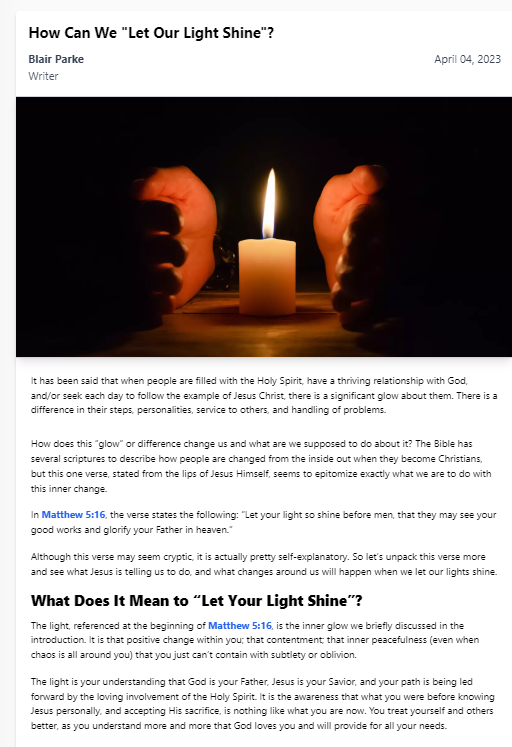
By being a source of inspiration and unwavering support, you bring light to others. Your actions guide and uplift people in difficult times, reminding them that goodness and hope still exist. Being a bearer of light means having inner strength, resilience, and upholding values like love, kindness, and empathy. It involves spreading positivity through words, actions, and interactions. In times of darkness, being a bearer of light brings hope, healing, and unity. You become a positive influence, offering guidance and support to those facing struggles.