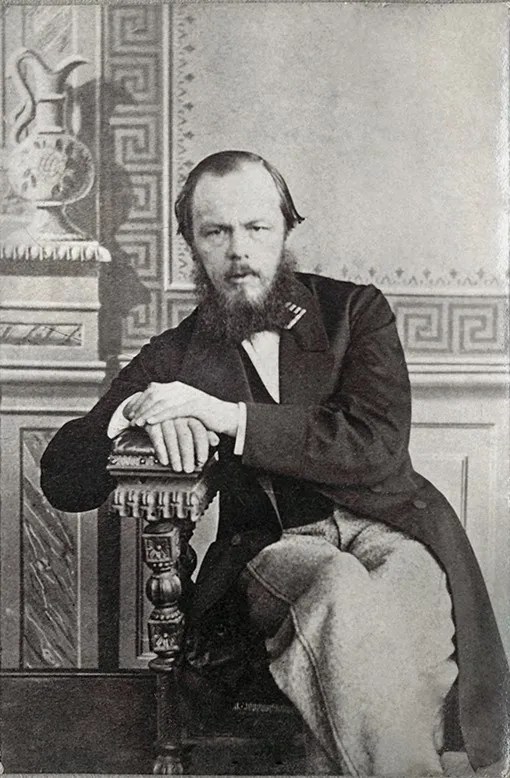
Tag: human condition

  • Dostoevsky’s Underground Man

    Dostoevsky’s Underground Man

    Excerpt:

    “I am a sick man… I am a spiteful man. I am an unattractive man. I think my liver is diseased. However, I know nothing about medicine and cannot say for certain. I am not even sure what is the matter with me. I am a ridiculous, absurd creature. But I am not as ridiculous as I am made out to be. I have a heart, and I have feelings, and I am not made of wood. I am a sick man, but I am not a foolish man. I am a sick man because I am a man, and I am a man because I am a sick man. I am a man who has been condemned to suffer, and I must suffer. I cannot help it. I must suffer, and I must be sick. I am a man who has been condemned to be sick, and I must be sick. I cannot help it. I must be sick, and I must suffer. I am a sick man, and I must suffer.”


    The protagonist of Notes from the Underground is a deeply spiteful and self-aware man who derives pleasure from causing unhappiness to others while feeling shame and guilt.

    He questions the nature of revenge, consciousness, and the absurdity of existence, ultimately assuming responsibility for his actions and feeling trapped by his own degradation.

    This provides insight into the complexities of his psyche.

    The Underground Man embodies the struggles of m man disconnected from society and its norms.

    His skepticism and inability to trust others and himself lead to self-loathing and masochistic tendencies, causing him to instigate conflict and subject himself to humiliation.

    Despite his desire for respect and admiration, his inability to interact with others in a healthy manner leads to disastrous attempts at relationships, further driving him deeper underground.

    The Underground Man’s contradictory nature, marked by intelligence and self-awareness but consumed by flaws and self-destructive tendencies, serves as a powerful reflection of the human condition.

    “Man is broad, too broad, indeed. I’d have him narrower.”

    – Fyodor Dostoevsky

    The Underground Man’s formative years as an orphan, which lacked normal affectionate connections, vividly illustrate the profound impact of his environment on his psyche.

    This background adds a poignant depth to his character, highlighting his sense of detachment and alienation from societal progress.

    Orphan: Archetype

    An archetype is a universally recognized symbol, theme, or pattern that recurs in literature, art, mythology, or culture, representing a fundamental human experience or characteristic.

    The orphan archetype is crucial for understanding the depth of the Underground Man’s character.

    It symbolizes profound solitude, alienation, and a lack of belonging, shaping the worldview and interactions of characters disconnected from traditional familial and societal structures.

    Juxtaposed against this portrayal of victimhood is the poignant revelation of the Underground Man’s role in perpetuating his own anguish.

    Pitfall Of Pride

    His pride and self-absorption hinder genuine human connections, while his pervasive skepticism and cynicism preclude belief in anything or anyone

    The narrative unfolds as a tragic chronicle of squandered potential, underscoring the profound tragedy of a man who could have ascended to greatness, only to succumb to self-inflicted suffering and self-loathing.

    Acknowledging this relentlessly, the Underground Man tragically resigns himself to needless, yet profoundly honest suffering, inflicting the misery upon himself as a testament to his internal struggles and complex inner turmoil.

    The Underground Man reveal a complex personality

    He is simultaneously fascinated and terrified by the concept of freedom.

    Despite being a rebel, he lacks a definitive cause.

    He dismisses societal norms, yet fails to propose an alternative. His nihilistic views contrast with his romantic tendencies.

    Despite his belief in life’s meaninglessness, he yearns for purpose and connection.

    The Underground Man exemplifies how even the most intelligent and self-aware individuals can become their own adversaries.

    Dostoevsky’s depiction of the Underground Man is regarded as one of the most impactful in literature..

    His character is a representation of the alienation and despair that can stem from residing in a modern, industrialized society.


    Primary source
    Other Related Resources:
    • Joseph Frank, Dostoevsky: The Seeds of Revolt, 1821-1849 (1976)
    • James P. Scanlan, Dostoevsky the Thinker (1970)
    • David Magarshack, Dostoevsky (1962)
    • George Steiner, Dostoevsky and the Demons (1973)
    • Robert Louis Jackson, Dostoevsky’s Underground Man in Russian Literature (1981)
    • Malcolm V. Jones, Dostoevsky and the Human Condition (1975)
  • Exploring the Mysterious Nature of Shadows

    Exploring the Mysterious Nature of Shadows

    Embarking on our intellectual journey, we must commence by unraveling the enigmatic question: What, indeed, is a shadow? At its core, a shadow manifests as the consequence of light encountering an opaque obstruction, resulting in the creation of a darker, often elongated silhouette on the opposing surface. Shadows materialize when an object intervenes between a source of light and a given surface, obstructing the direct light rays.

    The Scientific Underpinnings of Shadows

    Shadows, intriguingly, emanate from the intricate interplay of light and matter. When light, traveling in its straight trajectory, encounters an impediment, it succumbs to being halted in its tracks. In this state, it projects a shadow onto the surface lying beyond the obstructing object. The size and configuration of this shadow hinge upon several variables, including the angle of the light source, the spatial gap between the object and the surface, and the intrinsic form of the object itself.

    The significance of the light source’s angle in shaping shadows cannot be overstated. During moments when the light source skims the horizon, such as the dawning of a new day or the dusk of evening, shadows elongate, bestowing upon the scene dramatic and artistic allure.

    Shadows in the Natural World

    Shadows, however, are not confined solely to the realm of human artifice. In nature’s tapestry, shadows are ubiquitous and assume diverse functions. Consider, for instance, the trees on a sun-soaked day, offering refreshing patches of shade, a sanctuary from the blazing sun. These natural shadows also become instrumental in the lives of countless creatures, serving as places of refuge and camouflage.

    Shadows in Literature and Symbolism

    In the realm of literature and culture, shadows bear profound symbolic import. They can epitomize the enigmatic, the uncharted, or the concealed facets of human essence. In literature, shadows often feature as tools for enriching characters and narratives, endowing readers with deeper, more nuanced insights into the storyline.

    Shadows in the Scientific Pursuit

    Beyond their aesthetic and cultural resonance, shadows have emerged as pivotal elements in scientific exploration, fostering comprehension of the natural world.

    Physics

    Within the domain of physics, shadows have played a pivotal role in the scrutiny of wave phenomena, especially within the context of diffraction and interference. The intricate patterns woven by shadows and light unveil profound insights into the nature and behaviors of waves.

    Moreover, shadows contribute substantially to how we perceive our three-dimensional milieu. Our cognitive faculties, relying on shadows and their positioning, afford us the capacity to gauge depth and distance. This phenomenon, recognized as stereopsis, occurs when our eyes capture slightly disparate images due to their separation, thus enabling the construction of a mental three-dimensional map of our surroundings.

    Shadows in Popular Culture

    Shadows have not been remiss in infiltrating popular culture, manifesting in diverse forms as symbols of intrigue and mystery.

    The Philosophical Depth of Shadows

    Shadows, embodying dualities of absence and presence, have beguiled philosophers and thinkers across epochs. They have been invoked as metaphors for the concealed aspects of human existence, the schism between reality and illusion, and the fleeting nature of life itself.

    Plato’s Allegory of the Cave

    Plato, in his iconic Allegory of the Cave, ascribes a pivotal role to shadows. He narrates the tale of individuals held captive within a cave since birth, their sole comprehension of reality gleaned from shadows cast upon the cave wall by objects traversing before a fire. This allegory becomes a vehicle for the exploration of knowledge, illuminating the dichotomy between the world of appearances (shadows) and the world of actuality (the objects casting the shadows).

    Existentialist Philosophy

    Existentialist philosophers like Jean-Paul Sartre have contemplated shadows as symbols encapsulating the human condition. They contend that existence is frequently cloaked in uncertainty and ambiguity, obliging individuals to confront their own shadows—the obscure facets of their being—and make choices that configure their identity.

    Shadows in Contemporary Art

    Modern artists persist in their exploration of shadows as a medium for artistic expression. The manipulation of light and shadow has evolved into a sophisticated art form, with artists pushing the boundaries of the conceivable.

    Contemporary Shadow Installations

    Contemporary artists craft immersive installations, manipulating the viewer’s spatial perception and conception of reality. Employing innovative lighting techniques and materials, they metamorphose gallery spaces into captivating environments that challenge our grasp of shadows and their influence upon our sensory perceptions.

    The Unfolding Role of Shadows

    As technology progresses and our comprehension of light and shadow deepens, the role of shadows in our lives continues to evolve. From the rudimentary revelations of ancient thinkers to the cutting-edge visual marvels in today’s cinematic and gaming realms, shadows persist as fountains of fascination and wellsprings of inspiration.