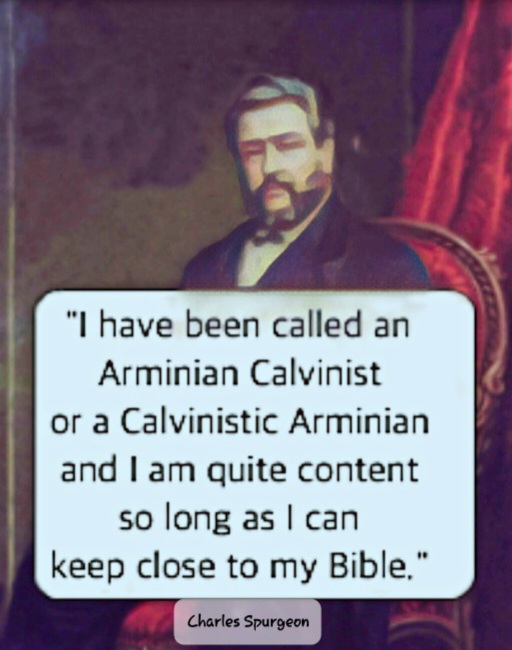
In his sermons and writings, Spurgeon often expressed his opposition to the argument of human free will, which he saw as a threat to the doctrine of grace and the glory of God.
“I do not come into this pulpit hoping that perhaps somebody will of his own free will return to Christ. My hope lies in another quarter. I hope that my Master will lay hold of some of them and say, ‘You are mine, and you shall be mine. I claim you for myself.’”
Charles Spurgeon
Here Are Some More Quotes; All Sourced And Available To View
“I believe that every particle of dust that dances in the sunbeam does not move an atom more or less than God wishes—that every particle of spray that dashes against the steamboat has its orbit as well as the sun in the heavens—that the chaff from the hand of the winnower is as much steered as the stars in their courses…The creeping of an aphid over the rosebud is as much fixed as the march of the devastating pestilence—the fall of leaves from a poplar is as fully ordained as the tumbling of an avalanche.”
This quote is from Spurgeon’s sermon titled “A Defense of Calvinism,” delivered on June 5, 1855.
“I do not come into this pulpit hoping that perhaps somebody will of his own free will return to Christ. My hope lies in another quarter. I hope that my Master will lay hold of some of them and say, ‘You are mine, and you shall be mine. I claim you for myself.’”
“A Defense of Calvinism,” delivered on June 5, 1855.
“The free will of man is a wretched idol, and deserves to be enthroned in hell.”
“Sovereign Grace and Man’s Responsibility,” delivered on October 9, 1859.
“Free will has carried many souls to hell, but never a soul to heaven.”
“Spiritual Resurrection,” delivered on August 24, 1856.
“If there is anything in the doctrine of the grace of God which commends it to us more than another, it is the sovereignty of it. If there is anything that is calculated to make men adore the grace of God, and to render them humble, it is the doctrine of the election of grace.”
“Election,” delivered on August 2, 1857.
Charles Spurgeon
SERMON #52: VOL. 1 (1855)
Free Will-A Slave
THIS is one of the great guns of the Arminians; mounted upon the top of their walls, and often discharged with terrible noise against the poor Christians called Calvinists!
SERMON #52: VOL. 1 (1855)
I intend to spike the gun this morning, or, rather, to turn it on the enemy—for it was never theirs. It was never cast at their foundry at all, but was intended to teach the very opposite doctrine to that which they assert.
Usually, when the text is taken, the divisions are—first that man has a will.
Secondly, that he is entirely free.
Thirdly, that men must make themselves willing to come to Christ, otherwise they will not be saved.
Now, we shall have no such divisions! But we will endeavor to take a calmer look at the text, and not because there happens to be the words, “will,” or, “will not,” in it conclude that it teaches the doctrine of free will.
It has already been proved beyond all controversy that free will is nonsense!
Freedom cannot belong to will any more than ponderability can belong to electricity. They are altogether different things.
Free agency we may believe in, but free will is simply ridiculous.
The will is well-known by all to be directed by understanding, to be moved by motives, be guided by other parts of the soul, and be a secondary thing. Philosophy and religion both discard at once the very thought of free will! And I will go as far as Martin Luther, in that strong assertion of his, where he says, “If any man does ascribe anything of salvation, even the very least to the free will of man, he knows nothing of divine grace, and he has not learnt Jesus Christ aright.”
It may seem a harsh sentiment, but he who in his soul believes that man does of his own free will turn to God, cannot have been taught of God—for that is one of the first principles taught us when God begins with us—that we have neither will nor power—but that He gives both—that He is “Alpha and Omega” in the salvation of men.
Free Will-A Slave
DELIVERED ON DECEMBER 02, 1855
To Read The Full Sermon: I created THIS NOTE.
“Free will carried many a soul
to hell, but never a soul to
heaven.”