Tag: metaphysics

  • Plato’s Cave

    Plato’s Cave

    Lesson Allegory of the Republic

    The Allegory of the Cave from Plato’s Republic is one of those perfect metaphors.

    I think about it’s truth over and over again, even more so in today’s societal atmosphere.

    The Cave depicts our tendency to mistake perception for truth.

    THE STORY

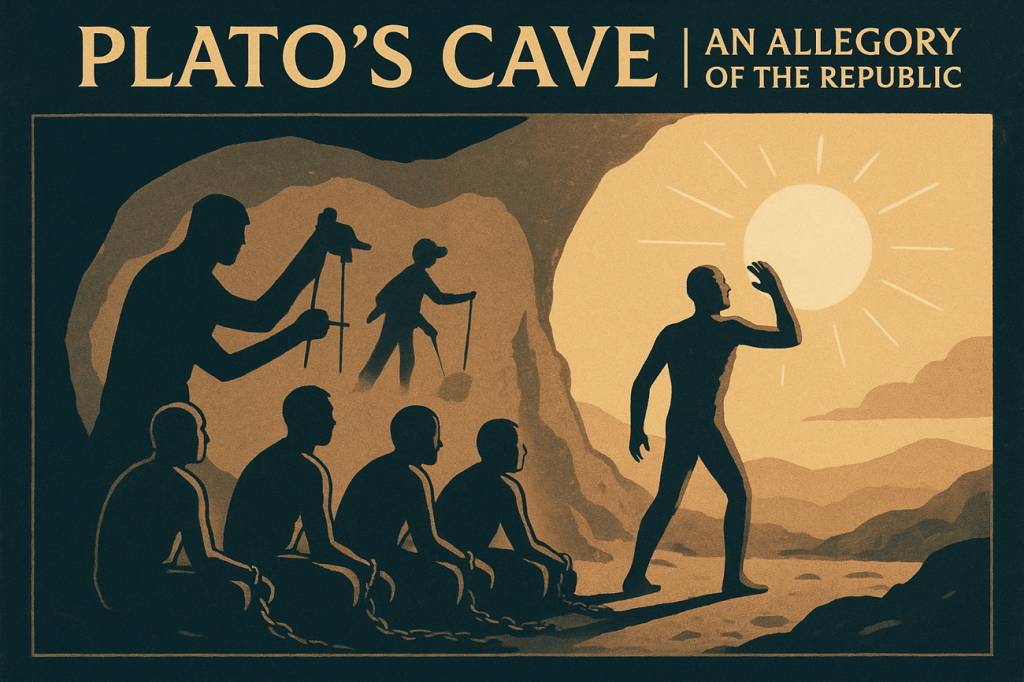
    In the story, these prisoners are chained inside a cave, they’re facing a wall where they watched these shadows dancing and moving.

    These shadows were cast by puppeteers, covertly hiding behind them.

    They were manipulating objects to create a shadow that gave the illusion of a fire’s flame.

    The prisoners named the shadows, studied them, and even built hierarchies around who interpreted the shadows most accuratel.

    To them, this was reality, and they took it very seriously.
    We’re not so different.

    Most people live confined within their own perceptual cave.

    We’re inevitably going to be shaped by our emotional connection to our belief systems, cultural roots, educational indoctrination, and familial conditioning.

    Too often we’re caught mistaking projection for truth.

    Yes, we’ve been conditioned, but this isn’t the problem per se. We can see past all the programs if we have a fully functioning brain.

    The resistance to confronting the possibility of a constructed reality is understandable.

    The idea that memories, identity, and perceptions might not be as solid as they seem can feel like an existential threat.

    Letting go of deeply held beliefs, even if they are illusions, requires confronting discomfort, uncertainty, and the fear of losing oneself.

    It’s easier to cling to familiarity, even if it’s flawed, than to face the unknown. But growth often begins where certainty ends.

    Freedom is admitting that you have been deluded and under an illusory story of your own making. Then you’ll break free.

    CONSIDER THE PUPPETEERS

    The puppeteers are those who shape the narratives we consume.

    They are the gatekeepers of knowledge and power:

    the donors, financiers, and elites who we likely will never know the true name of.

    By controlling the information and communication, they can and do shape what a society perceives as “real.

    Propaganda, entertainment, and social pressure all became tools of control through illusions.

    The Awakening

    Then comes the moment of liberation. One prisoner is freed.

    At first, he’s blinded by the fire’s light.

    His eyes, accustomed to shadows, can’t handle the truth so suddenly.

    But as they adjust, he begins to see clearly: the shadows were never real.

    They were only echoes of something greater.

    He’s led outside the cave into the sunlight, another painful adjustment.

    Yet when vision returns, he beholds the true world in all its beauty and realizes that the cave was only a prison of perception.

    Why Can’t They Turn Their Heads?

    CHAINS OF IGNORANCE

    Because they are chained. Not just physically, but mentally.

    The chains represent ignorance, the invisible grip of conformity and belief.

    Most never question the nature of their own bondage.

    To break these chains requires courage. It requires unlearning.

    It requires the willingness to endure the pain of seeing clearly for the first time.

    The Philosopher’s Task

    For Plato, this story points to his Theory of Forms.

    Theory of Forms is the idea that the physical world is but a shadow of a higher, more perfect reality.

    The philosopher’s role is to turn toward that higher truth, to step into the light and understand what truly is true.

    EXPECT STRUGGLE

    But enlightenment is not a comfortable process.

    When the freed prisoner returns to the cave to tell the others what he has seen, they mock him.

    They reject him. To them, his truth sounds like madness, because it threatens the foundation of their world.

    QUESTION YOUR OWN BELIEFS

    The Allegory of the Cave calls us to question our own shadows, to notice what we’ve been taught to believe and think: who benefits from those beliefs?

    It asks us to endure the blinding light of truth, no matter how uncomfortable, and to choose freedom over comfort.

    To break the chains of ignorance is to step into the light, not to escape the world, but to finally see it.
  • What is Time?

    From scientific models to ancient myths, humanity has long sought to unravel the mystery of time.

    THEORIES THROUGH HISTORY

    The concept of time has been a subject of intense interest for thinkers throughout history.

    Time as a Measure of Change:

    Aristotle argued that time is not a thing in itself, but rather a way of measuring change and motion

    Time, in essence, is a measure of change, and without change, there would be no way to perceive or measure the passage of time. 

    We experience time through changes in our surroundings like:

    • the sun rising and setting
    • the seasons changing
    • growing older

    Time & Motion

    Aristotle claimed that time is dependent on motion, meaning that time only exists in relation to and as a consequence of change occurring in the world. 

    Time is “Now”

    Aristotle considers the present moment, now, as a point of transition between the past and the future, a kind of “nothingness” that divides the two. 

    Richard Muller’s Theory

    Muller, a physicist at the University of California, Berkeley, posits that the expansion of the universe, starting with the Big Bang, constantly creates new space and, consequently, new time. 

    “Now” as the Leading Edge

    He argues that the “now” is the boundary, the shock front, or the leading edge of time, where new time is constantly being created. 

    Implications for Time Travel

    This theory has implications for our understanding of time travel, suggesting that the future is not predetermined, and that the “now” is the only reality that truly exists. 

    Eternalism vs. Presentism

    This concept contrasts with the block universe or eternalism, which suggests that all moments in time exist equally, and the presentism, which holds that only the present moment is real. 

    Einstein’s Relativity

    Muller’s theory builds on Einstein’s theory of general relativity, which views space and time as intertwined in a four-dimensional spacetime

    “Now” as a Relative Concept

    According to the American Museum of Natural History, time is relative, meaning the rate at which time passes depends on the observer’s frame of reference. 

    Time as a Dimension

    Some forms of eternalism view time as a dimension, similar to space, where different times are as real as different place.

    Time & Soul

    Aristotle and Time’s Dependence on the Soul: 

    • Aristotle argued that time, as a concept, depends on the soul’s ability to perceive and count it. 
    • He suggested that if there were no souls to “count” time, there might still be change, but not time itself. 
    • This view implies that time is not just countable but also essentially counted, meaning it requires a conscious entity to exist as a measurable concept. 

    Plato & the Soul’s Immortality

    • Plato’s theory of the soul, influenced by Socrates, considered the soul (psyche) as the essence of a person, an incorporeal and eternal entity. 
    • He believed the soul exists even after death and is able to think, and that as bodies die, the soul is continually reborn (metempsychosis) in subsequent bodies. 
    • Plato divided the soul into three parts: logistikon (reason), thymoeides (spirit), and epithymetikon (appetite or desire). 

    The World Soul (Anima Mundi)

    • Some philosophical traditions, like Neo-Platonism, explored the concept of a world soul (anima mundi) or soul of the world,suggesting an intrinsic connection between all living beings and that the world is animated by a soul. 
    • This concept posits that the world is animated by a soul much like the human body. 

    Quantum Theory of Soul

    This perspective suggests that the soul is not limited by space or time. 

    Some theories, like the Quantum Theory of Soul, propose that the soul, as defined as information stored in the quantum field, can extend over space and time, potentially transcending the limitations of the physical body. 

    Time as a Number

    Aristotle describes time as a “number of motion with respect to the before and after,” suggesting that we can count or measure time by counting instances of change. 

    Descartes on Time

    Time as a Foundation for Diversity and Motion

    Descartes’s mechanistic view of the world, where diversity and motion are fundamental, requires time for these phenomena to occur. 

    Time as Proof for God’s Existence

    Descartes uses the concept of “parts of time” in his Meditation III proof for God’s existence, emphasizing the role of time in our understanding of God’s attributes. 

    Time as a “Mode of Thought”

    In his Principles of Philosophy, Descartes also states that time is a mere attribute and “mode of thought”. 

    Time & Duration

    Descartes distinguishes between time as the measure of motion and duration as an attribute of things. 

    Time & the Span of Life

    Descartes sees no differentiation between the span of a life and the span of time itself. 

    Descartes’s Method

    Descartes’s method, which he later formulated in Discourse on Method (1637) and Rules for the Direction of the Mind (written by 1628 but not published until 1701), consists of four rules:

    1. Accept nothing as true that is not self-evident
    2. Divide problems into their simplest parts
    3. Solve problems by proceeding from … 

    Descartes’s dualism

    Descartes introduced the concept of dualism, which argued that reality or existence is divided into two parts.

    He argued that humanity could be divided into two parts as well: the mind and the body.

    TIME AS MOMENTS

    Time as a Series of Moments

    This perspective suggests that time can be broken down into a sequence of unique, distinct moments, each representing a specific point in the timeline. 

    Moment as a Point in Time

    A moment, in this context, is an instantaneous point, a “now,” rather than a duration. 

    Philosophical and Scientific Perspectives

    Philosophers and scientists debate whether time is a real, objective thing or a human way of conceptualizing changing events. Some theories, like the

    Static Theory of Time

    suggest that time is like space, with no passage.

    Dynamic Theory of Time

    view time as a real phenomenon. 

    Kairos vs Chronos

    Kairos refers to an opportune or significant moment, while chronos refers to a specific amount of time, such as a day or an hour. 

    Examples of “Moments in Time”

    Think of memorable events, like a wedding, a birth, or a historical turning point. 

    These are all “moments in time” that stand out as distinct points in the flow of time. 

    Time as Absolute

    Newtonian Time

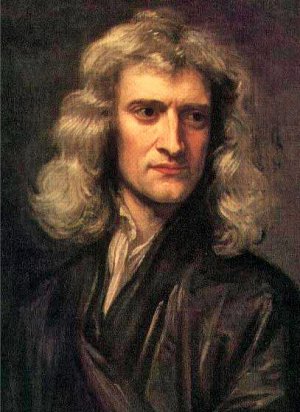
    According to its most famous proponent, Sir Isaac Newton, for example, absolute time (which is also sometimes known as “Newtonian time”) exists independently of any perceiver, progresses at a consistent pace throughout the universe, is measurable but imperceptible, and can only be truly understood mathematically.

    For Newton, absolute time and space were independent and separate aspects of objective reality, and not dependent on physical events or on each other.

    Time as a Product of the Mind

    Whitehead | Heidegger—Time as the Form of Becoming

    Whitehead and Heidegger described time as the process of things changing and becoming.

    They believed that time is essential for things to happen and transform.

    Theory of Relativity

    SPACETIME

    According to modern science, particularly the theories of relativity and quantum mechanics, time is considered a part of a larger concept called spacetime.

    Spacetime includes all the events in the past, present, and future, and is interconnected with space.

    Time as the Fourth Dimension

    In physics, time is often considered the fourth dimension, alongside the three spatial dimensions, used to describe events in space. 

  • Light Has Power

    Light Has Power


    Unveiling Hidden Depths

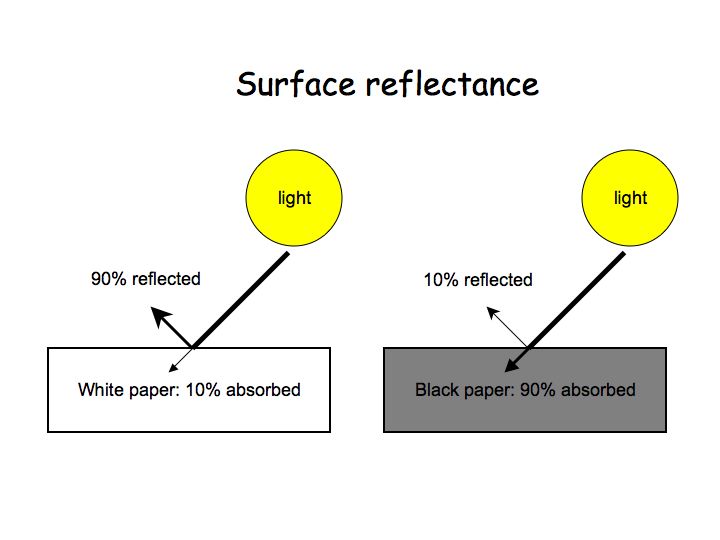
    Just as the obstruction of light casts shadows, material truths only disclose a fraction of the deeper meaning and purpose hidden within spiritual reality.

    As shadows form in the absence of light, the spiritual realm illuminates the genuine essence of our existence when revealed.

    By seeking spiritual enlightenment, we can explore our soul’s profound nature and comprehend our true purpose in life.


    Contrast Provides Clarity

    Examining the interplay between illuminated and unilluminated areas of an object offers valuable insight into its shape and form.

    This principle mirrors how spiritual enlightenment unveils our true being by dispelling ignorance and confusion.

    As light and darkness intertwine, spiritual understanding brings clarity and purpose to our existence.


    Material Truth

    A Shadow of Spiritual Reality

    Material truth can be likened to a shadow cast by the spiritual reality that underpins it.

    As the sun casts a tree’s shadow, spiritual reality is the unseen force that imbues our lives with meaning.

    Recognizing this interconnection between light and shadow in our spiritual journey fosters a profound understanding of our existence.

    We must delve into the spiritual realm to uncover the genuine significance of our lives, just as we cannot fully comprehend a tree by merely observing its shadow.


    The Light of Spiritual Enlightenment

    By embracing the contrast between light and dark in our spiritual lives, we appreciate life’s complexity and strengthen our connection with the divine.

    Acknowledging the relationship between light and shadow paves the way to spiritual enlightenment, unveiling the profound truths that shape our existence.

    As light exposes the true nature of objects, spiritual enlightenment reveals our essence, guiding us towards a more significant understanding of ourselves and the world around us.

    RESEARCH

    21.1 Planck and Quantum Nature of Light – Physics | OpenStax

    This theory, which created the branch of physics called quantum mechanics, speculated that the energy radiated by the blackbody could exist only in specific numerical, or quantum, states.

    The Relationship Between Quantum Physics and Spirituality

    The intersection of quantum physics and spirituality has become a subject of profound interest in both scientific and philosophical circles. While quantum physics is a branch of science that explores the fundamental nature of reality at the smallest scales, spirituality seeks to understand the deeper meaning of existence, consciousness, and interconnectedness….

    Quantum Mechanics and Relativity’s Impact on Metaphysical Matter

    Quantum mechanics and Einstein’s theory of relativity didn’t just change science; they forced a deep rethinking of metaphysical categories like substance, causality, determinism, and even the nature of space and time.

     Quantum Theory of Soul – ResearchGate

    This quantum theory supports monism, viewing the soul, spiritual heart, mind, energy, and matter as aspects of the quantum field, and endorses panpsychism, suggesting all things possess a soul.