Tag: Arminianism

  • Biblical Terminology

    Biblical Terminology

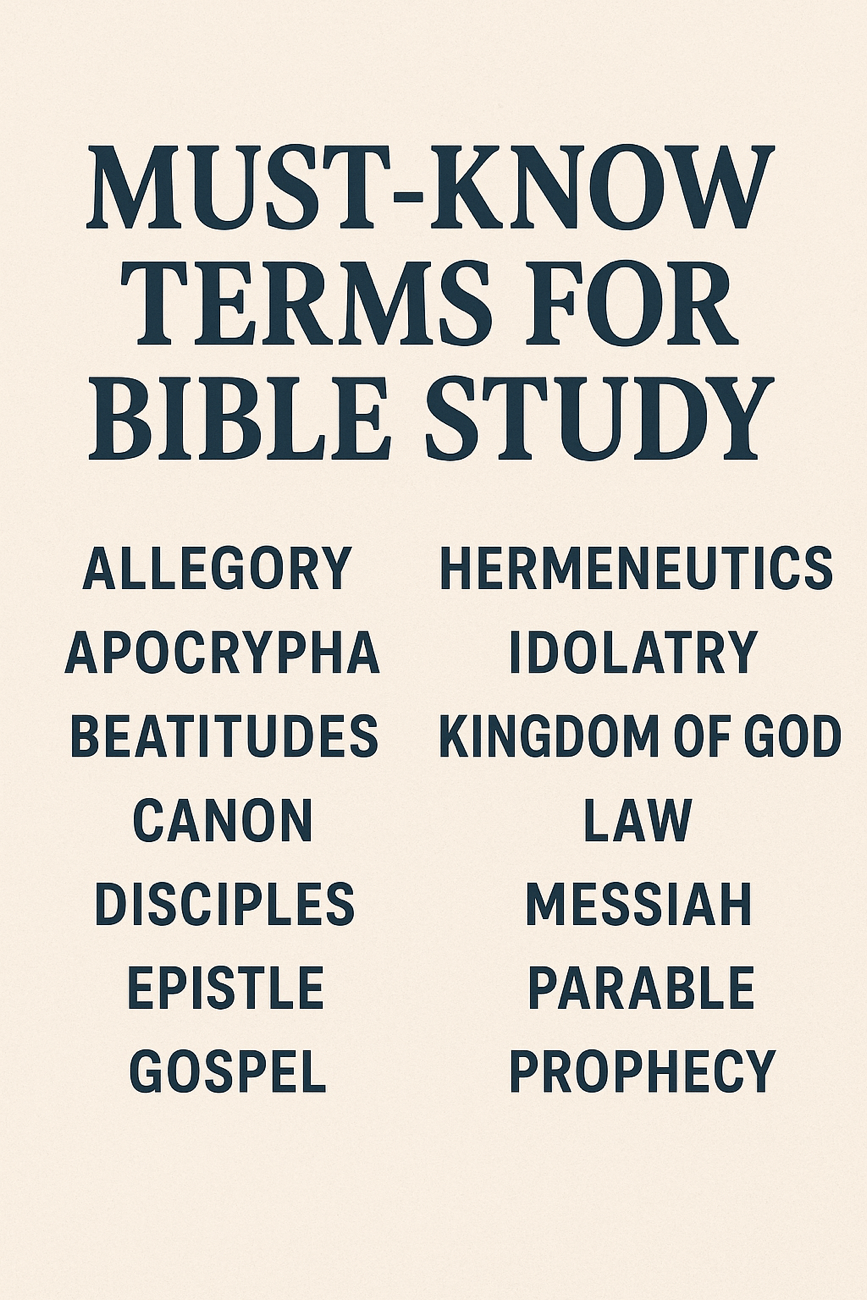
    Allegory

    Allegory is a literary and artistic device in which characters, events, and details within a narrative symbolize broader concepts and ideas, often conveying moral, social, or political messages. The term derives from the Greek word “allegoria,” meaning “speaking otherwise,” which highlights its function of expressing deeper meanings beyond the literal interpretation. Allegories can be found across various mediums, including literature, visual arts, and film, and they often involve a narrative that operates on two levels: the surface story and the underlying message.

    Classic examples include George Orwell’s “Animal Farm,” which critiques totalitarianism through the story of farm animals, and John Bunyan’s “The Pilgrim’s Progress,” which represents the spiritual journey of a Christian believer.

    Allegory has been a significant tool throughout history, allowing creators to address complex themes in a more accessible manner, as noted in sources like Britannica and Merriam-Webster.

    Apocrypha

    A collection of ancient texts that are not considered canonical by certain religious traditions, often included in some versions of the Bible.

    Beatitudes

    A series of blessings pronounced by Jesus in the Sermon on the Mount (Matthew 5:3-12), highlighting the values of the Kingdom of God.

    Canon

    The official list of books that are considered authoritative scripture by a particular religious community.

    Disciples

    Followers of Jesus Christ, particularly the twelve apostles who were chosen to spread his teachings.

    Epistle

    A letter, often written by apostles, that addresses specific issues or teachings within early Christian communities (e.g., the letters of Paul).

    Gospel

    The “good news” of Jesus Christ, specifically the accounts of his life, death, and resurrection found in the New Testament (Matthew, Mark, Luke, and John).

    Hermeneutics

    The study of interpretation, especially of biblical texts, focusing on understanding the meaning and application of scripture.

    Idolatry

    The worship of idols or false gods, which is condemned throughout the Bible.

    Kingdom of God

    A central theme in Jesus’ teachings, referring to God’s reign and authority, both in the present and in the future.

    Law

    Refers to the commandments and regulations given by God, particularly those found in the Torah (the first five books of the Old Testament).

    Messiah

    The anointed one, a savior or liberator expected by the Jewish people, fulfilled in the New Testament by Jesus Christ.

    Parable

    A simple story used to illustrate a moral or spiritual lesson, often told by Jesus.

    Prophecy

    A message from God, often delivered by a prophet, that foretells future events or conveys divine truth.

    Redemption

    The act of being saved from sin and its consequences, often associated with the sacrifice of Jesus.

    Righteousness

    The quality of being morally right or just, often associated with living in accordance with God’s will.

    Sacrament

    A religious rite recognized as of particular importance and significance, such as baptism and communion.

    Sin

    An act that goes against God’s will or law, often understood as a separation from God.

    Testament

    Refers to the two main divisions of the Bible: the Old Testament (Hebrew Scriptures) and the New Testament (Christian Scriptures).

    Transfiguration

    The event in which Jesus is transformed and revealed in divine glory to three of his disciples (Matthew 17:1-9).

    Worship

    The term “worship” originates from the Old English word “weorþscipe,” which combines “weorþ,” meaning worth or value, and “scipe,” indicating a condition or quality.

    Thus, worship fundamentally conveys the idea of attributing worth to a deity or divine being.

    In various religious contexts, worship encompasses acts of reverence, adoration, and devotion directed towards God or gods, often involving rituals, prayers, and communal gatherings. It serves as a means for individuals and communities to express their beliefs, seek spiritual connection, and engage in transformative experiences.

    True worship is not merely about fulfilling personal or communal needs but is centered on honoring and glorifying God, reflecting a commitment to divine values and principles.


    Understanding these terms can greatly enhance your study of the Bible and provide a clearer framework for interpreting its messages and teachings.

    MORE WORDS YOU SHOULD KNOW:

    Theology

    … the study of God.

    Apologetics

    … defense of Faith.

    Exegesis

    … critical interpretation of scripture.


    Substitutionary Atonement

    Christ died as a substitute for sinners, bearing the punishment that they deserved.

    Eschatology

    Eschatology is the study of the end times, focusing on events like

    • the Second Coming of Christ
    • the final judgment
    • the ultimate destiny of souls.

    It encompasses what happens to individuals after death and the fate of the entire universe.

    Key eschatological concepts include:

    • the resurrection of the dead
    • the millennium
    • the establishment of God’s kingdom. 

    Incarnation

    The Incarnation is the doctrine that the Son of God assumed human nature and became man in the person of Jesus Christ. This belief is central to Christianity, affirming that Jesus is both fully divine and fully human. The theological implications of the Incarnation include the idea that through Jesus, God entered human history, experiencing human life and providing a means of salvation.

    Grace

    Grace is the unmerited favor and love of God towards humanity. It is central to Christian soteriology (the study of salvation), emphasizing that salvation is a gift from God, not earned by human effort. Different traditions emphasize different aspects of grace:

    Justification

    Justification is the act by which God declares a sinner to be righteous on the basis of faith in Jesus Christ. In Protestant theology, this is often emphasized

    REFORMED THEOLOGY

    Reformed theology affirms the five solas with all their implications; recognizes the centrality of the covenant in God’s saving purposes; and is expressed in a historic and public confession of faith.


    CALVINISM

    Calvinism, also known as Reformed theology or the Reformed tradition: is a major branch of Protestant Christianity that originated with the teachings of the French theologian John Calvin in the 16th century.

    It is named after Calvin because he played a significant role in shaping its doctrines and organizing its Ecclesiastical structure.

    Calvinism emphasizes the sovereignty of God in all aspects of life, including salvation, divine providence, and the governance of the world. It is characterized by its adherence to the “Five Points of Calvinism,” which are often summarized using the acronym TULIP.

    Total Depravity

    This doctrine teaches that due to the fall of Adam and Eve, all human beings are born in a state of spiritual depravity and are incapable of choosing God or doing good on their own. They are entirely dependent on God’s grace for salvation.

    Unconditional Election

    According to this belief, God, out of His sovereign will and without any consideration of human merit or choice, predestines certain individuals to be saved. This election is not based on anything that humans do but solely on God’s divine purpose.

    Limited atonement

    This doctrine states that Christ’s atoning sacrifice on the cross was specifically intended for the salvation of the elect, those whom God has chosen for salvation. It does not extend to all people universally.

    Irresistible grace

    Also known as “effectual calling” or “regenerating grace,” this doctrine asserts that when God chooses to save someone, His grace is irresistible and will unfailingly bring that person to salvation. Those who are called by God cannot ultimately resist His saving work.

    Perseverance of the saints

    This belief affirms that those who are truly saved by God’s grace will persevere in faith and holiness until the end. Genuine believers cannot lose their salvation but will continue to follow Christ throughout their lives.

    Calvinism

    Calvinism is a theological system and branch of Protestant Christianity that originated with the teachings of John Calvin, a 16th-century French reformer. It emphasizes the sovereignty of God in all aspects of salvation, particularly through the doctrine of predestination, which asserts that God has already chosen who will be saved and who will not. This belief is often summarized by the Five Points of Calvinism, which include Total Depravity, Unconditional Election, Limited Atonement, Irresistible Grace, and Perseverance of the Saints. Calvinism stands in contrast to Arminianism, which emphasizes free will and the ability of individuals to choose salvation. The term itself derives from Calvin's last name, and the movement has significantly influenced various Protestant denominations, particularly in Reformed and Presbyterian traditions. It gained prominence during the Reformation and has continued to shape theological discussions and debates within Christianity today, as noted in various sources like Britannica and Clickmill.

    Arminianism

    Arminianism is a theological system named after the Dutch theologian Jacob Arminius (1560-1609), who proposed a framework of Christian belief that emphasizes free will and God’s universal grace. This doctrine arose as a response to the deterministic views of Calvinism, particularly regarding predestination and salvation. Arminianism asserts that while God offers salvation to all, individuals have the free will to accept or reject this offer, which stands in contrast to the Calvinist belief in irresistible grace. Central to Arminian theology are five key points: the denial of original sin as an insurmountable barrier, justification by faith, conditional predestination, the resistibility of grace, and the possibility of falling from grace.

    The theological debate between Arminianism and Calvinism was notably formalized during the Synod of Dort (1618-1619), where Arminian views were challenged but continued to influence various Protestant traditions, especially Methodism and the broader Evangelical movement (Christian History Institute, Wellspring MS Church).

    Free Will

    The term “free will” refers to the philosophical concept that individuals have the capacity to make choices that are not predetermined by prior causes or divine intervention.

    Etymologically, the phrase combines “free,” deriving from the Old English freo, meaning “not in bondage,” and “will,” from the Old English willan, meaning “to wish or desire.”

    This concept has been a subject of intense debate in philosophy, psychology, and neuroscience, particularly concerning whether human actions are determined by biological processes or if individuals can act independently of such influences.

    Some philosophers advocate for a “compatibilist” view, suggesting that free will can coexist with determinism, arguing that the essence of free will lies in the ability to act according to one’s motivations and desires, even if those are influenced by prior causes (psyche.co).

    The implications of free will are profound, affecting moral responsibility and ethical considerations in society, as individuals are often held accountable for their actions based on the assumption that they can choose freely (scientificamerican.com).

    Election

    The etymology of “election” comes from the Latin word “electio,” meaning “choice” or “selection,” which itself derives from the verb “eligere,” meaning “to choose.”

    In a biblical context, election is seen as an expression of God’s sovereignty, where He selects individuals based on His divine will rather than their actions or merits.

    This concept is discussed in various theological writings, emphasizing that God’s choice is unconditional and not based on foreseen faith or works (as noted in sources like gotquestions.org).

    The implications of this doctrine often lead to discussions about grace, justice, and the nature of God’s love, as seen in the debates surrounding unconditional election and its portrayal of God in relation to humanity (monergism.com).

    Atonement

    The term “atonement” refers to the act of making amends or reparation for a wrongdoing or injury, often implying a reconciliation between two parties. Etymologically, the word is derived from the Middle English phrase “at one,” which signifies being in harmony or agreement. This concept has significant theological implications, particularly in Christianity, where atonement is associated with the reconciliation between God and humanity through the life, suffering, and death of Jesus Christ. The doctrine of atonement encompasses various interpretations, such as the satisfaction view and substitutionary atonement, which explore how this reconciliation is achieved (Merriam-Webster, Cambridge Dictionary, Dictionary.com).

    Grace

    The term “grace” has a rich etymological background, originating from the Latin word “gratia,” which means favor, goodwill, or kindness.

    In contemporary usage, grace encompasses various meanings, including elegance or beauty of form, manner, motion, or action, as well as a disposition to kindness and compassion.

    In religious contexts, particularly within Christianity, grace refers to the unmerited favor of God towards humanity, often linked to salvation and divine assistance.

    This theological concept emphasizes that grace is a gift from God, as highlighted in Ephesians 2:8, which states, “For by grace you have been saved through faith.”

    The multifaceted nature of grace can be seen in phrases like “fall from grace,” which denotes a loss of status or favor, and “saving grace,” which refers to a redeeming quality that mitigates a negative situation.

    Perseverance of the Saints

    the belief that salvation is secure and cannot be lost, a concept often referred to as “eternal security.”

    The etymology of the word “perseverance” comes from the Latin “perseverare,” meaning to persist or continue steadfastly.

    This idea is rooted in the understanding of predestination, where God’s grace enables the faithful to endure in their beliefs despite challenges

    John 10:28-29: “I give them eternal life, and they will never perish, and no one will snatch them out of my hand. My Father, who has given them to me, is greater than all, and no one is able to snatch them out of the Father’s hand.”

    ECCLESIAL / ECCLESIOLOGY 

    ecclesiology is the study of the Church, the origins of Christianity, its relationship to Jesus, its role in salvation, its polity, its discipline, its eschatology, and its leadership.

  • DIMENSIONS Of SPIRIT: Calvinism VS Arminianism

    Dimensions: Length, width & height of something in space… (As well as Time.)

    • Length: The extent of an object from end to end along a line.
    • Width: The extent of an object from side to side.
    • Height: The vertical extent of an object from bottom to top.

    SPIRITUAL DIMENSIONS

    The Spirit dimension is a realm that provides energy, consciousness, and goes beyond earthly matter. The heavenly dimension offers a perspective that goes beyond earthly limitations and sees reality from an eternal, all-knowing viewpoint.

    Spiritual Length

    … represents God’s eternal nature.

    There is no beginning or end with God; He stretches infinitely in both directions. Length points to God’s everlasting love that knows no bounds. The depth and profundity of one’s connection to higher spiritual dimensions is characterized by expanded awareness, wisdom, and the direct realization of one’s identity as the deathless Self. The longer one’s spirit grows, the closer one comes to the goal of perfect self-realization and unity with the Divine.

    Spiritual Width

    … signifies God’s all-encompassing presence.

    God is wider than we can comprehend, surrounding us on all sides. Width symbolizes God’s omnipresence, indicating that he is present everywhere at once. The evolution of consciousness goes from a narrow identification with form to the expansive, inclusive awareness of nondual truth and unbounded presence beyond all limitations.

    Spiritual Height

    …reminds us of God’s lofty nature, high above all creation.

    Height points to God’s holiness and the great heights we can rise to in Christ. The height of spirit soars above all earthly things. Height refers to exaltation, supremacy, and transcendence.

    Perspective Determines Belief

    Perspective: The lens through which we view the world and our place within it.

    When it comes to Calvinism and Arminianism, there are two main dimensions of perspective as defined above:

    The Divine Dimension Heavenly Dimension (Bird’s-eye/The Big Picture):

    (Ethereal/ Heavenly)

    This is God’s perspective from outside of time and space. From this heavenly viewpoint, God sees all of history and human choices from start to finish. Salvation looks like a divinely determined election since God chooses who will be saved. This perspective prioritizes God’s sovereignty over all things.

    The Earthly Dimension (Human Perspective, Not Bird’s-eye View):

    (Human/ Worldly)

    From our limited earthly perspective, we believe humans have the freedom to make choices and respond to grace offered for salvation. This perspective emphasizes the importance of human decision-making over God’s Sovereign Destiny.

    God’s wisdom is perfect, but human wisdom is limited: We must acknowledge that “God’s ways are higher than our ways” (Isaiah 55:9).

    LENGTH

    The length of God refers to his eternal and everlasting nature. Scripture speaks of God’s eternity in passages like Psalm 90:2: “Before the mountains were born or you brought forth the whole world, from everlasting to everlasting you are God.”

    LENGTH: CALVINIST PERSPECTIVE

    God’s length – his duration without beginning or end – points to his transcendence of time and space. He is the Eternal One, unbounded by linear progression or dimensions.

    So the “length” of God – points to eternity, immutability, independence, perfection & self-sufficiency. God’s “long” duration signifies his spanless and unconditioned being, utterly free from the constraints of space and time that bind all creatures; God’s length reflects the infinite “brevity” of his changeless and complete eternity. He “is” – without succession, progress or persistence of being.

    St. Augustine spoke of God’s eternity as an “eternal present” where past, present and future exist simultaneously. This “length” without succession reflects God’s timeless and immutable nature. For Augustine, creation “emerges” from God’s eternal Now into linear time.

    LENGTH: ARMINIAN PERSPECTIVE

    Arminians argue that God’s predestination is “conditional;” it depends on whether individuals choose to have faith and persevere in that faith. Length then results from a synergistic partnership between divine grace and human volition, with individuals playing an active role in determining the extent of their own Length,

    WHY ARMIAN PERSPECTIVE IS FLAWED

    Misunderstanding God’s sovereignty: Human choices do not influence God’s plans. He is the ultimate authority, ordaining all things according to His will without adaptation. God is self-sufficient and doesn’t depend on creation for fulfillment. God’s independence is weakened if human actions influence Him. However, the Eternal One is completely self-existent and independent, not dependent on anything.

    WIDTH

     The comprehensiveness, vastness and all-encompassing nature of God… 

    WIDTH CALVINIST PERSPECTIVE

    The width of God points to truths about his omnipresence and omniscience – his infinity and immensity that encompasses all things. Everywhere we turn, we exist within the breadth of his being and knowledge. This divine width both secures and upholds creation, enabling God to be fully present in each person yet embracing all as one. The width of God is the infinite spatiality of the spiritual realm, revealing a perfect balance of uniqueness and unity in the divine Nature.

    WIDTH ARMINIAN PERSPECTIVE

    God’s width encompasses His omnipresence, omniscience, and omni benevolence. This showcases the perfect balance between His sovereignty and love for human freedom. He is fully present with each person in a unique way while also embracing everyone equally. His infinite knowledge includes all possibilities, respecting the choices of free beings. God’s omnipresence sustains human freedom and guides all for the greater good. It allows room for choice within His governance. This breadth of God’s being fosters a diverse and loving communion. From an Arminian perspective, God’s width exemplifies the harmony between divine unity and human diversity through His all-encompassing grace.

    WHY I BELIEVE THE ARMINIAN VIEW OF WIDTH IS FLAWED

    The Arminian perspective on the breadth of God’s attributes may be deemed insufficient in fully capturing the essence of qualities such as His absolute sovereignty, independence, and impeccable omniscience.

    God’s will doesn’t bend to human choices. He exercises total control, including over “free will.” Contrary to the idea God’s foreknowledge depends on creatures, Scripture says God works all for His counsel. The notion God needs creation distorts His self-sufficiency.

    Seeking to grasp divine mysteries, Calvinism strives to align with God as revealed – infinitely wise, sovereign over all, yet loving His creation according to eternal purposes formed within His perfect being.

    HEIGHT

    Referring to God’s altitude and elevation…

    ‘HEIGHT’ CALVINIST PERSPECTIVE

    God’s lofty place expresses His complete sovereignty ruling all with uncontested authority and might. The higher God is “lifted up,” the more His glory fills His church – arousing our worship as beings made for honoring the matchless Creator. The height of God magnifies the majesty and worth of His holy Name.

    HEIGHT ARMINIAN PERSPECTIVE

    Height points to the potential within all humans to rise up spiritually through Christ. The focus is on God’s planned desire of grace to all humanity and our sole responsibility to accept it through faith. Salvation depends on our response to God’s wide offer and our exertion to climb the heights possible in Christ.

    WHY THE ARMINIAN PERSPECTIVE OF HEIGHT IS FLAWED:

    While Arminian theology highlights significant truths about God’s nearness and compassion, it ultimately falls short of doing full justice to the heavenly height and absolute sovereignty of the Most High as Scripture reveals.

    That God somehow “adapts” to human choice or exists for creaturely communion diminishes His qualitative difference from and independence of creation. It implies the Exalted One needs or benefits from what is below, blurring the Creator-creature distinction.

    The notion free human decisions lie outside God’s eternal decree and perfect foresight fails to honor God’s complete rule from on high – that His plans are sovereignly fulfilled according to the counsel of His will.

    Though Arminianism rightly seeks to preserve human responsibility, it does so by lowering God from His rightful throne, reducing His attributes of wisdom, might, and glory.

    A truly biblical view of the height of God must above all magnify the transcendent majesty and worth of His majestic Name, invoking our worshipful submission as beings made to glorify our great Creator above all else!

    TIME

    Time, as we perceive it, is a linear concept on Earth, but there is a deeper truth of an eternal now where all moments converge. This aligns with theories of multiple dimensions and suggests that our spirit is connected to a timeless divine essence. As consciousness expands, we aim to reach a perfect union with God’s timeless now. In this sacred realm, all possibilities coexist harmoniously, and through Christ, we can experience a taste of eternity.

    GOD’S TIMELESSNESS DISPROVES FREE-WILL

    The concept of timelessness and higher dimensions suggests that free will is an illusion. From a transcendent viewpoint, all events, including choices, are already fixed. Temporality exists only within creation, and the perception of free will is contingent upon a wider perspective. If higher dimensions exist, human freedom can only be relative and apparent, not ultimately real.

    God exists beyond the spatial dimensions He created, transcending all dimensions from His exalted state.

    “Where were you when I laid the foundation of the earth? Tell Me, if you have understanding, Who set its measurements? Since you know. Or who stretched the measuring line over it?
    Job 38:5 
    

    Calvinists assert that Scripture depicts God as sovereignly electing individuals for salvation “according to the good pleasure of His will” (Ephesians 1:4-5). From this perspective, human choice is subordinate to God’s choice. He chooses whom He wills based on His eternal purposes in Christ (2 Timothy 1:9).

    Arminians stress that God “provides the means of salvation, but [humans] must freely choose to receive it”. They argue that if humans lack free will, we become “programmed automatons, not free moral agents” .

    SCRIPTURES:

    By grace you have been saved through faith; this is not of yourselves, it is the gift of God; not a result of works, so that no one may boast. We are His workmanship, created in Christ Jesus for good works, which God prepared beforehand so that we would walk in them. Ephesians 2:8-10

    "He chose us in Him before the foundation of the world, that we would be holy and blameless before Him. In love He predestined us to adoption as sons and daughters through Jesus Christ to Himself, according to the good pleasure of His will..."
    Ephesians 1:4-5
    
    "He says to Moses, “I will have mercy on whomever I have mercy, and I will show compassion to whomever I show compassion.” [16] So then, it does not depend on the person who wants it nor the one who runs, but on God who has mercy."
    Romans 9:15-16 

    THESE THINGS ARE FOR SURE:

    • God is sovereign, and all things work to fulfill His purpose.
    • God grants us (on earth) wisdom and insight through His gifts, freely given according to His purpose. (James 1:5).
    • We cannot earn these gifts through our own seeking, but instead, we receive them because God in His sovereignty has chosen to bestow them upon us (John 15:16).
    • God opens the eyes of the blind, making those who were once dead in sin come alive to truth (2 Corinthians 4:6).
    • Our longing for wisdom is itself a sign of His grace, a tender mercy that we in no way deserve (Ephesians 2:8-9).
    • Our hope rests not in our own abilities, but solely on God’s free choice to show compassion and give understanding to those He has elected from eternity (Romans 9:11, Ephesians 1:4-5).
    • All glory, honor, and praise belong to God, now and forevermore (Romans 11:36).
    • All we can do is surrender to His will and purposes, seeking Him with a humble and grateful heart (Jeremiah 29:13).
    • For apart from Him, we can do nothing (John 15:5).

    While there may be mysteries that we cannot fully comprehend, we should humbly trust in God’s purpose and provision for His people.

  • The Validity Of Calvinism & Arminianism

    The Validity Of Calvinism & Arminianism

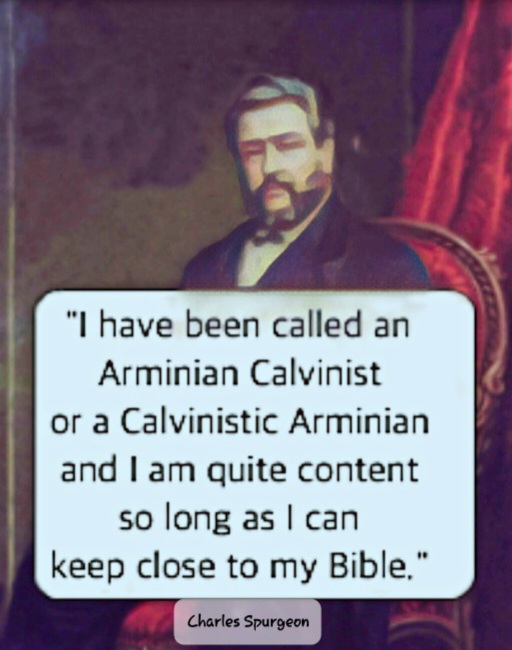
    I contend that they are both inherently valid, in a manner of speaking.

    The Arminian belief is founded on the human perspective, shaped by their own lived experiences, while Calvinism adheres to a bird’s-eye viewpoint, a celestial outlook based on what lies beyond this mortal existence.
    Arminianism holds scripture close to their heart, as do Calvinists, both with their vision on the Scriptural Revelations of God’s Word but from different angles.
    One’s perception varies according to the vantage point.
    The diversity of perspectives regarding the concept of Heavenly matters will always give rise to conflicting interpretations, but they aren’t always conflicting when analyzed deeper. (Sometimes they are.)
    Matter can never fully grasp the Spiritual from it’s material form, as we are made of matter.

    This war between Calvinism and Arminianism can be likened to observing a building from multiple vantage points, such as inside and outside or from an aerial view versus a ground-level perspective.
    While each observer may view the same physical structure, their respective viewpoints may lead to distinctly different understandings of the building description of the building.
    Then we fight over perspective because we lack enough perspective on both sides; to understand that we don’t see from the same position.

    It’s sad many won’t recognize that despite these differences, many of our interpretations are grounded in the same underlying Structure, God’s Word.

    The problem lies in the tendency to condemn those with differing perspectives as heretical: it’s a sign that one lacks Grace.

    With a Spirit of Grace and understanding, we will give Grace to others who may be in error, and correct them only to build, not tear down.