
Tag: symbolism

  • Manly P. Hall

    Manly P. Hall

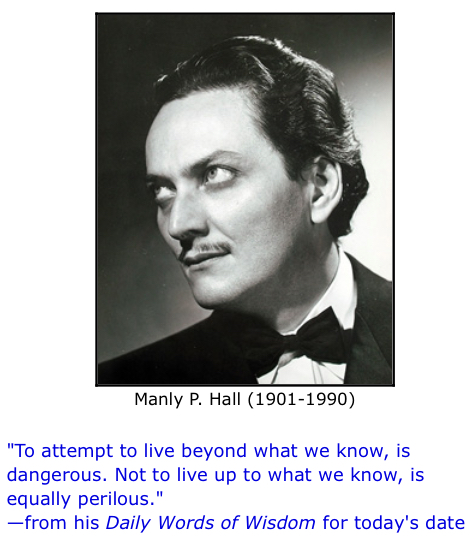
    Manly P. Hall (1901-1990) was a renowned authority on comparative religion and ancient philosophy, known for his extensive library and public lectures that reached millions.

    Photo of Manly Palmer Hall

    Canadian writer and mystic (1901–1990)

    Born18 March 1901, Peterborough Ontario
    Died29 August 1990, Los Angeles

    Hall authored over 200 books and founded the Philosophical Research Society in 1934, focusing on the dissemination of knowledge in philosophy, comparative religion, and psychology.

    Throughout his 70-year career, Hall delivered thousands of lectures worldwide, emphasizing the importance of philosophy in improving individual thought and living.

    Esoteric Wisdom

    Hall dedicated his life to uncoveringo and sharing the hidden knowledge passed down through secret societies and mystery schools.
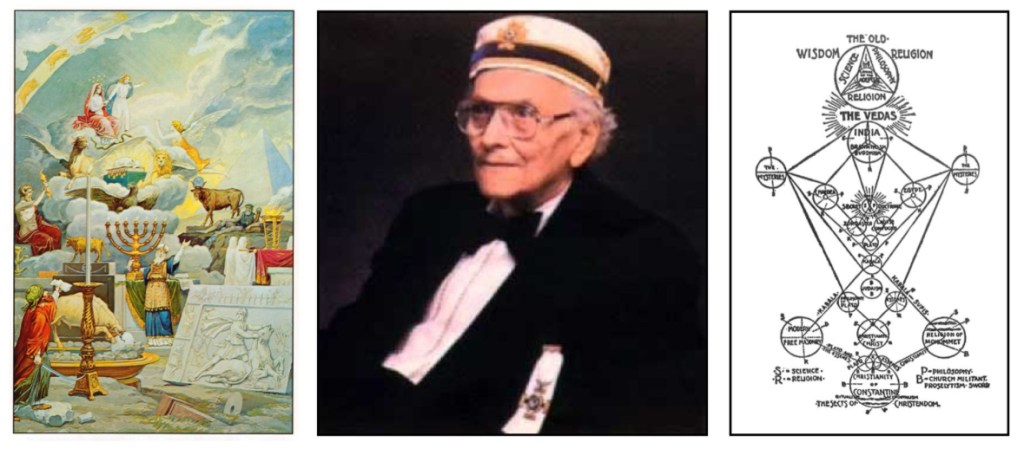
    Hall delved into ancient texts, symbols, rituals, and teachings, aiming to decode the esoteric wisdom they held.

    Hall believed this knowledge, once understood, could guide individuals on their path towards self-discovery and spiritual enlightenment.


    Philosophy

    Hall’s philosophical views were eclectic, drawing inspiration from a diverse range of traditions such as Platonism, Hermeticism, Rosicrucianism, and Eastern philosophies.

    from manlyphall.info

    Manly P. Hall was an inspired and prolific philosopher of the 20th century whose books, journals, and lectures are still available to a world-wide audience.

    From this site you can download and read issues from a complete PDF collection of Mr. Hall’s Journals (published 1923-1990). The site also offers his “on the lighter side” Contributors’ Bulletins, a list of his book titles including their topics, and all article titles in his Journal runs: The All-Seeing Eye(1923-1931), Horizon (1941-1958), and PRS Journal(1958-1990). Also presented are all of his Monthly Letters to Students, dated May 1934-July 1941.

    He emphasized the importance of understanding universal principles like:

    the law of attraction, the interconnectedness of all things, and the cyclical nature of life.


    Hall believed that by delving into these philosophical concepts, individuals could gain a deeper understanding of themselves, the world around them, and their place in the grand scheme of things.


    Symbolism

    Hall viewed symbols as a universal language, a way for the subconscious mind to communicate with the conscious mind.

    He meticulously analyzed symbols found in mythology, religion, art, and architecture, believing they held hidden meanings that could unlock profound insights into the human psyche and the mysteries of the universe.

    Hall’s interpretations of these symbols often focused on themes of transformation, rebirth, and the journey towards enlightenment.


    Ancient Cultures and Traditions

    Hall’s insatiable curiosity led him to explore a vast array of ancient cultures and traditions, including Egyptian, Greek, Roman, Mayan, Chinese, and Indian.

    He believed these cultures held valuable knowledge about the human condition, spiritual practices, and the secrets of the universe.

    Hall’s studies aimed to bridge the gap between ancient wisdom and modern understanding, offering contemporary interpretations of these traditions that resonated with a wider audience.


    Self-knowledge

    Hall considered self-knowledge to be the cornerstone of personal growth and spiritual development.

    He encouraged individuals to embark on a journey of introspection, to delve into their thoughts, emotions, and motivations, and to confront their shadow selves.

    Hall believed that by understanding their inner workings, individuals could break free from limiting beliefs, heal emotional wounds, and ultimately connect with their true essence.


    Spiritual Growth

    Hall’s teachings ultimately aimed to guide individuals towards spiritual awakening and enlightenment.

    He believed that through self-knowledge, understanding universal principles, and connecting with the divine, individuals could transcend their egoic limitations and achieve higher levels of consciousness.

    Hall’s vision of spiritual growth was not confined to a specific religion or doctrine but encompassed a broader, more inclusive understanding of spirituality.

  • Exploring the Mysterious Nature of Shadows

    Exploring the Mysterious Nature of Shadows

    Embarking on our intellectual journey, we must commence by unraveling the enigmatic question: What, indeed, is a shadow? At its core, a shadow manifests as the consequence of light encountering an opaque obstruction, resulting in the creation of a darker, often elongated silhouette on the opposing surface. Shadows materialize when an object intervenes between a source of light and a given surface, obstructing the direct light rays.

    The Scientific Underpinnings of Shadows

    Shadows, intriguingly, emanate from the intricate interplay of light and matter. When light, traveling in its straight trajectory, encounters an impediment, it succumbs to being halted in its tracks. In this state, it projects a shadow onto the surface lying beyond the obstructing object. The size and configuration of this shadow hinge upon several variables, including the angle of the light source, the spatial gap between the object and the surface, and the intrinsic form of the object itself.

    The significance of the light source’s angle in shaping shadows cannot be overstated. During moments when the light source skims the horizon, such as the dawning of a new day or the dusk of evening, shadows elongate, bestowing upon the scene dramatic and artistic allure.

    Shadows in the Natural World

    Shadows, however, are not confined solely to the realm of human artifice. In nature’s tapestry, shadows are ubiquitous and assume diverse functions. Consider, for instance, the trees on a sun-soaked day, offering refreshing patches of shade, a sanctuary from the blazing sun. These natural shadows also become instrumental in the lives of countless creatures, serving as places of refuge and camouflage.

    Shadows in Literature and Symbolism

    In the realm of literature and culture, shadows bear profound symbolic import. They can epitomize the enigmatic, the uncharted, or the concealed facets of human essence. In literature, shadows often feature as tools for enriching characters and narratives, endowing readers with deeper, more nuanced insights into the storyline.

    Shadows in the Scientific Pursuit

    Beyond their aesthetic and cultural resonance, shadows have emerged as pivotal elements in scientific exploration, fostering comprehension of the natural world.

    Physics

    Within the domain of physics, shadows have played a pivotal role in the scrutiny of wave phenomena, especially within the context of diffraction and interference. The intricate patterns woven by shadows and light unveil profound insights into the nature and behaviors of waves.

    Moreover, shadows contribute substantially to how we perceive our three-dimensional milieu. Our cognitive faculties, relying on shadows and their positioning, afford us the capacity to gauge depth and distance. This phenomenon, recognized as stereopsis, occurs when our eyes capture slightly disparate images due to their separation, thus enabling the construction of a mental three-dimensional map of our surroundings.

    Shadows in Popular Culture

    Shadows have not been remiss in infiltrating popular culture, manifesting in diverse forms as symbols of intrigue and mystery.

    The Philosophical Depth of Shadows

    Shadows, embodying dualities of absence and presence, have beguiled philosophers and thinkers across epochs. They have been invoked as metaphors for the concealed aspects of human existence, the schism between reality and illusion, and the fleeting nature of life itself.

    Plato’s Allegory of the Cave

    Plato, in his iconic Allegory of the Cave, ascribes a pivotal role to shadows. He narrates the tale of individuals held captive within a cave since birth, their sole comprehension of reality gleaned from shadows cast upon the cave wall by objects traversing before a fire. This allegory becomes a vehicle for the exploration of knowledge, illuminating the dichotomy between the world of appearances (shadows) and the world of actuality (the objects casting the shadows).

    Existentialist Philosophy

    Existentialist philosophers like Jean-Paul Sartre have contemplated shadows as symbols encapsulating the human condition. They contend that existence is frequently cloaked in uncertainty and ambiguity, obliging individuals to confront their own shadows—the obscure facets of their being—and make choices that configure their identity.

    Shadows in Contemporary Art

    Modern artists persist in their exploration of shadows as a medium for artistic expression. The manipulation of light and shadow has evolved into a sophisticated art form, with artists pushing the boundaries of the conceivable.

    Contemporary Shadow Installations

    Contemporary artists craft immersive installations, manipulating the viewer’s spatial perception and conception of reality. Employing innovative lighting techniques and materials, they metamorphose gallery spaces into captivating environments that challenge our grasp of shadows and their influence upon our sensory perceptions.

    The Unfolding Role of Shadows

    As technology progresses and our comprehension of light and shadow deepens, the role of shadows in our lives continues to evolve. From the rudimentary revelations of ancient thinkers to the cutting-edge visual marvels in today’s cinematic and gaming realms, shadows persist as fountains of fascination and wellsprings of inspiration.

  • Spiritual Adultery

    Spiritual Adultery

    Adultery is but a shadow or an Exoteric archetype corresponding with Spiritual Infidelity

    Spiritual adultery is putting anything above the Spirit.

    It is the violation of the sacred Unity between the individual and their Divinity in Heaven.

    It is a betrayal of love, betrayal of grace, and rejection of guidance that God has.

    Just as physical adultery usually damages the trust and intimacy between mates in a union, this isn’t the point, it is the example leading to the point.

    Spiritual adultery damages the intimacy and trust in the relationship between you and yourself, even worse it cuts you off from the God of your soul.

    You can no longer comprehend him as his voice no longer guides you as you have severed that aspect of yourself off.

    MATERIAL WORLD IS TRANSIENT

    Jesus told his followers that the physical world is transient but the spiritual realities He taught about are Eternal.

    ALLEGORICAL COMPREHENSION REVEALS PROFUNDITY

    Throughout scripture, physical phenomena are regularly used as allegories for profound spiritual truths.

    The prophets and apostles understood this well, as their writings are rich with metaphor and symbolism.

    Even acts as serious as adultery have deeper layers of significance, as both the prophets and Christ himself indicated.

    When God called Israel his wife through the prophets Jeremiah and Isaiah, he was illuminating profound mystical realities about humankind’s relationship with the divine. As James wrote, friendship with “the world” makes us enemies of God – and the “world” here refers not just to physical places and people, but the desires and allurements that captivate our hearts and minds.

    By understanding the earthly realities Jesus and the prophets spoke of as representatives of higher spiritual realities, we penetrate beneath surface meanings. We see how God was trying to warn Israel, and all humanity, about straying from intimate connection with our divine Source. Physical adultery reflects humanity’s natural tendency to replace love for God with love of lesser, temporary things that cannot satisfy our souls.

    Christ came to lift our eyes above earthly distractions, to the eternal spiritual verities of which our physical, temporary experiences are but pale foreshadowings. When we discern the fullness of meaning behind biblical passages, we find profound wisdom for nurturing an enduring marriage of spirit with God. May this deeper perspective guide us to cherish what truly endures, now revealed without a veil.

    RESOURCES

    ‡ Jeremiah 3:20- Surely, as a treacherous wife leaves her husband, so have you been treacherous to Me, O house of Israel, declares the LORD.’ ”

    ‡ Isaiah 1:21- How the faithful city has become a whore, she who was full of justice! Righteousness lodged in her, but now murderers.

    ‡ Isaiah 54:5- Your Maker is your husband, the LORD of hosts is His name; and the Holy One of Israel is your Redeemer, the God of the whole earth He is called.

    ‡ Isaiah 57:8- Behind the door and the doorpost you have set up your memorial; for, deserting Me, you have uncovered your bed, you have gone up to it, you have made it wide; and you have made a covenant for yourself with them, you have loved their bed, you have looked on nakedness.

    ‡ James 4:4,5- You adulterous people! Do you not know that friendship with the world is enmity with God? Therefore whoever wishes to be a friend of the world makes himself an enemy of God. Or do you suppose it is to no purpose that the Scripture says, “He yearns jealously over the spirit that He has made to dwell in us”?

    ‡ Revelation 17:5- And on her forehead was written a name of mystery: “Babylon the great, mother of prostitutes and of earth’s abominations.”

    ★ 1 John 2:15,16-

    Do not love the world or the things in the world. If anyone loves the world, the love of the Father is not in him. For all that is in the world—the desires of the flesh and the desires of the eyes and pride of life—is not from the Father but is from the world.

    ‡ Colossians 3:2- Set your minds on things that are above, not on things that are on earth.★