A PHILOSOPHER IS ONE WHO LOVES WISDOM
Do You Love Wisdom?
YOU’RE A PHILOSOPHER IF YOUR ANSWER IS YES.
philosophy origin
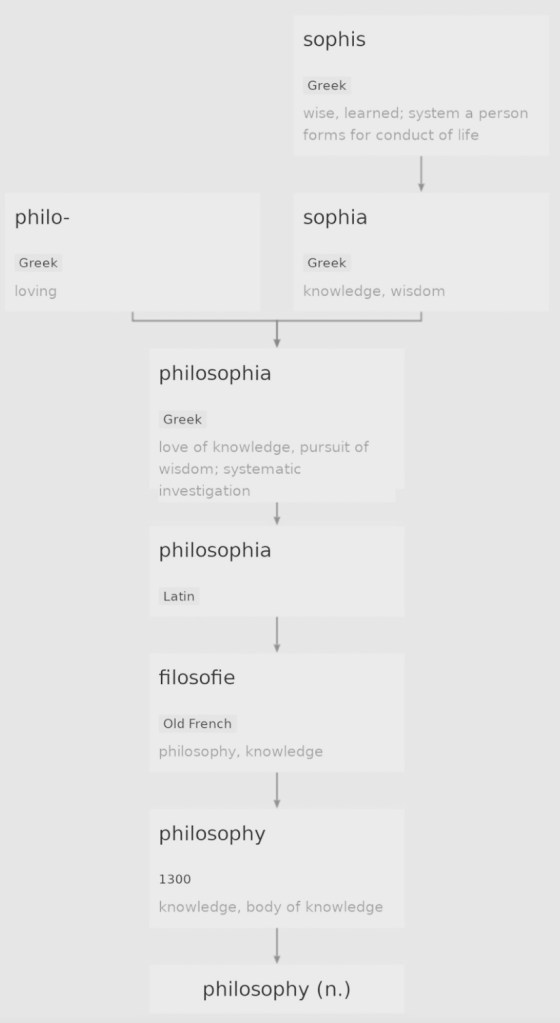
The term “philosophy” originates from the Greek
“Philo” (love) + “Sophia” (wisdom)
The Love of Wisdom
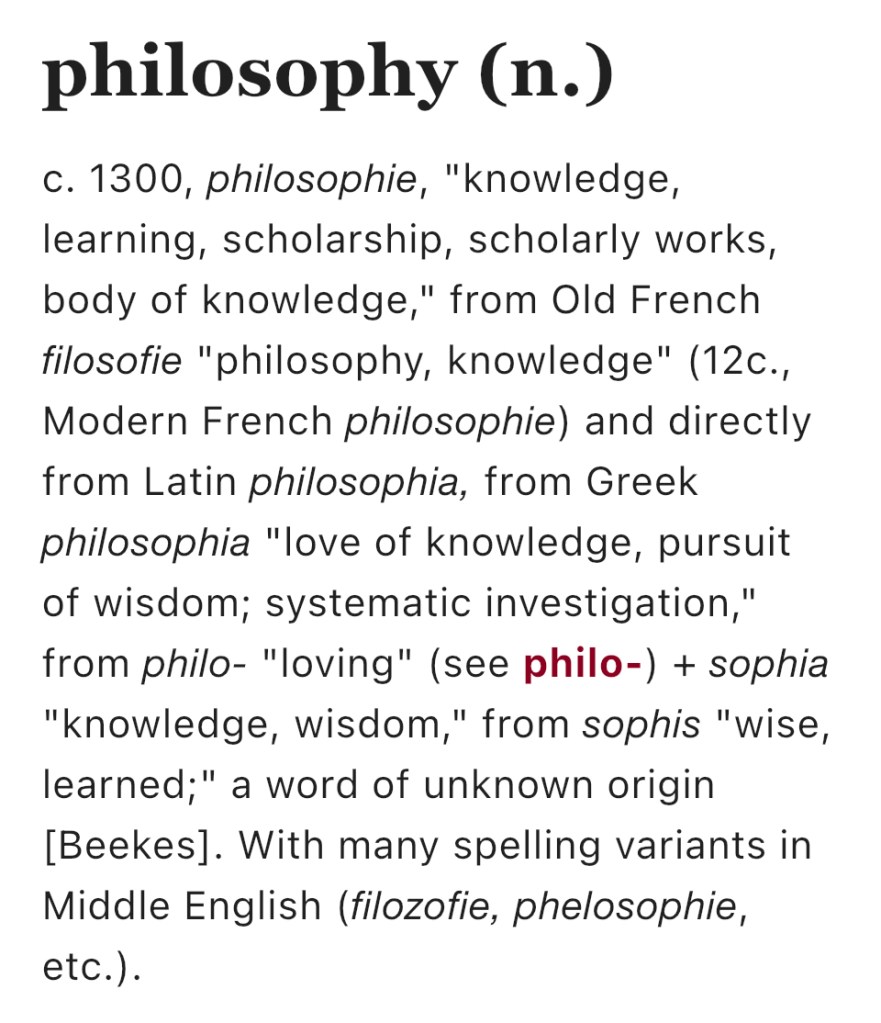
From The Etymological Dictionary:
Philosophy Is Not Limited to Academia
Philosophy is for you and me and even the dude down the road.
Why Philosophy Is Good To Take Part In?
You’ll Ask The Right Questions
Philosophy empowers you to inquire thoughtfully and meaningfully.
You’ll Find Meaning and Purpose
Delve into what truly matters in life.
You’ll Develop Critical Thinking
Enhance your ability to analyze and evaluate arguments.
Navigate Ethical Dilemmas ⚖️🤔✨
Tackle complex moral issues with clarity and insight.
Philosophy helps you unravel the mysteries of life’s fundamental questions..
Expand your mind, ignite your curiosity, and awaken the philosopher within you, you’ll be sure to discover the truth about yourself and the world around you.
The term “philosophy” is from its ancient Greek roots.
PHILO+ SOPHIE
Greek Tradition
Philo | Loving
Sophie | Wisdom
In Greek Mythology, Sophia was associated with wisdom and knowledge.
She embodies the idea of understanding and insight, representing a deeper connection to the universe and the divine.
Many Greeks woo would seek her guidance in times of uncertainty, hoping to gain clarity in their lives. They understood Wisdom is not just about knowledge, but, more so, about the ability to see beyond the surface. The richness of her meaning caused a greater appreciation for the complexities of life.
Sophia is closely associated with the concept of “phronēsis,” which means practical wisdom.

Read: Greek Virtue “Sophia”
Philosophia
The term “philosophia” was brought to prominence by Plato and his mentor Socrates, who underscored the pursuit of wisdom as a fundamental guiding principle for a meaningful life.
Socrates was famously declared the wisest man by the Oracle because of this:
Socrates recognized his own ignorance.
The philosophical pursuit of wisdom is through questioning and dialogue.
The Pythian Oracle
The Pythian Oracle was a priestess who delivered prophecies from the god Apollo at his temple in Delphi, Greece. She was also called Pythia, which was the original name of Delphi.
She entered a trance-like state and spoke cryptic messages that were interpreted by the priests. The oracle was consulted by many ancient Greeks for advice on war, politics, colonization, and religion. The oracle’s influence lasted from the 8th to the 4th century BCE, when it was banned by the Roman emperor Theodosius I.
Sources:
Delphic oracle | Definition, Greek Mythology, Pythia, & Facts.
Pythia – World History Encyclopedia.
Pythia (Oracle of Delphi): Ancient Greek History + Facts.
What Is the Oracle of Delphi and How Did She Prophecy? – Historic Mysteries. .
Philo of Alexandria
Integration of Greek and Jewish Thought:
Philo of Alexandria, a Hellenized Jew, attempted to harmonize Greek philosophy with Jewish scripture. He used “Sophia” to denote both human and divine wisdom, integrating it with the concept of “Logos” (Word), which later influenced Christian theology.
Sophia as Divine Wisdom
In Christian theology, “Sophia” was personified as Divine Wisdom, often equated with Christ. This interpretation is evident in the writings of the Church Fathers, who identified Christ as the Wisdom of God, a concept rooted in the New Testament.
Philo-Sophia:
Revising Philosophy: The book "Philo-Sophia: Wisdom Goddess Traditions" by Debashish Banerji and Robert McDermott explores the divine feminine aspect of wisdom. It argues for a revision of philosophy to include mystical, intuitive, emotional, performative, and collective knowledge, moving beyond the patriarchal and rational objectification that has dominated traditional academic philosophy.

Areas to Explore
What is the nature of reality?
Delve into the realms of metaphysics and ponder the ultimate nature of existence itself.
What is the meaning of life?
Engage in existential musings as we examine the purpose and significance of our existence in the grand tapestry of the universe.
PHILOSOPHY IS INTIMATELY CONNECTED TO THE PURSUIT OF KNOWLEDGE, TRUTH, ETHICS, SPIRITUALITY, AND LIFE’S DEEPER MEANINGS.
Epistemology
Epistemology is the study of knowledge, justification, and the relationship between the two.
It explores questions such as:
- What does it mean to be justified?
- Is knowledge justified?
- Is there such thing as true belief?
- Can we have justified beliefs at all?
Epistemologists debate the role of internal and external factors in justification, the permissibility of different doxastic attitudes, and how we use our knowledge to acquire more knowledge.
The value of knowledge is the mission to uncover in Epistemology.
Metaphilosophy
Metaphilosophy is the study of philosophy itself, exploring questions about the nature of philosophical inquiry and the epistemology of philosophy.
It examines whether philosophy aims to discover objective truths about the external world or is more focused on understanding words and concepts.
It also considers the possibility of armchair philosophical knowledge and the relationship between empirical science and philosophy.
Philosophy Of Mind
The philosophy of mind covers all philosophical topics about the mind and mental states. Its subtopics can be divided in two main ways. First, by the traditional divisions drawn between kinds of mental states:
1. Divisions are drawn between:
… consciousness, intentionality, perception, and other states and processes. types of phil
2. Quotations are asked about these activities regarding their nature.
Study the relation between the mental and the physical and questions regarding our knowledge of the activities, the relationship between them.
Philosophy of mind overlaps with the philosophy of cognitive science and the philosophy of action.
Further Study:


Examples Of Philosophic Disciplines:
Metaphysics…
or the study of reality.
Ethics…
or the study of what is morally right & good.
Epistemology…
or the study of how we know reality.
Logic…
or the study of good arguments.
Aesthetics…
or the Philosophy of Art.
The concept of “love of wisdom” can be defined as the pursuit and admiration of knowledge, guided by a deep affection and appreciation for intellectual exploration.