

{WI-FI MAPPING ~ {DensePose}
In the age of advancing technology, a new and concerning phenomenon has emerged, known as WiFi body surveillance. This method utilizes Wi-Fi signals to generate UV coordinates of the human body surface, mapping body parts onto a 2D surface and analyzing movement with precision. While this may seem like a significant breakthrough in computer vision, it also raises alarming implications regarding privacy and personal liberties.
how does it work?
The technique known as DensePose utilizes raw CSI signals to generate body surface coordinates, transforming them into image-like maps through an encoder-decoder network. Its potential for low-cost and privacy-preserving algorithms for human sensing is undeniable. However, we must critically contemplate the consequences of this technology.
By allowing the monitoring and analysis of human movement through Wi-Fi signals, we risk sacrificing our inherent freedoms and privacy.
Imagine a world where every step, every gesture, and every intimate detail of our physical existence is meticulously observed and analyzed. The implications are profound and unsettling.
We cannot afford to remain ignorant or indifferent to these matters. It is essential to recognize that history has shown us the dangers of oppressive regimes and the erosion of personal freedoms. By willingly embracing such invasive technologies, we risk subjecting ourselves to a future where our liberties are compromised and our autonomy is undermined.
This moment demands a collective awakening. Are you sleeping in ignorance while the world is ablaze around you? We must rise from our slumber of ignorance and actively seek knowledge about the critical issues at hand. We must refuse to be passive observers as the world around us deteriorates. Instead, we should assume a position of authority and contribute to shaping a future that upholds the well-being and rights of every individual.
Repressive regimes
Throughout history, repressive regimes have emerged and exerted their power over populations, often leading to devastating consequences. These regimes have demonstrated a consistent pattern of disregarding individual rights, suppressing dissent, and consolidating authority in the hands of a few. The lessons learned from these dark chapters of history serve as a reminder of the importance of safeguarding our inherent rights and remaining vigilant against the allure of oppressive leaders.
Repressive regimes have risen in various forms, ranging from totalitarian regimes like Nazi Germany under Adolf Hitler, communist regimes such as the Soviet Union under Joseph Stalin, to authoritarian regimes like those seen in many parts of the world. These regimes manipulate or dismantle democratic institutions, undermine freedom of speech and expression, and engage in surveillance and control of the population. They exploit the fears and vulnerabilities of the people, promising stability, security, or an ideological utopia while eroding personal freedoms and human rights.
The repetition of history’s atrocities can only be prevented through a deep understanding of our rights and a commitment to vigilance. By recognizing the patterns and tactics employed by repressive regimes of the past, we can better identify the warning signs and actively resist the rise of authoritarianism. It is crucial to value and protect the principles of democracy, human rights, and individual freedoms, as well as to foster a society that actively promotes inclusivity, justice, and the rule of law. Only through our collective efforts can we ensure that the mistakes of the past are not repeated and that the inherent rights of every individual are preserved for generations to come.
As a society, we have grown complacent and weak, avoiding discomfort and challenges. Yet, it is through adversity that we grow and learn. We must embrace discomfort and uncertainty as crucial aspects of personal growth and the pursuit of a more enlightened future.
Our rights are being violated
We must recognize the violation of fundamental constitutional rights. The unregulated use of technology poses a significant threat to privacy, freedom of belief, and the right to refrain from self-incrimination. We must ensure that technological advancements do not infringe upon these rights.
First AMENDMENT VIOLATION
Unregulated technology poses a significant threat to several fundamental constitutional rights. Specifically, the use of such technology may infringe upon an individual’s right to privacy, freedom of belief, freedom and privacy of their person and property, and the right to refrain from self-incrimination. Additionally, it is argued that these rights are further supported by the Ninth Amendment, among others. It is thus imperative that the intricacies of each of these rights be safeguarded within technological advancements.
In conclusion, the emergence of WiFi body surveillance is a grave concern that should not be taken lightly. We must not remain passive or indifferent in the face of this technological advancement. It is crucial for us to awaken to the potential consequences, question the realities we accept, and actively work towards a future that upholds our fundamental rights and preserves our humanity. Let us prioritize knowledge and understanding, reject complacency, and strive to build a society that cherishes freedom, justice, and individual autonomy. Only by doing so can we forge a path forward that safeguards our values and ensures a brighter future for generations to come.
LINK: Using a deep neural network to improve virtual images of people created using WiFi signals
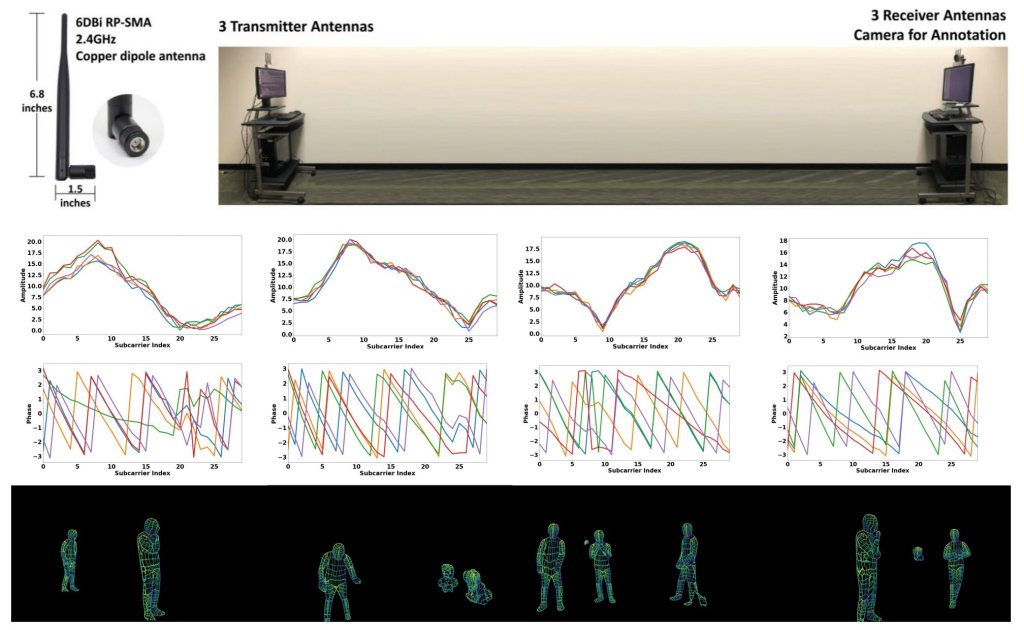
LINK: Amplitude and phase sanitization, a two-branch encoder-decoder network, then clean these signals and that translates them into 2D feature maps that resemble images1. This technique has the potential to pave the way for low-cost, broadly accessible, and privacy-preserving algorithms for human sensing2.
“The results of the study reveal that our model can estimate the dense pose multiple subjects, with comparable performance image-based approaches, by utilizing Wi-Fi signals as the only input. This paves the way for low-cost, broadly accessible, and privacy-preserving algorithms for human sensing,”
– Researchers Jiaqi Geng, Dong Huang, and Fernando De la Torre explain in their paper, DensePose From WiFi.
