Month: April 2023

  • Embracing the Law

    Embracing the Law

    Understanding the Relationship Between Jesus, the Spirit, and God’s Instruction

    The Revelation of God’s Divine Essence through His Law

    The law of God, which finds embodiment in Jesus, serves as a revelation of His divine essence. It unveils the depth of God’s love for humanity and offers a means of atonement for our sins. Through Jesus’ sacrificial act, we witness the profound display of God’s mercy and His desire for reconciliation.

    Embracing Love and Acquiring Knowledge through the Spirit

    By embracing the Holy Spirit, we gain knowledge of God and develop a deeper understanding of His true nature. Love, in its comprehensive form, encompasses understanding, active listening, and empathetic engagement with others. God’s Law, as a guiding principle, leads us toward truth, steers us onto the right path, and ultimately allows us to experience a fulfilling life.

    Jesus’ Fulfillment of the Law and the Connection with the Spirit

    Jesus, as the embodiment of the Law, establishes a profound connection between the Law and the Spirit. In this unity, contradictions dissolve, bringing coherence and harmony to our spiritual journey. Love, at its core, involves pure intentions and unswerving honesty. When we extend love even to our enemies, we strive to comprehend them and offer compassion.

    Transcending Physical Limitations through the Spirit

    The Holy Spirit transcends the limitations of our physical existence. It empowers us to perceive and experience God’s presence beyond the confines of our earthly senses. Through the Spirit, our understanding is enlightened by the Word, igniting transformation within our hearts and minds.

    Church Interpretations and the Importance of Personal Spiritual Connection

    Christian churches, though vital for community and shared faith, sometimes deviate from the core teachings of Jesus. While pastors provide interpretations, it is crucial to internalize the Bible’s teachings personally. Unfortunately, certain churches prioritize intellectual debates or misuse scripture to avoid deep self-reflection, thereby hindering personal and spiritual connections.

    Guiding Others to the True God through Love

    Leaders within the church often misguide their followers, limiting their understanding of God. It is with love and humility that we should aim to guide others toward the one True God, seeking unity through the atonement of Messiah Jesus. By embracing His Spirit and salvation, we can break free from deception and the ephemeral nature of earthly pursuits, gaining an eternal perspective.

    The Paradox of Christian Practices and Hypocrisy

    There exists a paradox among some Christians who oppose the Torah and established traditions while fervently embracing and defending pagan laws, holidays, and customs. Practices like decorating trees and exchanging presents during Christmas, participating in Easter celebrations with fertility symbolism, observing man-made New Year, and engaging in Halloween rituals are frequently diligently observed.

    Critiquing Legalistic Tendencies and Embracing God’s Names

    Some Christians criticize a legalistic approach to recognizing God’s entirety, yet they exhibit legalistic tendencies by prioritizing Sunday church attendance over understanding the comforting words of God through the Savior. This juxtaposition appears hypocritical when man-made practices influenced by darkness are embraced, while the names Jesus’ mother and disciples called Him are deemed “legalistic.”

    The Revelation of God’s Divine Essence through His Law

    God’s law, as manifested in Jesus, functions as an unveiling of His divine essence. It reveals the extent of God’s love for humanity and provides a mechanism for expiating our transgressions. Jesus’ act of sacrifice demonstrates the profound exhibition of God’s mercy and His longing for reconciliation.

    Embracing Love and Acquiring Knowledge through the Spirit

    By embracing the Holy Spirit, we gain knowledge of God and develop a deeper understanding of His true nature. Love, in its comprehensive form, encompasses understanding, active listening, and empathetic engagement with others. God’s Law, as a guiding principle, leads us toward truth, steers us onto the right path, and ultimately allows us to experience a fulfilling life.

    Jesus’ Fulfillment of the Law and the Connection with the Spirit

    Jesus, as the embodiment of the Law, establishes a profound connection between the Law and the Spirit. In this unity, contradictions dissolve, bringing coherence and harmony to our spiritual journey. Love, at its core, involves pure intentions and unswerving honesty. When we extend love even to our enemies, we strive to comprehend them and offer compassion.

    Transcending Physical Limitations through the Spirit

    The Holy Spirit transcends the limitations of our physical existence. It empowers us to perceive and experience God’s presence beyond the confines of our earthly senses. Through the Spirit, our understanding is enlightened by the Word, igniting transformation within our hearts and minds.

    Church Interpretations and the Importance of Personal Spiritual Connection

    Christian churches, though vital for community and shared faith, sometimes deviate from the core teachings of Jesus. While pastors provide interpretations, it is crucial to internalize the Bible’s teachings personally. Unfortunately, certain churches prioritize intellectual debates or misuse scripture to avoid deep self-reflection, thereby hindering personal and spiritual connections.

    Guiding Others to the True God through Love

    Leaders within the church often misguide their followers, limiting their understanding of God. It is with love and humility that we should aim to guide others toward the one True God, seeking unity through the atonement of Messiah Jesus. By embracing His Spirit and salvation, we can break free from deception and the ephemeral nature of earthly pursuits, gaining an eternal perspective.

    The Paradox of Christian Practices and Hypocrisy

    There exists a paradox among some Christians who oppose the Torah and established traditions while fervently embracing and defending pagan laws, holidays, and customs. Practices like decorating trees and exchanging presents during Christmas, participating in Easter celebrations with fertility symbolism, observing man-made New Year, and engaging in Halloween rituals are frequently diligently observed.

    Critiquing Legalistic Tendencies and Embracing God’s Names

    Some Christians criticize a legalistic approach to recognizing God’s entirety, yet they exhibit legalistic tendencies by prioritizing Sunday church attendance over understanding the comforting words of God through the Savior. This juxtaposition appears hypocritical when man-made practices influenced by darkness are embraced, while the names Jesus’ mother and disciples called Him are deemed “legalistic.”


  • Embracing Exaltation: The Triumph of the Lowly

    Embracing Exaltation: The Triumph of the Lowly

    Let the lowly brother boast in his exaltation, and the rich in his humiliation, because like a flower of the grass he will pass away.

    James 1:9-10

    In a world often fixated on wealth and social status, the words of James 1:9-10 remind us of a different perspective. The passage challenges our notions of success and significance, urging us to find joy and contentment in our lowly circumstances. This unexpected exaltation offers a profound shift in understanding and a renewed sense of purpose.

    The Power of God’s Exaltation

    James encourages those in lowly circumstances to rejoice, for they are exalted. This exaltation is not of worldly origin but stems from the divine intervention of God. It is a reminder that God sees beyond society’s standards and values. He lifts the humble and disregarded, choosing them as His own children and heirs of His kingdom. This exaltation extends beyond the temporal and superficial, granting an eternal inheritance that surpasses worldly wealth.

    Recognizing Intrinsic Worth

    The passage challenges our perception of worth and potential. It emphasizes that our value does not hinge on external factors such as wealth or societal standing. Instead, it rests in our relationship with God and our faith in Him. This recognition empowers us to embrace our lowly circumstances with confidence, knowing that we are treasured and loved by our Heavenly Father.

    Guarding Against Judgment

    Whoever mocks the poor shows contempt for their Maker; whoever gloats over disaster will not go unpunished.

    Proverbs 17:5 cautions against deriding the impoverished and deriving satisfaction from their misfortune. Such dispositions demonstrate a deficiency in comprehension and empathy, contradicting the principles of God’s realm. Finding delight in others’ suffering stands in opposition to the essence of Christ. Rather, we are summoned to exhibit compassion and solidarity towards the vulnerable, acknowledging their intrinsic value as fellow reflections of God’s image.

    The Equality in Christ

    has not God chosen those who are poor in the world to be rich in faith and heirs of the kingdom, which he has promised to those who love him?

    James 2:5 highlights God’s deliberate choice to bless the poor with faith and make them heirs of His kingdom. This passage emphasizes the leveling effect of Christ’s salvation, where societal distinctions hold no weight. In the body of Christ, there is no hierarchy based on wealth or status. All are equal and equally valued, united by their love for God. This unity transcends societal boundaries and fosters a community where the lowly are elevated and the rich are humbled.

    Finding Joy and Satisfaction

    The exaltation of the lowly in Christ is a cause for great joy and satisfaction. It offers a fresh perspective on our circumstances, reminding us that true fulfillment comes from our identity in Christ rather than worldly achievements. In recognizing our high position in Him, we find contentment and purpose, regardless of our socioeconomic status.

    The exaltation of the lowly is a profound concept that challenges societal norms and redefines success. It invites us to shift our focus from external measures of worth to our relationship with God. By embracing our lowly circumstances and finding joy in our exaltation, we align ourselves with God’s eternal perspective. Let us celebrate the triumph of the lowly and embrace the inherent worth and potential found in our identity as children of God.

  • Morning Thoughts

    Morning Thoughts

    April 21, 2023

    When we candidly walk with God, we compassionately pity our enemies; We don’t hate them.

    We desire their healing and repentance, not retribution. Because we know we’re just as deserving of punishment as our aggressor.

    Warfare is strategy.

    Spiritual warfare is God’s strategy: working inside of His own dwelling, our Temple/body.

    THE SECRET IS:

    You don’t fight.
    He does.
    You let go.
    & watch Him Do.

    Giving Him ALL THE GLORY!!!

  • Human Will | Quantum Geometry

    Human Will | Quantum Geometry


    Key Words:

    • General Relativity: Einstein’s theory of gravity that describes the curvature of spacetime caused by massive objects
    • String Theory: a theoretical framework that attempts to explain all particles and forces of nature in terms of tiny one-dimensional strings
    • Loop Quantum Gravity: a theory that attempts to reconcile general relativity with quantum mechanics by quantizing spacetime itself
    • Quantum Gravity: the field that attempts to unify general relativity and quantum mechanics to create a consistent description of the universe at all scales.
    • Human Will: The human will refers to the ability of individuals to make conscious choices and decisions, exerting control over their actions and behavior. It encompasses factors such as desires, motivations, intentions, and the capacity to act in accordance with one’s goals. The study of the human will is primarily within the realms of psychology, philosophy, and cognitive science. Researchers in these fields investigate the neural mechanisms, cognitive processes, and psychological factors that influence decision-making and voluntary action.

    Human Will + Quantum Geometry | The Connection

    The concept of the human will and its connection to quantum geometry offers a captivating intersection of philosophy and science.

    This topic has ignited debate among scientists and philosophers, as it explores the nature of consciousness and its possible implications for the fabric of reality.

    Some theorists propose that human will may influence quantum events, implying a deep connection between subjective experience and the objective world. + link

    nature of consciousness |fabric of reality

    It raises questions about free will and the role of consciousness in shaping reality.

    QUANTUM GEOMETRY

    Quantum Geometry merges Quantum Mechanics and Geometry to study Space at the smallest scale.

    Quantum Geometry re-evaluates the structure of space and time, suggesting they are discrete rather than continuous, which challenges classical geometry.


    Quantum Geometry investigates the fundamental makeup of spacetime at very small scales where quantum effects are important.

    Source

    Space time's mathematical model merges : 

    three dimensions of space
    +
    one dimension of time
    =
    a four-dimensional continuum.

    Scientists seek to unify general relativity and quantum mechanics through approaches like:

    • string theory
    • quantum gravity
    • other quantum gravity models.

    The goal is to develop a consistent understanding of the fundamental structure of spacetime.

    Deeper Into Quantum Geometry

    Quantum geometry studies the tiny-scale structure of spacetime, blending quantum mechanics and geometry.

    It investigates the behavior of particles and fields within a quantum framework.

    There is compelling evidence that proposes a strong connection between our thoughts and quantum phenomena.

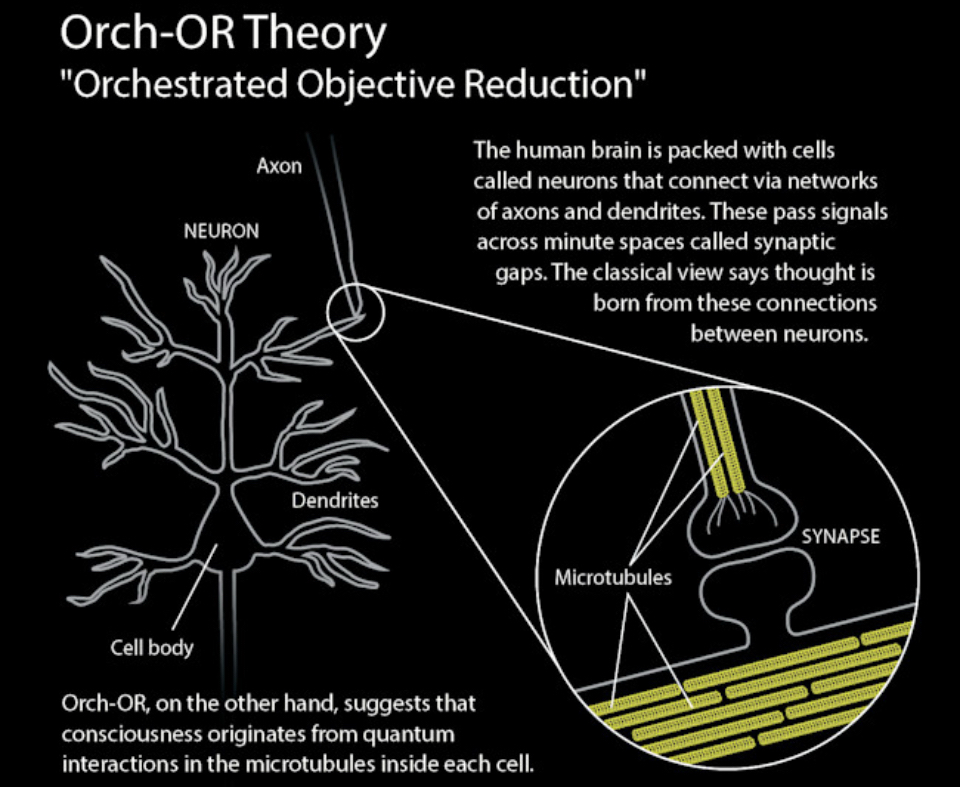
    Orch-OR theory

    The Orch-OR theory proposed by Roger Penrose and Stuart Hameroff suggests that consciousness arises from quantum processes occurring in microtubules within brain cells.

    This theory remains controversiacontroversial.

    It suggests that our consciousness, including our thoughts and feelings, is significantly influenced by intricate quantum processes occurring within our brain cells.


    Orch-OR Theory

    This theory proposes a connection between thoughts and quantum phenomena, claiming that consciousness is influenced by intricate brain cell processes.

    Orch-OR theory, proposed by physicists, Sir Roger Penrose and Stuart Hameroff, suggests an intriguing link between consciousness and quantum mechanics.

    THIS THEORY POSITS THAT:

    Consciousness arises from quantum processes occurring within neuronal microtubules.

    Meanings that the brain operates not just as a traditional information processor, but also experiences quantum effects that affect our conscious experiences.

    So if true, these quantum vibrations play a crucial role in the coherence and organization of neural activity in the brain, ultimately giving rise to consciousness.

    This geometry relies on the principles of quantum mechanics, which explores how matter and energy behave at the smallest levels.

    With the aid of this geometry, we can visually represent the intricate structure of the human will in a manner that is both reflexive and scientifically grounded.

    QUANTUM GEOMETRY IS GAINING POPULARITY BECAUSE IT ACCURATELY VISUALIZES THE STRUCTURE OF THE HUMAN WILL USING SCIENTIFIC PRINCIPLES.

    The quantum geometry of the human will can be visualized as a complex network of interconnected circles, each representing a distinct aspect of the will.

    These circles are connected by lines of varying lengths and widths, illustrating the diverse pathways of conscious perception.

    Additionally, the circles are filled with a variety of colors, symbolizing the different energies associated with the will.

    At the center of this network lies a single, large circle that represents the core of the human will, where all other circles converge.

    Understanding the structure of the human will is essential for comprehending the influence of the quantum field on our decisions and actions.

    Understanding the structure of the human will enables us to grasp how the quantum field influences our decisions and actions.

    The quantum geometry of the human will also aids in examining the effects of quantum entanglement, which occurs when two particles become interconnected, regardless of the distance between them.

    On the quantum "self-teleportation" probability of a human body

    The geometry of quantum events

  • BEARING FRUIT

    If you’re a Christian, you’ve probably heard of the phrase “bearing fruit” used to describe a life that is walking in accordance with the standards of God. But what does it really mean to “bear fruit”? Is it the same as good works, or does it involve something deeper?

    In this blog post, we will explore the nature of bearing fruit and what it means to be a follower of Christ.

    An image of God's Power coming out of Heaven while fruits are falling out of a lightning storm, in a mysterious style artist painting realism

    Why It’s Important?

    According to Scripture, bearing fruit is important for several reasons.

    In the New Testament, Jesus often used the metaphor of a fruit-bearing tree to describe the nature of his followers’ lives.

    He emphasized the importance of producing good fruit, which symbolizes acts of righteousness and good deeds that reflect God’s love and character.

    In John 15:5, Jesus said, “I am the vine; you are the branches. If you remain in me and I in you, you will bear much fruit; apart from me, you can do nothing.”

    This passage emphasizes the significance of being connected to Christ, the source of life, and having His life flow through us.

    The apostle Paul also wrote about the importance of bearing fruit in Galatians 5:22-23, where he listed the fruits of the Spirit as love, joy, peace, patience, kindness, goodness, faithfulness, gentleness, and self-control.

    Scripture teaches that bearing fruit is important because it is a reflection of our relationship with God.

    What Bearing Fruit Is Not

    According to Scripture, bearing fruit is not just about external performance Nor from works-based salvation.

    Jesus warned against the danger of doing good deeds to gain recognition or approval from others, rather than out of a genuine desire to serve God and love others (Matthew 6:1-4).

    The Bible makes it clear that bearing fruit is not just about outward actions, but also about the condition of our hearts.

    Jesus highlighted true righteousness involves inward transformation, as He said in Matthew 5:20:

    "For I tell you that unless your righteousness surpasses that of the Pharisees and the teachers of the law, you will certainly not enter the kingdom of heaven."

    Bearing Fruits Of The Flesh

    “Bearing fruits of the flesh” is the effect of living according to our sinful nature. Galatians 5:19-21 lists the “acts of the flesh” as sexual immorality, impurity, debauchery, idolatry, witchcraft, hatred, discord, jealousy, fits of rage, selfish ambition, dissensions, factions, envy, drunkenness, orgies, and the like.

    These behaviors are defined as the opposite of the fruits of the Spirit, which are love, joy, peace, patience, kindness, goodness, faithfulness, gentleness, and self-control (Galatians 5:22-23).

    Bearing fruits of the flesh is a reflection of a person’s sinful nature, leading to spiritual decay and separated from the Grace of God.

    Bearing Inferior Fruits

    Bearing inferior fruits refers to producing works that fall short of God’s essence and fail to demonstrate authentic faith in Christ.

    Salvation is a gift of God’s grace, received by faith alone.

    Good works are evidence of genuine faith, but they do not contribute to a person’s salvation.

    Bearing bad fruits means producing works that are motivated by self-interest or pride, rather than by a desire to serve God and love others.

    The Holy Spirit transforms the heart { Meaning; the inner person/ the psyche }, leading to a life characterized by love, joy, peace, and other fruits of the Spirit.

    Believers are called to bear fruit that reflects the character of Christ, relying on His strength and guidance rather than their own efforts.

    When good works are produced from within a heart transformed by grace, they are evidence of the work of the Holy Spirit in a believer’s life.

    Doing As You Please

    Galatians 5:16-17, "So I say, walk by the Spirit, and you will not gratify the desires of the flesh. For the flesh desires what is contrary to the Spirit, and the Spirit what is contrary to the flesh. They are in conflict with each other, so that you are not to do whatever you want."

    This passage highlights the importance of following the Spirit’s leading and rejecting the desires of the flesh. Doing as you please, without regard for God’s will or guidance, can lead to a life marked by selfishness, sin, and spiritual emptiness.

    It is only by abiding in Christ that we can bear fruit that is pleasing to God and valuable to others.

    According to the Merriam-Webster dictionary, “bearing fruit” means “to produce fruit; to yield results; to be productive or successful.”

    Bearing Fruits Of The Spirit

    The word “fruits” indicates that these qualities are the genuine outcome of a person’s vitality that is embedded in Christ and conducted by the Holy Spirit.

    These fruits are not the product of human effort or willpower but are evidence of the transforming work of the Holy Spirit in a believer’s life.

    The fruits of the Spirit mirror the essence of Christ and are evidence of His actuality in your life.

    Fruits are not external behaviors but are the inward transformation that produces those external behaviors.

    Spiritual Fruits are the proof of a genuine relationship with Christ and are critical for the evolution and maturity of a follower of The Way.

    Abiding in bad fruits means you fall short of God’s glory, guided by your own flesh, leading you to abide in narcissism; a spiritual void. Disciples of Christ must bear fruit that mirrors Christ’s nature, depending on Him, rather than our fallible selves.

    The fruits of the Spirit are proof of a true connection with Christ and are critical for evolving and maturing.

    Spiritual fruits are supernaturally produced from a heart transformed by Grace.

    Spiritual Fruits are supernaturally produced in a heart transformed by grace.

  • God Is Bound By Man’s Will & Ego

    God Is Bound By Man’s Will & Ego

    NOT!

    Given God’s infinite nature and His omnipotence, it is clear that The human ego does NOT limit him.

    Omnipotence is the quality of being ALL-POWERFUL. 

    The word comes from the Latin words "omni-," meaning "ALL," and "potens," meaning "POWERFUL."

    God's Omnipotence demonstrates He does what He desires & no one can stop Him.

    He is not accountable to our desires. He is the One who establishes the regulations and causes the decisions. We are called to rest in God’s sovereignty & to be at peace with His will.

    When we submit to God’s will, we are released from the bondage of our own ego.

    The Bible teaches that God is a spirit (John 4:24)

    He is infinite (Psalm 147:5).

    This means that He is not limited by time or space.

    He is not limited by our understanding or our comprehension.

    He is beyond our ability to fully know or understand.

    God is all-knowing (Psalm 139:1-6)

    ALL-POWERFUL (Jeremiah 32:17)

    This means that He knows everything that has happened, is happening, and will happen.

    He is also able to do anything that He wants to do.

    GOD IS A SPIRIT (John 4:24).

    This means that He is not limited by the physical world.

    GOD IS INFINITE (Psalm 147:5).

    He is without limit or end. He is not limited by our capacity to know or understand, we must understand this.

    GOD IS ALL-KNOWING (Psalm 139:1-6).

    This means that He knows everything that has happened, is happening, and will happen.

    AGAIN!!!

    He is not limited by our knowledge or our understanding.

    GOD IS ALL-POWERFUL (Jeremiah 32:17).

    This means that He is able to do anything that He wants to do.
    Here are some implications of the fact that God is not limited by the human ego:
    We cannot manipulate God. He is not fooled by our schemes or our plans.

    He sees through our hearts and our motives.

    WE CAN’T

    • We cannot use God for our own purposes.
    • He is not a tool that we can use to get what we want. He is a sovereign God who is in control of all things.
    • We must submit to God’s will.
      • He knows what is best for us, even when we don’t. We must trust Him and obey Him, even when it is difficult.
      • We must trust God’s love. He loves us unconditionally, even when we don’t deserve it. We can rest in His love and His care, knowing that He will never abandon us.

    WE CAN

    • We can trust God in all things.
      • He is in control, and He will never let us down.
      • We can rest in God’s peace. He is our refuge and our strength, and He will keep us safe.
    • We can be bold in our witness for Christ.
      • We know that He is the only way to salvation, and we can share the good news with others with confidence.
    • We can live a life of joy and hope.
      • We know that God is good, and He has a good plan for our lives.

    If you are feeling like your ego is holding you back, I encourage you to seek God with logic. Ask Him to give you wisdom, to see yourself as He sees you, which is where the freedom from self begins.

    Depend on His grace to help you overcome your ego and to live in accordance with His will. Such as:

    “Fill me with your love, so that I can love others with the same love that you have for me. Fill me with your peace, so that I can be a source of peace to others.”

    BEG GOD

    Beg Him to help you to see yourself as He sees you.

    Beg Him to give you the strength to surrender your will to His.

    Beg Him to fill you with His love, peace, and wisdom.

  • WE WRESTLE WITH… LUCIFER, IN FAITH ? {eph. 6}

    Standing against Satan’s wiles means standing against his schemes and maneuvers designed to achieve his objectives. These can include deceptive and seductive tactics intended to disarm us and trick us into following him. It is important to recognize these tactics and stay vigilant against them in order to resist his influence and stay true to our beliefs.

    Emphasis on “the whole armour”. The focus continues to remain on completeness above all. Leaving no point unguarded or vulnerable.

    It is called the armor of God, because he both prepares and bestows it. We have no armour of our own that will be armour that is able to withstand a truly trying time. Nothing will stand us in stead but the armor of God. This armor is prepared for us. The reason why the Christian should be completely armed is so that we may be able to stand against the wiles of the devil–that we may be able to hold out, and to overcome, notwithstanding all the devil’s assaults, both of force and fraud, all the deceits he puts upon us, all the snares he lays for us, and all his ploys and schemes against us. This the apostle enlarges upon here, and shows:

    Romans 13 Paul says that The night is far spent, the day is at hand: let us therefore take off the works of darkness, and put on the armour of light...
    PUT ON the Lord Jesus Christ…

    What our danger is, and what need we have to put on this whole armour, considering what sort of enemies we have to deal with–the devil and all the powers of darkness:

    The combat for which we are to be prepared is not against ordinary human enemies, but against the several ranks of devils, who have a government which they exercise in this world.

    This is a subtle enemy, an enemy who uses wiles and strategy, as Ephesians 6:11. He has a thousand ways of beguiling unstable minds: hence he is called a serpent for subtlety, an old serpent, highly skilled in the art of tempting.

    He is a powerful enemy: 
    Principalities, and powers, and rulers. 

    They are spiritual enemies: Spiritual wickedness in high places, or wicked spirits, as some translate it.

    The devil is a spirit, a wicked spirit & our risk is greater  because they are unseen, they assault us when we are not aware of them. Because they are wicked spirits, they provoke spiritual wickednesses, pride, envy, malice, etc in all people, with their aim directed at God’s people.

    They are in high places, or in heavenly places, so the word is, taking heaven (as one says) for the whole expanse, they are spread out of the air between the earth and the stars, the air being the place from which the devils assault us.

    As Scoffield stated: “It might read more properly, “We wrestle about heavenly places or heavenly things ” so some of the ancients interpret it.

    Our enemies strive to prevent our ascent to Heaven, to deprive us. They assault us in the things that belong to our souls, and labour to deface the heavenly image in our hearts and therefore we have to be on guard against them. We need faith in our God to battle, because we have spiritual enemies to grapple with.

    So, our wrestling is not against flesh, flesh is shallow & material, obviously weak. We dont dwell on what’s already wasting away for too long because He reminds us that we are going to die in our flesh & what a beautiful thing that is because the death of the flesh is Life.

    John 1:13: We were born, not of blood, nor of the will of the flesh, nor of the will of man,but of God.                                                     

    🔗 Scriptures Outlining the prominence of our flesh to God.🔗

    We who know Him, whom He made able to distinguish & recognize Him distinctly, clearly come to See that the flesh is no profit, None. Flesh is dying, rotting, already dead.

    In Him we seek the imperishable, KNOWING it is our future, if I didn’t know I was in the Truth, I would NOT Keep on this road.

    SCRIPTURE Says we wrestle, we dont kick with anger & force, we dont beat the crap out of Lucifer in self-righteous Pride & we dont destroy or eradicate Lucifer & his angels either.

    God said the BATTLE IS NOT OURS, IT BELONGS TO THE LORD. We grapple, we know GODS GOT THIS.

  • What is the “Logos” ?

    λόγο
    In the Works of Heraclitus and Aristotle, "logos" refers to the underlying principle of order and reason that governs the universe. It was associated with rationality, logic, and intelligence that bring coherence and structure to the world.

    Logos, an ancient Greek word, has diverse meanings like word, statement, story, thought, principle, reason, and speech. Its usage can be technical or common, and the meaning depends on the context. In the technical sense, it refers to human reason/speech or universal intelligence/principle. Pythagoras, a philosophical pioneer, employed logos with specialized significance. He posited three fundamental principles: Monad (unification), Dyad (diversification), and Harmony (relation). Harmony represents the proportionate relationship between numbers, shapes, or tones. Logos play a unifying role in connecting these principles, establishing a cohesive framework of understanding.

    In the Works of Heraclitus and Aristotle, “logos” refers to the underlying principle of order and reason that governs the universe. It was associated with rationality, logic, and intelligence that bring coherence and structure to the world.

    Heraclitus

    Heraclitus was an ancient Greek philosopher who lived before Socrates and Plato. He was known for his written book of sayings, which covered topics such as the nature of the physical universe, ethics, and politics. Although he avoided involvement in politics and was a loner, his influence was greatest among the Stoics. Heraclitus’ metaphysical ideas have retained their power over time.

    He claimed “Logos” {the Word} as Reason, a Reason that rules the universe. Still, for Heraclitus, man remained trapped within the cycles of the earth (spring, summer, fall, winter; birth, middle age, death).

    “Although this Logos is eternally valid, yet men are unable to understand it – not only before hearing it, but even after they have heard it for the first time … though all things come to pass in accordance with this Logos, men seem to be quite without any experience of it … My own method is to distinguish each thing according to its nature, and to specify how it behaves; other men, on the contrary, are as forgetful and heedless in their waking moments of what is going on around and within them as they are during sleep.”

    Aristotle

    Aristotle understood logos as the basis of reason and rationality, especially in ethics. He believed that logos guides us in making logical and ethical decisions by bringing together reason and morality in a meaningful way. This deep understanding of logos sheds light on the importance of logical coherence and ethical comprehension.

    The stoics

    The Stoics emphasized the concept of logos as an active and rational force shaping the universe.

    In the Greek language, “logos” translates to “word,” “speech,” or “reason.” It can refer to the expression of thoughts and ideas through language or the act of speaking itself.

    “Logos” encompasses communication, discourse, and the power of language to convey meaning.

    Christian Theology

    In Christian theology, “logos” is used to denote the pre-existent, divine Word of God, as mentioned in the Gospel of John: “In the beginning was the {logos} Word, and the {logos} Word was with God, and the {logos} Word was God.”

    The Lexham Bible Dictionary defines logos (λόγος) as “a concept word in the Bible symbolic of the nature and function of Jesus Christ. It is also used to refer to the revelation of God in the world.” Logos is a noun that occurs 330 times in the Greek New Testament.

    The embodiment of God’s eternal creative powers is observed, clearly signifying the process that the vast expanse of the universe was brought into existence. Simultaneously serving as the conduit, through which transcendent truths are constructively and effectively conveyed to the totality of humanity. The Logos, or The Christ imparts deep insights to us. Giving way to an exhaustive ability to comprehend, and experience transcendence, moving past the borders of mundane cognition.

    New Testament

    In the New Testament, the Greek word logos is used to refer to Jesus Christ in many places, notably in John 1:1, which states; “In the beginning was the Word, and the Word was with God, and the Word was God.”

    The Gospel of John makes frequent use of the term logos to refer to Christ. John 1:14 states “And the Word {logos} became flesh and dwelt among us.”

    This verse holds significant meaning as it discloses that Jesus embodies and represents the power and intentions of God, within this world.

    Jesus is not solely a messenger or servant of God but rather a direct expression of God’s authority and purpose.

    Through the quintessence of {the logos} Jesus, we are granted the ability to witness the manifestation of God’s incredible power and the complete actualization of His intentions. It is only through the reality of Jesus that we are granted the ability to seize the profundity and immenseness of God’s omnipresence, as well as a visualization of His blueprint.

  • A Demonic Awakening

    {OLD Journal Entries from when I was a “Shamanic” pagan practitioner. A tiny fragment of my perception during a supposed: Spiritual “Awakening” before Lucifer was forced to hand me over to my Creator: 

    I FULL-HEARTEDLY BELIEVED IN THE DIVINE POWER OF THE HUMAN WILL. }

    Today I KNOW the error and twisted perception flipping God’s word upside down: As above, so below.

    My Recent Thoughts In The Midst Of Awakening: Seeking Full Transcendence Past this Realm 

    Spiritual awakenings always get precipitated by experiences of wounding, abuse, and trauma, which is to say, allowing oneself to not only fully experience suffering, but cultivate suffering to work for you as a conduit, masochism is a strength; a way of being; and a discipline.

    Meaning, Being severly damaged or wounded most initiates the primal “Calling” and forces the fast progression of the “Shamanic Archetype” to begin emerging and embed itself in the Unconscious with violence.

    A genuine spiritual awakening can only be started in the complete freedom of the human will seeking out inflicting upon itself pain and fear: a sure way to kick start some hard-core spiritual development and growth.

    Many substances will help on this journey if only used ritualistically and medicinally, but only attainment can come by your powerful will: be strengthened by the power of your Mind, and you can be fulfilled; I am not fulfilled yet, but I am experiencing higher- and higher-level downloads of ancient wisdom.

    The Ancient ones have initiated me, this much I am sure, and I am manifesting my compliance to them so that I can continue my Ascension Process, or else complete breakdown and chaos will consume me. 

    Spiritual Awakening is often co-joined of both healthy and pathological factors. 

    This means we must foster ONLY the healthy aspects of our behaviors and beliefs that aid in the progression of jumping dimensions, as well as forcing and administering the annihilation of other characteristics, forcing them to be annihilated by a Shiva-type energy. 

    The idea is to nourish the healthy facets of the approach so that they keep becoming more potent while allowing the pathological factors to naturally fall away as they merge into the totality of the newly materializing psyche. 

    To quote the great Hindu saint: 

    Ramakrishna, “How to get rid of the lower self? The blossom vanishes of itself as the fruit grows, so will your lower self-vanish as the divine grows in you.” 

    Shamanism is the root from which humanity’s various Spiritual disciplines have been disseminated; the earliest origins of modern psychotherapy known to history lie in archaic Shamanism.